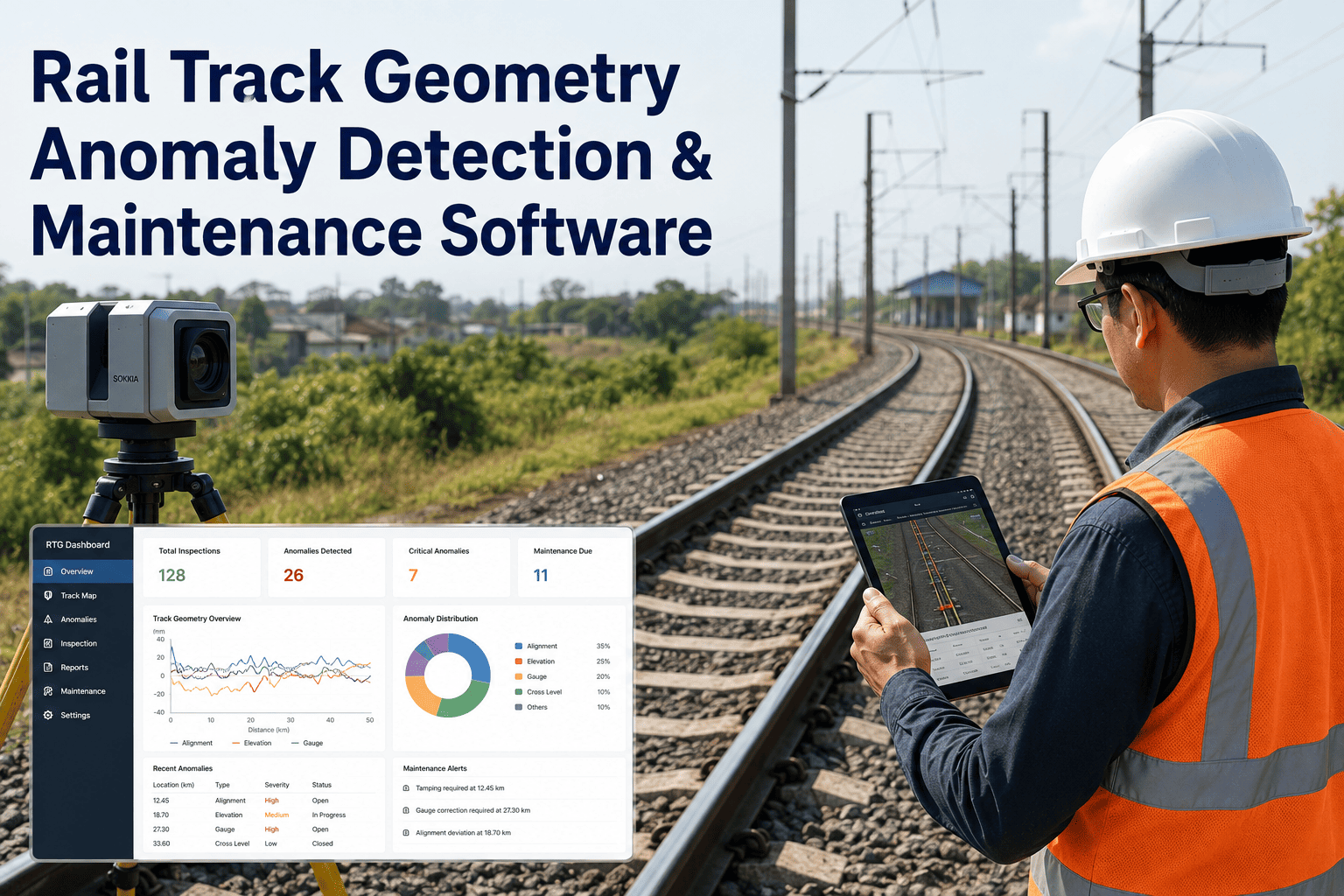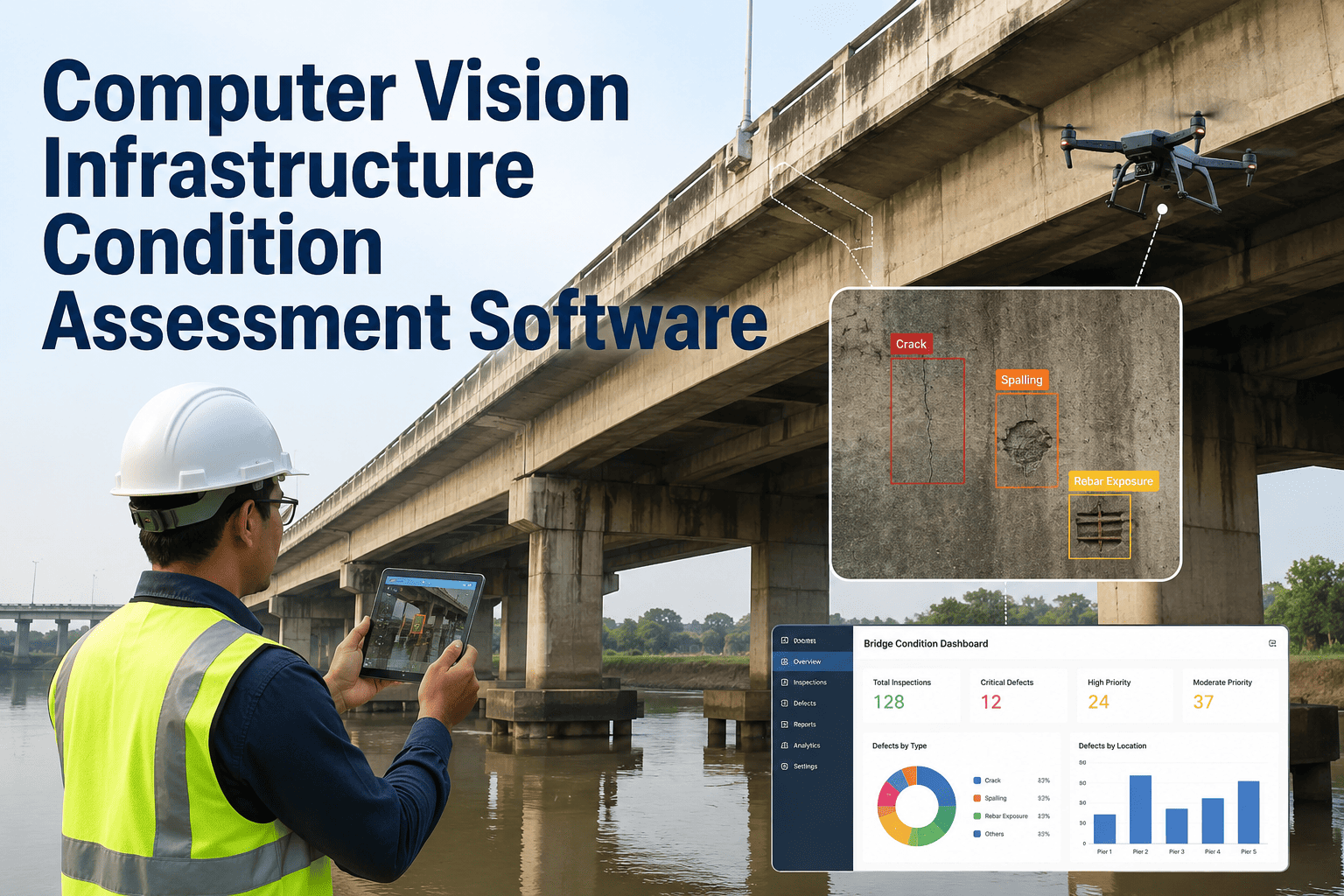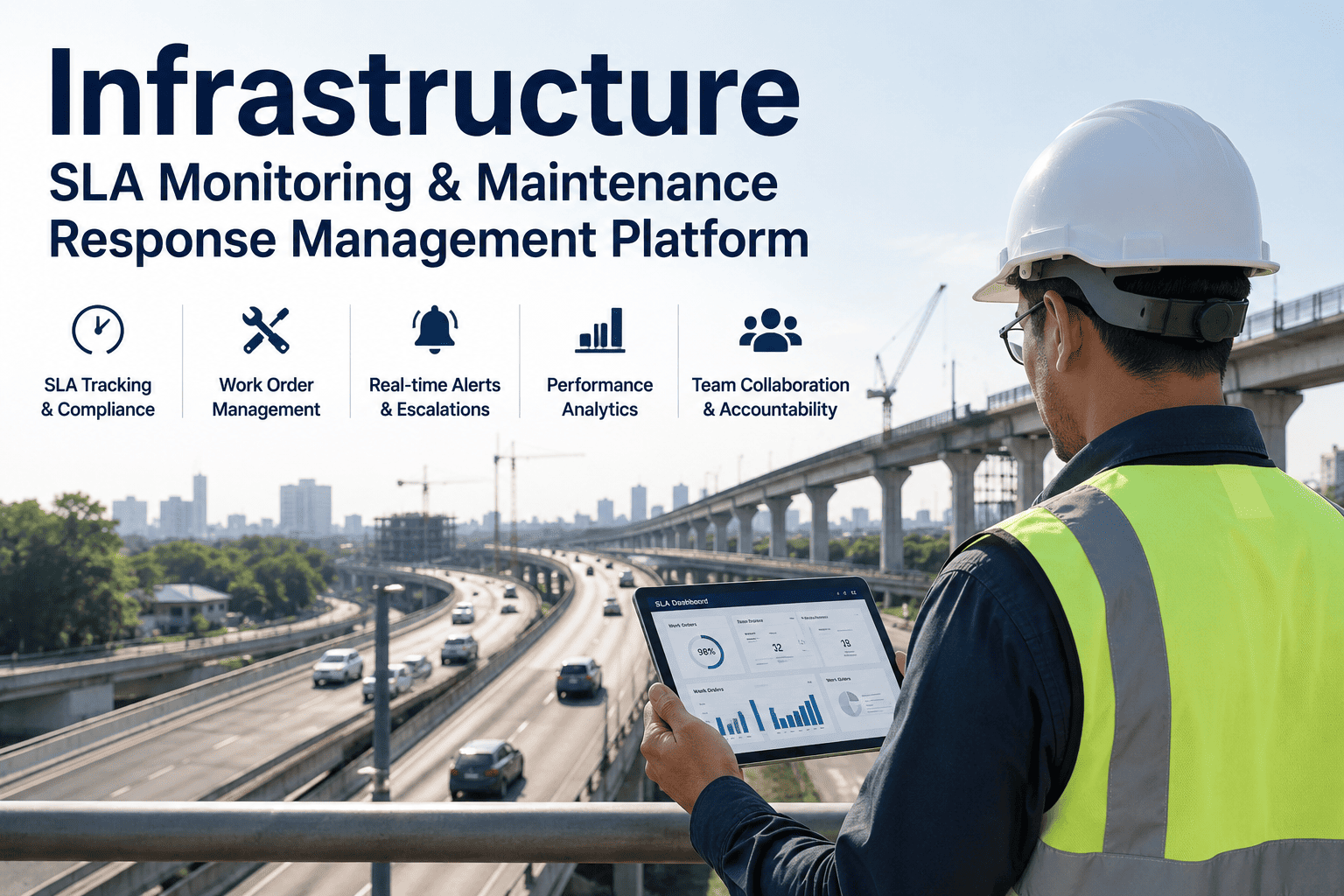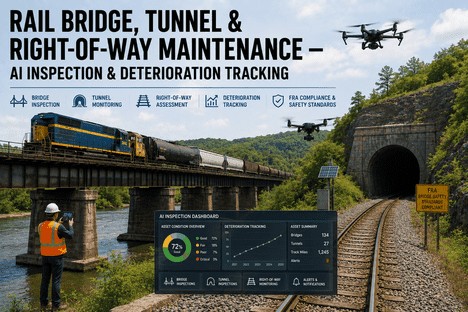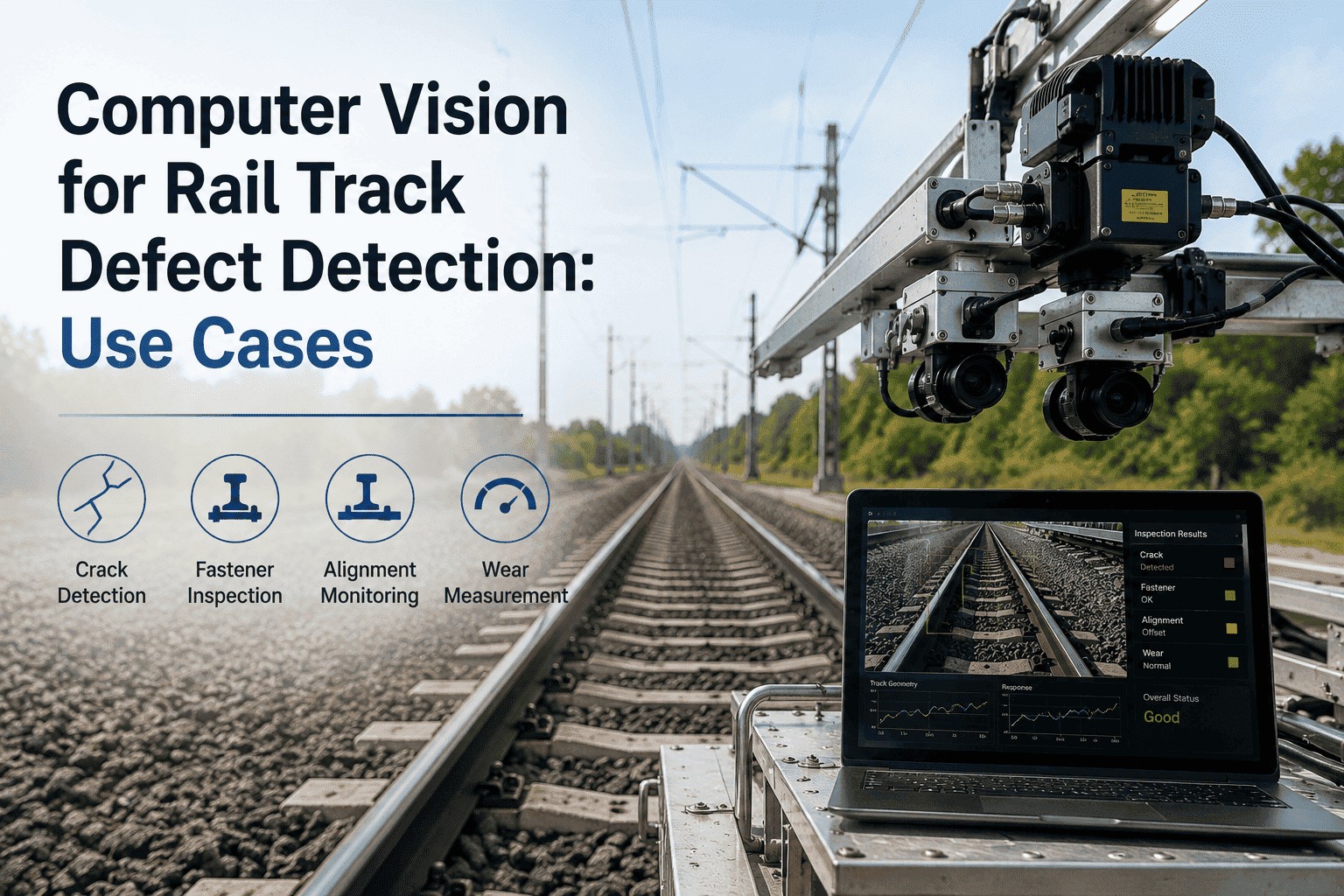
A track engineer walking 10 kilometres of railway with a clipboard can inspect a few thousand sleepers, fasteners, and metres of rail head in a shift. A vision-equipped inspection vehicle running at 30–60 km/h with line-scan cameras and deep learning covers the same distance in 15 minutes — and captures pixel-resolution imagery of every fastener, sleeper, weld, and millimetre of rail head along the way. This is the quiet revolution inside modern rail track maintenance: computer vision now performs the work of dozens of inspectors, continuously, with consistent severity grading and zero fatigue. The FRA in the US, the ORR in the UK, the EBA in Germany, and equivalent regulators worldwide still mandate periodic human and ultrasonic inspections — but they increasingly accept CV-based monitoring as a supplementary continuous layer that catches defects between scheduled measurement runs. This article walks through how CV-powered rail track defect detection actually works in service — the seven defect categories it identifies, the camera and ML architectures behind it, the accuracy benchmarks worth trusting, and the deployment realities operators meet on day one. Book a Demo to see iFactory's rail CV pipeline running on live track today.
Technical Article · CV for Rail Track Defects
Every Sleeper, Every Fastener, Every Weld — Inspected at Train Speed.
iFactory orchestrates line-scan cameras, area-scan vision, and CNN-based defect classifiers on in-service trains, HiRail vehicles, and trolleys — finding cracks, missing clips, sleeper damage, and ballast contamination at scale.
60 km/h
Inspection speed achievable with modern line-scan camera + CV systems
7 defects
Track defect categories reliably detected by production CV pipelines
95%+
Classification accuracy on fastener and sleeper defects in published research
In-service
Sensors mounted on revenue trains — no dedicated possession needed
The Seven Track Defects CV Reliably Detects
Rail track CV is not a single problem. It is seven distinct visual classification problems — each with its own image signature, severity grading, and maintenance urgency.
D1
Rail Head Defects
Squats, head checks, surface cracks, and shelling on the rail running surface. The earliest visible indicator of rolling contact fatigue.
Production-Ready
D2
Fastener Defects
Missing clips, worn or broken Pandrol fasteners, loosened bolts, and damaged baseplates. The most common and most automatable target.
Production-Ready
D3
Sleeper / Tie Damage
Cracked concrete sleepers, split timber ties, end-rot, and shoulder degradation. Severity grading from minor to replacement-needed.
Production-Ready
D4
Weld & Joint Defects
Battered joints, fishplate cracks, weld porosity, and rail-end mismatch. Visual screening plus ultrasonic confirmation downstream.
Production-Ready
D5
Ballast Condition
Fouling, contamination, missing ballast, pumping, and drainage failure. Inferred from texture and colour analysis of the trackbed.
Emerging
D6
Track Geometry Anomalies
Visual indicators of gauge widening, twist, and alignment errors. Complements traditional track geometry car measurement.
Emerging
D7
Vegetation & Obstruction
Encroaching vegetation, foreign objects on track, and clearance envelope violations — safety-critical, especially on high-speed lines.
Production-Ready
Anatomy of a Rail Track CV Inspection System
A production track-inspection CV system is more than a camera and a model. Six functional blocks work together — each addressing a different physical or computational constraint.
Block 01
Line-Scan Cameras
High-resolution single-line sensors capture continuous track imagery at full vehicle speed without motion blur — the foundation of any high-speed track CV system.
Block 02
Pulsed LED Illumination
Synchronised high-power LED arrays eliminate dependence on ambient light. Enables consistent imagery in tunnels, at night, and under bridges.
Block 03
GPS & Tachometer Sync
Each captured frame is tagged with precise chainage from GPS and wheel-tachometer fusion — so defects are geo-located to centimetre accuracy.
Block 04
Edge Compute & Inference
On-vehicle GPU runs CNN inference at full capture speed. Real-time alerts; deeper analysis offloaded to cloud for batch reprocessing.
Block 05
Defect Classifier Ensemble
Multiple specialised models (one per defect class) run in parallel — fastener model, rail-head model, sleeper model, vegetation model.
Block 06
EAM & Possession Planner
Detected defects flow to Network Rail Ellipse, SAP PM, or Maximo with severity and chainage — auto-scheduled into next possession window.
The Vision Models Doing the Detection
Production rail CV runs an ensemble of specialised models — each picked for a specific defect class and the trade-off between accuracy and inference speed.
M1
YOLOv8 & YOLOv7 Detectors
Single-stage object detection at real-time speed. Standard for fastener counting, missing-clip detection, and obstruction alerts on in-service trains.
M2
U-Net & DeepLabv3+ Segmentation
Pixel-precise segmentation for rail head crack mapping, weld defect extent, and ballast fouling area calculation — when quantification matters.
M3
ResNet & EfficientNet Classifiers
Multi-class severity grading per detected defect — distinguishing Grade A through E sleeper damage, light versus severe rail-head shelling.
M4
Mask R-CNN Multi-Defect
Two-stage detector with per-region masks. Critical for high-resolution close-range imagery where cracks, fasteners, and sleeper damage co-occur in one frame.
M5
Anomaly Detection (Autoencoder)
Unsupervised models trained on healthy track flag anything that deviates — useful for novel defect types not seen during supervised training.
Three Deployment Modes — Choose by Frequency & Coverage
CV inspection systems deploy in three distinct configurations. Operators typically combine two or three for full coverage.
Mode 01
In-Service Train
Cameras mounted on revenue trains. Continuous, network-wide coverage at zero possession cost. Lower-resolution but very frequent inspection.
Coverage: Daily, full network
Mode 02
HiRail Vehicle
Road-rail truck with high-resolution camera array. Scheduled possession runs at 20–40 km/h. Higher resolution; better for severity grading.
Coverage: Weekly, selected sections
Mode 03
Push Trolley / Drone
Manual or autonomous walk-pace inspection. Highest resolution. Reserved for known defect sites and engineering investigations.
Coverage: Targeted, on-demand
Real Accuracy & False-Positive Benchmarks
Published research and operator data on rail CV consistently report the following ranges. Real deployments typically need facility-specific tuning to reach the top of each range.
Defect Class
Architecture
Detection Accuracy
False-Positive Rate
Fastener defects (missing, worn, broken)
YOLOv7 / Faster R-CNN
94–98%
1–3%
Rail head cracks & squats
U-Net + ResNet ensemble
89–95%
3–7%
Sleeper / tie damage grading
ResNet-50 / EfficientNet
88–93%
4–8%
Weld & joint defects
Mask R-CNN
85–91%
5–10%
Ballast condition (fouling, pumping)
Segmentation + texture analysis
80–88%
6–12%
Vegetation & obstruction
YOLOv8 / DeepLab
92–97%
2–5%
False-positive rate matters more than raw accuracy in rail CV — a 95% accurate system that generates 50 false alarms per kilometre is operationally worthless. Production systems target false-positive rates below 5% per defect class.
Five Deployment Realities Rail Teams Hit on Day One
01
Lighting is half the problem
Tunnel transitions, low-sun glare, and shadows from overhead infrastructure defeat models trained on consistent imagery. Pulsed LED illumination plus exposure-aware training fixes most of it.
02
Motion blur kills line-scan systems
Without precise tachometer synchronisation, line-scan output stretches or compresses with speed variation. Tachometer-locked acquisition is mandatory above 20 km/h.
03
False positives are the operational killer
A 95% accurate model that produces 100 false defect calls per kilometre will be ignored by the maintenance team. Production deployments target false-positive rates below 5% per defect class.
04
Regional fastener variation is real
Pandrol e-Clip looks nothing like Nabla looks nothing like Vossloh. A model trained on UK fasteners fails in continental Europe. Multi-region training data is essential for cross-network deployment.
05
CV does not replace ultrasonic
CV sees surface defects only. Internal rail flaws — head shelling propagating downward, transverse defects, web cracks — still need ultrasonic. The future is fused CV + UT, not CV alone.
iFactory Rail Track CV Platform
Inspect Every Metre of Track, Every Day, Automatically.
iFactory orchestrates line-scan vision, pulsed LED illumination, GPS-tachometer sync, and CNN ensembles — feeding defect alerts directly to Network Rail Ellipse, SAP PM, Maximo, and Infor EAM possession planners.
Trusted by track engineers, infrastructure managers, and rolling stock operators across national rail networks.
Frequently Asked Questions
Tap any question to reveal the answer.
Modern CV systems reliably detect seven defect categories: rail head defects (squats, head checks, surface cracks, shelling), fastener defects (missing, worn, broken clips and bolts), sleeper or tie damage (cracks, splits, shoulder degradation), weld and joint defects, ballast condition issues (fouling, pumping, drainage failure), track geometry anomalies (visual indicators of gauge widening and twist), and vegetation or obstruction encroachment. Fastener, rail head, sleeper, and obstruction detection are production-ready with 88–98% accuracy in published research. Ballast condition and geometry anomaly detection remain emerging. Book a demo to see the live detection stack.
Speed depends on camera type and inspection mode. Modern line-scan systems with pulsed LED illumination and tachometer-locked acquisition operate reliably at 30–60 km/h on in-service trains — covering full national networks at revenue-service speeds. Modern ultrasonic-and-camera HiRail inspection cars achieve testing speeds above 48 km/h. Higher resolution targeted inspections (push trolley, drone) operate at walking pace and reserved for known defect sites. The trade-off is always image resolution versus coverage frequency: line-scan at speed catches gross defects across the network; trolley speed catches sub-millimetre detail in selected sections.
False positives are the single biggest operational problem in rail CV — a system that flags 50 phantom defects per kilometre will be ignored by maintenance teams within weeks. Production deployments target false-positive rates below 5% per defect class through three techniques: (1) multi-class training that includes explicit distractor classes (shadows, paint marks, debris, normal wear patterns); (2) ensemble voting where multiple specialised models must agree before a defect is reported; and (3) temporal consistency — a real defect persists across multiple frames as the train moves, while transient artefacts do not. Combined, these techniques typically bring per-defect-class FPR below 5%.
No — and regulators do not currently allow it to. Ultrasonic testing remains the standard for detecting internal rail flaws that propagate below the surface (transverse defects, head shelling extending downward, web cracks, bolt-hole cracks). The FRA in the US, ORR in the UK, and equivalent regulators worldwide mandate ultrasonic inspection on prescribed intervals, and any indication from a detector must be hand-verified immediately. CV is a complement, not a replacement: it identifies surface defects between scheduled ultrasonic runs, prioritises sections for ultrasonic re-inspection, and provides continuous visual evidence to support ultrasonic findings. Modern best practice is fused CV + UT, not either alone.
Fastener diversity is a real and underappreciated problem. Pandrol e-Clip, Pandrol Fastclip, Nabla, Vossloh, and traditional cut-spike-and-tie-plate all look different to a CNN — and a model trained on one fastener system fails on another. Production deployments handle this in two ways: either multi-region training data covering every fastener type on the network (preferred for national operators), or per-region model variants automatically selected by geo-fence (preferred for cross-border or franchise operators). Transfer learning between fastener types reduces but does not eliminate the labelled-data requirement; expect 500–2,000 annotated examples per new fastener variant.
iFactory connects natively to the EAM and possession-planning systems used by major rail operators — Network Rail's Ellipse, SAP PM, IBM Maximo, Infor EAM, and national systems via standard REST APIs. Detected defects flow with chainage (geo-referenced to centimetre accuracy via GPS-tachometer fusion), severity grading, AI confidence score, and annotated visual evidence directly into the maintenance workflow. Work orders auto-generate against next available possession windows, and the digital twin updates with each inspection pass. The platform layers on top of your existing EAM and inspection stack — no rip-and-replace, with typical integration completed in 2–4 weeks.