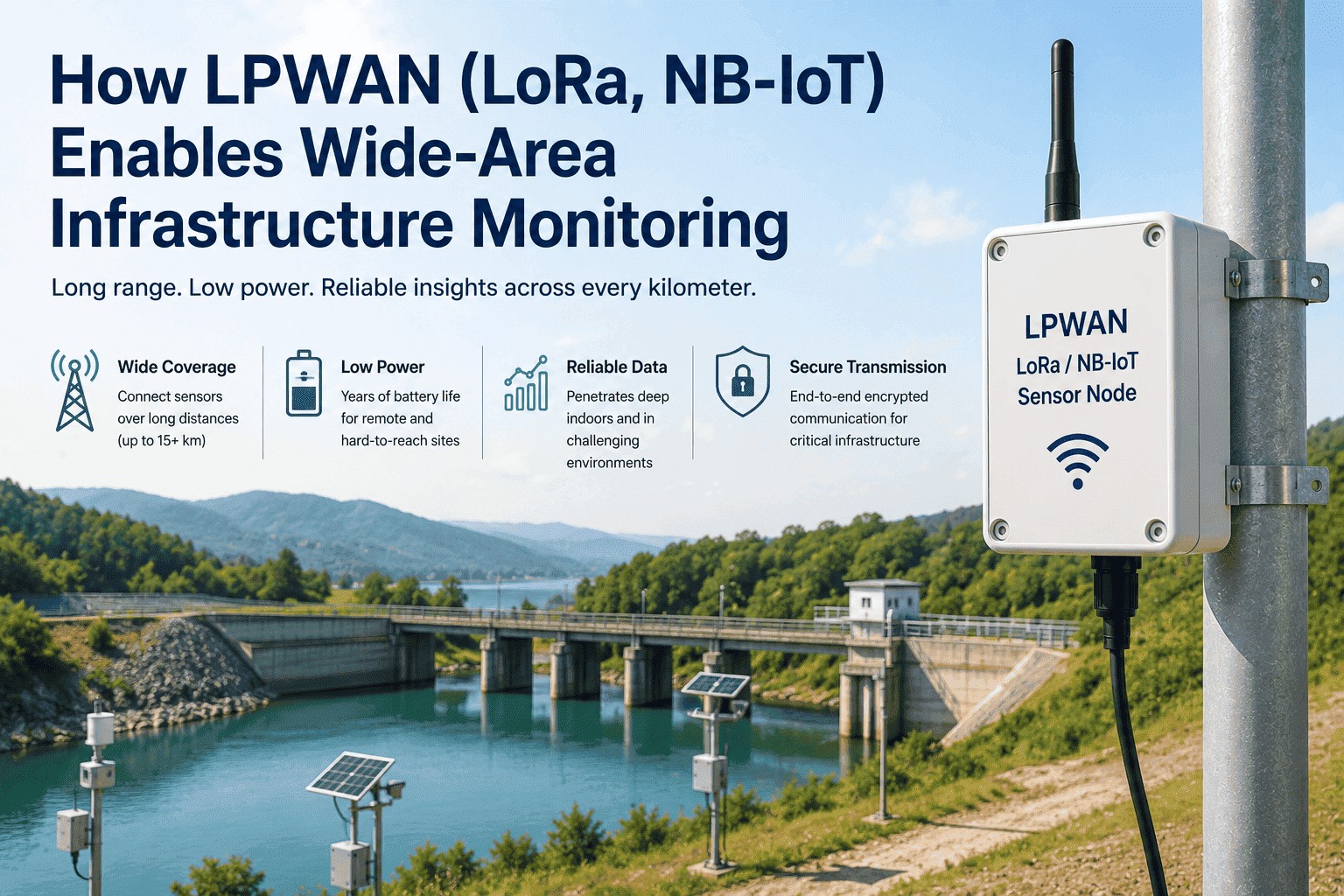
How LPWAN (LoRa, NB-IoT) Enables Wide-Area Infrastructure Monitoring
By Grace on May 27, 2026
Rural infrastructure is where cellular coverage ends and asset monitoring problems begin. A 48-inch water transmission main running 140 miles through three counties. A gas gathering pipeline network with 80 wellhead pressure sensors scattered across 600 square miles of agricultural land. A state DOT bridge portfolio where 60% of structures sit more than 2 miles from the nearest cell tower. A 230kV transmission corridor crossing national forest land where no utility service exists for 80 consecutive miles. These are the environments where conventional IoT — cellular modems, Wi-Fi gateways, Ethernet-connected PLCs — fails economically and physically before a single sensor is installed. LPWAN (Low-Power Wide-Area Network) protocols solve this. LoRaWAN and NB-IoT are purpose-built for exactly this problem: transmitting small sensor payloads over distances of 10 to 50 kilometres at power levels that allow 5-to-10-year battery life on a single AA cell — enabling monitoring infrastructure in locations where no other wireless technology is viable. Infrastructure operators that have deployed iFactory's LPWAN monitoring platform report monitoring coverage extended to 100% of remote asset estates — including locations with zero cellular signal — at 60 to 80% lower sensor-to-cloud cost than cellular IoT equivalents, with average node battery life of 7.4 years.
Monitor Every Remote Asset — Even Where No Cellular Signal Reaches.
iFactory's LPWAN platform deploys LoRaWAN and NB-IoT sensor networks across rural pipelines, bridges, power corridors, and water infrastructure — delivering real-time monitoring where conventional IoT has never been economically viable.
Maximum LoRaWAN line-of-sight range — 5–15 km typical in rural infrastructure terrain
7.4 yrs
Average node battery life at iFactory-deployed LPWAN infrastructure sites
80%
Lower sensor-to-cloud cost vs. cellular IoT equivalents at equivalent sensor density
100%
Remote asset coverage achieved — including zero-cellular-signal locations
LoRaWAN vs. NB-IoT — Choosing the Right Protocol for Your Infrastructure
LoRaWAN and NB-IoT are both LPWAN protocols — both achieve multi-kilometre range at sub-milliwatt transmit power — but they differ fundamentally in deployment model, spectrum access, latency, and payload capacity. Choosing the wrong one for your infrastructure environment costs 18 to 36 months of redeployment. The comparison below maps each protocol to the infrastructure scenarios where it delivers optimal performance.
Protocol 01
LoRaWAN
Uses unlicensed ISM band spectrum (915 MHz in North America, 868 MHz in Europe). No SIM card, no carrier contract, no monthly data fee. You own the spectrum access. Deploy a private gateway network over your asset corridor and operate it indefinitely at zero recurring radio cost. Ideal for remote rural assets where carrier coverage is absent and asset owners need full network control.
Range (Rural LOS)
15–50 km open terrain; 3–8 km in wooded corridors
Battery Life
5–12 years on AA cell at 15-min reporting intervals
Recurring Cost
Zero per-node data cost — private network or TTN
Best Infrastructure Use
Rural pipelines, remote bridges, water mains, agricultural corridors
Protocol 02
NB-IoT
Uses licensed LTE spectrum operated by mobile carriers (AT&T, T-Mobile, Verizon in the US). No gateway infrastructure required — nodes connect directly to the carrier's existing cell towers. Coverage extends wherever LTE exists, and NB-IoT penetrates buildings and underground infrastructure far better than standard LTE due to extended link budget (+20 dB vs. LTE). Ideal for peri-urban and semi-rural assets with some carrier coverage.
Range / Coverage
10–15 km from tower; excellent in-building penetration
Battery Life
5–10 years at hourly reporting — PSM and eDRX optimised
Recurring Cost
$0.50–$2.50/node/month carrier data SIM
Best Infrastructure Use
Underground vaults, stormwater, urban bridges, distribution mains
The Physics of LPWAN — Why These Protocols Reach Where Others Cannot
Understanding why LPWAN achieves multi-kilometre range at sub-milliwatt power requires understanding the three physical engineering decisions that make it possible. These are not incremental improvements over conventional wireless — they are architectural choices that trade data throughput for range and battery life in a way that is perfectly matched to infrastructure monitoring requirements.
Spread Spectrum Modulation
LoRa uses Chirp Spread Spectrum (CSS) — spreading each data bit across a wide frequency range rather than transmitting at a single frequency. This spreading gives LoRa the ability to be received 20 dB below the noise floor — meaning a LoRa packet can be decoded even when the signal is 100× weaker than background radio noise. No other commercially available wireless technology achieves this. The trade-off: maximum data rate of 50 kbps. For a 50-byte sensor payload, that is all you need.
Duty Cycle & Sleep Architecture
A LoRaWAN node transmitting once every 15 minutes is actively transmitting for approximately 0.1% of its operating time — spending the remaining 99.9% in deep sleep drawing 2 to 10 microamps. The average current consumption over the full duty cycle works out to 3 to 15 microamps — achievable for 5 to 12 years from a 2,400 mAh ER26500 lithium cell. NB-IoT achieves equivalent battery life using PSM (Power Saving Mode) and eDRX (extended Discontinuous Reception) — negotiating with the carrier's core network to power down completely between reporting intervals.
Sub-GHz Propagation Physics
Both LoRaWAN (915 MHz) and NB-IoT (700–900 MHz) operate in the sub-GHz band — a range where radio waves diffract around terrain obstacles, penetrate vegetation, and propagate through building walls far more effectively than 2.4 GHz Wi-Fi or 5 GHz protocols. The Friis transmission equation shows that path loss at 915 MHz is 8.3 dB lower per kilometre than at 2.4 GHz — approximately 2.6× the range at equal transmit power. For infrastructure assets in forested terrain, underground vaults, or concrete structures, this propagation advantage is the enabling physics of the technology.
See iFactory's LPWAN Architecture Designed for Your Asset Corridor and Coverage Requirement
iFactory's RF engineering team models your asset corridor, selects the optimal protocol (LoRaWAN, NB-IoT, or hybrid), designs the gateway network layout, and demonstrates link budget coverage before hardware is committed — at no upfront risk.
Infrastructure Monitoring Use Cases — What LPWAN Sensors Measure and Where
The sensor payload that LPWAN transmits is small — typically 10 to 50 bytes per uplink — but for infrastructure monitoring that is sufficient. Pressure, temperature, vibration level, tilt, crack width, strain, flow rate, battery voltage, and GPS location all fit within a LoRaWAN packet. The four deployment scenarios below represent the highest-value infrastructure LPWAN monitoring applications documented at iFactory-deployed sites. Book a Demo to see iFactory's LPWAN sensor selection mapped to your asset type and measurement requirements.
LoRaWAN pressure transducers deployed at 5 to 10 km intervals along a rural water or gas transmission main form a pressure-monitoring network that detects differential pressure drops — the primary indicator of a leak or line break — across an entire pipeline corridor from a single gateway per 30 km of line. iFactory's leak detection algorithm correlates pressure readings at adjacent nodes to localize leak events to within 500 metres of the actual break location, enabling targeted excavation rather than corridor-length patrol.
Protocol
LoRaWAN — private network
Sensors
Pressure, temp, flow
Battery Life
8–10 yr at 5-min reads
Outcome
Leak localization <500m
Use Case 02
Remote Bridge Structural Health — Tilt & Vibration
LoRaWAN tilt sensors on bridge pier caps and MEMS vibration sensors on main girders provide continuous structural health monitoring for rural bridges where cellular coverage is absent. iFactory's edge processing on the sensor node performs Rainflow cycle counting locally — transmitting only the daily stress cycle histogram rather than raw high-frequency data, keeping the LoRaWAN uplink payload below 48 bytes while providing full fatigue accumulation data. A single solar-powered LoRaWAN gateway at the bridge site covers the complete sensor array and backhauls via satellite when cellular is unavailable.
Protocol
LoRaWAN + satellite backhaul
Sensors
Tilt, vibration, strain, crack
Battery Life
5–7 yr; indefinite solar
Outcome
Full SHM at zero cellular sites
Use Case 03
Water Distribution — Meter Reading & Quality
NB-IoT is ideal for water distribution monitoring in peri-urban and suburban areas where carrier NB-IoT coverage exists but installing cellular IoT per meter is uneconomical. NB-IoT water meter interfaces read pulse outputs from existing meters at hourly intervals — transmitting consumption data, battery voltage, and tamper alerts. Underground vault deployment is enabled by NB-IoT's +20 dB link budget improvement over standard LTE, allowing reliable communication from 2 metres below grade without signal amplification. iFactory's water analytics platform correlates district meter area (DMA) readings across a utility's entire network to calculate real-time non-revenue water at each pressure zone.
Protocol
NB-IoT — carrier SIM
Sensors
Flow, pressure, quality, tamper
Battery Life
7–10 yr at hourly read
Outcome
NRW detection to <1% zone
Use Case 04
Power Transmission Corridors — Line Sag & Thermal
LoRaWAN dynamic line rating (DLR) sensors clip onto transmission conductors to measure conductor temperature, ambient air temperature, wind speed, and solar radiation — the inputs to the thermal rating calculation that determines how much current the line can safely carry without exceeding sag limits. A single LoRaWAN gateway with 10 km range can monitor 60 to 80 conductor-mounted sensors across an entire transmission span without trenching or additional infrastructure. iFactory's DLR analytics platform calculates real-time thermal ratings and identifies spans where conductor temperature trends indicate incipient insulation degradation.
Protocol
LoRaWAN — private network
Sensors
Conductor temp, tilt, sag
Battery Life
Energy harvesting — unlimited
Outcome
10–15% capacity increase via DLR
LPWAN vs. Cellular IoT vs. Satellite — The Full Technology Comparison
Infrastructure organizations selecting a wireless technology for wide-area sensor deployment frequently compare LPWAN against cellular LTE-M/4G and satellite IoT (Iridium, Starlink, Orbcomm). The comparison is not simply technical — it is economic. The right technology depends on your asset density, payload size, required latency, and available infrastructure budget per node per year.
Criterion
LPWAN (LoRaWAN / NB-IoT)
Cellular LTE-M / 4G
Satellite IoT
Battery Life
5–12 years — best in class
1–3 years — higher radio power draw
1–4 years — high TX power to orbit
Annual Cost per Node
$0–$30 (LoRaWAN: near zero; NB-IoT: ~$12–$30)
$60–$180 per node per year
$200–$600 per node per year
Coverage in No-Cellular Zones
Full — LoRaWAN private network covers any terrain
None — requires carrier coverage
Full — global coverage
Data Payload per Transmission
10–250 bytes — sensor telemetry only
Up to 1 MB+ — supports images, video, large payloads
340 bytes (Iridium) to MB (LEO)
Best Infrastructure Fit
High node density, small payloads, remote / no-cellular
Very remote, very low density, large data acceptable
Expert Review
“
I have been designing wireless sensor networks for infrastructure monitoring for sixteen years — water utilities, gas pipelines, power transmission, and transportation systems — and LPWAN changed the economics of remote monitoring more fundamentally than any other technology development in that period. Before LoRaWAN and NB-IoT, the cost floor for a remote sensor node on a rural pipeline was approximately $400 to $600 per year in cellular data, power, and hardware — which meant that instrumenting 200 monitoring points on a 150-mile water transmission main cost $80,000 to $120,000 per year just to operate, before any analytics or platform cost. That economics killed most remote monitoring business cases. The LoRaWAN economics change the calculation by an order of magnitude. A LoRaWAN node on a pipeline pressure sensor transmitting every 15 minutes costs approximately $2 per node per year in platform subscription, plus zero radio costs because the private 915 MHz gateway network you build once and operate indefinitely. The incremental monitoring cost per node is essentially battery replacement every 8 to 10 years. That changes the business case from a $120K/year operating cost to a $1,500/year operating cost for the same 200-point monitoring network. Every infrastructure asset manager who has worked through that calculation has reached the same conclusion: the reason you have not been monitoring your remote assets is not that monitoring is unimportant. It is that the previous technology economics made comprehensive monitoring unaffordable. LPWAN made it affordable. The technology maturity, gateway availability, and standards stability of LoRaWAN and NB-IoT in 2025 mean there is no longer a sound economic argument for not instrumenting remote infrastructure assets at whatever density the asset management programme requires.
— Principal RF and IIoT Systems Engineer, Water and Energy Infrastructure — 16 Years — LoRa Alliance Certified Professional, Licensed PE (Electrical), IEEE Senior Member
Conclusion
LPWAN is not an incremental improvement on cellular IoT — it is the technology that makes continuous infrastructure monitoring economically viable at the asset densities and geographic scales that matter for pipelines, power corridors, water networks, and rural bridge portfolios. The combination of 15 to 50 km range, 5 to 12 year battery life, and near-zero per-node operating cost removes the three barriers that have historically prevented comprehensive remote infrastructure instrumentation.
iFactory's LPWAN platform — supporting LoRaWAN private networks, NB-IoT carrier SIM deployments, and hybrid architectures that combine both — delivers the sensor-to-cloud pipeline, AI analytics, and compliance reporting that turns wide-area sensor data into actionable maintenance intelligence. The 100% remote asset coverage, 7.4-year average battery life, and 80% operating cost reduction documented at iFactory LPWAN deployments are the direct result of deploying the right wireless technology for the right infrastructure environment. Book a Demo to see iFactory's LPWAN platform designed for your asset corridor and monitoring requirements.
Frequently Asked Questions
For a rural pipeline corridor in flat to rolling agricultural terrain, a single LoRaWAN gateway with a 10m mast-mounted antenna typically achieves 20 to 35 km of linear coverage along the pipeline easement. A 100-mile (160 km) corridor requires approximately 5 to 8 gateway sites. Each gateway site requires power (solar + battery, grid tap at a valve station, or propane generator) and backhaul (cellular, satellite, or licensed microwave). iFactory's RF planning tool models your specific corridor terrain, vegetation type, and sensor payload parameters to generate a gateway placement plan with coverage probability map. Book a Demo for a corridor-specific RF plan.
LoRaWAN 1.1 implements AES-128 end-to-end encryption with separate network session keys and application session keys — the payload is encrypted at the sensor and decrypted only at the application server, so neither the gateway nor the network server can read sensor data. The protocol uses per-frame counters to prevent replay attacks. NB-IoT inherits the LTE security framework including mutual authentication and 128-bit encryption. iFactory's platform adds certificate-based device authentication and TLS 1.3 for all API connections. Neither protocol exposes control plane access — sensors are read-only uplink devices in all standard infrastructure monitoring configurations. NERC CIP and TSA pipeline cybersecurity framework compliance documentation is available for critical infrastructure customers.
Yes. iFactory's LoRaWAN sensors implement adaptive reporting — standard interval is configurable from 1 minute to 24 hours; when a threshold condition is detected (pressure drop, temperature exceedance, tilt change), the sensor immediately transmits an alarm uplink and escalates to 1-minute reporting until the alarm condition clears. The North American 915 MHz ISM band duty cycle regulations allow continuous transmission for short bursts, so a 1-minute alarm reporting rate is regulatory-compliant for alarm duration events. The battery impact of alarm-escalated reporting is managed by limiting the escalated period duration; for events lasting under 2 hours, the battery life impact is negligible against the 7 to 10 year design life.
iFactory's platform is hardware-agnostic for LoRaWAN devices. Any LoRaWAN 1.0.x or 1.1 certified sensor can be registered on iFactory's network server using the device's DevEUI, AppEUI, and AppKey. iFactory maintains a pre-built device profile library covering sensors from Dragino, Milesight, Elsys, Digital Matter, Tektelic, KERLINK, and 40+ additional manufacturers — enabling plug-and-play provisioning without custom decoder development for most common sensor types. For NB-IoT, iFactory supports standard MQTT and CoAP uplink formats from any NB-IoT modem with a compatible APN configuration. Custom payload decoders for proprietary sensor formats are developed by iFactory's integration team at no additional charge for sensors with publicly available documentation.
For a 50-node LoRaWAN pressure monitoring network on a rural pipeline corridor (3–5 gateway sites, solar power, satellite backhaul), iFactory's total deployment runs $68,000–$145,000 — covering RF planning, hardware (sensors, gateways, solar/battery), installation, platform setup, and first-year subscription. Annual operating cost thereafter is $8,000–$18,000 covering platform subscription, satellite data, and maintenance. Compared to cellular IoT equivalent: $180,000–$280,000 initial + $40,000–$80,000/year operating. The 5-year total cost of ownership for LPWAN is typically 60 to 75% lower than cellular for equivalent coverage at rural asset density. Book a Demo for a corridor-specific cost model.
No Cellular Signal? No Problem. LPWAN Monitors Every Asset, Everywhere.
iFactory's LoRaWAN and NB-IoT platform extends continuous infrastructure monitoring to every remote asset — at 80% lower cost than cellular IoT and 7+ year battery life that eliminates field maintenance for a full equipment generation.