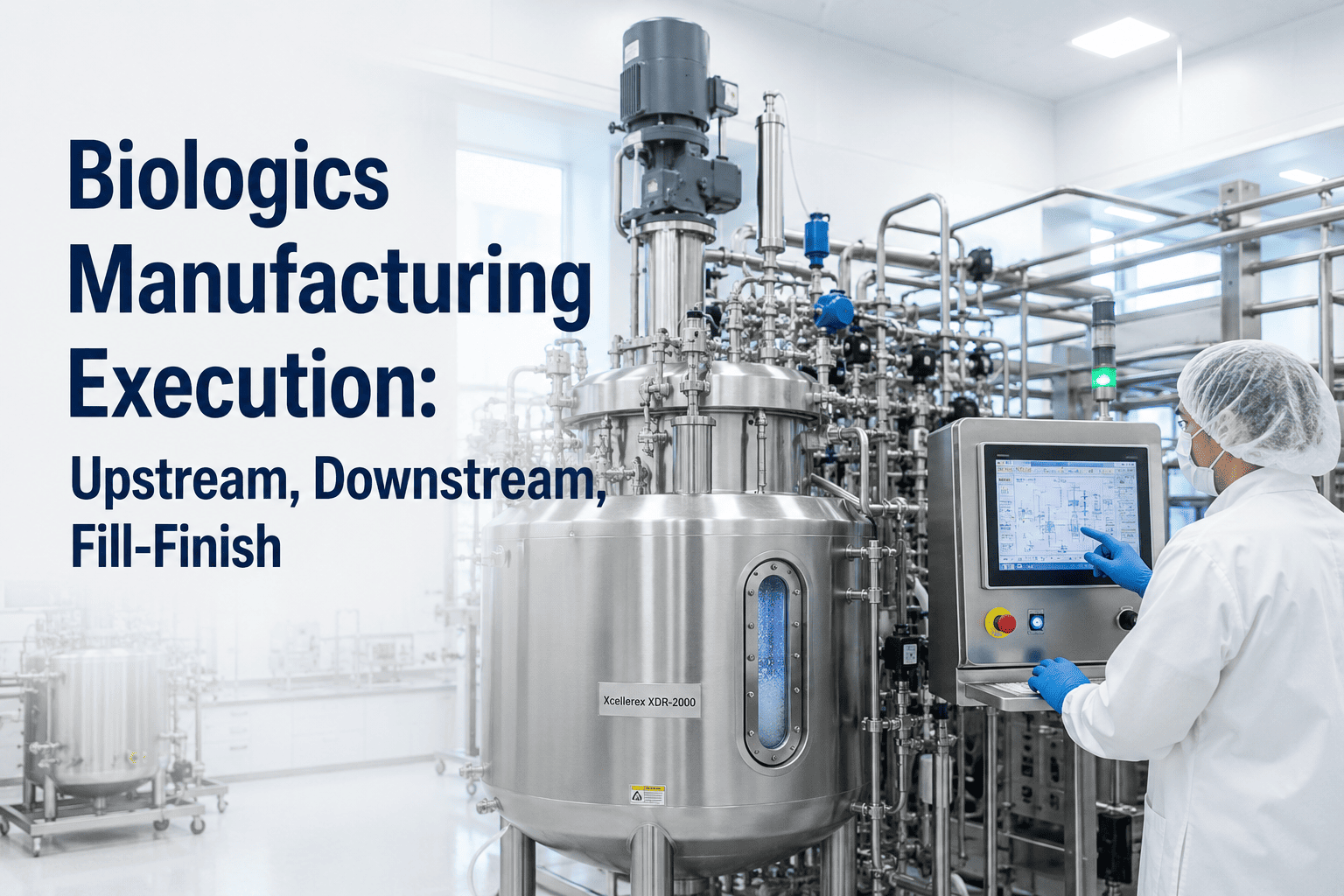
Every hour a bioreactor runs off-spec without real-time intervention, a biologics manufacturer hemorrhages tens of thousands in batch losses, regulatory exposure, and irreversible product degradation — yet most facilities still rely on disconnected spreadsheets, paper-based logbooks, and siloed systems that cannot bridge upstream fermentation, downstream purification, and fill-finish operations into a single, audit-ready intelligence layer.
Is Your Biologics Line Ready for Zero-Deviation Manufacturing?
Unify upstream, downstream, and fill-finish into a single compliant execution layer — eliminating batch failures, manual transcription errors, and regulatory gaps.
The Financial & Clinical Cost of Fragmented Biologics Manufacturing
Biologics manufacturing is categorically different from small-molecule pharma. A single contaminated upstream batch of a monoclonal antibody can eliminate months of production capacity and trigger an FDA 483 observation that costs millions in remediation. The iFactory Biologics MES Platform is purpose-built to close the execution gap across the three critical production phases — with bioreactor integration, single-use system tracking, and an unbroken electronic batch record from cell culture to vial fill.
Upstream Processing
- Real-time bioreactor parameter monitoring (pH, DO, temperature)
- Automated cell culture media dispensing with lot traceability
- Seed train management with passage tracking
- Deviation alerts before critical process parameters breach limits
Downstream Processing
- Chromatography step sequencing with resin lifetime tracking
- UF/DF diafiltration cycle management and yield calculations
- In-process sampling scheduler with QC lab integration
- Buffer preparation verification with electronic sign-off
Fill-Finish
- Filling line reconciliation with container closure integrity data
- Lyophilization cycle management and parametric release support
- Label reconciliation and serialization integration
- Environmental monitoring correlation with fill events
Single-Use System Tracking
- Full component genealogy from unboxing to post-use disposal
- Integrity test data capture at each installation step
- Supplier lot correlation for extractables risk management
- Automated hold and quarantine workflows on test failure
Legacy Friction vs. iFactory Optimized Excellence
The gap between a paper-based biopharma operation and an iFactory-orchestrated facility is not incremental — it is the difference between reactive batch disposition and proactive quality assurance. This matrix quantifies the operational and financial delta across the full biologics manufacturing lifecycle.
| Manufacturing Area | Legacy Friction | iFactory Optimized Excellence | Financial Impact | Risk Profile |
|---|---|---|---|---|
| Bioreactor Monitoring | Manual log entries every 30–60 min | Continuous automated data capture | Eliminates batch investigation costs | High → Low |
| Batch Record Closure | 5–15 days paper compilation | Real-time eBR, same-day review | Accelerates product release by weeks | High → Low |
| Single-Use Traceability | Spreadsheet-based, error-prone | Barcode-driven component genealogy | Reduces contamination risk exposure | High → Low |
| Deviation Management | Reactive; post-event investigation | Predictive alerts; pre-emptive holds | Avoids full-batch write-offs | Med → Low |
| QC Lab Integration | Manual result transcription | Bidirectional LIMS interface | Eliminates transcription errors & rework | Med → Low |
| Regulatory Audit Readiness | Days of document retrieval | Instant electronic audit trail | Reduces 483 observation remediation cost | Low Risk |
Five-Phase Implementation Roadmap for Biologics MES Deployment
A successful biopharma MES deployment cannot be a generic software rollout. The iFactory implementation methodology is built specifically for the validated GxP environment, ensuring each phase delivers measurable compliance and operational value before the next begins.
Process Mapping & Gap Assessment
- Current-state workflow documentation across all three manufacturing phases
- Identification of data integrity gaps and manual intervention points
- Risk-ranked prioritization of integration requirements (LIMS, ERP, DCS)
Master Batch Record Digitization
- Conversion of paper MBRs into validated electronic master batch records
- Role-based review and approval routing configured per 21 CFR Part 11
- Version control and change management workflows established
Equipment & Bioreactor Integration
- OPC-UA / DCS interface configuration for upstream bioreactor systems
- Single-use assembly barcode scanning and integrity test data ingestion
- Automated CPP/CQA trending dashboards with configurable alert thresholds
Validation & Qualification (IQ/OQ/PQ)
- Pre-authored validation protocols designed to accelerate regulatory submission
- Traceability matrix linking requirements to test evidence automatically
- Computer system validation (CSV) documentation package delivered
Continuous Improvement & Lifecycle Analytics
- Aggregate process performance data across batches for yield trend analysis
- CAPA integration to close deviations with verified corrective action evidence
- Annual product review automation reducing QA report compilation by 70%+
Operational Outcomes Across People, Processes & Product Quality
Beyond regulatory compliance, the iFactory Biologics MES Platform delivers tangible outcomes that affect staff performance, production throughput, and the quality of life-saving biological medicines reaching patients.
Staff & Operator Outcomes
- Eliminates repetitive manual data entry — reducing transcription errors by up to 85%
- Role-guided work instructions reduce training time for new operators by 40%
- Real-time alerts surface actionable information, reducing cognitive overload on the floor
- Electronic sign-off workflows eliminate bottlenecks from shift handover documentation
Process & Throughput Outcomes
- Batch record review cycle reduced from 10+ days to under 48 hours on average
- Deviation investigation timelines shortened by automated event capture and root-cause data
- Campaign scheduling optimization increases equipment utilization by 20–30%
- Automated in-process sampling reminders reduce missed sample events to near zero
Product Quality & Patient Outcomes
- Complete upstream-to-fill genealogy ensures contaminated batches never reach patients
- Parametric release data package supports accelerated product disposition
- Single-use component traceability reduces extractables investigation risk significantly
- Continuous process verification (CPV) data supports post-approval change submissions
Six Critical Gaps in Biopharma MES Deployments — and How iFactory Closes Them
Most biopharma MES failures are not technology failures — they are architecture failures. Understanding where these gaps emerge is essential for any quality director or VP of Manufacturing planning a digital transformation investment for a biologics facility.
Separate systems for upstream and downstream prevent cross-phase yield correlation and make holistic batch analysis impossible for QA teams.
In-process results stored exclusively in the QC lab LIMS cannot trigger manufacturing holds in real time, creating a dangerous lag in quality decision-making.
Single-use component installation managed by paper checklists creates undetectable failure modes that only surface during batch disposition review — too late to intervene.
Legacy MES platforms with poor CSV support accumulate unvalidated configuration changes, creating significant 21 CFR Part 11 exposure during FDA inspections.
Platforms without real-time CPP monitoring force operators to react to bioreactor excursions after the fact, making batch salvage impossible in many biologics processes.
Hybrid paper-electronic systems produce incomplete audit trails that fail data integrity expectations outlined in FDA's data integrity guidance and WHO Annex 11 equivalents.
Deploy a Unified Biologics MES Platform Across Your Entire Manufacturing Chain
Eliminate batch record backlog, close single-use traceability gaps, and achieve inspection-ready compliance across every phase of biologics production.
Biopharma MES Software — Frequently Asked Questions
Does iFactory support both stainless steel and single-use bioreactor systems?
Yes. The platform provides equipment-agnostic bioreactor integration via OPC-UA and vendor-specific DCS interfaces. Single-use assembly components are tracked via barcode scanning with full integrity test data capture at each installation step, regardless of the bioreactor format or supplier.
How does the platform handle the complexity of mAb manufacturing processes?
iFactory supports multi-step mAb manufacturing workflows including protein A affinity chromatography, viral inactivation, ion exchange polishing, and UF/DF concentration — each with configurable step parameters, in-process acceptance criteria, and automated yield calculations that feed directly into the eBR. Book a Demo to see a full mAb process walkthrough.
What is the timeline for a validated biopharma MES implementation?
A standard phased deployment from process mapping through PQ execution typically takes 9–14 months for a full three-phase biologics facility. iFactory's pre-authored validation protocol library reduces IQ/OQ/PQ execution time by approximately 40% compared to building documentation from scratch.
Can iFactory integrate with existing ERP and LIMS systems?
Absolutely. The platform provides validated, bidirectional interfaces for leading LIMS platforms (LabVantage, LabWare, StarLIMS) and ERP systems (SAP, Oracle). Material consumption, batch disposition, and inventory reconciliation data flows are configurable without custom code. Book a Demo to review our integration architecture.
How does iFactory support FDA and EMA inspection readiness?
Every manufacturing action, parameter entry, deviation, and approval is captured in an immutable, 21 CFR Part 11-compliant audit trail. Batch records and supporting data packages can be exported on demand in structured formats acceptable for regulatory submission, inspection response, and annual product review compilation.
Close Your Biologics Manufacturing Execution Gap — Starting Today
Join leading biopharma manufacturers already running upstream, downstream, and fill-finish on iFactory's validated MES platform with full bioreactor integration and single-use system traceability.




.png)