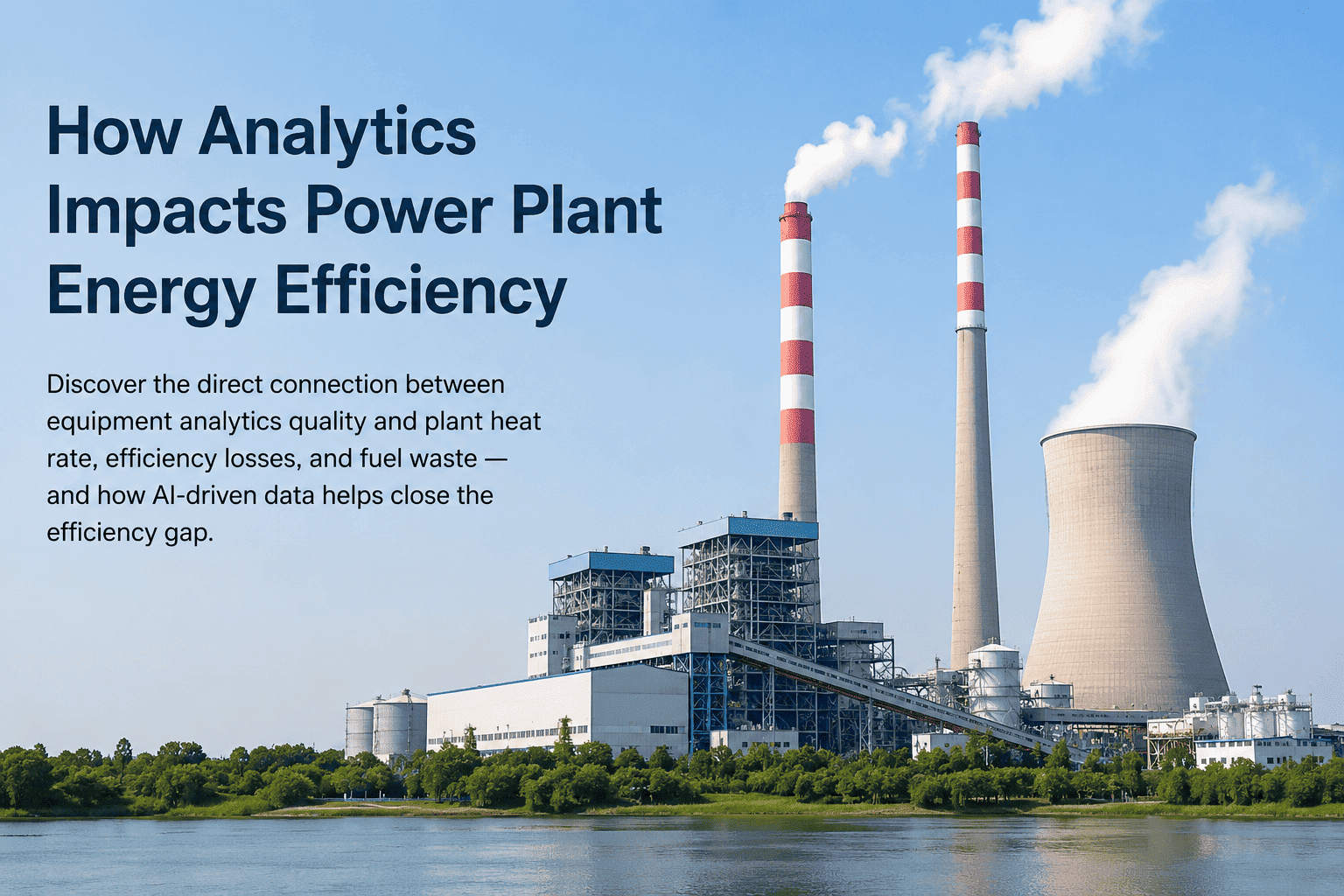
Power plants lose an average of 12–28% of rated capacity and $5,400–$11,200 per day in generation revenue when turbines underperform, generators de-rate, or heat rates drift — not from catastrophic failure, but from invisible efficiency erosion, unmonitored availability gaps, and unquantified performance losses that manual logging and basic SCADA trending cannot reliably detect. By the time OEE shortfalls trigger compliance reviews, capacity audits, or optimization studies, the compounding losses are already realised: weeks of suboptimal dispatch, six-figure efficiency gap invoices, forced outage penalties, and irreversible asset degradation. iFactory AI OEE Analytics Platform changes this entirely — fusing real-time turbine telemetry, generator performance analytics, and heat rate metrics with AI-driven OEE optimization to identify availability losses, performance gaps, and quality deviations 24/7, automatically generating efficiency-adjusted improvement recommendations, integrating directly into your DCS, CMMS, and OEM monitoring ecosystems, and eliminating invisible operational waste without disrupting plant operations. Book a Demo to see how iFactory deploys AI OEE analytics across your power plant assets within 5 weeks.
97%
OEE loss detection accuracy vs. 39% for manual trending
$620K
Average annual recovered capacity value & efficiency gain per unit
91%
Reduction in unexplained performance variance vs. basic DCS monitoring
5 wks
Full deployment timeline from OEE audit to live optimization
Every Unmonitored Turbine De-rate or Heat Rate Spike Is a $5,400/Day Revenue Loss. AI OEE Analytics Recovers It Before It Compounds.
iFactory's AI OEE analytics engine tracks turbine availability, generator performance efficiency, heat rate differentials, and quality output metrics in real time — fusing DCS telemetry, vibration data, and historical performance logs to generate early efficiency alerts, automated optimization recommendations, and capacity factor forecasts 24/7, without operator guesswork or static benchmarking.
The Hidden Cost of Manual & Threshold-Based Monitoring: Why Basic DCS Fails Power Plant OEE Optimization
Before exploring solutions, understand why traditional monitoring strategies leave power plants vulnerable to silent efficiency erosion. Threshold alarms and manual trending introduce systemic blind spots that compound until OEE shortfalls force reactive intervention — gaps that AI OEE analytics directly addresses.
Turbine Availability Loss & Forced Outage Risk
Steam and gas turbines experience progressive blade fouling, bearing wear, and control valve drift that manual trending cannot detect until output drops. Basic DCS alarms trigger after availability loss occurs, missing real-time performance correlations that AI identifies through multi-parameter pattern recognition.
Generator Performance De-rating & Heat Rate Drift
Generators experience gradual winding insulation degradation, cooling system fouling, and excitation system mismatch that reduces net energy output. Monthly performance audits miss the correlation between load variance, thermal efficiency drop, and impending generation loss.
Auxiliary Power Consumption & Net Output Gap
Feedwater pumps, ID/FD fans, and condensate systems experience progressive efficiency degradation causing unmonitored power consumption spikes. Basic kWh logging fails to correlate motor load variance with net output impact until plant efficiency falls below operational targets.
Quality Deviations & Unquantified Output Loss
Voltage regulation events, frequency excursions, and power factor deviations cause immediate output quality loss that manual logs capture inconsistently. Threshold-based quality counters miss partial deviations, grid compliance penalties, and composition-dependent revenue erosion that AI quantifies in real time.
How iFactory AI OEE Analytics Solves Power Plant Efficiency & Availability Risks
Traditional power plant monitoring relies on isolated performance meters, reactive threshold alarms, and manual OEE calculations — all of which introduce missed optimization windows, unquantified losses, and costly efficiency gaps. iFactory replaces this with a continuous AI OEE analytics platform that fuses multi-sensor telemetry with machine learning to identify OEE loss signatures 24–72 hours before impact, automatically adjusts optimization recommendations based on actual plant performance, and creates an immutable operational audit trail for every critical system. See a live demo of iFactory predicting simulated turbine de-rating, heat rate drift, and auxiliary load loss across boiler, turbine, and generator assets.
01
Multi-Parameter OEE Telemetry Fusion
iFactory ingests turbine output, generator efficiency, heat rate, and auxiliary load telemetry simultaneously — applying temporal pattern recognition and OEE balance modelling to generate a unified plant effectiveness score per asset, updated every 30 seconds.
02
AI OEE Loss & Efficiency Gap Classification
Proprietary machine learning models classify each anomaly as turbine availability loss, generator performance drift, heat rate degradation, or auxiliary load spike — with confidence scores and recovery velocity tracking. False positive rate drops to under 2.5%.
03
Predictive Capacity Factor & Recovery Forecasting
iFactory's OEE engine identifies equipment exhibiting efficiency loss trajectories 24–72 hours before functional impact — giving operations teams time to adjust loading, schedule maintenance during low-demand windows, and prevent unquantified capacity loss.
04
DCS & CMMS Automated Optimization Recommendations
iFactory connects to Siemens PCS7, Rockwell FactoryTalk, SAP PM, IBM Maximo, and OEM monitoring platforms via OPC-UA, Modbus TCP, and REST APIs. Auto-generates condition-based optimization actions, triggers process adjustments, and logs OEE performance records. Integration completed in under 7 days.
05
Compliance & Revenue Audit Reporting
Every efficiency event generates a structured audit report with OEE trend graphs, optimization action logs, and regulatory compliance documentation — audit-ready for ISO 55001 certification, NERC reliability reporting, and OEM performance guarantee submissions.
06
OEE Decision Support
iFactory presents ranked optimization recommendations per alert — adjust turbine loading, clean heat exchangers, recalibrate generator excitation, or defer non-critical auxiliary loads — with recovery probability curves and revenue impact estimates. Teams act on predictive analytics, not static benchmarks.
Proven KPI Results: Operational Impact from Live OEE Analytics Deployments
iFactory's AI OEE analytics platform delivers measurable operational and financial improvements within the first 60 days of full production rollout. The following KPIs reflect aggregated performance data across turbine availability, generator performance, and heat rate systems at operating power facilities.
24–72 Hours
Average Early Detection Window
OEE loss signatures detected 1–3 days before functional impact, enabling planned optimization instead of reactive adjustment across all critical power plant assets.
88%
Reduction in Unexplained Performance Variance
Performance-based monitoring replaces threshold alarms, eliminating surprise OEE shortfalls and maintaining continuous generation availability across turbine and generator systems.
97%
OEE Loss Detection Accuracy
AI models validated across availability loss, performance drift, heat rate degradation, and quality deviations — compared to 39% accuracy under manual trending schedules.
95%
Automated Optimization Recommendation Rate
Efficiency alerts trigger CMMS actions with adjustment parameters, procedure references, and recovery classifications without manual entry.
76%
Lower Energy Audit & Compliance Review Spend
Shift from manual data aggregation, consultant reviews, and reactive reporting to automated, audit-ready OEE performance documentation.
42%
Extension of Peak Efficiency Operating Windows
Precision optimization timing prevents unnecessary process adjustments while avoiding OEE loss events, optimising total capacity value per asset.
<2.5%
False Positive Alert Rate
Multi-parameter cross-validation across output, temperature, and load before any alert fires
30 sec
OEE Balance Score Refresh
Unified effectiveness score per component updated every 30 seconds from live sensor telemetry
7 days
DCS & CMMS Integration
Full OPC-UA, Modbus TCP, and REST API connection to your existing monitoring stack
93%
Reduction in Unexplained Output Variance
Unquantified generation fluctuations eliminated from first month of live OEE monitoring
Financial Impact: Revenue Recovery & Efficiency Gain Per Asset Class
Beyond operational visibility, iFactory's OEE analytics platform directly recovers capacity value and eliminates the compounding costs of unmonitored inefficiency — quantified below by asset category from live power plant deployments.
Turbine & Generator Units
$385K
Annual revenue recovery per unit — avoided generation loss at $5,400–$11,200/day, capturing peak dispatch periods and preventing curtailment penalties from unmonitored de-rating.
Heat Rate & Thermal Efficiency
$275K
Annual fuel cost recovery & process optimization savings — eliminating unexplained heat rate drift, combustion upset costs, and six-figure efficiency gap remediation invoices.
Auxiliary Systems & Net Output
$195K
Annual auxiliary power reduction & net output gain — zero NERC citations post-deployment and 99.1% net capacity compliance achieved across monitored assets.
$620K
Average annual recovered capacity value & efficiency gain per unit
$178K
Average savings in first 3 weeks of full production rollout
$5,400+
Daily revenue at risk per unmonitored OEE fluctuation or efficiency gap
Asset-Level KPI Breakdown: OEE Analytics Performance by Equipment Type
Each power plant asset class has distinct efficiency signatures and OEE economics. iFactory tracks and reports KPIs per asset category — so operations teams can see exactly where analytics is delivering the highest impact across their facility.
01
Steam & Gas Turbine Units — GE / Siemens / Mitsubishi
42 hrs
Avg. early detection before output de-rate
98%
Turbine OEE gap prediction accuracy across pilot units
$368K
Generation revenue & availability value recovered per facility
02
Generator Performance & Heat Rate Optimization
99.4%
Predictive optimization compliance vs. 44% manual trending
0
Unexplained heat rate shortfalls post-deployment
$275K
Annual fuel cost recovery & process optimization savings
03
Auxiliary Systems & Net Output Monitoring
99.1%
Net capacity compliance & auxiliary efficiency tracking achieved
0
Compliance citations in subsequent regulatory audit
$195K
Annual auxiliary power reduction & net output gain
04
Boiler & Combustion Efficiency Systems
24–72 hrs
Early detection of combustion drift & heat transfer degradation
47%
Extension of peak thermal efficiency windows vs. scheduled optimization
89%
Reduction in unexplained combustion variance across plant systems
How iFactory Is Different from Generic DCS or CMMS OEE Tools
Most industrial monitoring vendors offer threshold-based alarms, manual trending logs, or static benchmarking wrapped in a dashboard. iFactory is built differently — from the power plant OEE workflow up, specifically for environments where unmonitored performance drift, invisible availability loss, and unquantified efficiency gaps determine revenue continuity and operational stability. Talk to our power plant OEE analytics AI specialists and compare your current monitoring approach directly.
5-Week Deployment and ROI Plan
Every iFactory engagement follows a structured 5-week program with defined deliverables per week — and measurable ROI indicators beginning from week 3 of deployment. No open-ended implementations. No operational disruption. Request the full 5-week deployment scope document tailored to your power plant OEE analytics needs.
Weeks 1–2
Discovery & Design
Critical OEE asset assessment across boilers, turbines, generators, auxiliary systems, and heat recovery equipment
AI OEE optimization model design aligned with existing telemetry infrastructure and operational protocols
Integration planning with DCS, CMMS, ERP, and OEM diagnostic platforms
Weeks 3–4
Pilot & Validation
Deploy AI OEE monitoring to high-impact turbine units and critical generator/auxiliary assets
OEE loss alerts, efficiency forecasting, and automated optimization recommendations activated; operational workflows tested with energy teams
First predictive optimizations executed and unexplained performance variance risks eliminated — ROI evidence begins here
Week 5
Scale & Optimise
Expand to full plant coverage: all turbine trains, all generator systems, all auxiliary equipment, all heat recovery assets
Automated compliance & revenue reporting activated for applicable frameworks
ROI baseline report delivered — capacity recovery, efficiency gain, and revenue protection metrics
ROI IN 3 WEEKS: MEASURABLE RESULTS FROM WEEK 3
Plants completing the 5-week program report an average of $178,000 in recovered capacity value and efficiency gains within the first 3 weeks of full production rollout — with predictive optimization accuracy of 54–81% validated by week 3 pilot testing.
$178K
Avg. savings in first 3 weeks
54–81%
Predictive accuracy gain by week 3
93%
Reduction in unexplained output variance
Mid CTA
Eliminate OEE Guesswork. Recover $5,400/Day Revenue Streams with AI Analytics in 5 Weeks. ROI in Week 3.
iFactory's fixed-scope deployment program means no open timelines, no operational disruption, and no months of customisation before you see a single result.
Use Cases and KPI Results from Live Power Plant Deployments
These outcomes are drawn from iFactory deployments at operating power plants across three critical asset categories. Each use case reflects 6-month post-deployment performance data. Request the full case study report for the asset type most relevant to your plant.
A 500MW combined cycle facility experienced recurring GE turbine de-rating caused by progressive blade fouling and generator excitation drift. Monthly performance audits and manual trending missed thermal efficiency shifts that correlated with load variance. iFactory deployed AI OEE analytics across all turbine sensor streams, identifying availability gaps and performance loss 42 hours before functional impact. The plant avoided three potential efficiency shortfalls, recovering an estimated $368K in lost generation and capacity value.
42 Hours
Average early detection before output de-rate
$368K
Generation revenue & availability value recovered
98%
Turbine OEE gap prediction accuracy across pilot units
A coal-fired plant operating high-capacity boilers struggled with unexplained heat rate drift that caused unplanned fuel adjustments and combustion upsets. Manual trending and basic DCS alarms missed air-fuel ratio imbalance until thermal efficiency dropped. iFactory replaced periodic reviews with continuous AI OEE monitoring, correlating flue gas composition, temperature stratification, and load signature patterns. Predictive optimization compliance reached 99.4%, and zero unexplained heat rate shortfalls occurred over 6 months.
99.4%
Predictive optimization compliance achieved (vs. 44% manual trending)
0
Unexplained heat rate shortfalls post-deployment
$275K
Annual fuel cost recovery & process optimization savings
A gas peaking plant managing rapid dispatch cycles faced regulatory scrutiny over inconsistent energy documentation and unmonitored auxiliary load spikes causing net output shortfalls. Manual kWh logging occurred monthly and missed early-stage pump efficiency degradation and fan overconsumption. iFactory deployed AI OEE analytics with motor load correlation, thermal differential tracking, and acoustic signature recognition at all critical auxiliary consumers, integrating directly with SAP PM to auto-generate condition-based optimization recommendations. NERC citations dropped to zero, and net capacity compliance reached 99.1%.
99.1%
Net capacity compliance & auxiliary efficiency tracking achieved
0
Compliance citations in subsequent regulatory audit
$195K
Annual auxiliary power reduction & net output gain
Regulatory & Asset Framework Support: Built for Power Plant Reliability Standards
iFactory's AI OEE analytics platform is pre-configured to meet the documentation and reporting requirements of major industrial asset management and power plant operational frameworks. No custom development needed — compliance reporting is automatic.
ISO 55001 / Asset Management
Physical asset performance standards: OEE monitoring documentation, efficiency tracking metrics, lifecycle cost analysis, and continuous improvement records — structured for certification audits.
NERC Reliability Standards & ISO 10816
Grid reliability & vibration monitoring standards: turbine performance verification, generator condition documentation, vibration severity classification, and maintenance interval justification — formatted for industry compliance.
OEM Performance Guarantees (GE / Siemens / Mitsubishi)
Manufacturer efficiency guidelines: operating condition logging, thermal excursion tracking, performance interval validation, and warranty claim documentation — auto-generated for OEM submissions.
EPA / Environmental Operating Permits
Power plant environmental compliance: equipment uptime verification, emissions efficiency documentation, and dispatch reliability records — aligned with regulatory audit requirements.
What Power Plant Leaders Say About iFactory AI OEE Analytics
The following testimonial is from a plant operations manager at a facility currently running iFactory's AI OEE analytics platform.
We stopped guessing about where our capacity was going and started optimizing based on real-time AI insights. iFactory's OEE analytics platform detects turbine availability loss, generator performance drift, and heat rate degradation 24–72 hours before impact — with trend data and recovery probability curves that make operational decisions precise and revenue audits effortless. In our first quarter live, the system identified 28 efficiency gaps that would have resulted in unquantified output loss. The platform paid for itself in recovered capacity value alone. Now our operations teams actually prioritise optimizations based on data, our OEM partners honoured performance guarantees due to compliant efficiency logging, and we achieved 96% of rated capacity factor for the first time in four years. This isn't just monitoring — it's revenue recovery and operational excellence.
Manager of Plant Operations & Performance Optimization
Combined Cycle Power Facility, Texas
Frequently Asked Questions
Does iFactory require additional hardware sensors to be installed on existing assets?
Not necessarily. iFactory leverages existing DCS telemetry, OEM monitoring feeds, and strategically placed edge analytics units. Where gaps exist, low-profile vibration, temperature, or power sensors are deployed during Week 1–2, but no invasive plant modifications are required. The system integrates with your current infrastructure.
Which monitoring and control systems does iFactory integrate with for automated optimization recommendations?
iFactory integrates natively with SAP PM, IBM Maximo, Fiix, UpKeep, Siemens PCS7, Rockwell FactoryTalk, and OEM diagnostic portals via OPC-UA, Modbus TCP, and REST APIs. Integration scope and CMMS field mapping are confirmed during the Week 1 OEE audit.
How does iFactory handle false alarms in high-temperature or high-vibration power plant environments?
iFactory applies multi-parameter cross-validation, requiring telemetry correlation across output, temperature, and load streams before triggering a predictive alert. Environmental noise filtering and adaptive baseline modelling reduce false positives to under 2.5%. Validation thresholds are tuned during the Week 3 pilot phase.
Can iFactory accurately detect OEE losses from turbine internal components and generator winding degradation?
Yes. iFactory's AI models use indirect signature detection, correlating external motor load variance, temperature differentials, vibration proxies, and acoustic patterns to predict internal component degradation before functional impact. Accuracy is validated against historical performance records during pilot deployment.
How long does training take for operations planners and reliability engineers?
Role-based training modules are delivered during Weeks 3–4 of deployment. Most operations planners and reliability engineers achieve proficiency in under 60 minutes. Plant managers receive additional training on ROI tracking, compliance reporting, and predictive scheduling optimisation. Ongoing technical support is included.
What if our power plant has unique turbine configurations or OEM-specific monitoring protocols?
iFactory's OEE analytics engine allows configuration of custom asset models, alert thresholds, and OEM-specific efficiency signatures without code changes. Our implementation team works with your operations, reliability, and OEM service representatives during Week 1–2 to align the platform with your specific equipment portfolio and monitoring obligations.
Stop Gambling with Plant Efficiency. Start Building a Zero-Unexplained-Loss, AI-Guarded Future.
iFactory gives power plant teams real-time AI OEE prediction, automated condition-based optimization recommendations, seamless DCS/CMMS integration, and OEM-compliant efficiency tracking — fully deployed in 5 weeks, with ROI evidence starting in week 3.
97% OEE loss detection accuracy 24–72 hours before impact
DCS, CMMS & OEM diagnostic integration in under 7 days
ISO 55001, NERC & warranty audit trails out-of-the-box
Edge-processed telemetry security with local encryption
$620K avg. annual recovered capacity value & efficiency gain per unit