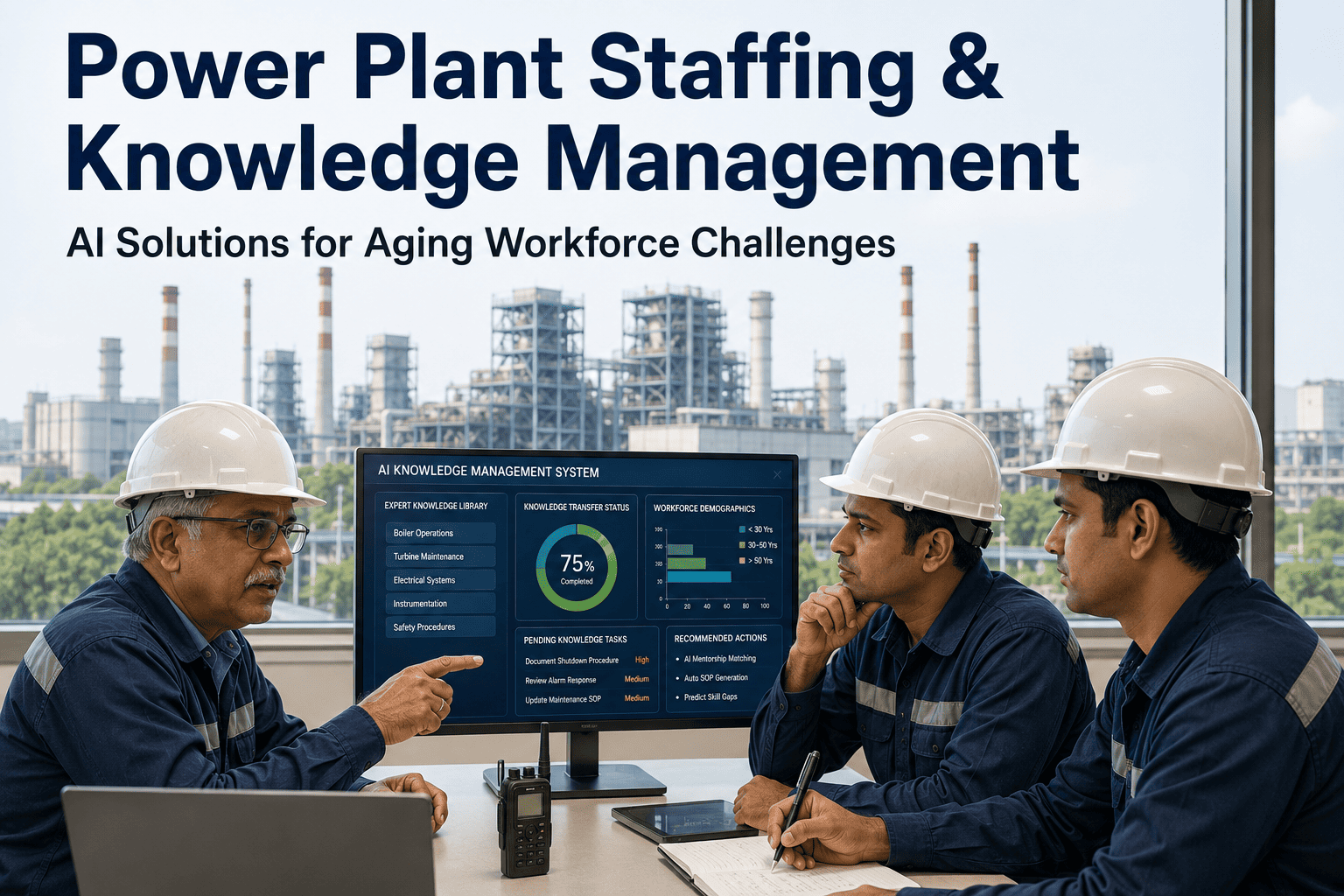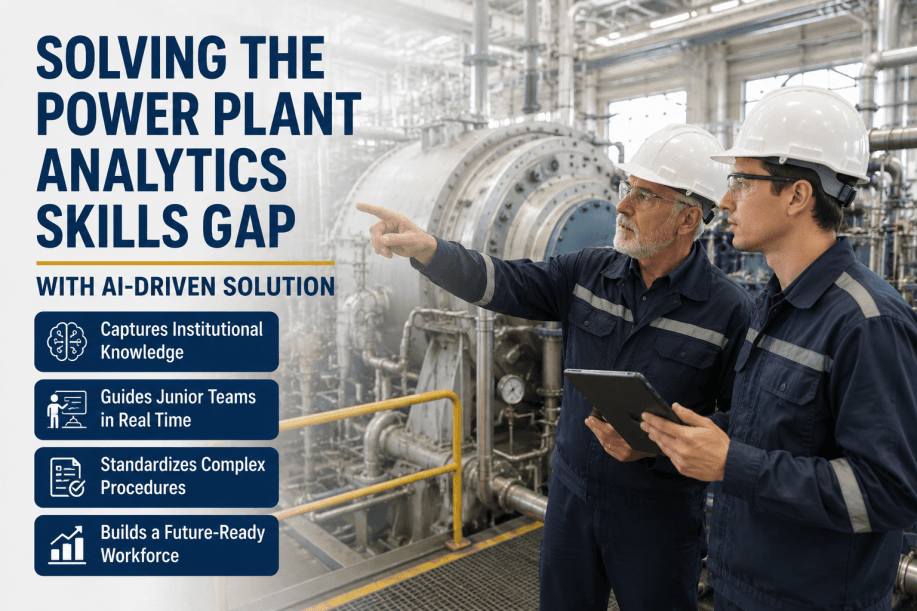
The most underreported risk in U.S. power plant operations is not equipment age, grid volatility, or cybersecurity — it is the accelerating loss of the experienced technicians who know how keep aging assets running safely. The Energy Information Administration estimates that more than 40% of the current power generation workforce will reach retirement age within the next decade. That departure does not just create a headcount problem. It creates a knowledge vacuum: decades of plant-specific diagnostic intuition, failure pattern recognition, and procedural nuance that exists nowhere in any manual, nowhere in any CMMS work order history, and nowhere that AI can reach — unless it is deliberately captured before the people carrying it walk out the door. iFactory's AI-driven analytics platform addresses the workforce skills gap directly: capturing institutional knowledge from experienced technicians into structured, actionable digital procedures; guiding junior technicians through complex diagnostics with AI-assisted decision support; and building the analytics infrastructure that makes a plant less dependent on individual expertise and more resilient to the personnel transitions that every U.S. power facility is already managing. For a conversation about how iFactory's workforce intelligence capabilities apply to your specific facility and workforce situation, contact our support team.
Is Your Plant Prepared for the Knowledge Loss That Comes With Workforce Transition?
iFactory's AI-driven platform captures institutional knowledge from experienced technicians, structures it into guided diagnostic procedures, and delivers AI-assisted decision support that keeps junior teams productive — even without the senior expertise they no longer have on shift.
What the Power Plant Workforce Crisis Actually Looks Like on the Ground
The workforce skills gap in power generation is not a future projection — it is a present operational reality at most U.S. thermal, combined cycle, and nuclear facilities today. Understanding where the gap is largest, and what it costs, is the prerequisite to addressing it systematically rather than reactively.
Retirement Exposure
Of current U.S. power plant workforce eligible for retirement within 10 years — concentrated in the most experienced operators, I&C technicians, and maintenance engineers whose knowledge is least documented and hardest to transfer.
Training Gap
Time required to develop a junior technician to independent competency on complex power plant systems — a timeline that assumes experienced mentors are still available throughout that period, an assumption most plants can no longer guarantee.
Knowledge Loss Cost
Estimated annual cost impact of unplanned outages attributable to diagnostic errors by undertrained technicians — failures that experienced technicians would have identified and corrected during the symptom phase rather than the failure phase.
Undocumented Knowledge
Proportion of plant-specific diagnostic and operational knowledge estimated to exist only in the minds of experienced personnel — not in any procedure manual, not in any CMMS work order, not accessible to the next generation of technicians.
Where the Skills Gap Translates Into Operational Risk: The Five Primary Failure Pathways
Workforce knowledge loss does not produce a single, visible failure — it distributes operational risk across five pathways simultaneously, each of which degrades plant performance independently before combining into the compound reliability risk that characterizes a facility in active workforce transition.
| Risk Pathway | Primary Impact | Typical Cost Range | Knowledge Type at Risk | iFactory Capability |
|---|---|---|---|---|
| Delayed Fault Diagnosis | Availability — extended outage duration | $150K–$2M per event | Pattern recognition: symptom-to-cause mapping | AI Diagnostic Decision Support |
| Incorrect Maintenance Execution | Quality — rework, secondary failures | $80K–$800K per incident | Procedural: step sequence and torque/clearance specs | Digital Guided Work Instructions |
| Missed Condition Indicators | Availability — failure not prevented | $500K–$5M per event | Intuitive: subtle trend recognition before threshold | AI Predictive Analytics |
| Suboptimal Operating Parameters | Performance — heat rate, efficiency loss | $200K–$1.5M annually | Experiential: load following and unit optimization | AI Performance Benchmarking |
| Compliance Documentation Gaps | Regulatory — NERC, EPA, OSHA exposure | $50K–$500K per violation | Procedural: regulatory requirement awareness | Automated Compliance Records |
Knowledge-Dependent Operations vs. AI-Augmented Workforce: The Structural Difference
The fundamental problem with knowledge-dependent plant operations is fragility — performance is only as good as the most experienced person available on that shift, on that day. AI-augmented workforce programs replace that fragility with a systematic capability that does not degrade when experienced technicians retire, transfer, or are unavailable.
- Diagnostic capability depends entirely on which technician is on shift
- Institutional knowledge exists only in retiring personnel — never documented
- Junior technicians escalate to senior staff for every non-routine situation
- Procedure manuals written for experienced readers, not actionable for new hires
- Condition monitoring data collected but requires specialist to interpret trends
- Training delivered through informal mentorship — no consistency, no measurement
- Knowledge loss accelerates as retirements cluster in the same 2–3 year window
- No visibility into which technicians have which knowledge gaps until failure occurs
- AI diagnostic support provides consistent guidance regardless of who is on shift
- Experienced technician knowledge captured in structured digital procedures before departure
- Junior technicians guided through complex diagnostics by AI decision trees
- Work instructions contextualized to the specific asset, condition, and task sequence
- AI analytics automatically flags condition trends that require human investigation
- Competency gaps identified through task completion analytics before they become failures
- Knowledge base grows continuously as each completed work order adds to the digital record
- Performance benchmarking shows which procedures need reinforcement per technician and system
The operational risk implication is measurable: facilities with AI-augmented workforce programs report 30–50% reductions in mean time to diagnose on complex faults, and 40–60% reductions in maintenance rework rates within 18 months of deployment. Book a Demo to see how iFactory's workforce intelligence platform applies to your current skills gap situation.
Stop Losing Knowledge When Experienced Technicians Retire. Capture It Before They Leave.
iFactory's AI-driven platform structures experienced technician knowledge into guided procedures, delivers AI diagnostic decision support for junior teams, and builds the analytics record that makes your plant more resilient with every completed work order.
How iFactory's AI Platform Closes the Power Plant Workforce Skills Gap
iFactory delivers workforce skills gap solutions across three integrated capability layers — knowledge capture, AI-guided execution, and performance analytics. Each layer addresses a specific dimension of the workforce risk that power plants face during personnel transition periods.
Institutional Knowledge Capture
- Experienced technician workflows recorded and structured as reusable digital procedures
- Fault-to-symptom diagnostic maps built from historical work order data and technician input
- Asset-specific knowledge linked directly to equipment records in the CMMS
- Knowledge base searchable by system, component, symptom, and failure mode
- Version-controlled procedures updated as plant modifications are completed
AI-Guided Diagnostic Support
- Junior technicians guided through complex fault diagnostics via AI decision tree workflows
- Symptom entry triggers relevant procedure recommendations from the knowledge base
- Real-time condition data surfaced alongside the diagnostic procedure being executed
- Escalation triggers automatically identify when senior review is required
- Completed diagnostic paths recorded for knowledge base improvement
Workforce Performance Analytics
- Task completion analytics identify which procedures take longer for which technicians
- Rework rate tracking by technician, procedure type, and equipment system
- Competency gap heat maps show where additional training investment is needed
- Shift-level productivity benchmarking across teams and experience levels
- Management reporting on workforce readiness for planned outage execution
A 90-Day Path to AI-Augmented Workforce Capability in Your Power Plant
Building AI-augmented workforce capability does not require a multi-year transformation. The power plants closing their skills gap most effectively follow a structured 90-day activation sequence that delivers measurable operational improvement within the first month — and compounds that improvement with every work order completed thereafter.
Days 1–20: Knowledge Audit and Priority Capture
Map the workforce knowledge at highest risk — identify which experienced technicians carry knowledge for which critical systems, and which of those systems have the highest failure consequence. Deploy iFactory's knowledge capture workflows to digitize the top 20 highest-priority diagnostic procedures from your most experienced technicians before any further workforce transitions occur. This phase alone reduces the plant's exposure to the most consequential knowledge loss scenarios.
Days 21–45: AI Diagnostic Platform Integration
Connect iFactory's AI analytics layer to your plant's condition monitoring, SCADA historian, and CMMS work order records. Activate AI-guided diagnostic decision support for the priority systems identified in Phase 1 — so junior technicians encountering those fault scenarios have immediate access to the structured diagnostic path that experienced technicians would have followed from memory. Typical plants see mean time to diagnose on covered fault types reduce by 40–60% within the first two weeks of activation.
Days 46–70: Competency Gap Analysis and Targeted Development
Activate workforce performance analytics across all completed work orders. Task completion time, rework frequency, and escalation rate data build a competency profile for each technician — identifying specific procedure types and equipment systems where additional guided practice or formal training is needed. This replaces the traditional approach of waiting for a failure to identify a knowledge gap, converting a reactive training response into a proactive competency investment.
Days 71–90: Knowledge Base Expansion and Outage Readiness
Expand the digitized knowledge base to cover the remaining high-priority systems and complete workforce readiness benchmarking ahead of the next planned outage window. Establish the ongoing knowledge capture workflow so that every completed work order adds to the platform's diagnostic knowledge base — creating a compounding return where the platform becomes more capable with every technician interaction rather than remaining static after initial deployment.
Power plants that complete this activation sequence consistently report workforce performance improvements that would have required 12–18 months of traditional mentorship programs to achieve — delivered in 90 days and sustained without requiring the presence of the experienced technicians who originated the knowledge. Book a Demo to build a facility-specific workforce intelligence activation plan with iFactory's team.
What Experienced Power Plant Engineers Say About the Knowledge Transfer Crisis
I spent 28 years at a 1,200 MW coal plant before transitioning to consulting work, and I can tell you with certainty that the knowledge I carry about that specific facility — the particular vibration signature that Unit 2's boiler feed pump makes before a bearing failure, the exact procedure sequence for a generator excitation system trip that is slightly different from the vendor manual because of a modification we made in 2009, the reason you never use the automated sequence for a black start on a cold morning — none of that is written down anywhere. It never occurred to anyone to write it down, because I was always there. The crisis that power generation is heading into is not primarily a staffing problem. It is a knowledge problem. And the plants that recognize that distinction early enough to act — to deploy the technology that captures what experienced technicians know before they leave — are the plants that will be able to maintain safe, efficient, competitive operations through the transition. The ones that wait until the knowledge is gone will be managing the consequences for a decade. The gap between 'we should document this' and 'we actually have it in a format that helps a junior technician at 2am on a Saturday' is where most plants fail. Closing that gap is the entire value proposition of AI-driven workforce intelligence platforms, and it is exactly the right priority for any plant facing the retirement wave that every utility I know is currently experiencing.
The Power Plant Workforce Skills Gap Is a Knowledge Problem. AI Is the Knowledge Solution.
The staffing dimension of the power plant workforce crisis — the raw headcount problem of more retirements than available replacements — is a challenge that the industry must address through recruitment, compensation, and training pipeline investment over years. But the knowledge dimension of the crisis — the loss of diagnostic intuition, procedural mastery, and plant-specific expertise that experienced technicians carry — is a problem that can be addressed now, with technology that exists today, before the knowledge leaves the facility.
iFactory's AI-driven platform closes the knowledge gap through three integrated capabilities: structured digital knowledge capture that preserves experienced technician expertise before retirement; AI-guided diagnostic decision support that makes captured knowledge actionable for junior technicians in real time; and workforce performance analytics that identify competency gaps proactively, before those gaps translate into diagnostic errors, maintenance rework, or unplanned outage events. The facilities that deploy these capabilities now — while experienced technicians are still available to inform the knowledge capture process — will build a compounding resilience advantage that continues to grow with every completed work order. The facilities that wait until the knowledge is gone will spend years recovering it at a fraction of its original completeness. Book a Demo to see iFactory's workforce intelligence capabilities configured for your plant's specific workforce transition timeline.
Your Most Experienced Technicians Will Retire. Their Knowledge Does Not Have To Leave With Them.
iFactory's AI platform captures institutional knowledge, guides junior teams through complex diagnostics, and builds the analytics infrastructure that makes your power plant more resilient with every completed work order — regardless of who is on shift.
Power Plant Workforce Skills Gap — Frequently Asked Questions
How does iFactory's AI platform capture institutional knowledge from experienced technicians before they retire?
iFactory's knowledge capture process works through three parallel channels. First, experienced technicians are guided through structured knowledge elicitation workflows during their normal work order execution — the platform captures the steps they take, the parameters they check, and the decision logic they apply as embedded data rather than requiring a separate, time-consuming documentation effort. Second, historical work order records in the CMMS are analyzed by AI to identify diagnostic patterns, common fault-symptom associations, and procedure variations that experienced technicians apply to specific asset configurations — patterns that never existed in formal documentation but are visible in historical execution data. Third, targeted knowledge capture sessions can be scheduled for the highest-priority diagnostic procedures, with iFactory's structured elicitation format converting interview content directly into searchable, version-controlled digital procedures. Book a Demo to see the knowledge capture workflow applied to a sample power plant procedure.
What is the difference between iFactory's AI diagnostic support and a standard procedure manual?
A standard procedure manual is static, generic, and written for a reader who already has the contextual knowledge to interpret it. iFactory's AI diagnostic support is dynamic, asset-specific, and condition-aware. When a junior technician encounters a fault scenario, the platform presents a guided diagnostic decision tree that adapts based on the symptoms they observe, the condition monitoring data currently available for the specific asset, and the historical fault-resolution patterns for that equipment unit. The procedure the technician follows is not a generic manual procedure — it is a contextualized diagnostic path informed by the specific asset's current condition, its maintenance history, and the resolution approaches that experienced technicians have applied to similar scenarios on that specific machine. This distinction — between generic documentation and contextualized AI-guided decision support — is why AI-augmented workforce programs achieve 30–50% reductions in diagnostic time where procedure manual programs do not.
How does iFactory measure workforce competency gaps, and how is that data used for training investment decisions?
iFactory's workforce performance analytics measure competency indirectly through work execution data rather than through formal testing — which means the measurement reflects actual operational performance rather than assessment performance. The platform tracks task completion time against procedure baseline by technician, procedure type, and equipment system; rework rate (return work orders on the same fault within 72 hours) by technician and procedure category; escalation rate (how frequently a technician requires senior review) by system type and procedure complexity; and first-time-right rate on quality-critical procedures. These metrics generate a competency heat map that shows — by technician, by system category, and by procedure type — where guided practice, formal training, or mentored shadowing would produce the highest operational risk reduction per training hour invested. Management receives a workforce readiness report ahead of planned outage windows showing which technicians are prepared for which scope elements and where additional preparation is needed.
How long does it take to see measurable workforce performance improvement after iFactory deployment?
Most power plants following iFactory's structured 90-day activation sequence see measurable diagnostic performance improvement within the first 2–3 weeks after AI-guided decision support is activated on priority fault scenarios — because junior technicians immediately have access to the structured diagnostic paths that previously existed only in experienced technicians' memory. Rework rate and task completion time improvements typically become measurable within 30–45 days as the workforce adapts to guided procedure execution. The full compound benefit — where the knowledge base has grown sufficiently to cover the broad fault scenario population and the workforce performance analytics are providing actionable competency gap data — is typically realized by day 90. This timeline compares favorably to traditional mentorship-based training programs, which typically require 12–18 months to produce measurable competency improvements. Book a Demo to see a deployment timeline configured for your plant's workforce situation.
Can iFactory's workforce intelligence platform be integrated with our existing CMMS, LMS, and training management systems?
Yes — iFactory's platform is designed for integration with existing plant systems rather than replacement. CMMS integration (Maximo, SAP PM, Infor EAM, and others) enables work order data to flow bidirectionally — historical work orders inform the knowledge base, and AI-generated work orders from predictive alerts carry guided procedure links for the responding technician. LMS integration enables iFactory's competency gap data to trigger formal training course assignments in the existing learning management system, closing the loop between operational performance analytics and formal training delivery. SCADA and historian integration provides the real-time condition context that makes AI diagnostic support asset-specific rather than generic. Standard API and OPC-UA integration protocols are supported across all major plant system vendors.