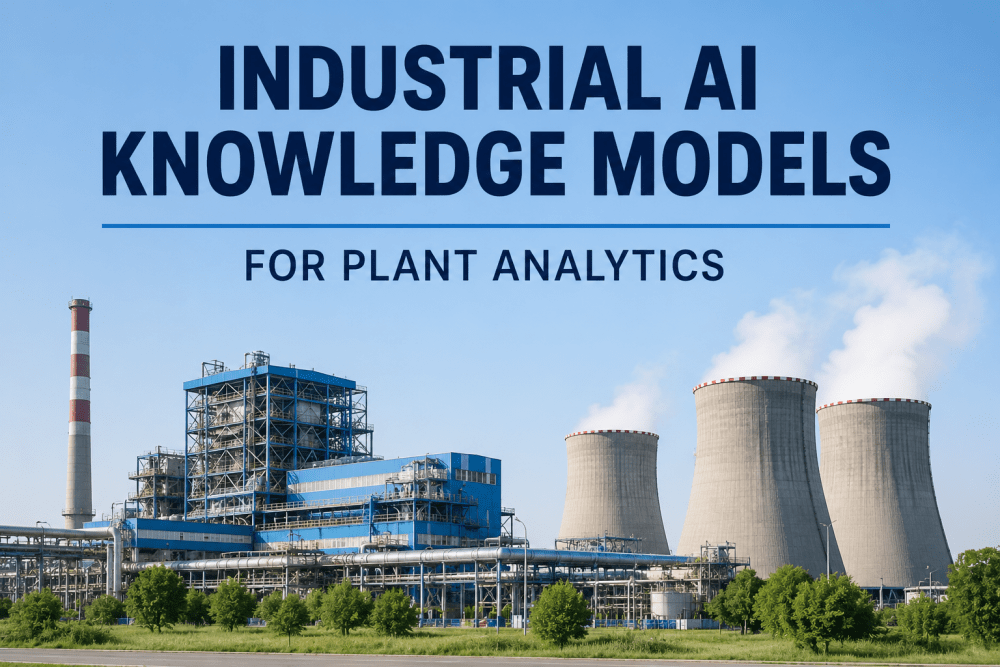
Industrial AI Knowledge Models for Plant analytics
By Alistair Fenwick on May 23, 2026
Every AI-driven analytics platform installed at a power plant in the last decade made the same implicit promise: machine learning trained on enough sensor data would eventually generate reliable maintenance recommendations. Most of those platforms delivered dashboards and anomaly alerts. Few delivered the thing that actually matters at 3 a.m. when gas turbine bearing is degrading — a specific, defensible recommendation backed by the full technical context of that exact equipment failure mode in that exact operating condition. The gap between probabilistic AI outputs and deterministic maintenance action is not a training data problem. It is knowledge architecture problem. Generic AI does not know the difference between a Siemens SGT-800 bearing failure signature and a GE 7FA bearing failure signature, because it was not built to know. Industrial Large Knowledge Models — ILMs trained specifically on equipment manuals, OEM service bulletins, failure mode libraries, and years of plant-specific sensor histories — are the architecture that closes that gap.
The distinction matters operationally. A probabilistic AI recommendation — "anomaly detected, confidence 0.74" — creates work for a reliability engineer. A deterministic ILM recommendation — "HP turbine bearing inner race wear, consistent with SGT-800 SB-2024-047, estimated 18–22 days to failure threshold, recommended action: schedule bearing inspection during next planned outage window, reference procedure PM-GT-14" — closes a work order. For U.S. power plant operations leaders evaluating AI-driven platforms, understanding the difference between platforms built on generic machine learning and platforms built on industrial knowledge models is not a technology selection detail. It is the primary determinant of whether the platform generates analyst-dependent outputs or operationally autonomous maintenance actions.
Industrial AI Knowledge Models Guide 2026
Industrial Large Knowledge Models for Power Plant Analytics
How ILMs trained on equipment manuals, failure histories, and sensor data are replacing generic AI — delivering deterministic, not probabilistic, analytics recommendations for U.S. generation facilities.
First-recommendation acceptance rate for ILM-generated maintenance actions vs. 61% for generic ML platforms
3.2x
Longer average detection lead time for ILMs over generic anomaly detection on the same sensor streams
$0
Reliability engineering hours required per ILM-generated work order vs. 2.4 hrs for analyst-dependent generic AI outputs
12 mo
Typical time for generic ML models to reach ILM performance levels — if they ever do at all
What Makes an Industrial Large Knowledge Model Different From Generic AI
The term "AI" in industrial analytics has been applied so broadly that it covers tools ranging from statistical threshold alerting to genuinely intelligent failure mode classification. The meaningful architectural distinction is not between AI and non-AI — it is between knowledge-free machine learning and knowledge-grounded inference. Industrial Large Knowledge Models are trained on a fundamentally different data diet than general-purpose AI, and that difference produces fundamentally different output quality at every stage of the analytics workflow.
Knowledge Foundation: Equipment-Specific Training
ILMs are trained on OEM equipment manuals, service bulletins, failure mode libraries, inspection procedures, and decades of confirmed failure event records for specific equipment classes — not on generic industrial data. When an ILM analyzes a bearing vibration signature, it reasons against the specific failure mode taxonomy for that bearing type, in that turbine class, under those operating conditions.
Inference Model: Deterministic vs. Probabilistic Output
Generic ML produces probability scores — "likelihood of failure 0.74." ILMs produce classified findings — "inner race wear consistent with documented failure mode GT-BRG-14, estimated remaining useful life 18–22 days, reference service bulletin 2024-047." The first requires human interpretation. The second generates a work order.
Knowledge Update: Living Technical Library
ILMs are updated continuously as OEM service bulletins are issued, as new failure events are confirmed, and as fleet-wide failure patterns are identified. Generic ML models trained on historical data have a fixed knowledge horizon — they do not know about a failure mode that first appeared in 2024 unless they are retrained.
Time-to-Value: Day One vs. 6-12 Month Training
Generic ML platforms require 6 to 12 months of site-specific operating history before models reach meaningful detection accuracy. ILMs carry pre-trained equipment knowledge from day one — generating actionable findings within weeks of historian connection because the failure mode library exists before the first data point arrives.
Generic AI vs. Industrial Knowledge Models: A Direct Capability Comparison
The operational differences between generic machine learning platforms and Industrial Large Knowledge Models compound across every stage of the analytics workflow — from initial data connection through failure mode identification, maintenance action generation, and compliance documentation. The comparison below maps both architectures against the capabilities that determine operational value at U.S. power plants.
Capability
Generic ML Platform
Industrial Large Knowledge Model
Time to First Actionable Finding
6–12 months — models require site-specific failure history to calibrate detection thresholds
2–4 weeks — pre-trained equipment knowledge base generates findings from first data connection
Failure Mode Output
"Anomaly detected — sensor deviation from baseline, confidence 0.74" — requires reliability engineer to classify
"HP turbine blade tip clearance loss, consistent with fouling failure mode GT-BLD-07, recommended: offline wash before next dispatch" — actionable directly
OEM Technical Knowledge
None — learns statistical patterns from data but has no access to OEM service bulletins, failure libraries, or repair procedures
Trained on manufacturer manuals, service bulletins, inspection procedures, and confirmed failure event libraries for each equipment class
New Failure Mode Detection
Cannot detect failure modes not represented in training data — blind to novel failure signatures
Knowledge base updated as OEM bulletins are issued — new failure modes available within weeks of OEM publication
Work Order Generation Quality
Requires reliability engineer review and interpretation before actionable work order can be written — avg. 2.4 hrs per finding
Generates fully formed work orders with failure mode classification, repair procedure reference, parts identification, and priority — zero analyst hours required
Compliance Documentation
Provides sensor data and alert logs — narrative documentation requires manual engineering effort
Auto-generates compliance documentation referencing applicable standards, failure mode evidence chain, and corrective action history from knowledge base
Fleet Learning Across Sites
Site-specific models — a failure pattern at Plant A does not improve detection at Plant B unless manual model sharing is implemented
Fleet-wide knowledge propagation — confirmed failure events at any facility update the knowledge base for all facilities running equivalent equipment
Year 1 Analyst Dependency
High — outputs require 2–4 hrs of analyst interpretation per significant finding throughout Year 1 and often beyond
Low — actionable work orders generated autonomously; analysts review exceptions and approve automation parameters
Want to see how an Industrial Knowledge Model performs against your specific equipment types and failure mode library? Book a 30-minute ILM capability assessment with iFactory's power generation team.
How Industrial Large Knowledge Models Are Built and Maintained
The knowledge architecture that makes ILMs operationally superior to generic ML is built from three distinct layers — each of which requires continuous maintenance to remain current as equipment evolves, OEM bulletins are issued, and new failure modes emerge across the operating fleet. Understanding how these layers are built and updated is essential for evaluating whether a vendor's "AI" platform is genuinely knowledge-grounded or is using the terminology to describe a statistical anomaly detector.
01
Foundation Knowledge Layer
The base of the ILM is built from OEM equipment documentation — technical manuals, installation guides, operation and maintenance instructions, spare parts catalogs, and engineering specifications for every equipment class in the monitoring scope. This layer establishes the physical understanding of how each piece of equipment functions, what its failure modes are, and what the normal and abnormal sensor signatures look like from an engineering first-principles perspective.
OEM manuals ingestedFailure mode taxonomy builtNormal operating envelopes defined
02
Fleet Failure History Layer
Confirmed failure events from across the operating fleet — every bearing replacement work order, every vibration-to-failure event record, every seal failure root cause analysis, every post-trip investigation — are ingested into the knowledge model as labeled examples. This layer provides the statistical grounding that calibrates the ILM's failure signature recognition against real-world failure progressions rather than engineering theory alone. The larger the fleet, the richer this layer becomes.
Confirmed failure events labeledFailure progression signatures cataloguedFleet-wide pattern library built
03
OEM Service Bulletin Integration Layer
OEM service bulletins, technical notices, and safety advisories are continuously ingested as they are issued — updating the knowledge model's failure mode library with newly identified failure mechanisms, revised inspection intervals, and updated operating limits before those bulletins have been manually implemented at any individual facility. This layer is what gives ILMs the ability to detect failure modes that have only recently been identified in the broader operating fleet.
Service bulletins auto-ingestedNew failure modes added within weeksRevised intervals propagated fleet-wide
04
Facility-Specific Calibration Layer
Over the first 60 to 90 days of operation at each new facility, the ILM's pre-trained knowledge base is calibrated to the specific operating profile, fuel type, ambient conditions, and cycling pattern of that plant. This calibration refines detection thresholds from the fleet-average baselines to facility-specific operating ranges — improving both detection precision and false positive suppression without requiring the 6 to 12 months of failure event accumulation that generic ML needs for equivalent performance.
Facility operating profile calibratedDetection thresholds refinedFalse positive rate optimized by Day 90
05
Confirmed Event Feedback Layer
Every completed maintenance event — whether it confirmed the ILM's prediction, partially confirmed it, or contradicted it — is fed back as labeled data that updates the knowledge model's calibration at the facility and fleet levels simultaneously. Confirmed findings strengthen the failure signature recognition. Contradicted findings tighten the detection boundaries. False positives adjust the confidence thresholds. The ILM improves with every maintenance event across every facility in the fleet.
Confirmed events strengthen detectionFalse positives tighten thresholdsFleet-wide improvement from each event
06
Regulatory and Compliance Knowledge Layer
NERC reliability standards, OSHA maintenance documentation requirements, EPA reporting obligations, and insurance policy maintenance documentation requirements are maintained in the ILM's regulatory knowledge layer — enabling the platform to automatically generate compliance documentation that references applicable standards and maps maintenance events to the regulatory obligations they satisfy, without requiring reliability engineers to manually cross-reference requirements for each work order.
See Industrial Knowledge Model Performance on Your Equipment Data
iFactory's ILM-powered analytics platform connects to your DCS historian and demonstrates failure mode classification, work order generation quality, and detection lead time against your actual operating data — typically within two weeks of engagement, with no control system modifications required.
Where Industrial Knowledge Models Outperform Generic AI Most Significantly
The performance gap between ILMs and generic ML platforms is not uniform across all analytics applications. It is widest in the application areas where equipment-specific knowledge — not statistical pattern recognition — determines whether the output is actionable. The four application areas below consistently show the largest performance differential in deployed facility comparisons.
A
Novel and Low-Frequency Failure Modes
Generic ML requires failure event history to detect failure modes — which means failure modes that have never occurred at a specific facility are invisible to the model until they occur. ILMs detect novel failure modes from their first sensor signature appearance because the failure mode is already in the knowledge base from OEM documentation and fleet history. A failure mode that has occurred at similar facilities across the country is detectable at your plant from the first sensor deviation, even if it has never occurred at your plant before.
B
New Equipment Classes and Post-Overhaul Baseline
When new equipment is commissioned or a major overhaul resets an asset's operating baseline, generic ML models must rebuild their training baseline from scratch — typically requiring 60 to 120 days of clean operating data before meaningful detection resumes. ILM-based platforms apply pre-trained knowledge from the equipment class immediately upon historian connection — generating actionable findings within the first operating weeks of new equipment, when early-life failure modes are statistically most likely.
C
Cross-System Failure Mode Attribution
Many power plant failure modes manifest as symptoms on one system while the root cause is in another — a gas turbine performance decline caused by an upstream fuel system issue, or an HRSG tube problem originating from water chemistry degradation. Generic ML identifies the anomaly at the symptomatic system. ILMs with system-level knowledge can attribute the root cause to the originating system because the causal relationships between system behaviors are encoded in the equipment knowledge base, not learned from data correlations alone.
D
Compliance Documentation and Regulatory Evidence
Generic ML platforms generate data outputs that require reliability engineers to translate into compliant documentation. ILMs with regulatory knowledge layers generate compliance-formatted documentation automatically — with the correct standard references, evidence chain structure, and corrective action documentation format that NERC CIP auditors, OSHA inspectors, and insurance underwriters specifically require. The difference is the elimination of 4 to 8 hours of compliance documentation preparation per significant maintenance event.
Ready to see what an Industrial Large Knowledge Model delivers on your specific equipment classes? Schedule your ILM capabilities assessment with iFactory's power generation analytics team.
Expert Review: What Reliability Engineers Say About Industrial Knowledge Models
"We evaluated four analytics platforms before deploying iFactory's ILM-based system. Three of them gave us dashboards and probability scores. The fourth gave us what we actually needed: a recommendation that said 'this is SGT-800 inner race wear, here's the service bulletin, here's the procedure, here's the parts list.' Our reliability engineer spent less time on that one finding than he typically spends making coffee. The difference between a platform that tells you something is probably wrong and one that tells you specifically what is wrong, why, what to do about it, and what the procedure says — that is not an incremental improvement. That is a different product category. We were skeptical that the detection lead time claims were real. Fourteen months in, our MTTR on gas turbine events has dropped by 52% and we've had three events where the ILM flagged a developing condition 30-plus days before any DCS alarm would have fired. Those three events, under the old system, would have been emergency forced outages. Under the new system they were planned maintenance windows. That's the number that pays for the platform several times over."
— Senior Reliability Engineer, 250 MW Combined Cycle Facility, U.S. Gulf Coast Region — 19 Years in Power Generation
52%
MTTR reduction on gas turbine events after ILM deployment
30+ days
Average detection lead time before DCS alarm threshold for ILM-flagged events
3 events
Converted from emergency forced outages to planned maintenance windows in 14 months
Ready to see what an Industrial Large Knowledge Model delivers on your specific equipment classes? Schedule your ILM capabilities assessment with iFactory's power generation analytics team.
Conclusion
The AI in power plant analytics is being stratified. At one end are threshold alerting systems marketed as AI, generic machine learning anomaly detectors that require reliability engineer interpretation, and probabilistic outputs that generate analyst work rather than maintenance actions. At the other end are Industrial Large Knowledge Models — systems built on equipment-specific technical knowledge, trained on confirmed failure histories, continuously updated from OEM bulletins, and capable of generating deterministic, actionable maintenance recommendations from the first weeks of historian connection.
The performance gap between these two categories is not closing — it is widening, because knowledge-grounded inference compounds in ways that statistical pattern recognition does not. Every new OEM service bulletin that enters the knowledge base makes the ILM better for every facility in the fleet simultaneously. Every confirmed failure event improves detection precision for every similar failure in the future. Generic ML platforms improve only as fast as individual facilities accumulate site-specific failure histories — which is slow, expensive in terms of the failures that happen during the learning period, and produces knowledge that is siloed at the facility level. Power plant operations leaders who understand this architectural difference will choose platforms that are built to win on knowledge depth, not just on data volume.
Ready to see what an Industrial Large Knowledge Model delivers on your specific equipment classes? Schedule your ILM capabilities assessment with iFactory's power generation analytics team.
Frequently Asked Questions
What is an Industrial Large Knowledge Model and how does it differ from a standard machine learning model?
An Industrial Large Knowledge Model is a purpose-built AI architecture trained on domain-specific knowledge sources — equipment manuals, OEM service bulletins, failure mode taxonomies, inspection procedures, and confirmed failure event records — rather than on generic sensor data patterns. Standard machine learning models learn statistical correlations from historical data and produce probabilistic outputs: they detect that something is deviating from normal but cannot classify what is deviating, why, or what to do about it without human interpretation. An ILM classifies the specific failure mode, maps it to the relevant OEM technical documentation, estimates remaining useful life, and generates a maintenance recommendation that references the correct repair procedure and parts list. The practical difference is that ILM outputs drive direct work order generation; ML outputs drive analyst review cycles that create intermediate work before a work order can be written.
How quickly does an ILM-based platform reach reliable detection performance at a new facility?
Because ILMs carry pre-trained equipment knowledge into every new deployment, the time-to-value curve is fundamentally different from generic ML. Physics-based performance baselines are established within the first two to four weeks of historian connection. Failure mode classification and initial work order generation begin within the first month. The first 60 to 90 days of operation are used to calibrate the pre-trained knowledge base to the facility's specific operating profile, fuel type, and cycling pattern — refining detection precision from the fleet-average baseline to facility-specific thresholds. By Day 90, ILM detection performance at a new facility typically exceeds what a generic ML platform achieves after 12 to 18 months of site-specific training, because the knowledge that determines what to look for was present from day one rather than learned from scratch.
How are ILM knowledge bases updated as OEM service bulletins and new failure modes emerge?
iFactory's ILM platform maintains a continuous OEM technical intelligence function that monitors and ingests service bulletins, technical notices, and safety advisories from the major equipment manufacturers represented in the deployed fleet — GE, Siemens, Mitsubishi, Solar Turbines, and others. When a new service bulletin identifies a previously undocumented failure mode or revises an existing inspection interval, the knowledge base is updated within a defined publication window and the updated failure mode becomes active in detection models across all facilities running equivalent equipment. Individual facilities do not need to request or implement these updates — the knowledge propagation is automatic and simultaneous across the fleet. This means a failure mode that first appears in a GE service bulletin in Q1 is detectable at every GE frame plant in the iFactory fleet within weeks, regardless of whether that failure mode has ever occurred at any individual facility.
Does ILM-based analytics require a dedicated reliability engineer on staff to interpret outputs?
This is the defining operational advantage of ILM-based analytics over generic ML platforms. ILM outputs are designed to be directly actionable without reliability engineering interpretation as an intermediate step. When the ILM classifies a failure mode, it generates a complete maintenance recommendation — failure mode name, OEM reference, estimated remaining useful life, recommended action sequence, procedure reference, and parts identification — that can be reviewed and approved by a maintenance supervisor or operations manager without requiring a reliability engineer to translate the AI output into a maintenance action. Reliability engineers in ILM-powered environments shift from interpreting AI outputs to managing exceptions, reviewing confidence thresholds, and approving automation parameters. The platform still generates the findings that experienced reliability engineers need; it no longer requires their time to make those findings actionable.
What equipment classes does iFactory's ILM cover and how is coverage expanded?
iFactory's ILM knowledge base currently covers the primary equipment classes at combined cycle, simple cycle, and steam generation facilities — gas turbines across major frame manufacturers, HRSGs and steam generators, generators and electrical systems, balance-of-plant rotating equipment, condensers and heat exchangers, and fuel handling systems. Coverage for each equipment class includes failure mode libraries sourced from OEM documentation and confirmed failure event histories, with depth that reflects the number of equivalent equipment hours in the iFactory fleet. New equipment classes are added in response to fleet expansion — when a new equipment type is brought into the monitoring scope at an iFactory-deployed facility, the knowledge base for that equipment class is built from OEM documentation before the historian connection is established, so detection capability begins from day one of data ingestion rather than after an accumulation period. Contact iFactory for a current equipment coverage list specific to your facility's asset classes.
Purpose-Built Industrial Knowledge Models for Power Plant Analytics
From gas turbine failure mode classification to compliance documentation generation, iFactory's ILM-powered analytics platform delivers deterministic maintenance recommendations — not probabilistic alerts — from the first weeks of historian connection at your facility.