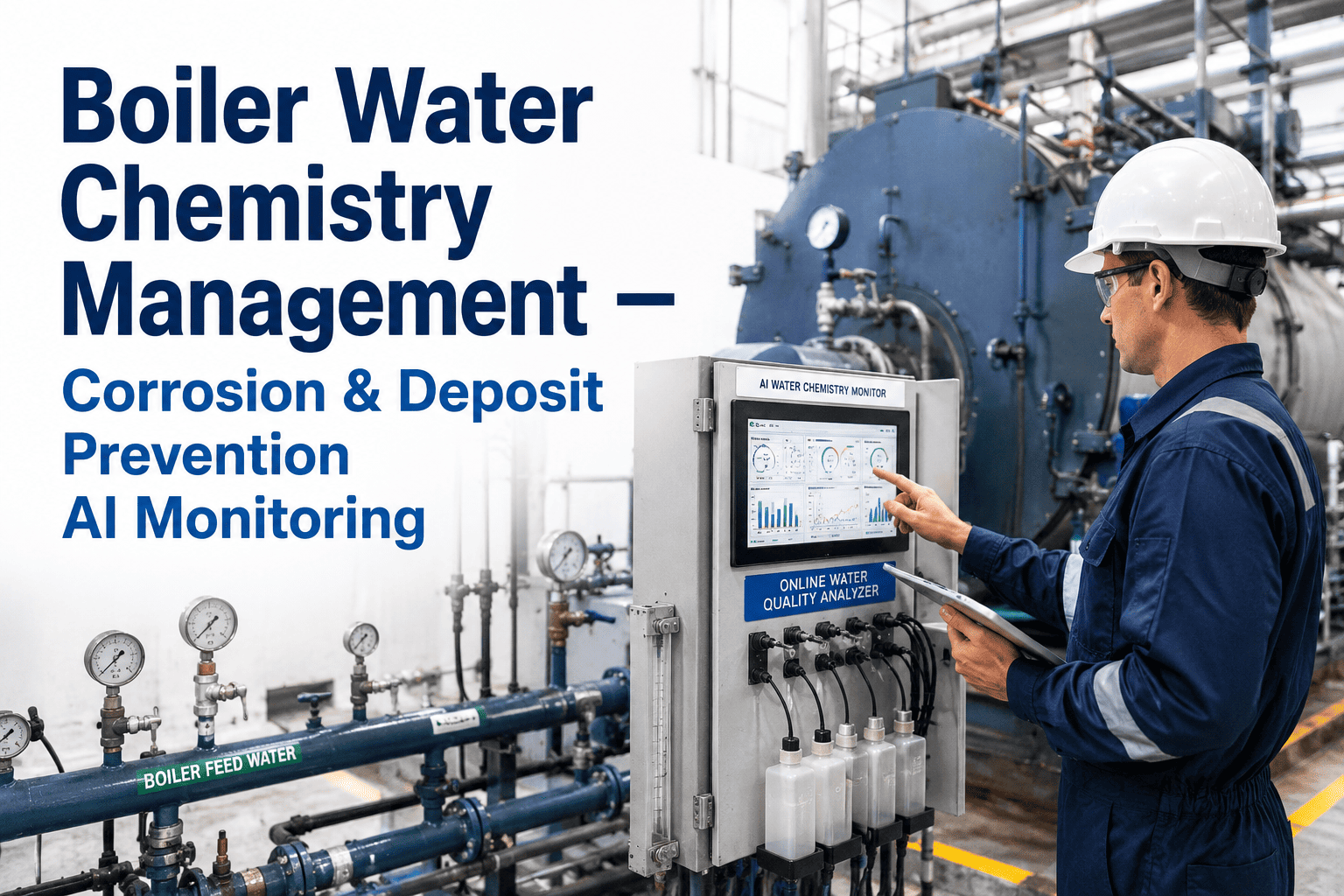
Water is both the working medium and the most aggressive corrosive agent in a power plant. Every megawatt-hour of generation depends on the quality of the water flowing through the boiler feedwater system, the cooling towers the condenser, and the raw water treatment train that feeds them all. When water chemistry drifts outside the tight operating bands that protect heat transfer surfaces, turbine blades and heat exchangers from corrosion and deposition, the consequences are not immediately visible on the DCS — they accumulate silently as tube thinning, deposit buildup, and material degradation that eventually surfaces as a forced outage, a tube failure, or an unplanned chemical cleaning event that costs $180,000 to $420,000 and takes unit offline for two to five days. The data that would have prevented it was in the water chemistry log all along — but at most power plants, that log is a spreadsheet reviewed on a weekly schedule by a chemist who has twelve other responsibilities, with no automated alert when the conductivity trend or the silica concentration is moving toward a limit that matters.
AI-driven water treatment analytics changes that model by continuously monitoring chemical dosing performance, filtration system health, RO membrane efficiency, and water chemistry compliance across all treatment trains — correlating parameter trends in real time and generating maintenance recommendations and chemistry adjustment alerts before treatment exceedances, equipment degradation, or cycle-of-concentration limit breaches accumulate into the kind of boiler or condenser damage that forces a unit offline. For U.S. power plant operations and chemistry teams, the platform replaces the weekly spreadsheet review with a continuous intelligence layer that knows the treatment history, understands the equipment condition, and automatically schedules the preventive maintenance that keeps the water treatment system performing at the chemistry specifications the boiler and cooling system manufacturer requires.
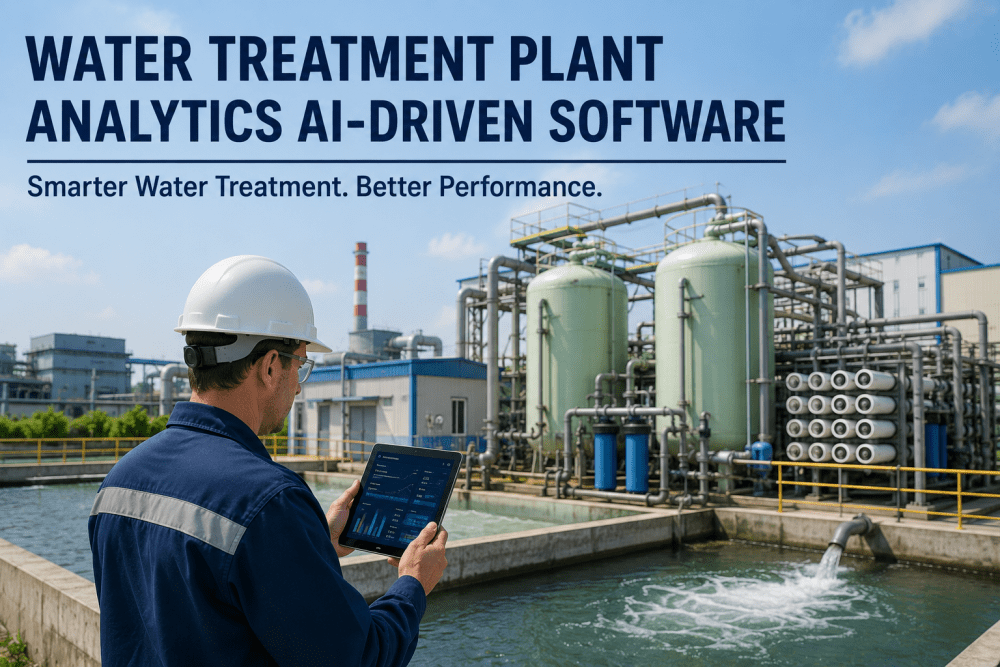
Water Treatment Plant Analytics AI-Driven Software
Chemical dosing equipment tracking, filtration system health, RO membrane performance, and water chemistry compliance — all managed with automated PM scheduling in one AI-driven platform built for power plant water treatment.
$300K Avg. Event Cost
Average cost per boiler tube failure or condenser fouling event attributable to water chemistry exceedances at combined cycle facilities — including outage, cleaning, and repair
Weekly vs. Real-Time
Typical gap between water chemistry sample intervals and the 2–4 hour window in which a treatment exceedance can initiate corrosion or deposition on heat transfer surfaces
3–5 Year RO Life
Typical RO membrane service life when fouling is detected and managed with condition-based maintenance — vs. 18–24 months under reactive replacement schedules at plants without performance tracking
73% Preventable
Percentage of boiler and condenser chemistry-related damage events that post-event analysis identifies as preventable with earlier chemistry trend intervention
The Water Chemistry Management Gap: Why Periodic Sampling Creates Preventable Risk
Power plant water treatment operates with an inherent timing vulnerability: the most important protection against boiler tube corrosion, condenser fouling, and cooling tower scale operates on a continuous basis, but most plants review the data that reveals its health status on a weekly sampling schedule. In the interval between samples, dosing pump failures, raw water quality shifts, ion exchanger exhaustion, and RO membrane fouling can all move the water chemistry outside the operating bands that protect boiler and heat exchanger metallurgy — with no alarm until the next lab result arrives days later. By that point, the exceedance has already been in contact with metal surfaces for hours or days, and the accumulated damage is invisible until it surfaces as a tube leak, a condenser performance decline, or a boiler inspection finding that generates an unplanned outage.
Ready to bring real-time intelligence to your power plant water treatment system? Schedule your water treatment analytics assessment with iFactory's power generation team.
Water Treatment System Components Managed: A Complete Asset Taxonomy
Effective water treatment analytics requires comprehensive asset coverage across every system in the treatment chain — from the raw water intake through the final polishing step that feeds the boiler. The table below maps the asset classes managed in iFactory's water treatment analytics module against their key monitored parameters, maintenance triggers, and the chemistry risk each protects against when managed effectively.
| Asset Class | Key Monitored Parameters | Maintenance Trigger | Chemistry Risk Protected | Failure Cost Range |
|---|---|---|---|---|
| Chemical Dosing Pumps | Stroke rate, output volume vs. setpoint, chemical consumption rate, discharge pressure | Output deviation >5% from setpoint for >15 min; consumption anomaly vs. flow rate | Oxygen corrosion (O2 scavenger), scale inhibition, pH control, biocide efficacy | $40K–$180K per boiler chemistry exceedance event attributable to dosing failure |
| Multimedia Filtration Systems | Differential pressure across media bed, turbidity of filtered effluent, backwash effectiveness per cycle | dP exceeding 80% of design value; turbidity trending above 0.1 NTU post-filter | Fouling protection for RO membranes and ion exchangers downstream; cooling system suspended solids | $60K–$140K per RO membrane replacement batch attributable to inadequate pretreatment |
| Ion Exchange Units (Demineralizers) | Effluent conductivity, sodium leakage, silica breakthrough, resin exhaustion rate | Effluent conductivity rising above 0.1 µS/cm; silica >10 ppb; Na+ leakage trending | Silica deposition on turbine blades; boiler tube corrosion from sodium ingress; feedwater chemistry | $80K–$300K per turbine silica deposit cleaning event; $120K–$400K per boiler tube failure |
| RO Membrane Systems | Normalized permeate flow, salt rejection %, differential pressure per stage, recovery rate | Normalized flow decline >10% from baseline; salt rejection decline >1%; dP increase >15% | Ion exchanger resin life; boiler makeup quality; dissolved solids in cooling makeup | $45K–$90K per membrane train replacement set; avoidable with condition-based CIP scheduling |
| Cooling Tower Chemistry | Cycles of concentration, pH, conductivity, biocide residual, Langelier Saturation Index | Cycles of concentration above target; LSI trending positive; biocide residual below 0.5 ppm | Scale deposition on condenser tubes; microbiological fouling; Legionella regulatory compliance | $90K–$280K per condenser acid cleaning event; significant regulatory exposure for bio program failures |
| Boiler Feedwater Chemistry | pH, dissolved oxygen, specific conductivity, cation conductivity, sodium, silica, iron | DO above 5 ppb; cation conductivity trending above 0.2 µS/cm; Na+ above 1 ppb | Corrosion fatigue; flow-accelerated corrosion; caustic gouging; hydrogen damage | $120K–$420K per forced outage for tube failure repair; HRSG or boiler chemical cleaning |
Want to see how AI-driven water treatment analytics maps to your specific treatment train and chemistry program? Book a 30-minute water treatment analytics assessment with iFactory's power generation team.
Automated PM Scheduling: How Condition-Based Maintenance Works for Water Treatment Equipment
The most operationally impactful capability of an AI-driven water treatment analytics platform is the replacement of fixed-calendar PM schedules with condition-based maintenance triggers that reflect the actual degradation rate of each treatment component. The workflow below maps how automated PM scheduling operates for the four equipment categories where condition-based intervals deliver the largest maintenance cost and chemistry risk reduction.
Dosing Pump Scheduled Maintenance Based on Stroke Count and Chemical Hours
Dosing pump diaphragm, check valve, and injection quill maintenance is triggered by accumulated stroke count and chemical contact hours rather than calendar months — because a pump running at high stroke frequency reaches its maintenance threshold in four months while a pump running at low duty cycle may go twelve months before the same threshold is reached. The platform tracks cumulative strokes and chemical contact hours for each pump, generates a maintenance work order at the configured threshold, and automatically adjusts the schedule when pump duty changes due to seasonal chemistry demands or treatment program modifications. The result is maintenance that happens when the equipment needs it — not when the calendar says it should.
Ion Exchanger Regeneration Triggered by Effluent Quality, Not Volume
Ion exchanger regeneration is conventionally scheduled based on estimated throughput volume — a calculation that assumes consistent influent quality and resin condition. Neither assumption is reliably true at power plants where raw water quality varies seasonally and resin condition degrades over service life. The platform tracks actual effluent conductivity, sodium leakage, and silica breakthrough in real time — triggering regeneration when effluent quality trends indicate approaching exhaustion rather than when a volume threshold is met. This approach eliminates both premature regeneration (which wastes regenerant chemicals and water) and delayed regeneration (which risks breakthrough events that contaminate downstream systems).
RO Clean-In-Place Scheduling Based on Normalized Performance Decline
RO membrane cleaning (CIP) timing is the most consequential maintenance decision in the treatment train — too early wastes chemicals and causes unnecessary membrane stress; too late allows fouling to compact and damage the membrane beyond recovery. The platform applies temperature and recovery corrections to raw performance data continuously, calculating the normalized permeate flow decline and salt rejection trend that indicate genuine fouling versus operating condition variation. CIP is scheduled when normalized performance metrics reach the AWWA or OEM-specified cleaning threshold — typically 10–15% normalized flow decline — with advance notification that allows chemical preparation and outage planning before the cleaning window opens.
Cooling Tower Chemical Program Adjustment Based on Real-Time LSI and Biocide Residual
Cooling tower chemistry management involves continuous tradeoffs: running cycles of concentration high reduces water consumption but increases scale and corrosion risk; running biocide levels high controls Legionella but increases chemical cost and discharge compliance exposure. The platform continuously calculates the Langelier Saturation Index from actual tower chemistry measurements — adjusting blowdown setpoints and chemical dose recommendations in real time to maintain the target operating window rather than relying on periodic manual adjustments. Biocide residual monitoring triggers supplemental disinfection before residual falls below the regulatory minimum, and the platform maintains the documentation record for Legionella control program compliance.
Expert Review: What Plant Chemists and Water Treatment Engineers Say About AI-Driven Analytics
Conclusion
Power plant water treatment management has always been understood as a critical reliability function — the chemistry that protects boiler tubes, turbine blades, and heat exchangers from corrosion and deposition is foundational to availability and unit life. What has not been possible until recently is continuous real-time visibility into the health of the treatment systems that maintain that chemistry. Weekly sample schedules and manual log reviews are not adequate for equipment that can drift into a damaging condition in hours — and the $300,000 average cost of a chemistry-attributable outage event reflects the consequences of that gap at scale.
AI-driven water treatment analytics closes the gap by treating the treatment system as an instrumented, analytics-managed asset rather than a periodic inspection program. Dosing pump anomalies are caught in minutes. RO membrane fouling is detected as a normalized performance trend before it becomes irreversible. Ion exchanger regeneration happens when the chemistry demands it. Cooling tower cycles of concentration are optimized continuously against actual water chemistry rather than adjusted weekly from a schedule. The result is not just a chemistry program that stays in control — it is a maintenance program that catches developing equipment problems before they generate the chemistry events that damage the boiler and cooling systems they are designed to protect.
Ready to bring real-time intelligence to your power plant water treatment system? Schedule your water treatment analytics assessment with iFactory's power generation team.
Frequently Asked Questions
AI-Driven Water Treatment Analytics for Power Plants
Chemical dosing equipment monitoring, filtration system health tracking, RO membrane performance analytics, automated PM scheduling, and water chemistry compliance — all in one platform that delivers real-time visibility and zero-surprise chemistry events.

.png)