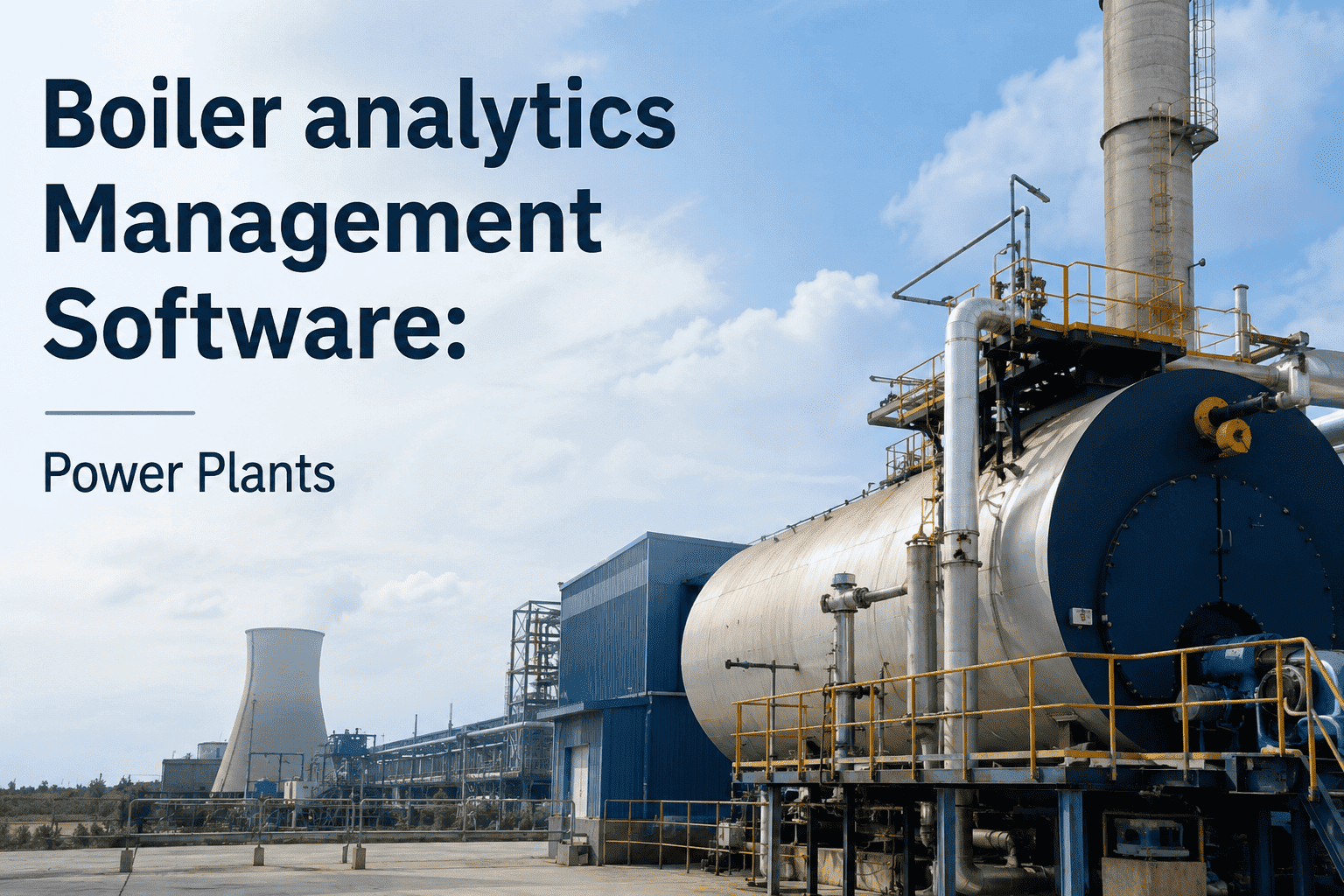
Every megawatt-hour a power plant generates creates two parallel records: an output record that goes to the grid and a byproduct record that goes into the atmosphere, the wastewater system, and the solid waste stream. For decades, the environmental side of that equation was managed by compliance teams working from EPA emissions reports and periodic stack tests — a retrospective, documentation-heavy process that told plant managers what had already happened their environmental footprint, not what was about to happen. The shift to AI-driven sustainability analytics changes the temporal orientation of that process entirely. Instead of reporting last quarter's emissions after the fact, properly configured analytics platform monitors equipment efficiency losses, fuel consumption deviations, and emissions rate trends in real time — identifying the maintenance conditions that drive unnecessary fuel burn and excess emissions before they accumulate into a compliance exceedance or a sustainability reporting gap.
For U.S. power plant operations leaders navigating an increasingly demanding environmental compliance landscape — EPA Clean Air Act permit conditions, state-level NOx and SO2 trading programs, voluntary carbon reporting commitments, and the emerging SEC climate disclosure requirements that will affect many generation asset owners — the value of sustainability analytics is not primarily about reporting convenience. It is about connecting equipment condition data to environmental performance data in a way that reveals which maintenance decisions, operating practices, and equipment degradation patterns are driving the largest share of the plant's avoidable environmental footprint. That connection is what turns sustainability from a compliance cost center into an operational optimization opportunity with measurable financial returns alongside the environmental ones.
Sustainable Analytics Guide 2026
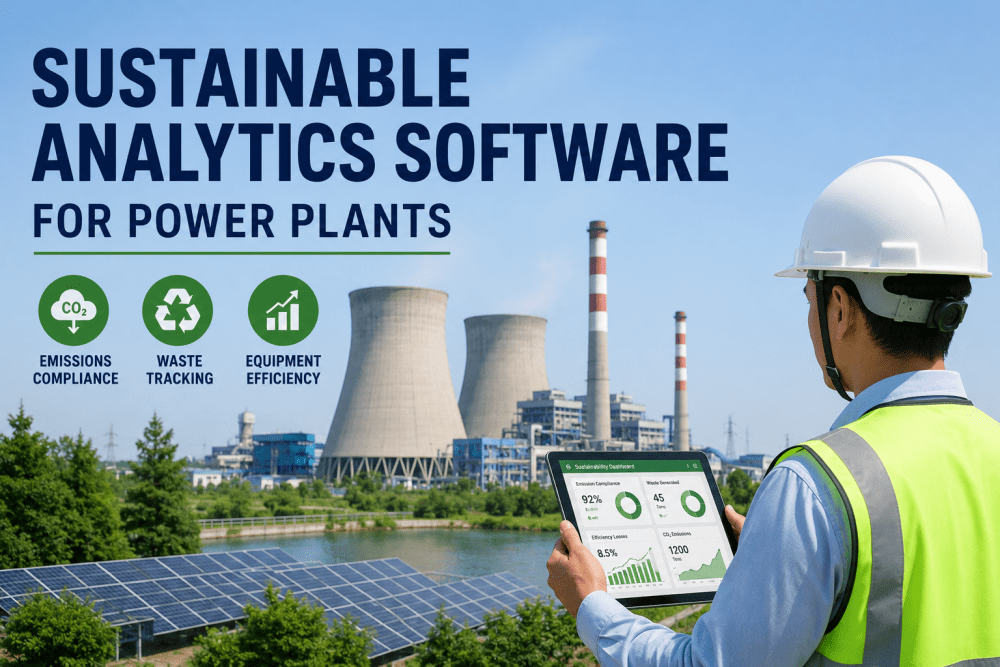
Sustainable Analytics Software for Power Plants
AI-driven emissions compliance tracking, equipment efficiency loss monitoring, and environmental footprint analytics — connecting maintenance decisions to environmental performance in real time.
Excess fuel burn attributable to degraded combustion and heat transfer efficiency at plants without real-time efficiency loss tracking
$2.4M
Average annual fuel cost attributable to recoverable efficiency losses at a 300 MW combined cycle plant
34%
Of EPA NOx permit exceedances traceable to equipment degradation conditions that were visible in sensor data before the exceedance occurred
60 days
Typical SEC climate disclosure preparation time reduction when AI-driven sustainability analytics are integrated with the plant's CMMS and historian
The Maintenance-Emissions Connection: Why Equipment Condition Drives Environmental Footprint
The most important insight that sustainability analytics delivers to power plant operations leaders is one that compliance teams rarely surface: a substantial fraction of a plant's avoidable emissions and fuel waste is not generated by operating decisions — it is generated by maintenance deferrals. Equipment degradation conditions that are already tracked in maintenance workflows have direct, quantifiable environmental consequences. Making those consequences visible in the analytics platform, alongside the maintenance action that resolves them, is what enables the maintenance team and the environmental team to work from the same set of priorities rather than from separate systems with no shared decision framework.
Combustion Degradation and NOx
Burner tip fouling, flame scanner drift, and combustion air system degradation increase NOx formation rates at conditions that are visible in DCS data weeks before they create permit issues. An analytics platform that correlates combustion parameter trends with NOx CEMS readings surfaces the maintenance action — burner cleaning or combustion tuning — alongside the emissions trajectory that justifies scheduling it before the permit condition is triggered.
Heat Transfer Degradation and Fuel Efficiency
HRSG fouling, condenser tube scaling, and heat exchanger degradation reduce thermal efficiency and increase fuel consumption per MWh generated. At a plant burning $28 to $42 per MMBtu of natural gas, a 2% efficiency reduction from fouling generates $800,000 to $1.4 million in annual excess fuel cost — and a proportional increase in CO2 emissions that is entirely attributable to deferred maintenance rather than to dispatch decisions.
Auxiliary Equipment Losses and Total Site Energy
Cooling tower fan degradation, BFP efficiency loss, compressed air system leakage, and HVAC inefficiencies in plant buildings collectively represent 2 to 4% of site energy consumption in a typical combined cycle plant. These losses are individually small but aggregated across a full year they represent significant fuel waste and emissions — and every one of them is a maintenance condition tracked in the CMMS that has a quantifiable environmental cost attached to it.
Regulatory Reporting Burden and Disclosure Risk
EPA Title V permit deviation reporting, state emissions trading program submissions, and emerging SEC climate disclosure requirements all draw on the same underlying plant data. When that data is fragmented across CEMS systems, process historians, and manually compiled spreadsheets, reporting preparation takes weeks and introduces transcription errors that create regulatory exposure. Integrated sustainability analytics reduces preparation time and eliminates the manual data assembly that generates compliance documentation errors.
Core Capabilities of AI-Driven Sustainability Analytics
A purpose-built sustainability analytics platform for power plants does not add a separate reporting layer on top of existing CMMS and historian systems — it integrates with them to connect equipment condition data, emissions monitoring data, and fuel consumption data into a single analytical environment. The capabilities below define what that integration enables across the four dimensions that matter most to power plant sustainability management.
Emissions Compliance Tracking — From CEMS Data to Permit Position in Real Time
The emissions compliance module ingests CEMS data for NOx, SO2, CO, CO2, and opacity — continuously calculating the plant's current permit utilization rate against Title V and state permit limits on hourly, daily, 30-day rolling, and annual accumulation bases. When the trajectory of current emissions rates places the plant on a path toward a permit limit within a configurable window, the platform generates an advance warning that identifies the specific equipment conditions contributing to the elevated emission rate and the maintenance actions available to address them before the permit threshold is crossed.
What Emissions Tracking Delivers
Real-time permit utilization tracking on all time horizons — hourly through annual — with trajectory projection
Advance warning when current emission rate trajectory will breach permit limit within configurable lead window
Emissions trading program position tracking — NOx and SO2 allowance balance updated in real time against current emissions rate
Automated deviation detection and reporting preparation for Title V excess emissions reports
Efficiency Loss Monitoring — Connecting Equipment Degradation to Fuel Waste and CO2
The efficiency loss module tracks the plant's actual heat rate against the design and baseline heat rate for current operating conditions — continuously quantifying the gap between actual and achievable fuel efficiency. The gap is then decomposed by contribution: HRSG fouling, condenser backpressure, gas turbine compressor fouling, steam turbine degradation, and auxiliary system losses are each assigned a quantified heat rate penalty and a corresponding annual fuel cost and CO2 impact. The result is a ranked list of maintenance investments prioritized by their efficiency and emissions return — not just by their equipment reliability value.
What Efficiency Loss Monitoring Delivers
Continuous heat rate gap calculation — actual vs. design and vs. baseline at current operating conditions
Efficiency loss decomposition by equipment — each degradation condition quantified in BTU/kWh and $/year fuel cost
CO2 impact calculation for each efficiency loss — translating maintenance deferrals into tons of avoidable CO2 per year
Maintenance ROI ranking — each corrective action scored on combined reliability, fuel cost, and emissions impact
Historical efficiency trend — recovery and degradation patterns across operating periods and outage cycles
Waste Analytics — Tracking Maintenance-Generated Waste Streams and Reduction Opportunities
Analytics activities generate waste streams that most plants track for compliance but rarely analyze for reduction opportunity: used oil from turbine and generator lubrication systems, spent filtration media, chemical treatment waste from water treatment and cooling systems, and hazardous waste from electrical equipment maintenance. The waste analytics module tracks waste generation by type, source equipment, and maintenance activity — identifying patterns that indicate abnormal waste generation rates, which are themselves indicators of equipment problems, over-treatment, or maintenance procedure inefficiencies that have both cost and environmental remediation implications.
What Waste Analytics Delivers
Waste generation tracking by type, source equipment, and maintenance work order — with trend and anomaly detection
Abnormal waste rate flagging — excess oil consumption linked to seal or bearing degradation rather than normal lubrication
Chemical treatment optimization — identifying over-treatment of cooling water and water injection systems that generates excess chemical waste
Waste disposal cost tracking — annual waste management spend by stream with reduction target modeling
Regulatory waste reporting support — RCRA and state hazardous waste program report preparation from integrated waste tracking records
Sustainability Reporting — From Plant Data to Board-Ready Disclosure in Hours, Not Weeks
The reporting module aggregates emissions data, efficiency performance data, and waste generation data into formatted sustainability reports aligned with the disclosure frameworks that generation asset owners increasingly face: EPA Title V annual reports, state emissions trading program submissions, GHG Protocol Scope 1 and Scope 2 reporting, voluntary carbon disclosure programs, and the SEC climate disclosure framework that applies to publicly reporting companies with material climate-related risks. The report preparation workflow reduces the data assembly and verification time from weeks of manual effort to hours of review of AI-assembled draft reports.
What Sustainability Reporting Delivers
EPA Title V annual compliance certification data package — automatically assembled from CEMS and permit tracking records
GHG Protocol Scope 1 CO2e calculation — combustion emissions quantified and formatted per GHG Protocol methodology
Scope 2 emissions from auxiliary power purchases tracked separately with location-based and market-based calculation methods
Carbon intensity metrics — CO2e per MWh generated, per MMBtu fuel consumed, and per operating hour at equipment level
Year-over-year performance comparison with variance attribution — separating dispatch-driven changes from equipment-driven changes
Want to see how sustainability analytics maps to your plant's specific permit conditions and efficiency loss profile? Book a 30-minute sustainability analytics assessment with iFactory's power generation team.
Sustainability Performance Benchmarks: What AI-Driven Analytics Delivers
The following table maps the primary sustainability performance dimensions tracked in AI-driven analytics platforms against their measurement baseline, the data sources used, and the typical performance improvement observed at U.S. power generation facilities after deploying integrated sustainability analytics against a pre-analytics baseline period.
Sustainability Dimension
Measurement Baseline
Data Sources Used
Typical Improvement
Primary Mechanism
NOx Emissions Rate
Annual average lb/MMBtu from CEMS — compared against permit limit and prior year baseline
CEMS NOx data, DCS combustion parameters, maintenance work order history
12–18% rate reduction
Earlier combustion tuning and burner maintenance triggered by NOx rate trending before permit limit trajectory develops
CO2 Intensity (Scope 1)
Tons CO2e per MWh net generation — separated into dispatch-driven and efficiency-driven components
Recovery of 8–14% efficiency loss from equipment degradation — primarily HRSG fouling, compressor fouling, and condenser backpressure
Heat Rate Gap from Baseline
BTU/kWh deviation from clean corrected heat rate at equivalent load and ambient conditions
Fuel flow, gross generation, DCS process parameters, ambient condition sensors
60–75% gap closure
Condition-based maintenance scheduling for HRSG, condenser, and compressor degradation timed to efficiency loss accumulation rate rather than calendar
Permit Exceedance Events
Count of Title V permit deviations requiring EPA notification per year — zero target
CEMS hourly data, permit limit database, emissions trading position, Title V permit conditions
Zero in deployed year
Advance trajectory warning generates maintenance action before permit limit is reached rather than after exceedance is detected
Maintenance Waste Generation
Annual pounds of regulated maintenance waste by stream — compared against benchmark per operating hour
CMMS waste disposal work orders, chemical treatment purchase records, oil analysis results
22–31% reduction
Abnormal waste rate flagging identifies equipment degradation driving excess oil consumption and chemical over-treatment before full waste stream accumulates
Sustainability Report Prep Time
Staff-hours required to prepare annual EPA, GHG Protocol, and voluntary disclosure reports
All emissions, fuel, generation, and waste data integrated in single platform — no manual cross-system assembly
65–75% time reduction
Automated data aggregation eliminates manual compilation from CEMS, historian, CMMS, and fuel records — staff time spent reviewing, not assembling
Connect Equipment Condition to Environmental Performance at Your Facility
iFactory's sustainability analytics team demonstrates emissions compliance tracking, efficiency loss quantification, and reporting automation against your plant's specific permit conditions and operating profile — typically within two weeks of historian connection.
What Sustainability Analytics Looks Like in Practice: Four Key Outcomes
The operational value of sustainability analytics is most clearly illustrated through the specific outcomes it generates — the decisions it enables that would not have been made, or would have been made later and at higher cost, without the integrated data picture the platform provides.
A
Maintenance Decisions Informed by Their Environmental Cost
When a reliability engineer reviews the CMMS work order queue, sustainability analytics adds an environmental cost dimension to each deferred maintenance item. A deferred HRSG offline water wash is not just a heat rate penalty — it is $180,000 in annual excess fuel cost and 4,200 tons of avoidable CO2. When the environmental consequence is quantified alongside the reliability consequence, the case for scheduling the maintenance is stronger and the prioritization decision is better informed. This is the primary mechanism by which sustainability analytics changes maintenance behavior without adding administrative burden to the maintenance team.
B
Permit Exceedances Prevented Rather Than Reported
The difference between a permit exceedance that generates an EPA notification and a compliance event that is prevented is almost always a matter of timing — whether the trajectory was visible early enough for a maintenance or operational intervention to change it. Sustainability analytics makes that trajectory visible 14 to 30 days in advance for NOx and CO permit conditions, giving the operations and maintenance team time to schedule combustion tuning, adjust dispatch, or request a permit operating limit review before the exceedance occurs. Plants deploying integrated emissions trajectory tracking consistently report zero permit exceedances in the first operating year following deployment.
C
Carbon Disclosure Prepared From Operational Records, Not Spreadsheets
SEC climate disclosure requirements and voluntary carbon reporting programs require GHG Protocol-formatted Scope 1 and Scope 2 emissions data with methodology documentation and year-over-year comparability. When that data must be manually assembled from CEMS reports, fuel delivery records, and generation metering spreadsheets, the preparation process typically requires three to five weeks of compliance staff time and introduces the transcription error risk that creates restatement exposure. Sustainability analytics platforms that maintain integrated records throughout the year reduce that preparation to a structured review of AI-assembled draft reports — typically reducing compliance report preparation time by 65 to 75%.
D
Sustainability Performance Separated From Dispatch Variability
One of the most analytically important capabilities of AI-driven sustainability reporting is the separation of equipment-driven environmental performance changes from dispatch-driven changes. A plant that increased its capacity factor by 20% in a reporting year will show higher absolute emissions — but if its CO2 intensity per MWh generated improved, the underlying equipment and maintenance performance improved. Conversely, a plant that reduced absolute emissions by running fewer hours may actually have worsened its efficiency-adjusted environmental performance. Sustainability analytics makes this distinction explicit, enabling plant managers and asset owners to communicate environmental performance accurately to regulators, investors, and ESG reporting counterparties.
Want to see how sustainability analytics maps to your plant's specific permit conditions and efficiency loss profile? Book a 30-minute sustainability analytics assessment with iFactory's power generation team.
Expert Review: What Environmental Compliance Leaders Say About Sustainability Analytics
"The most important thing I tell plant managers about sustainability analytics is that the environmental compliance problem and the efficiency problem are the same problem viewed from different angles. When a gas turbine's compressor section is fouled, it burns more fuel per MWh, it emits more CO2 per MWh, and it eventually runs hotter in ways that affect NOx formation. Those are three separate reporting obligations in three separate regulatory systems — but they are one maintenance action. The value of integrated sustainability analytics is that it makes that connection explicit and visible before any of those three consequences becomes a problem. The facilities I've worked with that deploy this approach stop treating environmental compliance as a documentation exercise and start treating it as operational intelligence. The reporting burden drops dramatically because the data is already assembled. But more importantly, the permit exceedance rate drops to zero because the trajectory is visible early enough to act on it. That is not a compliance achievement — it is a maintenance achievement that happens to eliminate the compliance exposure as a side effect."
— Senior Environmental Compliance and Sustainability Advisor — Power Generation Portfolio, U.S. Mid-Atlantic Region — 22 Years in Environmental Compliance and Plant Operations Interface
Zero
Title V permit exceedances in first operating year at deployed facilities with emissions trajectory tracking
$2.4M
Average annual fuel savings recovered from equipment efficiency loss correction at 300 MW combined cycle plants
70%
Reduction in compliance report preparation time from integrated sustainability analytics vs. manual cross-system assembly
Conclusion
Sustainability at a power plant is not a separate program that runs alongside operations — it is a dimension of operations that becomes visible when the right data connections exist. The plants that manage environmental performance most effectively are not the ones with the most comprehensive compliance reporting programs. They are the ones where equipment condition data, emissions monitoring data, and fuel efficiency data are connected in a single analytical environment — so that the maintenance team, the operations team, and the environmental compliance team are all working from the same picture of what the plant's environmental footprint is today, what is driving it, and what maintenance actions are available to improve it.
For U.S. power plant operations leaders, the business case for sustainability analytics has a financial dimension that often exceeds the compliance dimension. At a 300 MW combined cycle plant, recovering the 8 to 14 percent efficiency loss that accumulates from equipment degradation generates $1.4 to $2.4 million in annual fuel savings alongside the CO2 intensity improvement. Eliminating permit exceedance events eliminates the regulatory penalty and reputational exposure that a single Title V deviation creates. Reducing sustainability report preparation from five weeks to three days frees compliance staff for higher-value work. These are financial returns, not just environmental ones — and they are all generated from the same data connections that the analytics platform creates.
QDoes the platform connect to CEMS systems directly or does it require manual data entry of emissions data?
The platform connects directly to CEMS data via the plant DCS historian or dedicated CEMS data acquisition system — no manual data entry required for ongoing emissions tracking. The integration supports OPC-UA, PI API, and direct database connections to the major CEMS data acquisition systems used at U.S. power plants. For facilities where CEMS data is stored in a separate historian from process data, the platform's data integration layer bridges both systems, enabling the correlation between emissions rates and equipment operating parameters that is the foundation of emissions trajectory prediction. Historical CEMS data can be imported to establish the pre-analytics baseline against which current performance is measured — typically covering the prior two to three years of CEMS records to build a statistically meaningful performance baseline for permit utilization tracking and trend analysis.
QHow does the platform handle multi-unit facilities where permit conditions apply at the unit level and at the facility level simultaneously?
Multi-unit permit structures are a standard configuration in the platform's permit management module. Permit limits are configured at each applicable aggregation level — individual unit hourly limits, facility-wide daily and annual accumulation limits, and any combined unit limits that apply under the facility's Title V permit. The permit utilization calculation continuously tracks the current position at all configured levels simultaneously, and trajectory warnings are generated at the level where the constraint is most binding at any given time. For facilities with seasonal permit conditions — different summer and winter NOx limits under state ozone season programs, for example — the platform maintains seasonal permit profiles and transitions between them automatically. The permit configuration is reviewed and updated by iFactory's environmental compliance team when permit renewals or modifications change the applicable limits.
QCan the platform support both EPA-mandated reporting and voluntary sustainability disclosure programs simultaneously?
Yes. The reporting module maintains the plant's emissions and performance data in a format that supports simultaneous preparation of mandatory regulatory reports and voluntary disclosure program submissions from the same underlying data set. Mandatory reporting templates include EPA Title V annual compliance certifications, EPA GHGRP Subpart D (electricity generation) annual reports, state-specific emissions trading program submissions, and NPDES wastewater monitoring reports where applicable. Voluntary disclosure templates include GHG Protocol Scope 1 and Scope 2 calculation workbooks, CDP climate questionnaire response data packages, and SEC climate disclosure narrative support with quantitative data appendices formatted per the SEC's climate disclosure rule requirements. The platform does not replace legal and compliance review of these submissions — it eliminates the data assembly phase so that review starts from a complete draft rather than from blank templates and scattered source records.
QHow is the heat rate gap decomposed by equipment contribution if some efficiency losses cannot be directly measured?
The heat rate gap decomposition uses a combination of directly measured performance deviations and physics-based models for efficiency losses that cannot be directly instrumented. For major contributors — HRSG approach temperature degradation, condenser backpressure deviation, gas turbine compressor efficiency index — the measured deviation from the clean corrected performance baseline provides a directly calculated heat rate penalty. For auxiliary system losses that are not individually metered — cooling tower fan efficiency, BFP performance, compressed air system leakage — the platform uses equipment-specific performance models calibrated against periodic measurements and normalized operating data to estimate the efficiency contribution. The decomposition is presented with confidence classifications that distinguish directly measured contributions from modeled estimates, so plant engineers can evaluate both the total efficiency gap and the reliability of each contributing component's quantification. Over time, as the platform's performance models are calibrated against actual plant measurements, the modeled contributions converge toward directly calculated values.
QWhat does sustainability analytics cost and what is the typical payback period at a combined cycle facility?
iFactory's sustainability analytics module is available as a standalone capability or as part of the full plant analytics platform. For a 200–400 MW combined cycle facility, the annual subscription for the sustainability analytics module — covering emissions compliance tracking, efficiency loss monitoring, waste analytics, and reporting automation — typically ranges from $18,000 to $28,000. Implementation services for CEMS integration, permit configuration, GHG baseline establishment, and reporting template setup run $6,000 to $12,000 as a one-time cost. The payback calculation is dominated by the efficiency recovery value: at $2.4 million average annual fuel savings from closing the heat rate gap at a 300 MW combined cycle plant, the full platform cost is recovered in less than two weeks of efficiency-adjusted fuel savings in the first year. For facilities where the primary value driver is permit exceedance avoidance rather than efficiency recovery, a single prevented Title V exceedance — which typically generates $25,000 to $100,000 in regulatory penalties plus compliance and legal costs — recovers the full annual subscription cost from a single event. Contact iFactory for a site-specific ROI estimate based on your plant's current heat rate gap and permit utilization profile.
AI-Driven Sustainability Analytics for Power Plants
From emissions compliance trajectory tracking to efficiency loss quantification and GHG Protocol reporting, iFactory connects your plant's equipment condition data to its environmental performance picture — delivering financial returns alongside the environmental ones.