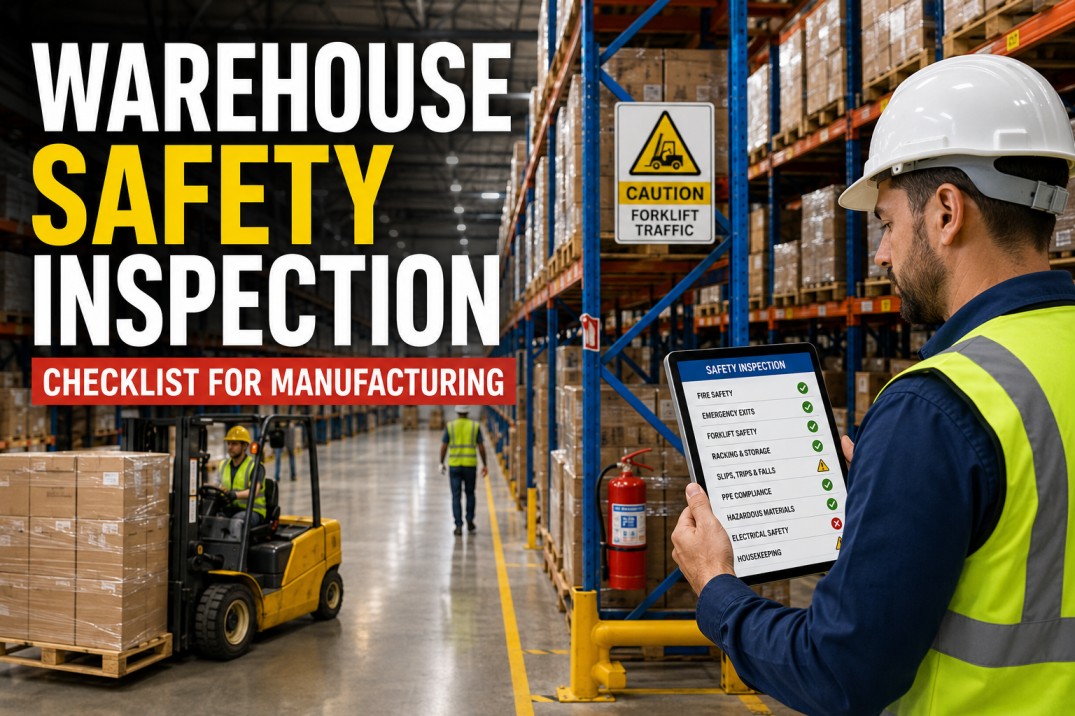
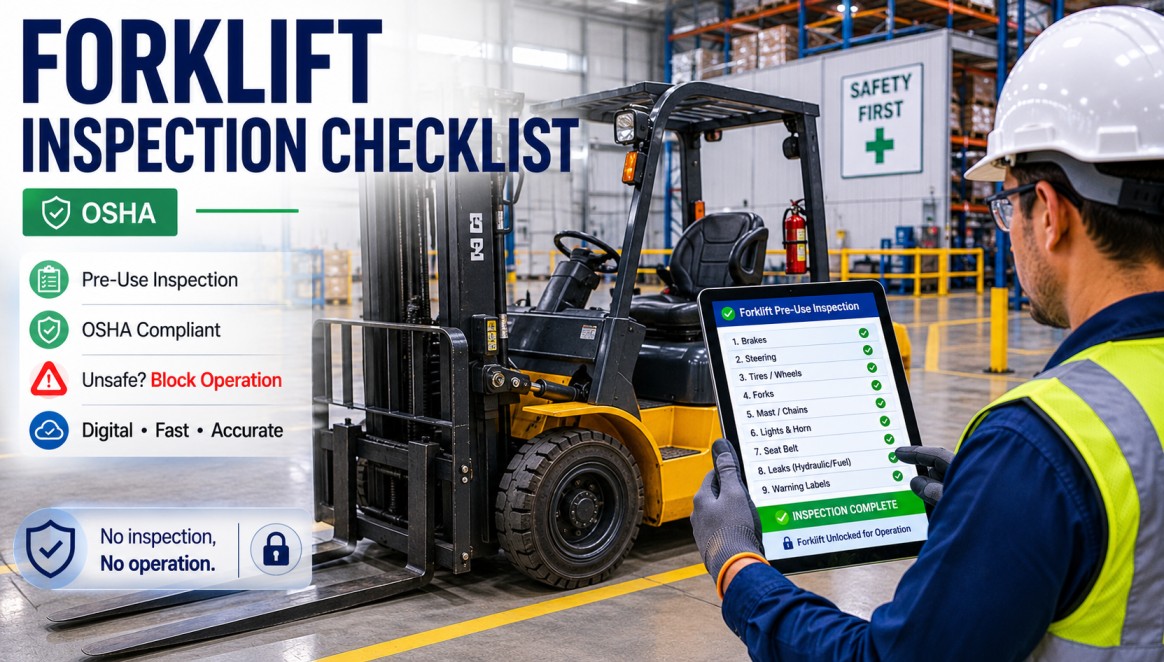
OSHA compliance in manufacturing is not a once-a-year audit exercise — it is the daily maintenance of safe working conditions across every shift, every machine, and every task. OSHA citations in manufacturing cluster around the same hazard categories year after year: machine guarding, lockout/tagout, electrical safety.
Log Hazards, Assign Fixes, Close Findings — All From the Plant Floor
iFactory digitizes your OSHA safety inspection workflow — photo-backed hazard logging, corrective action assignment, and completion tracking — so nothing falls through the cracks between a safety walkthrough and resolution. Book a demo to see it on your facility.
Machine Guarding
Machine guarding violations are the most frequently cited category in OSHA manufacturing inspections. Point-of-operation guards, nip-point guards, and rotating-part guards are all required wherever employees can contact moving machine parts.
Point-of-Operation Guarding
Point-of-operation guards required wherever hands or fingers can reach the danger zone. Guards must be secured and not removable without tools.
Rotating Parts & Nip Points
All rotating parts — shafts, gears, pulleys, belt drives — guarded throughout full range of motion. Nip points require barrier guards preventing any employee contact.
Mechanical Power Presses
Guards or presence-sensing devices installed and functional on all power presses. Two-hand controls required where applicable. Inspection records current.
Mechanical Power-Transmission
All power-transmission components — flywheels, belts, chains, sprockets — fully guarded with metal or substantial material. No improvised guards acceptable.
Guard Condition & Bypass
No guards removed, defeated, or bypassed during production. Guards must be undamaged, secured, and unmodified. Observed workarounds are citable violations.
Flying Chips & Sparks
Flying debris machines require shields protecting both operator and nearby workers. Eye and face protection required where shields are insufficient.
Lockout / Tagout (LOTO)
Lockout/tagout violations are consistently in OSHA's top-five most-cited standards, and the consequences of LOTO failures are severe — amputations, crush injuries, and fatalities are the predictable outcomes when energy is not controlled before maintenance or service work begins. OSHA's standard at 29 CFR 1910.
A documented energy control program must cover the scope of the program, rules for protecting employees, the specific techniques for controlling hazardous energy, and enforcement procedures. The program must be reviewed and updated whenever equipment, processes, or procedures change.
Individual energy control procedures must exist for every piece of equipment with unique lockout requirements, identifying each energy source and the specific method to isolate and verify zero energy. Procedures must be posted at or near the equipment and kept current for its actual configuration.
All employees who perform lockout/tagout must be trained and documented as authorized employees. Employees who work in areas where energy control is used — affected employees — must understand why they cannot restart or re-energize equipment that carries a personal lock or tag.
Adequate lockout devices — personal locks assigned to and exclusively controlled by specific authorized employees — must be available at each machine requiring lockout. All devices must be uniquely identified to the individual, substantial enough to prevent removal without force, and used for no other purpose.
Annual audits of LOTO procedures must be conducted by an authorized employee other than the one who routinely uses the procedure. The audit must generate a certification record identifying the machine, the date, the employees involved in the audit, and the name of the auditor.
The five areas above — machine guarding, LOTO, electrical safety, walking-working surfaces, and PPE — account for the majority of OSHA citations in manufacturing facilities every year. Organizations that receive clean OSHA inspections conduct regular internal safety audits, correct findings promptly with documented corrective actions, and.
OSHA Safety Inspection Checklist — 25 Items
Use this checklist during manufacturing safety inspections. Each row maps to an OSHA standard with evidence type and criticality.
| # | Checklist Item | Type | Priority | Photo | Required | Critical |
|---|---|---|---|---|---|---|
| 1 | Point-of-operation guards in place — prevent hands entering danger zone during operation | Pass/Fail | High | ✓ | ✓ | ✓ |
| 2 | All rotating parts (shafts, gears, pulleys, belts) guarded throughout full range of motion | Pass/Fail | High | ✓ | ✓ | ✓ |
| 3 | Power press guards or presence-sensing devices installed and functional | Pass/Fail | High | ✓ | ✓ | ✓ |
| 4 | No guards removed, defeated, or bypassed during production — no employee workarounds observed | Pass/Fail | High | ✓ | ✓ | ✓ |
| 5 | Guards constructed of metal or substantial material — no improvised guards | Pass/Fail | High | ✓ | ✓ | — |
| 6 | Flying debris machines have shields protecting operator and nearby workers | Pass/Fail | Med | ✓ | ✓ | — |
| # | Checklist Item | Type | Priority | Photo | Required | Critical |
|---|---|---|---|---|---|---|
| 1 | Written LOTO energy control program documented and available to all affected employees | Pass/Fail | High | — | ✓ | ✓ |
| 2 | Machine-specific LOTO procedures posted at each piece of equipment requiring lockout | Pass/Fail | High | ✓ | ✓ | ✓ |
| 3 | Authorized employees trained — affected employees understand LOTO procedures | Pass/Fail | High | — | ✓ | ✓ |
| 4 | Personal lockout devices available at each machine — identifiable to individual employee | Pass/Fail | High | ✓ | ✓ | ✓ |
| 5 | Annual LOTO audit conducted — certification record on file with date and employees involved | Pass/Fail | High | — | ✓ | ✓ |
| # | Checklist Item | Type | Priority | Photo | Required | Critical |
|---|---|---|---|---|---|---|
| 1 | Floors and aisles clean, dry, and free of tripping hazards — aisle widths marked | Pass/Fail | High | ✓ | ✓ | — |
| 2 | Standard guardrails (42" top rail, 21" mid-rail, 4" toeboard) on all open sides ≥ 4 ft | Pass/Fail | High | ✓ | ✓ | ✓ |
| 3 | Fixed ladders — rungs spaced 12", side rails extend 42" above landing, cage above 24 ft | Pass/Fail | High | ✓ | ✓ | ✓ |
| 4 | Portable ladders rated for load — set at 4:1 angle, secured at top when used for access | Pass/Fail | Med | ✓ | ✓ | — |
| 5 | Loading dock edge protection or guardrails in place — dock levelers maintained | Pass/Fail | Med | ✓ | ✓ | — |
| # | Checklist Item | Type | Priority | Photo | Required | Critical |
|---|---|---|---|---|---|---|
| 1 | Written PPE hazard assessment completed and certified for each work area | Pass/Fail | High | — | ✓ | ✓ |
| 2 | Safety glasses or face shields worn in all areas with debris, chemical, or radiation hazards | Pass/Fail | High | ✓ | ✓ | ✓ |
| 3 | Hearing protection required and worn above 90 dBA — hearing conservation program active above 85 dBA | Pass/Fail | High | ✓ | ✓ | ✓ |
| 4 | Respiratory protection — medical evaluation, fit testing, and training documented before use | Pass/Fail | High | — | ✓ | ✓ |
| 5 | PPE training records current — employees trained on selection, use, and limitations | Pass/Fail | Med | — | ✓ | — |
| # | Checklist Item | Type | Priority | Photo | Required | Critical |
|---|---|---|---|---|---|---|
| 1 | SDS available for every hazardous chemical — accessible to employees during all shifts | Pass/Fail | High | — | ✓ | ✓ |
| 2 | All containers labeled with product identifier, GHS pictograms, signal word, and hazard statements | Pass/Fail | High | ✓ | ✓ | ✓ |
| 3 | No unlabeled secondary containers — all labels legible and undamaged | Pass/Fail | High | ✓ | ✓ | ✓ |
| 4 | HazCom training conducted at initial assignment and when new chemicals introduced | Pass/Fail | Med | — | ✓ | — |
Frequently Asked Questions
How much notice does OSHA give before a manufacturing inspection?
Book a Demo to see iFactory in action.
What are the most commonly cited OSHA violations in manufacturing?
The most consistently cited OSHA standards in general industry manufacturing include: fall protection (1926.501 in construction; 1910.28 in general industry), hazard communication (1910.1200), respiratory protection (1910.134), lockout/tagout (1910.147), powered industrial trucks (1910.178), ladders (1910.23), machine guarding (1910.212), personal protective equipment (1910.
What is the OSHA General Duty Clause and when does it apply?
Section 5(a)(1) of the OSH Act — the General Duty Clause — requires employers to provide a workplace free from recognized hazards that are causing or likely to cause death or serious physical harm, even when no specific OSHA standard addresses the hazard.
Run Consistent Safety Inspections Across Every Shift and Area
Book a Demo — iFactory gives your safety team a structured digital inspection workflow — hazard logging with photo evidence, automatic corrective action assignment, completion tracking, and trend reporting — so your facility maintains a defensible safety record every day. Book a 30-minute demo and we will walk through your safety inspection process.