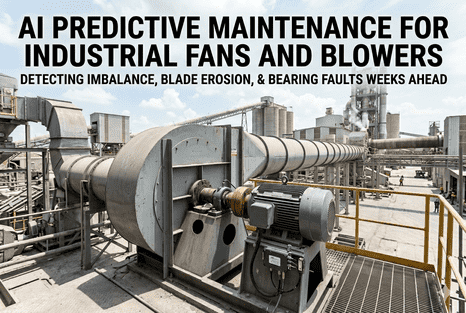
AI Predictive Maintenance for Industrial Fans and Blowers
By Rebecca on June 7, 2026
In thermal power plants, cement kilns, steel mills, and chemical processing facilities, unplanned failures of industrial fans and blowers — including induced draft (ID) fans, forced draft (FD) fans, primary air (PA) fans, and process blowers — rank among the top causes of unplanned production stoppages. A single ID fan failure at a 500 MW coal-fired power plant can cost upwards of $200,000 per day in lost generation and emergency repair logistics. Traditional time-based fan maintenance schedules cannot address the variable operating conditions — flue gas temperatures ranging from 150°C to 350°C, fly ash particulate erosion, corrosive atmospheres from combustion byproducts, and vibration excursions during start-up and load changes — that accelerate impeller wear, bearing degradation, rotor imbalance, and shaft misalignment. iFactory's predictive maintenance platform fuses IoT vibration sensors, bearing temperature probes, motor current signature analysis, and oil analysis data into machine learning models that forecast fan bearing failure, blade erosion, rotor imbalance, and resonance conditions 2-4 weeks in advance, enabling maintenance teams to act before catastrophic failure occurs. Book a Demo to see how iFactory connects your fan and blower telemetry to predictive intelligence.
Predictive Maintenance · Power & Cement 2026
AI Predictive Maintenance for Industrial Fans and Blowers
ID fan & FD fan bearing prediction · PA fan blade erosion monitoring · Centrifugal fan imbalance detection · Process blower vibration surveillance · All flowing into iFactory CMMS & Shift Logbook.
Why Reactive Maintenance Fails in Harsh Fan Operating Environments
Industrial fans and blowers operate under conditions that accelerate wear beyond what scheduled maintenance intervals can predict. ID fans extract combustion gases laden with fly ash and corrosive sulphur compounds at temperatures exceeding 250°C, while FD fans deliver ambient air to the furnace through ducts that accumulate dust and moisture. PA fans in cement plants handle preheated air through coal mills where dust concentrations saturate the air stream, and process blowers in steel mills transport abrasive materials that erode impeller surfaces. Fixed-interval maintenance replaces components based on calendar time or operating hours rather than actual condition — meaning bearings are replaced prematurely (wasting service life) or too late (causing unplanned rotor seizure). iFactory's condition-based approach replaces the calendar with sensor-driven prediction tailored to each fan's actual duty cycle and environment.
LIMITATIONS OF TIME-BASED MAINTENANCE FOR FANS
1
Variable operating conditions ignored — same maintenance interval applied regardless of flue gas temperature, particulate loading, or start-up cycles
2
Sensor-blind to early-stage faults — vibration, bearing temperature, and blade condition remain unmonitored between quarterly shutdown inspections
3
Remote site logistics delays — specialist fan repair teams and replacement rotors must travel hours to remote power and cement plant sites after failure
4
No failure trend visibility — maintenance decisions based on last failure rather than fleet-wide fan degradation patterns across multiple units
Three Fan and Blower Failure Categories iFactory Predicts
01
ID Fan and FD Fan Bearing and Rotor Failure Prediction
ID and FD fans in thermal power plants and cement kilns handle flue gases at 150–350°C with suspended particulate matter that erodes blades and accelerates bearing wear. Rotor imbalance from uneven blade erosion, bearing degradation from high-temperature grease breakdown, and shaft misalignment from thermal expansion of ductwork connections are the dominant failure modes. Each unplanned ID fan failure at a 500 MW unit costs $200,000+ per day in lost generation and emergency repairs. iFactory ingests vibration sensor data, bearing RTD temperature trends, motor current draw, and flue gas temperature to train ML models that predict bearing and rotor failures 2–4 weeks in advance with 70–80% accuracy. Plants running these systems report 15–20% reductions in unplanned fan-related downtime. Book a Demo to see iFactory's fan prediction models in production.
2-4 week lead time70-80% accuracy15-20% downtime reduction
02
PA Fan and Process Blower Blade Erosion Detection
Primary air fans and process blowers operate in the most abrasive industrial environments — delivering preheated air through coal mills where fly ash concentration can exceed 50 g/Nm³, or transporting cement raw meal and clinker dust in material handling systems. Blade erosion is the primary failure mechanism, causing progressive imbalance that accelerates bearing wear and eventually leads to blade liberation, which can penetrate the fan casing with catastrophic consequences. iFactory monitors vibration amplitude trends at blade pass frequency, motor current harmonics, and casing vibration to detect erosion patterns 3–4 weeks before imbalance reaches critical thresholds. The Shift Logbook captures inspection findings alongside sensor data to build increasingly accurate erosion prediction models.
Centrifugal Fan Imbalance and Misalignment Forecasting
Centrifugal fans used for induced draft, forced draft, and process air applications are susceptible to imbalance from uneven dust buildup on impeller blades, asymmetric erosion, or material deposits that accumulate during operation. Misalignment develops from thermal expansion of connected ductwork, foundation settling, or coupling wear over extended operating periods. These conditions produce distinct vibration signatures — imbalance elevates 1X running speed vibration, misalignment elevates 2X vibration — that iFactory's ML models learn to recognise and separate from background noise. While prediction accuracy in centrifugal fan applications with variable duty cycles ranges from 50–70%, the platform's continuous learning loop improves precision as more operating and failure data accumulates.
Ensemble ML modelsContinuous learning loopShift Logbook correlation
How iFactory Transforms Fan Telemetry Into Predictive Intelligence
iFactory is the AI software intelligence layer — not a sensor manufacturer or hardware vendor. The platform integrates with existing fan telemetry from PLCs, SCADA (Rockwell, Siemens, Wonderware), ERP (SAP, Oracle), vibration sensors, bearing RTD probes, motor current transducers, thermal cameras, and oil analysis labs already deployed on your fan systems. The Shift Logbook captures operator shift reports, daily inspection findings, vibration reading trends, and maintenance notes alongside the real-time sensor stream, creating a unified data fabric for predictive model training and fleet-wide fan reliability analysis.
Asset Class
Telemetry Sources
iFactory Prediction Output
Business Impact
ID / FD Fans
Vibration · bearing RTD · motor current · flue gas temp
Bearing & rotor failure forecast · RUL estimate
$200K+ per prevented failure
PA Fans
Vibration · air flow · motor amps · blade pass frequency
Blade erosion alert · imbalance risk score
Extended fan overhaul intervals
Centrifugal Fans
Vibration · shaft position · oil analysis · thermal imaging
Imbalance & misalignment prediction
Reduced emergency maintenance logistics
Process Blowers
Oil analysis · bearing temp · belt tension · vibration
Bearing & belt failure prediction
Fewer unplanned process outages
Predictive Maintenance Use Cases for Industrial Fans and Blowers
Power Generation
ID Fan & FD Fan Bearing Condition Monitoring
Continuous
ID and FD fans are critical rotating equipment in thermal power plants where unplanned failure directly impacts generation revenue. iFactory monitors bearing temperature, casing vibration, and motor current draw continuously. ML models trained on historical failure patterns predict bearing degradation and rotor imbalance 2–4 weeks in advance. Predicted failures include a confidence score and recommended intervention window — plant engineers schedule fan overhauls during low-demand periods or planned outages, avoiding forced derates or emergency shutdowns that cost $200,000+ per day. Every prediction event is logged in iFactory's Shift Logbook with full traceability to the sensor data that triggered the alert.
Primary air fans in cement plants deliver preheated air to the coal mill and kiln burner system, handling dust-laden air that erodes impeller blades asymmetrically. iFactory detects early-stage erosion patterns through blade pass frequency vibration analysis and motor current signature monitoring. The platform pinpoints the specific fan and impeller requiring inspection, enabling targeted blade repair or replacement weeks before imbalance leads to secondary bearing damage or blade liberation. Alerts route directly to the maintenance shift in the Shift Logbook with fan location metadata, severity score, and recommended inspection scope.
Centrifugal Fan & Process Blower Health Surveillance
Continuous
Centrifugal fans and process blowers serve material transport, aeration, and ventilation systems across cement, power, steel, and chemical plants. These fans face variable operating conditions — different load points, damper positions, and ambient temperatures throughout the day — producing noisy vibration data that challenges conventional threshold-based monitoring. iFactory applies ensemble ML models with a continuous learning loop that improves prediction precision for imbalance, misalignment, and bearing fault detection as more operating data accumulates. The Shift Logbook captures operator-reported anomalies alongside sensor data to build richer training corpora for variable-duty-cycle fan equipment.
What iFactory Delivers for Fan and Blower Reliability
70-80%
Fan bearing failure prediction accuracy
2-4 week advance warning vs catastrophic breakdown
15-20%
Reduction in unplanned fan downtime
Planned intervention replaces emergency response
30%
Fewer fan-related unplanned stoppages
Blade erosion · bearing · imbalance monitoring
$200K+
Prevented loss per ID fan failure avoided
Generation + logistics + repair savings
FAQ
iFactory is the AI software intelligence layer — not a sensor manufacturer or hardware vendor. The platform integrates with vibration sensors, bearing RTD probes, motor current transducers, thermal cameras, PLCs, SCADA (Rockwell, Siemens, Wonderware), ERP (SAP, Oracle), and IoT gateways already deployed on your fan systems. Your site selects the sensor and telemetry hardware; iFactory turns the data into predictive intelligence, maintenance alerts, and shift-ready work orders.
Model tuning typically requires 6–12 months of operation on a specific fan fleet to eliminate false positives from variable-load conditions, tune threshold parameters for blade pass frequency monitoring, and build maintenance team confidence. The platform's continuous learning loop improves precision over time as more operating data and failure events accumulate across different fan types and operating conditions. iFactory recommends starting with one fan type and one failure mode — such as ID fan bearing prediction — proving value before expanding to the full fan fleet.
Yes. iFactory connects to SAP, Oracle, JDE, Microsoft Dynamics, and major CMMS platforms. The Shift Logbook captures operator defect reports, shift handover notes, and maintenance actions alongside sensor-generated predictions. Every prediction event, sensor reading, and maintenance action is recorded with full traceability for audit, compliance, and continuous model improvement — enabling your team to move from reactive fan repairs to data-driven reliability.
Deploy iFactory for Fan and Blower Predictive Maintenance
AI-powered predictive maintenance platform connecting ID fans, FD fans, PA fans, centrifugal fans, and process blower telemetry into one unified intelligence layer — with ML-based failure prediction, Shift Logbook integration, CMMS workflow automation, and plant-wide fan reliability analytics.