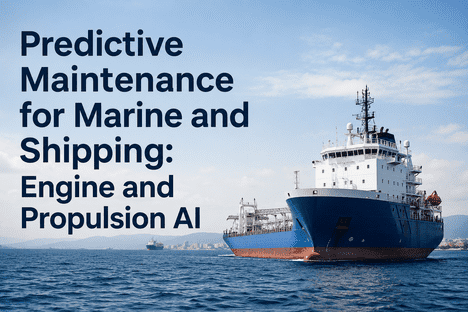
Predictive Maintenance for Marine and Shipping: Engine and Propulsion AI
By Rebecca on June 6, 2026
Main engines, turbochargers, auxiliary generators, and propulsion systems form the mechanical backbone of maritime operations — yet unplanned failures in these assets remain the primary cause of at-sea breakdowns, port arrival delays, and costly emergency towage across commercial shipping, offshore, and naval fleets. Traditional planned maintenance schedules based on running hours cannot account for the variable load profiles introduced by slow-steaming, fuel quality variation, and dynamic weather routing that define modern maritime operations. iFactory's predictive maintenance platform ingests engine cylinder pressure, turbocharger vibration, fuel oil temperature, lube oil debris, and shaft line telemetry into machine learning models that forecast cylinder liner wear, turbocharger bearing degradation, fuel injector fouling, and stern tube bearing failure weeks before breakdown — enabling marine engineers to shift from reactive repair to condition-based intervention. Book a Demo to see how iFactory connects your vessel telemetry to predictive intelligence.
Predictive Maintenance · Marine & Shipping 2026
Predictive Maintenance for Marine Engine & Propulsion Reliability
Main engine cylinder & turbocharger monitoring · Generator & auxiliary wear prediction · Propulsion shaft & stern tube bearing condition · All flowing into iFactory CMMS & Shift Logbook.
Why Running-Hour Maintenance Falls Short in Modern Maritime Operations
Commercial vessels today face operating profiles that change by the voyage — slow-steaming at 40-60% load for fuel efficiency, followed by full-power transits to meet berth windows, while fuel quality varies across bunkering ports and weather routing forces continuous load adjustments. Fixed-interval maintenance based on running hours assumes steady-state degradation that no longer reflects actual engine wear patterns. iFactory replaces running-hour schedules with continuous condition monitoring — ingesting data from engine control systems, turbocharger vibration pickups, lube oil debris sensors, fuel oil temperature and pressure transducers, and shaft line proximity probes to detect cylinder liner wear, turbocharger bearing degradation, and fuel injector fouling before they escalate into at-sea breakdowns.
LIMITATIONS OF RUNNING-HOUR MARINE MAINTENANCE
1
Load-variable wear ignored — slow-steaming and full-power transits create accelerated wear patterns that running-hour schedules cannot capture
2
No real-time debris detection — lube oil and fuel system degradation develops between scheduled oil analysis intervals undetected
3
Fixed intervals regardless of fuel quality — same inspection schedule applied regardless of bunkered fuel sulphur, viscosity, or catalytic fines content
4
No fleet-wide trend visibility — cross-vessel engine degradation patterns invisible when each ship is maintained in isolation
Three Marine Asset Categories iFactory Predicts and Prevents
Main engine failures rank among the highest-cost events in maritime operations — each catastrophic cylinder or turbocharger failure can exceed $500,000 in emergency repair costs plus lost charter revenue from extended off-hire periods. iFactory integrates cylinder pressure curves, exhaust gas temperatures per cylinder, turbocharger bearing vibration envelope, fuel oil inlet temperature and pressure, lube oil debris concentration, and scavenge air temperature into ensemble ML models. The platform classifies engine health into four states — healthy, moderately stressed, highly stressed, critical — enabling marine engineers to prioritise interventions before cylinder liner scuffing, turbocharger bearing seizure, or fuel injector nozzle fouling causes at-sea breakdown. Sites using similar AI-driven marine engine monitoring report 30% fewer unplanned main engine outages and 22% lower maintenance costs. Book a Demo to see iFactory's marine engine prediction models in production.
Auxiliary generators and marine boilers in commercial vessels operate under continuous variable loading driven by hotel loads, cargo refrigeration, and ballast pump demand. iFactory monitors generator winding temperature, bearing vibration, fuel injection pressure, alternator output stability, and lube oil condition alongside boiler tube wall temperature, burner modulation frequency, and flue gas O₂/CO₂. The Shift Logbook captures chief engineer rounds, fuel bunkering records, and maintenance logs alongside sensor data — creating a unified asset health record that feeds remaining useful life (RUL) estimates for each generator and boiler assembly. Predicted failures trigger work order generation in iFactory with recommended intervention windows aligned to scheduled port calls.
Propulsion shaft lines and stern tube bearings form the critical interface between engine power and vessel propulsion — failures here strand vessels for extended dry-docking periods costing $100,000+ per day in lost revenue. iFactory ingests shaft line proximity probe data, stern tube bearing temperature and wear rate, thrust bearing axial displacement, controllable pitch propeller (CPP) hydraulic pressure and response time, and shaft power telemetry into degradation models based on classification society guidelines. The platform identifies propulsion assets operating in degraded states — flagging bearings requiring replacement, CPP systems needing hydraulic overhaul, and shaft lines approaching alignment correction thresholds before failure causes propulsion loss. Every alert is logged in iFactory with full traceability to the sensor data that triggered the prediction.
How iFactory Transforms Vessel Telemetry Into Predictive Intelligence
iFactory is the AI software intelligence layer — not a sensor manufacturer or hardware vendor. The platform integrates with existing vessel automation systems (Kongsberg K-Chief, Wärtsilä UNIC, Siemens SISHIP, ABB Marine & Ports, MAN CEON), engine control systems (MAN B&W, Wärtsilä, Caterpillar / MaK, Rolls-Royce / Bergen), turbocharger control units, lube oil debris sensors, vibration monitoring systems, and ERP (SAP, Oracle). The Shift Logbook captures chief engineer shift reports, oil analysis results, fuel bunkering records, and maintenance logs alongside the sensor stream — creating a unified data fabric for predictive model training across your entire vessel fleet.
Predictive Maintenance Use Cases in Marine & Shipping Operations
Engines
Main Engine Cylinder, Turbocharger & Fuel Injection Health Monitoring
Continuous
iFactory fuses main engine cylinder pressure curves, exhaust gas temperatures per cylinder, turbocharger bearing vibration velocity and acceleration envelopes, fuel oil temperature and pressure trends, and lube oil debris concentration into a single engine health model. The stacked ensemble classifier assigns a health score — healthy, moderately stressed, highly stressed, or critical — based on multi-dimensional feature fusion. Engines flagged as critical trigger automated alerts in the Shift Logbook with recommended actions, RUL estimates, and links to historical fault records. Marine engineers schedule interventions based on actual condition rather than running-hour intervals.
Auxiliary generators on commercial vessels face continuous variable loading from hotel services, cargo systems, and ballast operations. iFactory monitors winding temperature rise above ambient, bearing vibration envelope, fuel injection pressure stability, alternator output voltage and frequency regulation, and lube oil condition trends. The ensemble ML model predicts remaining useful life for each generator winding, bearing set, and fuel injection system. Predicted end-of-life triggers work order generation in iFactory with intervention window recommendations aligned to scheduled port calls and bunkering stops — minimising operational disruption.
Propulsion shaft lines and stern tube bearings require continuous monitoring to prevent catastrophic propulsion loss at sea. iFactory ingests shaft proximity probe measurements, stern tube bearing temperature and wear debris trends, thrust bearing axial displacement, CPP hydraulic system pressure and blade response time, and shaft power / torque telemetry into degradation models aligned with classification society rules (DNV, Lloyd's, ABS). The platform generates per-asset health scores — flagging bearings approaching replacement thresholds, CPP systems requiring hydraulic overhaul, and shaft lines needing alignment correction. Every forecast event is logged in iFactory with full traceability to the sensor data that triggered the prediction.
What iFactory Delivers for Marine & Shipping Reliability
30%
Fewer unplanned main engine outages
AI-driven engine & turbocharger prediction
22%
Lower marine maintenance costs
Condition-based vs running-hour scheduling
4 States
Health classification per engine asset
Healthy · stressed · high · critical
RUL
Remaining useful life for engines & generators
Port-aligned replacement scheduling
FAQ
iFactory is the AI software intelligence layer — not a sensor manufacturer or hardware vendor. The platform integrates with existing vessel automation systems (Kongsberg, Wärtsilä, Siemens, ABB), engine control units (MAN, Wärtsilä, Caterpillar / MaK), turbocharger controllers, lube oil debris sensors, and vibration monitoring systems already installed across your fleet. For older vessels without factory-fitted sensors, standard retrofit kits for cylinder pressure monitoring, turbocharger vibration, and lube oil debris detection are available at minimal cost per engine. Your technical team selects the monitoring hardware; iFactory turns the data into predictive intelligence, health scores, RUL estimates, and maintenance work orders.
iFactory integrates with Modbus RTU/TCP (engine sensors and controllers), OPC UA (vessel automation), NMEA 2000 (navigation and bridge systems), CAN bus (engine control units), and REST APIs (modern vessel analytics platforms). For satellite and shore-side data transfer, iFactory supports VSAT and 4G/5G connectivity with configurable data compression to minimise bandwidth costs. The platform normalises data from multi-vendor engine types, automation systems, and ancillary sensors into a unified asset health model — eliminating the integration overhead of managing disparate vessel monitoring systems.
Yes. iFactory connects to major planned maintenance systems including DNV Nauticus, Lloyd's Register Fleet Manager, ABS MyFreedom, and standard PMS platforms. The Shift Logbook captures chief engineer round reports, oil analysis results, fuel bunkering records, and maintenance logs alongside sensor-generated predictions. Every prediction event, sensor reading, and maintenance action is recorded with full traceability for audit, class society surveys, and continuous model improvement across the vessel fleet.
Deploy iFactory for Marine Predictive Maintenance
AI-powered predictive maintenance platform connecting main engine cylinder monitoring, turbocharger bearing health, generator winding degradation, and propulsion shaft line telemetry into one unified intelligence layer — with ML-based failure prediction, Shift Logbook integration, PMS workflow automation, and fleet-wide marine reliability analytics.