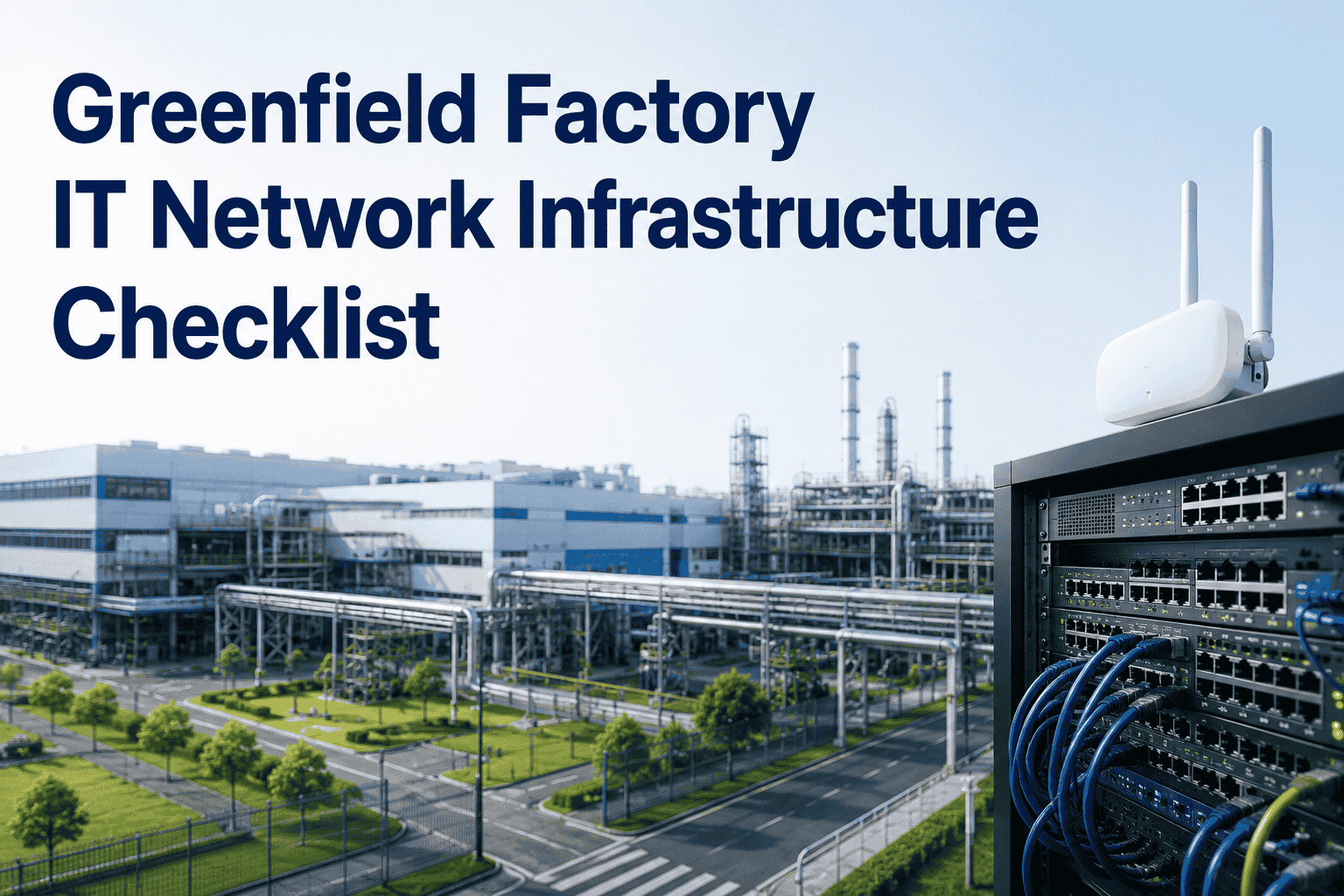
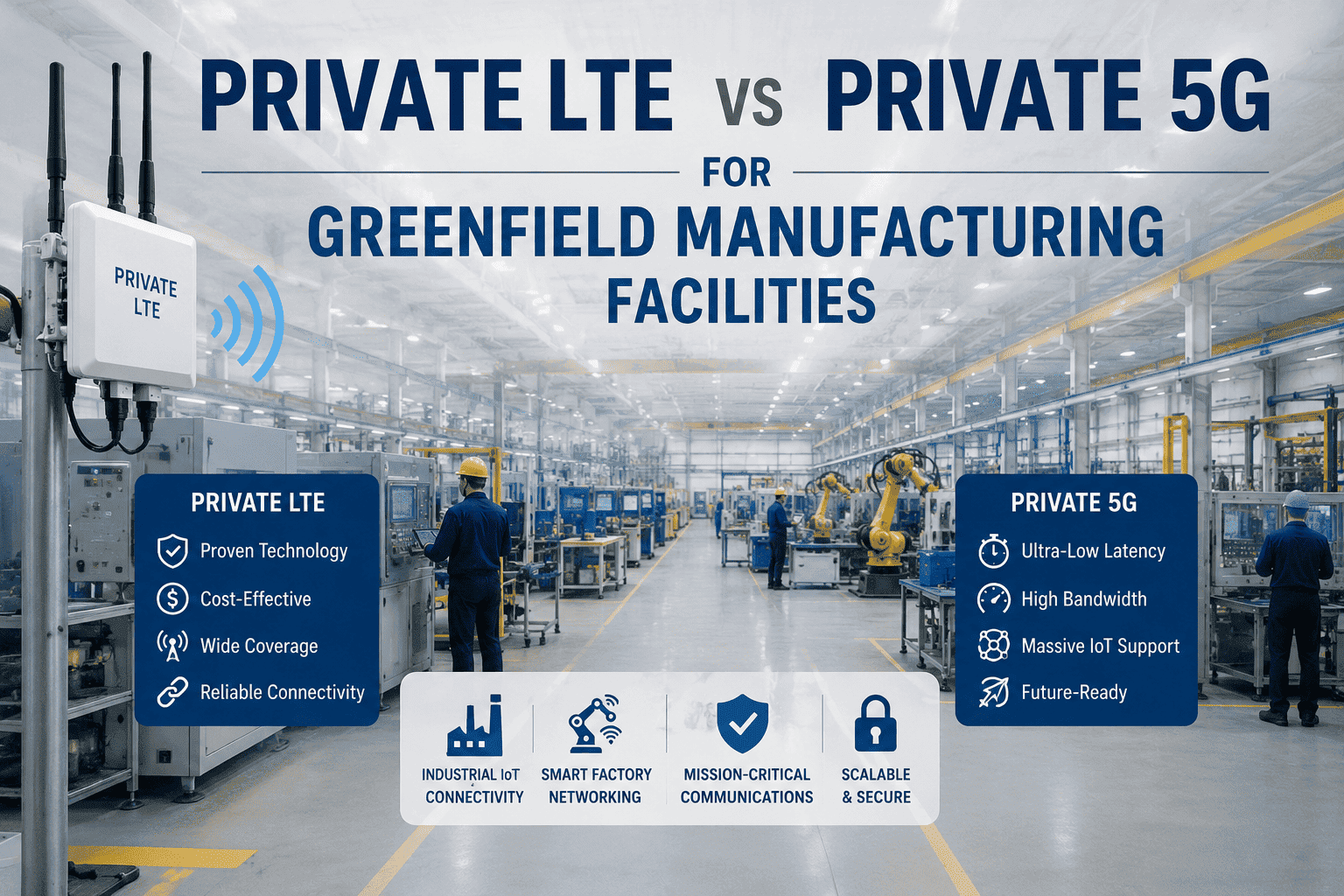
WiFi was designed for offices — laptops, phones, and printers in drywall environments with predictable RF propagation. Factories are the opposite: metal structures that create multipath reflections, forklifts and cranes that become moving RF obstacles, hundreds of IoT devices competing for shared unlicensed spectrum, and mission-critical applications that need deterministic latency — not "best effort." Private 5G solves every one of these problems with dedicated spectrum, guaranteed QoS, sub-5ms latency for URLLC applications, and the ability to connect 100,000+ devices per cell. The technology has moved well past pilot phase — Ericsson, Nokia, NTT DATA, and other providers now operate production 5G networks in manufacturing facilities worldwide, with Cargill deploying across 50 sites globally and Airbus advancing factory digitization with private 5G at production sites. The Forrester Wave named private 5G services a mainstream technology category in Q4 2025. But the lesson from early deployments is clear: 5G performance in factories depends entirely on RF engineering quality. Reflective surfaces, metallic structures, ceiling heights, and machine movement significantly affect signal behavior — and these RF characteristics must be modeled and designed during the greenfield phase, not discovered after the walls are up. We design private 5G networks for greenfield factories from the ground up — RF propagation simulation, antenna placement optimization, network slice configuration, and edge compute integration — so your AGVs, robots, AR systems, and video analytics have deterministic, industrial-grade wireless from commissioning day. Schedule a Demo
Why WiFi Fails on the Factory Floor
WiFi for tablets and laptops. 5G for everything mission-critical. Schedule a demo to see how private 5G and WiFi 6 coexist in a properly designed factory network — each handling the applications it was built for.
RF Planning for Metal-Dense Factories
3D Propagation Simulation
Full 3D RF propagation model built from facility CAD — including metal walls, machine locations, overhead cranes, mezzanines, and material storage areas. Ray-tracing simulation predicts signal strength, multipath reflection, and interference at every point in the facility. Output: coverage heatmap at 1m resolution showing signal-to-noise ratio across every zone. Identifies dead zones before any antenna is installed.
Antenna Placement Optimization
Indoor small cell and antenna locations optimized for coverage uniformity, handover zones, and capacity density. Factory-specific challenges: overhead cranes block line-of-sight to ceiling-mounted antennas, forklifts create moving obstructions, and metal racks create RF canyons. In greenfield: antenna mounting points, power feeds, and fiber backhaul pre-installed during construction at calculated locations — not retrofitted onto existing structures with compromise positions.
Handover Zone Design
For AGVs and AMRs moving through the facility, handover zones between cells must provide seamless make-before-break transitions with zero packet loss. Handover boundaries placed in areas with clear line-of-sight to both serving and target cells — not behind metal obstructions where signal quality drops. Handover timing tuned to AGV speed profiles and route patterns. In greenfield: AGV routes and cell boundaries co-designed during facility layout.
Capacity Planning
Cell density calculated from device population and bandwidth requirements per zone. Assembly areas with hundreds of IoT sensors need capacity for mMTC. Quality inspection zones with 4K cameras need eMBB uplink capacity. AGV corridors need URLLC priority. Each zone's traffic profile mapped to antenna count and spectrum allocation. In greenfield: capacity designed for full production device density, not day-one sparse deployment that fails when the factory reaches full capacity.
Network Slicing Architecture
Dedicated radio resources with pre-emption priority. Grant-free uplink for sub-millisecond access. Edge-deployed UPF (User Plane Function) co-located with the factory's automation network — data never leaves the premises. Reserved for: AGV fleet control, robotic motion commands, safety-critical PLC communication, and real-time closed-loop control. Traffic from this slice cannot be preempted by any other application.
High-throughput slice for bandwidth-intensive applications. Guaranteed minimum bandwidth per device with burst capability. Used for: 4K video analytics streams (50-100 Mbps per camera), AR/VR maintenance overlays (20-50 Mbps per headset), digital twin synchronization, AI model deployment to edge devices, and large file transfers. QoS prevents video traffic from starving sensor telemetry.
Massive device connectivity with battery-optimized protocols. 5G RedCap (Reduced Capability) modules for low-cost sensors, barcode scanners, and wearables — bridging the cost gap between WiFi and full 5G devices. Used for: environmental sensors (T/RH/dust), asset tracking, vibration monitoring, worker safety wearables, and smart meters. Devices transmit small packets at intervals of seconds to minutes — minimal bandwidth, maximum battery life.
Logically isolated slice for corporate IT devices, visitor access, and non-critical applications. Completely separated from OT slices — a guest device cannot access any industrial traffic. Standard internet breakout through the enterprise firewall. No impact on URLLC or eMBB performance regardless of guest traffic volume. Replaces the need for a separate WiFi SSID for visitors.
Use Case Catalog
| Use Case | Slice | Latency Requirement | Bandwidth | Device Count | Why Not WiFi |
|---|---|---|---|---|---|
| AGV / AMR Fleet | URLLC | <5ms deterministic | 1-5 Mbps per vehicle | 20-200 vehicles | WiFi roaming causes 50-150ms gaps; AGVs stop or collide |
| Collaborative Robots | URLLC | <1-5ms | 5-20 Mbps per robot | 10-100 robots | WiFi jitter causes position overshoot; safety system triggers |
| AI Vision / Video | eMBB | 10-50ms | 50-100 Mbps per camera | 20-200 cameras | WiFi uplink throughput insufficient for 4K streams at scale |
| AR Maintenance | eMBB | 10-20ms | 20-50 Mbps per headset | 10-50 headsets | WiFi latency causes AR overlay lag; motion sickness |
| Digital Twin Sync | eMBB | 20-100ms | 10-50 Mbps | 5-20 endpoints | Tolerable on WiFi; 5G provides guaranteed throughput |
| Environmental Sensors | mMTC | 1-60 sec | <1 Mbps total | 500-10,000 | WiFi AP capacity exhausted; 5G handles 100K+ devices |
| Asset Tracking | mMTC | 1-10 sec | <1 Mbps total | 1,000-50,000 tags | WiFi not designed for thousands of low-power beacons |
| Worker Safety | mMTC/URLLC | 100ms (alert) / <5ms (e-stop) | <1 Mbps | 50-500 wearables | Safety-critical alerts need guaranteed delivery, not best-effort |
Spectrum Strategy
Citizens Broadband Radio Service provides shared spectrum access in the US — no traditional FCC license needed. GAA (General Authorized Access) tier allows immediate deployment; PAL (Priority Access License) provides interference protection via auction. 150 MHz bandwidth (3550-3700 MHz) supports 10-20 MHz channel widths per private network. Ideal for most US factory deployments. In greenfield: CBRS SAS (Spectrum Access System) registration and antenna parameters specified during network design.
Dedicated licensed spectrum provides the highest reliability — zero risk of interference from neighbors. Available via carrier partnerships or direct allocation in countries with industrial spectrum programs (Germany's 3.7-3.8 GHz local licenses, Japan's local 5G bands, UK's Shared Access). Higher cost but guaranteed exclusive access. Required for safety-critical URLLC applications where any interference is unacceptable.
Extremely high bandwidth (400 MHz-1 GHz channels) for dense video analytics zones and AR hotspots. Limited range (50-100m) and poor penetration through metal — requires line-of-sight or near-line-of-sight. Used as capacity overlay in specific zones, not as primary coverage. In greenfield: mmWave small cells deployed in quality inspection stations, training areas, and control rooms where maximum bandwidth is needed in a confined space.
Reduced Capability 5G modules bring lower-cost, lower-power chipsets to barcode scanners, wearables, and simple sensors — shrinking the price gap between WiFi and 5G devices. RedCap modules support 20 MHz bandwidth, 150 Mbps downlink, and significantly reduced power consumption vs full 5G. Expected to accelerate mMTC adoption by making 5G-connected sensors economically viable at scale. In greenfield: design for both full 5G and RedCap devices from day one.
Need a spectrum strategy for your greenfield factory? Schedule a demo to see CBRS vs licensed spectrum analysis, RF coverage simulation, and network slice design for your specific use cases and facility layout.
Core Network & Edge Integration
O-RAN or proprietary indoor radio units mounted at calculated positions throughout the facility. Sub-6 GHz (n77/n78/CBRS) for primary coverage; optional mmWave for high-density zones. MIMO configuration (2×2 or 4×4) for throughput and diversity. Fiber fronthaul from each radio unit to the distributed unit (DU) in the server room. In greenfield: ceiling mounting points, power drops, and fiber runs pre-installed during construction.
5G core network (AMF, SMF, UPF) deployed on-premise — all data stays within the factory. UPF (User Plane Function) co-located with edge GPU servers for sub-5ms end-to-end latency. No traffic routed to public cloud for URLLC applications. Edge MEC (Multi-access Edge Computing) hosts AI inference, video analytics, and digital twin applications co-located with the network. In greenfield: server room rack space, power, cooling, and fiber connectivity pre-designed for 5G core and edge compute.
5G network integrated with existing OT architecture via the UPF — acting as a wireless extension of the industrial Ethernet network. TSN (Time-Sensitive Networking) mapping to 5G QoS ensures deterministic behavior across wired and wireless domains. IEC 62443 zone/conduit model applied: 5G OT traffic in dedicated security zone, separated from IT/guest traffic at the network slice level. In greenfield: 5G UPF connected directly to the OT firewall/DMZ, with security policies designed alongside the automation network architecture.
Centralized SIM/eSIM lifecycle management for all 5G devices — provisioning, policy assignment, revocation. Per-device security policies enforced at the network level. Zero Trust framework: every device authenticated by SIM identity before any network access. Device health monitoring: firmware version, signal quality, battery status. Remote device management for sensors and wearables across the entire facility. In greenfield: SIM management platform and device onboarding workflow designed during commissioning.
Key Benefits & ROI
WiFi Was for Offices. Your Factory Deserves Better.
iFactory designs private 5G networks for greenfield factories — RF propagation simulation, antenna placement, network slicing, spectrum strategy, and edge compute integration — so your AGVs, robots, cameras, and sensors have deterministic, industrial-grade wireless from commissioning day.
Frequently Asked Questions
Retrofit 5G in a Running Factory: $200K-$500K. Greenfield: $80K-$200K.
Antenna mounting points, fiber runs, power drops, edge compute rack space, and RF-optimized antenna positions — all trivial during construction. All expensive and compromised after commissioning.