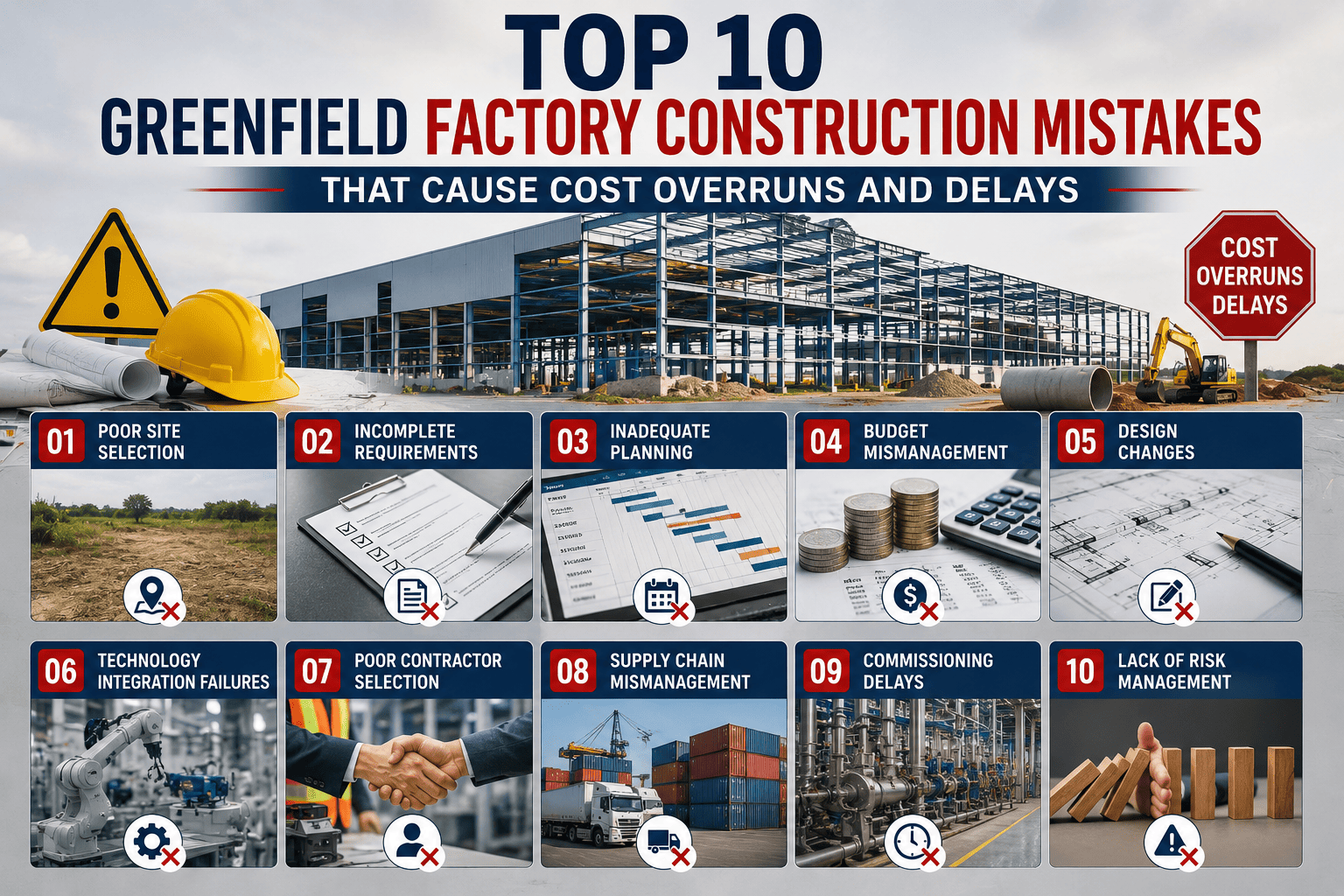
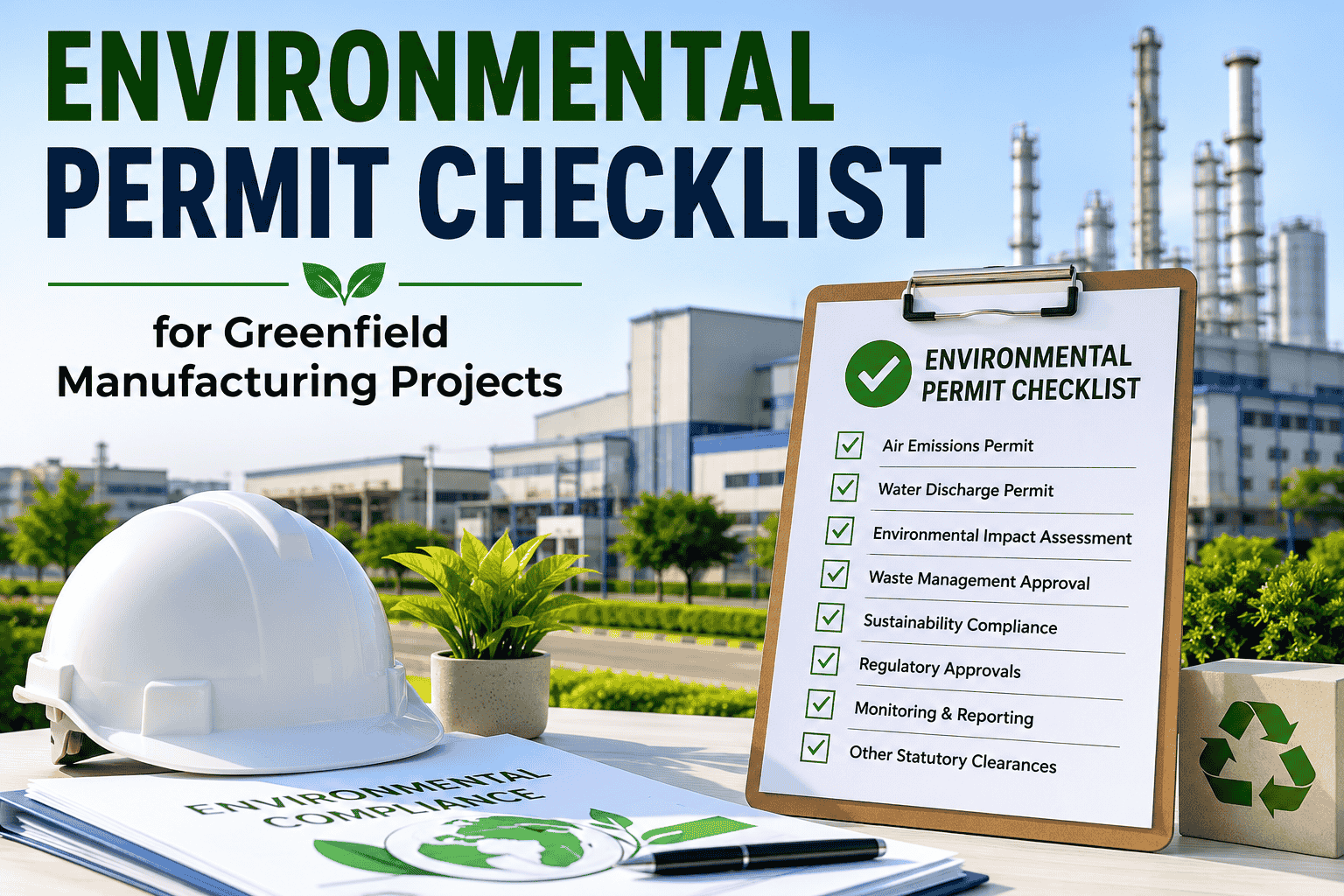
Greenfield projects don’t fail in construction. They fail in the planning phase — a quiet six to twelve months where every decision deferred becomes a change order that costs ten times more once concrete is poured. The plants that finish on time and on budget aren’t the ones with the best contractors. They’re the ones whose project teams locked 120 specific decisions before breaking ground. This checklist is exactly that: eight phases, fifteen steps each, covering site selection through commissioning readiness. Print it, share it with your project owner, and use it as the master review document before every gate. Book a checklist walkthrough demo to run it against your specific project with our greenfield team.
120
total steps across the full planning lifecycle
10×
cost of fixing in construction
75%
commissioning time saved with virtual CQV
How to Use This Checklist
Read the eight phase headers first. Each represents a critical-path workstream that runs partly in parallel with the others. Then walk the steps inside each phase — they’re ordered roughly by dependency, but treat them as a completeness audit rather than a strict sequence. Every step left open at the end of planning is a risk you’re carrying into construction. The plants that hit ramp-up close all 120 before steel starts moving.
01
Strategy & Business Case
Months 0–3
02
Site Selection & Due Diligence
Months 2–6
03
Permits & Regulatory
Months 3–9
04
Factory Design & FEED
Months 4–10
05
Digital Twin & AI Architecture
Months 5–11
06
Equipment & Procurement
Months 6–12
07
CMMS & Maintenance Setup
Months 8–12
08
Commissioning Readiness
Months 10–14
Phase 01 — Strategy & Business Case (Steps 1–15)
Where the entire project is won or lost. Get the business case wrong here and every downstream phase compounds the error.
Phase 02 — Site Selection & Due Diligence (Steps 16–30)
Speed-to-power is now the dominant site selection criterion globally. Permits, utilities, and labor availability outweigh land cost in nearly every 2026 build.
Halfway Through Planning? Pressure-Test the First 30 Steps
iFactory’s greenfield team can audit your strategy and site selection work product against the full 120-step checklist — identifying the 3 highest-risk gaps before they become construction change orders.
Phase 03 — Permits & Regulatory (Steps 31–45)
Environmental permits alone add 3–6 months to greenfield timelines. Start every permit workstream the day after site selection is final — not when design is ready.
Phase 04 — Factory Design & FEED (Steps 46–60)
Every layout decision made here costs ten times more to change once concrete is poured. Digital twin simulation during FEED catches what static drawings miss.
Phase 05 — Digital Twin & AI Architecture (Steps 61–75)
Where modern greenfield plants separate from legacy ones. AI architecture designed in at FEED is the foundation for every operational KPI you’ll chase later.
Want the AI architecture (Steps 61–75) shaped to your specific factory now? Book a 30-minute AI architecture demo with our greenfield team.
Phase 06 — Equipment & Procurement (Steps 76–90)
Custom production equipment runs 12–18 month lead times. Procurement is now the single biggest schedule risk on every 2026 greenfield project.
Phase 07 — CMMS & Maintenance Setup (Steps 91–105)
The most underestimated phase. CMMS deployed during construction means maintenance teams have full visibility from commissioning day one — not six months in.
Phase 08 — Commissioning Readiness (Steps 106–120)
Virtual commissioning saves up to 75% of physical startup time. Get FAT/SAT and CQV documentation right before equipment ships and you eliminate the most expensive surprises.
Approaching commissioning and want Phase 08 pressure-tested? Book a virtual commissioning demo with our greenfield specialists.
Where Each Phase Saves You the Most Money
Not every phase carries equal ROI weight. Here’s where the eight phases stack on actual cost-of-fix and project leverage, so you know which gates deserve extra scrutiny.
Highest leverage
Phases 01, 02, 04
Strategy, site selection, and FEED. Decisions here cost 10× more to change once construction starts. Worth weeks of executive review time.
High leverage
Phases 03, 05, 06
Permits, AI architecture, and equipment procurement. Schedule slip here directly extends time-to-revenue. Pre-empt with parallel workstreams.
Compounding value
Phases 07, 08
CMMS setup and commissioning readiness. Determine ramp-up speed and year-one OEE — the difference between 12-month and 24-month payback.
Expert Perspective
"The root cause of greenfield failure is almost always incomplete planning. Teams rush into construction without locking critical decisions across technology, infrastructure, maintenance, and workforce readiness. Changes made during construction cost ten times more than changes during the planning phase. Every box left unchecked at the end of planning is a risk you’re paying for during construction — and that bill compounds across the entire project lifecycle."
— Greenfield manufacturing project practice, 2026 industry research
3–6 mo
added to timeline by environmental permits alone
5–15 MW
typical power requirement for an AI-ready factory
2.1M
unfilled US manufacturing jobs forecast by 2030
Conclusion: Closed Boxes, Open Plant
A greenfield factory built on 120 closed checklist boxes finishes on time. One built on guesses, deferred decisions, and good intentions doesn’t. The eight phases above aren’t bureaucracy — they’re the difference between a plant that hits design throughput in year one and one still chasing it in year three. Walk this list with your project owner. Audit it monthly. Treat any open box past its target month as a project red flag. The plants that ship cells, packs, components, and finished goods on schedule in 2027 are the ones running this discipline today. The ones that don’t will be writing post-mortems explaining why their schedule slipped — and the answer will be in here, on a row that nobody closed before the concrete poured.
Run This Checklist Against Your Project
iFactory’s greenfield team runs your project work product against the full 120-step checklist in a single 30-minute working session — identifying the highest-risk open boxes and quantifying the schedule and cost impact of closing each. Get a free readiness assessment.
Frequently Asked Questions
When should we start working through this 120-step checklist?
Start the day you approve a greenfield business case. Phase 01 begins at month zero and the full planning window runs roughly 6–12 months before any construction activity. Phases 02 (Site Selection) and 03 (Permits) overlap heavily, with permit applications filed the moment site selection is final because environmental approvals alone can add 3–6 months to your timeline. Phases 04 (Design) through 07 (CMMS) run in parallel through months 4–12, and Phase 08 (Commissioning Readiness) starts as soon as long-lead equipment ships. Every step left open at the end of planning is a risk carried into construction at 10× the cost.
Which phase is most commonly underestimated by greenfield project teams?
Phase 07, CMMS and Maintenance Setup. Most project teams treat maintenance configuration as a post-commissioning activity — mapping assets, loading PM schedules, and training technicians only after production is running. By then the maintenance team is firefighting from day one without visibility, spare parts are stocked reactively, and predictive maintenance never gets configured. Plants that deploy CMMS during construction — not after — have operational visibility from commissioning day one, which directly accelerates the ramp curve and improves first-year OEE by meaningful margins.
How does the checklist change for AI-ready or smart factories?
Phase 05 (Digital Twin & AI Architecture) expands significantly for AI-ready plants. Power requirements jump to 5–15 MW — 2–3× a traditional plant of similar size — to support edge computing, GPU servers, IIoT networks, and high-density cooling. Sensor inventories often run into the thousands of points. MES and SCADA platform decisions need to support real-time AI inference and historian storage at scale. Cybersecurity architecture has to assume OT/IT convergence rather than air-gapped legacy isolation. The remaining 105 steps stay structurally the same but get tighter tolerances on data architecture decisions throughout.
Can we use this checklist for a brownfield retrofit instead of a greenfield build?
Mostly yes, with adjustments. Phase 01 (Strategy) and Phase 02 (Site Selection) collapse or simplify for retrofits since the site is already chosen. Phase 03 (Permits) is usually lighter because the facility already exists, though changes of use can trigger fresh permit reviews. Phase 04 (Design) and Phase 05 (AI Architecture) carry over almost completely — the constraints just shift from blank-slate optimization to working within existing column spacing, ceiling height, and electrical capacity. Phases 06 through 08 (Equipment, CMMS, Commissioning) apply nearly identically. Plan on roughly 90 of the 120 steps being directly relevant to a retrofit project.
How does iFactory accelerate this checklist for greenfield project teams?
iFactory engages from Phase 01 onward, but the highest-impact involvement is in Phases 04, 05, 07, and 08. We model layout and line balancing in a digital twin during FEED, configure asset hierarchies, sensor architecture, predictive maintenance models, and KPI dashboards during construction, and run virtual commissioning of PLC code and robot programs against the twin before equipment ships — saving up to 75% of physical commissioning time. The result is a smart-factory operating platform that goes live with the plant rather than being assembled after the fact. Most clients close roughly 35–50 of the 120 steps directly through the iFactory engagement.