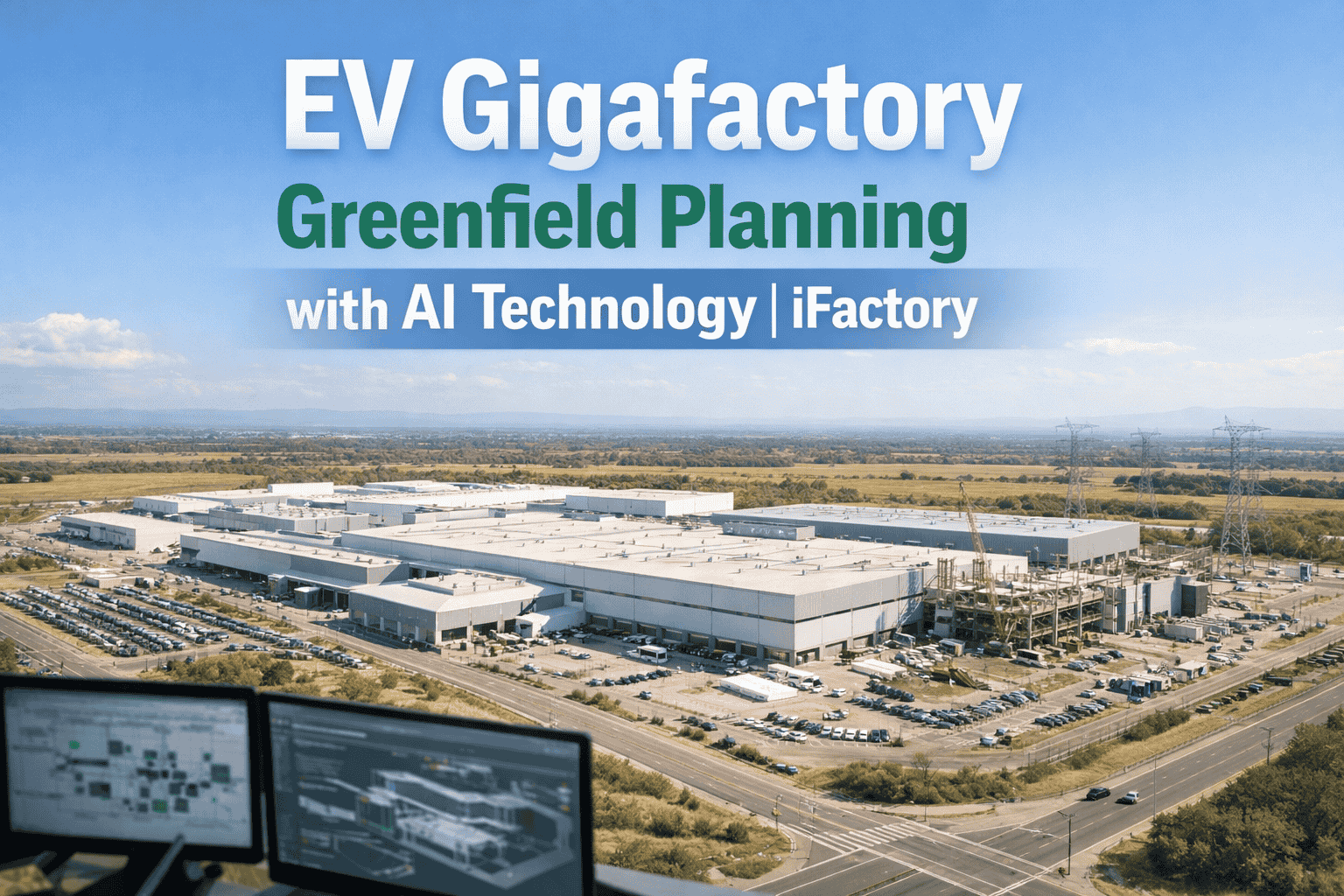
Greenfield Consulting for EV Manufacturers & Battery Makers | iFactory
By Riley Quinn on May 20, 2026
A modern battery gigafactory consumes 30–50 kWh of electricity for every 1 kWh of battery output. The dry room alone — that single climate-controlled space where cells are formed — eats up over half the facility’s utility budget through desiccant dehumidification units and chillers running continuously at minus-40°C dew point. A 3–5 GWh plant burns through $1.1–$1.8 million in electricity monthly before it ships its first cell. This is the new physics of EV manufacturing: every design decision made before groundbreaking compounds across a decade of operations. iFactory’s greenfield consulting for EV manufacturers and battery makers exists to make those decisions with AI-driven simulation, not assumption — from dry room load modeling to utility-scale power planning, thermal runaway zoning, Battery Passport compliance, and the digital twin that runs the plant after handoff. Book a gigafactory planning demo to see how it changes your project economics.
150
gigafactories planned globally over the coming years
30–50 kWh
electricity consumed per 1 kWh of battery output
61%
of dry room load from DHU + chiller alone
$1.8M
monthly electricity bill for a 3–5 GWh plant
Why EV & Battery Greenfield Projects Are a Different Animal
A semiconductor fab, a pharma plant, and a battery gigafactory all need clean environments and tight process control — but the similarities end there. Battery manufacturing is the only one where a single thermal runaway event in formation can destroy six months of inventory, where utility load planning is essentially the project, and where EU regulation now mandates a digital twin from day one for every cell above 2 kWh. EV consulting that doesn’t start with these specifics is generic factory consulting with a battery wrapper.
Dry Room Dominance
Every cell line needs a climate-controlled dry room at minus-40°C dew point. It’s the largest single energy cost, the highest fire risk, and the most expensive thing to redesign post-construction.
Utility-Scale Power Demand
Gigafactories consume the electrical equivalent of small cities. Grid interconnection delays, substation builds, and on-site generation must be planned at site selection — not at execution.
Thermal Runaway Risk
Formation and aging zones are the highest-risk areas in the plant. Layout must isolate them behind reinforced firewalls with dedicated thermal management — or insurance and compliance fail.
Battery Passport & EU 2026
Every battery above 2 kWh now needs a digital twin from manufacturing onward. Data architecture, traceability, and AI-supported quality must be designed into the plant from FEED.
Our Greenfield Consulting Services for EV & Battery Makers
iFactory’s gigafactory practice is organized around six service tracks that map directly to where EV and battery projects routinely lose schedule and budget. Each track combines advisory with our proprietary AI platform — not advisory followed by a separate tech engagement.
01
Dry Room Engineering & Energy Modeling
AI-driven thermodynamic modeling of dry room load, DHU sizing, chiller selection, and air handling architecture. We optimize the single largest energy line item before the design is locked.
Dew-point load modelDHU/chiller sizingEnergy benchmark vs. peer plants
02
Utility-Scale Power Planning
Grid interconnection studies, substation sizing, on-site generation, battery energy storage system (BESS) buffering, and renewable PPA strategy. Speed-to-power is now the primary site selection criterion globally.
Layout design that isolates formation and aging zones behind firewalls with dedicated thermal management. Fire-protective steel coatings, chemically resistant flooring, and compliance with EU 2026 and U.S. NFPA codes built in.
Full plant simulation from coating through pack assembly — layout optimization, line balancing, protocol handshake validation, and operator training in a digital twin before equipment arrives on site.
First-pass yield optimization, predictive quality on coating thickness and cell capacity, real-time defect root-cause detection, and OEE acceleration from go-live through stable production.
Yield predictionQuality AIOEE ramp curve
06
Battery Passport & Traceability Architecture
Data architecture for full cell traceability, Battery Passport-ready records, supplier chain-of-custody, and ESG reporting integrated into MES from day one — not bolted on after audits.
Battery and EV plants follow a recognizable rhythm. The earlier AI enters the project, the more leverage it has on the eventual operating cost structure. Here’s how the typical 36-month gigafactory journey breaks down, and where iFactory delivers maximum impact.
Virtual commissioning of control logic, MES configuration, predictive maintenance models trained on equipment vendor data.
High leverage
Month 24–30
Commissioning & SOP
First cells produced, formation and aging cycles begin, AI quality models calibrated against actual line data, yield optimization starts.
Solid leverage
Month 30–36+
Ramp-Up to Nameplate
First-pass yield climbs, OEE improves through predictive maintenance and AI defect detection, traceability records flow into Battery Passport.
Recurring value
De-Risk Your Gigafactory Before Groundbreaking
iFactory’s EV greenfield team engages at FEED with dry room load modeling, utility planning, digital twin simulation, and a finance-grade ROI projection. The earlier we model the plant, the more design dollars get spent on the things that actually drive ramp-up speed.
Most EV consulting comes in two flavors: pure-play engineering firms that deliver dry rooms but no operating intelligence, and strategy firms that deliver decks but no working technology. iFactory is the third option — an AI-first greenfield partner that ships a working smart-factory platform with the build.
A
AI Platform Ships With the Plant
Predictive maintenance, AI quality control, real-time OEE, and Battery Passport-ready traceability operational from day one of commissioning — not phase three of a separate tech engagement.
B
Battery-Specific Domain Depth
Dry room thermodynamics, formation and aging zone risk modeling, dry electrode vs. wet electrode tradeoffs, cell chemistry-specific yield models — not generic Industry 4.0 templates.
C
Integrates Above Your EPC
We work alongside your existing EPC, dry room specialist, and equipment vendors — not in competition with them. The AI risk and intelligence layer sits above the project stack.
D
Outcome-Based Engagement
Measurable KPIs across schedule, energy intensity per kWh produced, first-pass yield, and OEE ramp curve — signed off by your finance team, not assumed by ours.
Want a side-by-side of how this approach compares to traditional EV consulting? Book a comparison demo with our gigafactory team.
Expert Perspective
"Highly automated production combined with comprehensive real-time data analysis is the key to continuously improving process stability, efficiency, and quality. Thousands of data points from machine and building monitoring enable seamless traceability and form the basis for AI-supported quality control. The gigafactories shipping cells in 2026 aren’t the ones that bolted AI on after commissioning — they’re the ones that designed AI into the plant’s nervous system from FEED. That’s the difference between a 24-month ramp to nameplate and a 48-month one."
— Gigafactory Manufacturing Practice, 2026 industry insight
2 kWh
EU threshold for mandatory Battery Passport digital twin
115K t
annual CO&sub2; reduction from green-powered dry rooms
30+
gigafactories currently planned across Europe
Conclusion: The Window to Plan Right Is Narrow
EV demand isn’t slowing. Battery cell supply is the bottleneck for an entire industry transition, and the gigafactories breaking ground in 2026 will define market share for the rest of the decade. The plants ramping fastest aren’t the ones with the largest CAPEX — they’re the ones whose dry rooms were sized correctly the first time, whose thermal zoning passed audit on the first review, whose digital twin caught layout conflicts before concrete was poured, and whose AI quality models were calibrated against simulation data before the first cell ran. iFactory’s greenfield consulting for EV manufacturers and battery makers exists for one reason: to compress the gap between groundbreaking and stable production. The earlier we engage, the wider the window to get every one of those decisions right.
Plan Your Gigafactory With AI From Day One
Whether you’re at site selection or detailed design, iFactory’s EV greenfield team can model dry room load, utility planning, safety zoning, and ramp-up economics against your specific project parameters. Get a free 30-minute strategy session.
What are the biggest risks in building an EV gigafactory in 2026?
Five risks dominate. First, utility-scale power: grid interconnection delays are now the single most common cause of schedule slip, with substation builds often taking longer than the factory itself. Second, dry room mis-sizing: the DHU and chiller represent 61% of dry room load and locking in the wrong design at FEED commits the plant to higher energy costs for its full operating life. Third, thermal runaway zoning: formation and aging areas are the highest-risk zones in the plant and must be isolated behind firewalls or insurance and compliance fail. Fourth, Battery Passport compliance: every cell above 2 kWh now needs a digital twin from manufacturing onward, which has to be architected into MES at FEED, not bolted on. Fifth, ramp-up speed: yield curves that take 36+ months to reach nameplate destroy the project ROI even when CAPEX is on budget.
How is consulting for an EV/battery factory different from other manufacturing greenfields?
Three things make EV greenfield work fundamentally different from a typical industrial build. Energy intensity is extreme — 30–50 kWh of electricity per kWh of battery output means utility planning is essentially the project, not a supporting activity. Safety risk is unique — thermal runaway in lithium-ion cells can destroy six months of inventory in a single event, making layout zoning a life-or-death design decision. And regulatory complexity is highest in this sector — EU Battery Regulation 2026, U.S. NFPA codes, and global ESG reporting all impose architecture-level requirements that have to be designed into the plant from FEED. Generic factory consulting that doesn’t start with these specifics will produce a generic plant that struggles to ramp.
When should we engage greenfield consulting for an EV or battery project?
At site selection or earliest FEED — ideally before grid interconnection studies are commissioned. Speed-to-power has become the dominant site selection criterion globally, and the decisions made in the first six months of a gigafactory project determine the eventual energy cost structure for the next decade. Dry room sizing, thermal zoning, and Battery Passport data architecture all need to be designed in at FEED to avoid expensive rework. Engaging at construction is still useful for virtual commissioning and ramp-up management, but the highest-leverage opportunities — layout, utility, and energy modeling — have already passed by then.
Does iFactory replace our EPC contractor or dry room specialist?
No. iFactory works alongside your existing EPC contractor, dry room engineering specialist, and equipment vendors as an independent AI-driven advisory and platform layer. We ingest data from whatever project management, EPC, and design tools you already use, model the plant as a digital twin, and surface risk and optimization opportunities that fragmented project teams typically miss. Our role is the intelligence layer above the project stack — not the dry room you buy from Exyte or the cell line you buy from your equipment vendor. This preserves the project owner’s unbiased view of true schedule risk and avoids the contractor disputes that come from replacing preferred partners mid-project.
What ROI can we expect from AI-driven greenfield consulting on a gigafactory?
The ROI math on a gigafactory is dominated by ramp curve and energy intensity. Compressing the ramp to nameplate by 12 months on a 5 GWh plant typically unlocks $80M–$200M in pulled-forward revenue. Reducing dry room energy intensity by 10% on the same plant saves $1.3M–$2.2M annually for the plant’s full operating life. Preventing even one major thermal incident or compliance failure during ramp can be worth more than the entire consulting engagement. Most iFactory gigafactory clients see payback inside the first year of operations, with multi-year ROI in the 8–15x range relative to consulting investment. Specific numbers depend on plant size, chemistry, and starting energy mix — which is exactly what a scoping demo is designed to model.