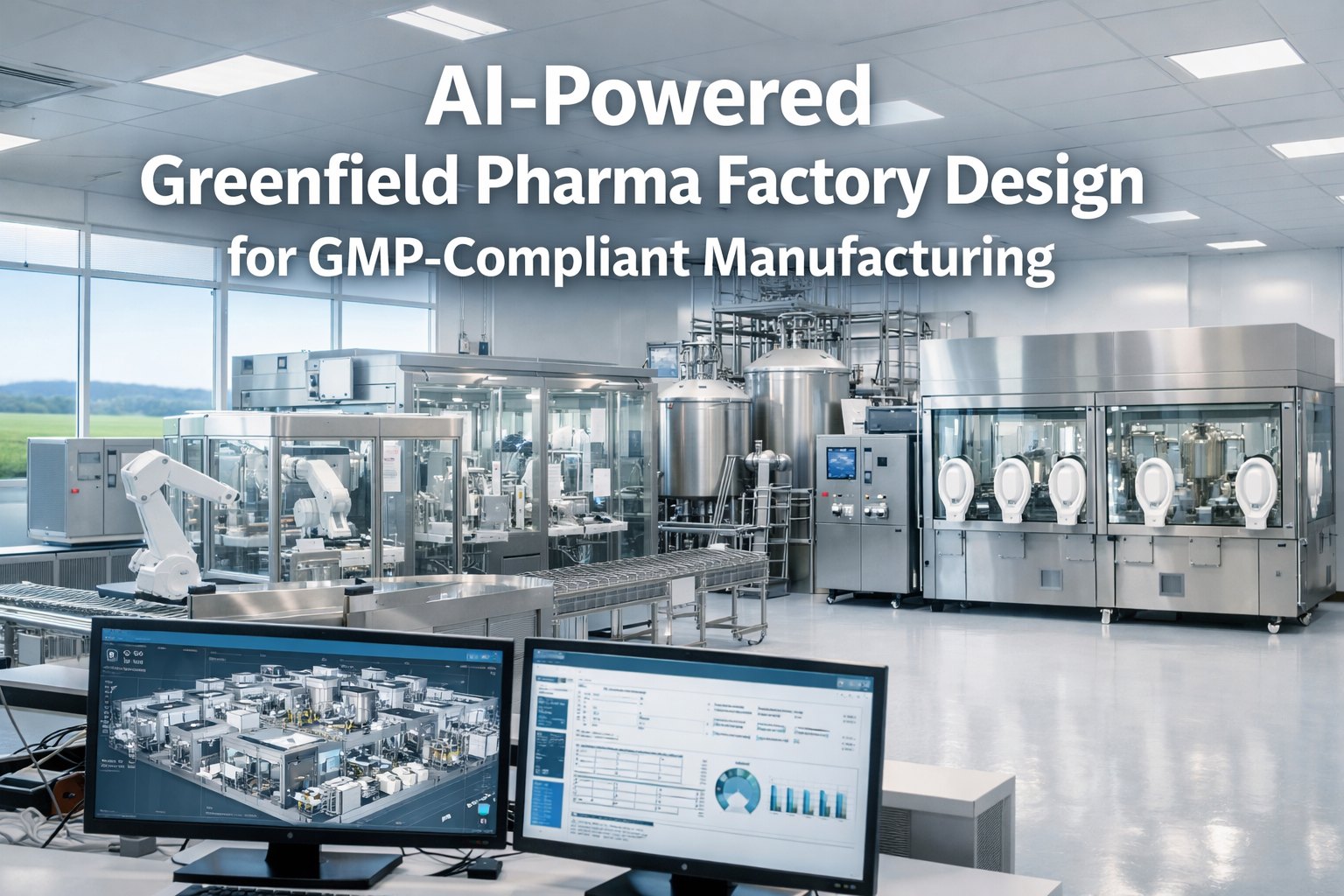
Building a pharmaceutical factory is one of the most complex, expensive, and regulated construction projects on earth. A typical biotech plant costs ~$2 billion and takes 8–10 years from planning to full operations. Over $300 billion in pharma manufacturing investments are currently on the table globally, with Pfizer, Moderna, Novartis, and Sanofi all racing to build AI-integrated Pharma 4.0 facilities. Yet every one of these plants must navigate the same unforgiving reality: a single GMP violation can halt production, a batch deviation destroys millions in product, and an FDA 483 observation can delay market launch by months. This guide shows how AI-powered greenfield design — with electronic batch records, GAMP5-compliant systems, cleanroom automation, and iFactory CMMS at the core — builds compliance into the factory's DNA from day one.
Why Pharma Greenfield Design Demands AI-First Architecture
Pharmaceutical manufacturing operates in the most heavily regulated environment in any industry. Every piece of equipment must be qualified (IQ/OQ/PQ). Every process must be validated. Every action must be documented with 21 CFR Part 11 compliant electronic records. Every deviation must be investigated. And every batch must prove — with data — that it was manufactured exactly according to the approved process. Traditional paper-based systems and disconnected software silos cannot sustain this burden at the scale and speed that modern pharma demands.
AI-first greenfield design changes the equation. By embedding electronic batch records, GAMP5-compliant automation, real-time environmental monitoring, and predictive maintenance into the facility from the design phase, manufacturers build "compliance by design" — where GMP adherence is a natural output of the system, not a manual burden layered on top. iFactory is the CMMS platform that connects your cleanroom HVAC, process equipment, utilities, and maintenance workflows into one audit-ready, AI-powered command center.
Building a GMP-Compliant Pharma Factory?
In 30 minutes, we'll show you how iFactory delivers validation-ready maintenance management, electronic documentation, and predictive equipment intelligence — all configured before your first batch runs.
The 6 Critical Systems Every Greenfield Pharma Plant Must Automate
A GMP pharmaceutical facility is only as compliant as its weakest system. Miss one, and you're building FDA 483 observations into the factory's DNA. Here are the six automation systems iFactory connects into a single platform:
Cleanroom Environmental Monitoring
Particle counts, temperature, humidity, pressure differentials, and microbial monitoring across every classified area — ISO 5 through ISO 8. iFactory tracks excursions in real time and auto-generates deviation reports before they compromise a batch.
HVAC & Utility Qualification
Pharmaceutical HVAC is mission-critical — air handling units, HEPA filtration, WFI systems, clean steam, and compressed gas. iFactory monitors every utility system with calibrated sensors and auto-documents qualification status for continuous validation.
Process Equipment Maintenance
Bioreactors, fermenters, tablet presses, fill-finish lines, lyophilizers, and autoclaves — all require predictive maintenance that prevents mid-batch failures. iFactory's AI catches vibration, thermal, and pressure anomalies weeks before they destroy product or halt production.
Electronic Batch Record Integration
Every maintenance action on production equipment must correlate with batch records. iFactory timestamps every work order, calibration, and repair with 21 CFR Part 11 compliant electronic signatures — creating the traceability that FDA inspectors require.
Calibration & Instrument Management
Hundreds of calibrated instruments — temperature probes, pressure transducers, flow meters, pH sensors — each with calibration schedules, tolerance limits, and expiration tracking. iFactory manages the full calibration lifecycle and prevents out-of-calibration instruments from being used.
Aseptic & Sterile Process Support
Fill-finish isolators, restricted access barrier systems (RABS), CIP/SIP systems, and depyrogenation tunnels demand flawless maintenance. iFactory tracks intervention events, filter integrity, and sterilization cycle verification — critical for EU Annex 1 compliance.
Every system above is what we configure during your demo. Book 30 minutes and we'll map iFactory to your specific process type — oral solids, injectables, biologics, or cell/gene therapy.
The Cost of Getting Pharma Compliance Wrong
In pharmaceutical manufacturing, compliance failures aren't just expensive — they're existential. Here's what's at stake when maintenance systems fail in a GMP environment:
FDA 483 Observations Stop Production
An FDA 483 observation for inadequate equipment maintenance, missing calibration records, or environmental monitoring failures can halt production, delay product launches, and trigger consent decrees that take years to resolve. In 2025, the FDA resumed full FSMA-frequency inspections — high-risk facilities face audits every 3 years. iFactory ensures every maintenance record is complete, timestamped, and retrievable in minutes.
Batch Deviations Destroy Millions in Product
A single equipment failure during a biologic batch can destroy product worth $500,000 to $5 million — and the batch cannot be reworked. Environmental excursions in sterile manufacturing trigger automatic batch rejection. Predictive maintenance that catches a failing seal, a drifting temperature probe, or a degrading pump before it compromises a batch isn't a luxury — it's the difference between shipping product and writing it off.
EU Annex 1 Raised the Bar on Sterile Manufacturing
The updated EU GMP Annex 1 (effective August 2023, with industry still reaching full compliance) demands documented contamination control strategies, continuous environmental monitoring, and lifecycle management of all sterile manufacturing equipment. Many facilities are finding that procedural compliance alone is insufficient — tangible upgrades to utilities, HVAC, and monitoring systems are required. iFactory automates the documentation.
The Reality: In pharmaceutical manufacturing, your maintenance system IS your compliance system. Every work order, calibration, and repair is an auditable record. iFactory turns this from a burden into an automated output — so compliance is proven continuously, not assembled retroactively before an inspection. See compliance automation in a free demo →
The iFactory Technology Stack for Pharma Manufacturing
Pharmaceutical plants need a CMMS that understands validation, data integrity, and regulatory documentation — not a generic maintenance tool adapted for pharma. Here's the iFactory stack:
See How iFactory Handles GMP Compliance Automatically
30 minutes. We'll walk you through 21 CFR Part 11 electronic signatures, calibration management, environmental monitoring, and predictive maintenance — customized to your drug type and facility classification.
How iFactory Deploys — From URS to Commercial Manufacturing
iFactory integrates into your pharma greenfield project using pharmaceutical industry standard lifecycle terminology — URS, FAT/SAT, IQ/OQ/PQ — so validation teams speak the same language from day one:
iFactory Defines Maintenance Requirements During Design
During User Requirements Specification (URS) and Design Qualification (DQ), iFactory maps every GMP-critical asset, defines maintenance strategies per equipment class, plans calibration programs, and establishes environmental monitoring sensor networks — all documented in GAMP5 lifecycle format.
iFactory Configures as Equipment Is Qualified
As equipment passes Factory Acceptance Testing (FAT) and Site Acceptance Testing (SAT), each asset is registered in iFactory with qualification status, maintenance procedures, calibration schedules, and spare parts requirements. AI models begin pre-training on digital twin data for predictive maintenance readiness.
iFactory Proves Equipment Reliability During Validation
During Process Performance Qualification (PPQ) batches, iFactory provides documented proof that every piece of equipment operated within qualified parameters, every calibrated instrument was in tolerance, and every maintenance action was completed on schedule. Environmental monitoring data flows automatically into batch records.
iFactory Maintains Continuous Validated State
Once commercial production begins, iFactory maintains your continuous process verification (CPV) data, environmental trending, calibration lifecycle, and predictive maintenance intelligence — ensuring your facility stays in a validated state every day, not just during audits.
This pharma-specific roadmap is what we'll customize in your demo. Book 30 minutes and we'll map iFactory to your process type, facility classification, and qualification timeline.
What iFactory Delivers Per Pharma Manufacturing Zone
Environmental Monitoring & Control
Particle counts, viable monitoring, temperature, humidity, and differential pressure — all feeding into iFactory dashboards. Excursions trigger auto-generated deviation reports with corrective action workflows.
Equipment Health & Batch Protection
Predictive maintenance on bioreactors, presses, fill-finish lines, and lyophilizers. AI catches degradation before it compromises the current batch — saving product worth $500K–$5M per batch event.
Calibration & Instrument Lifecycle
Full calibration lifecycle management — scheduling, execution, tolerance verification, traceability, and out-of-tolerance lockout. Every calibration is documented with 21 CFR Part 11 compliant electronic signatures.
Audit-Ready Documentation
Every maintenance action, calibration, deviation, and environmental excursion is auto-documented with timestamps, technician IDs, and electronic signatures. FDA and EU inspectors get instant access to any record — making audits a non-event.
Turn GMP Compliance From a Burden Into a Competitive Advantage
30 minutes. Zero obligation. We'll show you how iFactory automates 21 CFR Part 11 documentation, calibration management, environmental monitoring, and predictive maintenance — specifically for your drug type and facility classification.
Who Needs AI-Powered Pharma Greenfield Design?
Large-molecule production in bioreactors and fermenters where a single batch failure destroys millions in product. iFactory's predictive maintenance protects bioreactor health, monitors CIP/SIP cycles, and correlates equipment status with batch records — ensuring every batch meets release specifications.
Aseptic processing demands the highest level of environmental control and equipment reliability. iFactory monitors isolator integrity, RABS barrier performance, and depyrogenation tunnel health — while auto-documenting every intervention event for EU Annex 1 compliance.
Tablet presses, granulators, coaters, and packaging lines running at high speed with tight weight and content uniformity specifications. iFactory monitors tooling wear, compression force trending, and coating system performance — preventing the quality drifts that trigger OOS investigations.
The newest and most complex pharma manufacturing segment — autologous and allogeneic therapies produced in small batches with patient-specific protocols. iFactory provides the equipment traceability and environmental documentation that these high-value, low-volume processes demand.
Build Compliance Into the Foundation — Not the Paperwork
The pharmaceutical industry is investing over $300 billion in new manufacturing capacity — and the EU's draft Annex 22 on AI, the FDA's accelerating FSMA-frequency inspections, and the shift to continuous process verification are all raising the bar on what GMP compliance requires. The facilities that win in this environment are the ones where compliance is an automated output of intelligent systems — not a retroactive documentation exercise before the next audit. iFactory makes this possible by connecting every piece of qualified equipment, every calibrated instrument, and every maintenance action into one AI-powered, 21 CFR Part 11 compliant platform — configured before your first PPQ batch runs.
Your Next Pharma Factory Deserves AI-Native Compliance
30 minutes. Zero obligation. We'll walk you through iFactory's validation-ready CMMS — electronic signatures, calibration management, environmental monitoring, and predictive maintenance — customized to your process type and regulatory requirements.