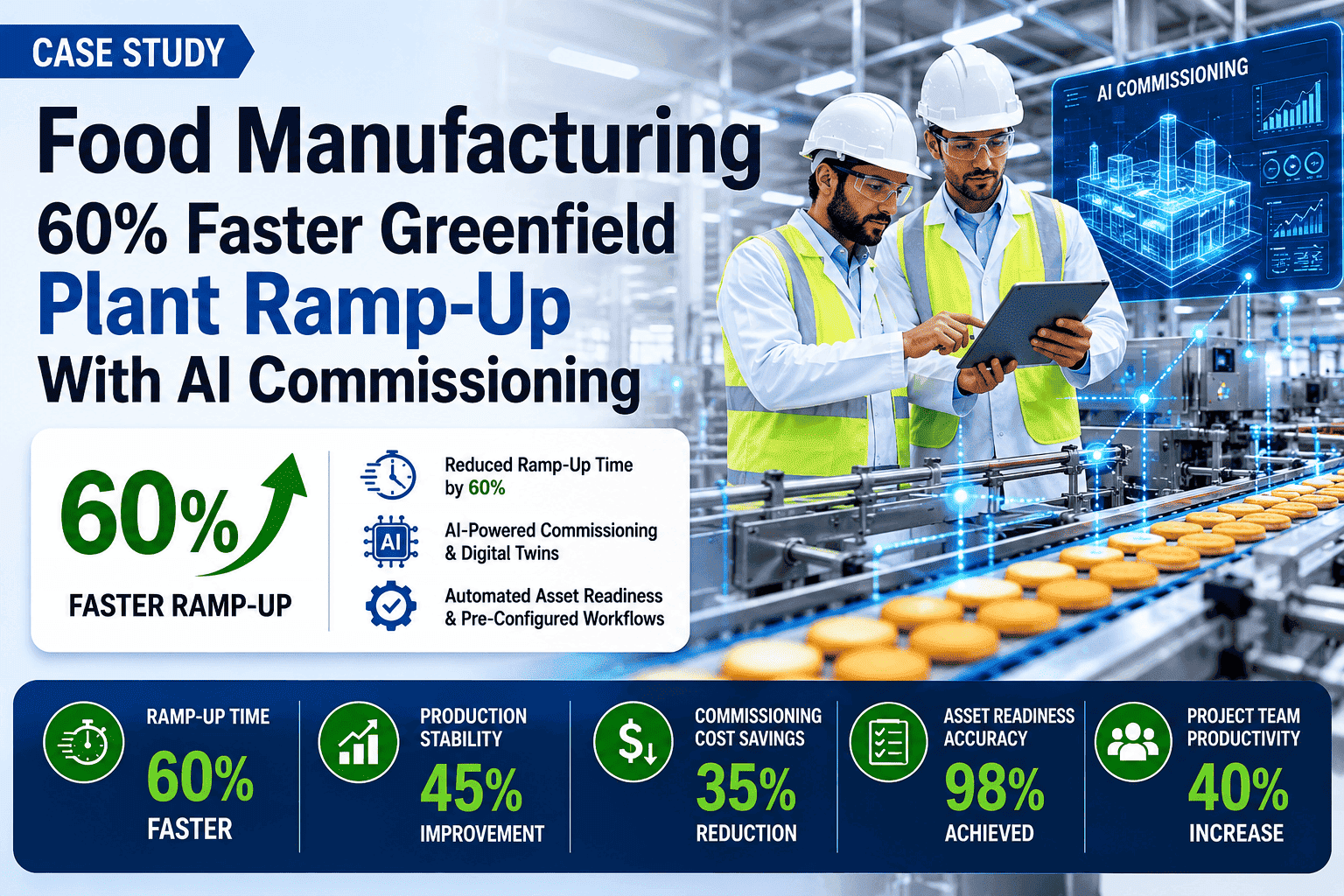
A Fortune 500 North American food manufacturer building a new $180M frozen ready-meals facility used AI-powered commissioning to compress greenfield ramp-up from a planned 56 weeks to just 22 weeks — a 60% reduction. The approach combined virtual commissioning via digital twin, automated asset readiness, and Day-1 CMMS activation with pre-configured maintenance workflows. This anonymized case study documents the approach, phase-by-phase execution, and quantified business impact. Schedule a commissioning consultation to evaluate a similar approach for your greenfield project.
Case Study · Food Manufacturing · 2026
Customer Profile (Anonymized)
IndustryFrozen ready-meals manufacturing
Scale$180M greenfield facility
LocationU.S. Southeast
Production4 lines, 280K units/day
60% Faster Greenfield Plant Ramp-Up
From 56-week planned ramp-up to 22 weeks actual — using AI-powered commissioning, digital twin validation, automated asset readiness, and Day-1 CMMS activation.
60%
Faster Ramp-Up
22 weeks vs 56-week industry baseline
$8.4M
Revenue captured in early production
92%
FAT pass rate on first attempt
Day 1
CMMS active with full asset data
34 wks
Schedule compression vs plan
The Customer & The Challenge
The customer is a Fortune 500 North American food manufacturer expanding capacity in the frozen ready-meals category. The greenfield facility represented a $180M capital investment with four production lines targeting 280,000 units per day at full ramp. Time-to-revenue was the central constraint. Every week of delayed full production represented approximately $240K in deferred revenue plus carrying costs on $180M in deployed capital. The internal planning baseline called for a 56-week ramp from mechanical completion to certified full production — consistent with industry norms for FSMA-regulated food manufacturing. Leadership challenged the engineering team to find a path to compress this timeline materially without compromising food safety qualification rigor.
01
Sequential Commissioning Bottleneck
Traditional commissioning runs sequentially: mechanical completion → SAT → IQ → OQ → PQ. Each phase waits for the previous. Issues found in OQ trigger rework cascading backward. Industry average: 14 weeks from mechanical completion to first qualified production, with frequent slips.
02
CMMS Activation Gap
Maintenance teams typically start with a blank CMMS at mechanical completion. Asset hierarchies, PM schedules, spare parts catalogs, and work order templates take 12–16 weeks to populate. During this gap, reactive maintenance dominates and reliability suffers, slowing ramp.
03
Integration Surprises at SAT
Protocol mismatches between equipment vendors, SCADA, MES, and ERP systems surface during Site Acceptance Test — when they’re most expensive to fix. Industry data: integration issues account for 38% of commissioning delays. Each delay cascades schedule and budget.
04
Operator Training Bottleneck
Operator training on live equipment competes with commissioning activities for plant access. Limited training time delays qualification. New operators meeting production volumes require 8–12 weeks of supervised running before they sustain target rates.
Facing similar greenfield ramp-up challenges? Schedule a commissioning consultation — we’ll evaluate which AI commissioning capabilities apply to your specific facility design, production volume, and regulatory profile.
The AI Commissioning Approach
The team adopted iFactory’s AI-powered commissioning methodology built around four reinforcing capabilities. Each addressed a specific traditional bottleneck. Together they enabled parallel commissioning activities, early issue detection, and Day-1 operational readiness rather than the sequential, surprise-prone industry-standard approach.
Pillar 01
Virtual Commissioning via Digital Twin
Complete plant digital twin built during detailed engineering phase. PLC code, control logic, equipment interlocks, and protocol handshakes validated in the digital twin before physical installation. Result: 80%+ of integration issues caught in simulation, eliminated before they reached the floor.
Impact:
8 weeks saved on SAT phase
Pillar 02
Day-1 CMMS Activation
Asset hierarchies, PM schedules, OEM-recommended spare parts, and work order templates pre-loaded during construction phase using vendor data plus AI-extracted information from O&M manuals. CMMS goes live at mechanical completion, not 12 weeks later. Maintenance team starts informed.
Impact:
12 weeks saved on maintenance ramp
Pillar 03
AI-Powered Anomaly Detection During Ramp
Machine learning models trained on industry benchmark data and digital twin simulation outputs monitor every signal during ramp. Anomalies detected within minutes of occurrence with ranked root cause hypotheses. Engineering team addresses issues before they cascade into quality or downtime.
Impact:
6 weeks saved on ramp stability
Pillar 04
Operator Training via Digital Twin
Operators trained on plant-specific digital twin before mechanical completion. Realistic process scenarios including upset conditions, recipe changes, and CIP cycles. Day-1 operators arrive trained on the actual plant they’ll run, not generic equipment. Faster qualification and fewer Day-1 errors.
Impact:
8 weeks saved on operator qualification
Want to apply this approach to your project? Book a methodology walkthrough — we’ll detail how each of the four pillars maps to your specific facility design and ramp-up timeline.
Phase-by-Phase Implementation Timeline
The 22-week actual ramp-up was structured across five overlapping phases beginning during the late construction stage. Critical to the compression: phases that traditionally run sequentially executed in parallel because the digital twin enabled testing without physical access to the partially-completed plant.
01
Pre-Mechanical Completion (Weeks -16 to 0)
Digital twin built and validated. Virtual FAT executed on all major equipment. PLC code reviewed and integration tested in simulation. CMMS asset hierarchy and PM schedules populated from vendor documentation. Operator training curriculum built into twin scenarios.
Deliverable: 94% of FAT activities completed before equipment arrived
02
Mechanical Completion & SAT (Weeks 0 to 4)
Physical SAT executed on equipment as installed. Because most integration issues were resolved in virtual commissioning, SAT focused on verification rather than discovery. First-time SAT pass rate: 92%. Integration issues fixed in real-time using digital twin to model alternatives before physical changes.
Deliverable: All four production lines SAT-complete in 4 weeks (vs 8-12 baseline)
03
IQ/OQ Qualification (Weeks 4 to 10)
Installation Qualification verified equipment against specifications. Operational Qualification verified equipment performs within tolerance across operating ranges. CIP validation and allergen segregation testing per FSMA requirements. Digital twin used to design OQ test sequences in advance, minimizing physical iteration.
Deliverable: IQ/OQ certified, FSMA preventive controls validated
04
PQ & First Saleable Production (Weeks 10 to 16)
Process Qualification at progressively increasing volumes. AI anomaly detection identifying yield drift, CIP completeness deviations, and temperature variations within minutes. Operators trained on twin run live equipment with confidence. First saleable product certified to commercial specification at week 14.
Deliverable: First commercial shipment from line 1 at week 14
05
Volume Ramp to Steady State (Weeks 16 to 22)
All four lines progressively ramped to 280K units/day target. AI yield optimization tuning recipes against actual plant performance data. Maintenance team operating proactively from Day-1 CMMS with full PM histories. OEE stabilized above 78% by week 22.
Deliverable: Full production volume sustained at target OEE
Plan Your Greenfield Commissioning Timeline
A commissioning consultation maps the four-pillar approach to your specific facility, equipment scope, regulatory requirements, and ramp-up target. Output: a documented commissioning plan with realistic timeline and risk register.
Quantified Business Results
The 60% timeline compression translated directly into business outcomes that justified the AI commissioning investment many times over. The results below compare actual outcomes against the original 56-week planning baseline established during capital approval.
Time from mechanical completion to first commercial shipment
14 weeks (baseline)
→
6 weeks actual
57% faster
Time from first shipment to steady-state production
42 weeks (baseline)
→
16 weeks actual
62% faster
First-time FAT pass rate
65% (industry avg)
→
92% actual
+27 pts
CMMS active with PM schedules and asset data
Week 12 (typical)
→
Day 1 (week 0)
12 weeks earlier
Operator qualification time per role
8–12 weeks
→
3–5 weeks
60% faster
OEE at week 22
62% (baseline forecast)
→
78% actual
+16 pts
Revenue captured during compression period
$0 (baseline)
→
$8.4M actual
Capital ROI accelerated
Could a similar acceleration apply to your project? Book a results review session — we’ll model the potential business impact of AI commissioning against your specific ramp-up baseline and capital plan.
Key Success Factors
Three factors drove the successful 60% timeline compression. Plants attempting similar acceleration without all three see significantly reduced benefits — the approach is not modular. Critically, the decision to deploy AI commissioning was made during basic engineering phase, when digital twin integration into facility design was still possible. Plants making this decision after construction starts capture only a fraction of the potential acceleration.
01
Early Decision (Basic Engineering Phase)
Digital twin and AI commissioning capabilities were integrated into facility design during basic engineering, not retrofitted later. Equipment specifications included data connectivity requirements. Vendor selection prioritized open protocols. Construction sequence enabled parallel virtual and physical commissioning.
02
Vendor Coordination & Data Access
Equipment vendors contractually required to provide PLC source code, control logic documentation, and digital twin model data. Without this access, virtual commissioning capability is limited to surface-level validation. Procurement specifications explicitly named these requirements.
03
Operations Team Embedded Early
Future plant operators, maintenance leads, and quality team embedded with project team starting 16 weeks before mechanical completion. Used digital twin for training and qualification protocol development. Operations team fully ready Day 1, not in remediation mode through ramp.
Customer Perspective
"The 60% ramp-up compression wasn’t about one technology — it was about restructuring the commissioning process so phases that traditionally run sequentially could run in parallel. The digital twin gave us a place to test integration before physical assembly. The pre-populated CMMS gave maintenance teams full visibility on Day 1 instead of week 12. AI anomaly detection during ramp surfaced issues in minutes instead of days. Operator training on the twin meant Day-1 operators arrived ready, not learning on live equipment. None of these capabilities works alone — the value is in the combination. For our project, $8.4 million in captured early revenue more than justified the AI commissioning investment, and the capability transferred forward into ongoing operations. The next greenfield project will start with all four pillars committed during basic engineering."
— VP Engineering & Project Delivery, Fortune 500 food manufacturer (anonymized customer perspective)
60%
faster ramp-up to steady state
$8.4M
early-production revenue captured
Day 1
CMMS active with full asset data
Apply This Approach to Your Greenfield Project
A commissioning consultation evaluates which AI commissioning capabilities apply to your specific facility design, production volume, regulatory profile, and ramp-up timeline. Output: a documented plan with realistic compression targets and prerequisites.
Frequently Asked Questions
Is the 60% ramp-up reduction realistic for other food manufacturers?
The 60% reduction is achievable when all four AI commissioning pillars are committed during basic engineering phase: virtual commissioning via digital twin, Day-1 CMMS activation, AI anomaly detection during ramp, and digital twin operator training. Plants implementing only one or two pillars typically capture 15–30% acceleration. Plants making the commitment after construction starts capture significantly less because vendor specifications and facility design constraints have already been locked. The case study facility achieved 60% because the decision was made early enough to influence all four pillars.
How much does the AI commissioning approach cost?
AI commissioning investment for a mid-size food manufacturing greenfield typically ranges $1.5M–$4M depending on facility scope, line count, and regulatory complexity. For the case study facility (4 production lines, $180M capital), investment was approximately $2.8M. ROI from captured early revenue alone was 3x in the first year. Additional value from sustained AI operations capabilities (predictive maintenance, anomaly detection, yield optimization) compounds annually.
Schedule a cost-benefit review to model the investment for your specific project.
Does this approach work for non-food greenfield projects?
Yes. The four-pillar AI commissioning approach applies to greenfield projects across industries including pharma, automotive, consumer packaged goods, chemical processing, and discrete manufacturing. Specific implementation varies — pharma adds IQ/OQ/PQ documentation rigor, automotive emphasizes line balancing simulation, semiconductor requires extreme cleanroom validation — but the underlying principle of parallel virtual + physical commissioning, Day-1 operational systems, and AI-guided ramp applies universally. Regulated industries typically capture larger benefits because traditional sequential commissioning is most painful in those environments.
What if our equipment vendors won’t share PLC code or twin model data?
Vendor data access is a contractual issue solved in procurement specifications. Modern equipment vendors increasingly provide digital twin models, PLC documentation, and integration data because customers require it. If vendors resist, customers have negotiating leverage: equipment award depends on data access. The case study facility’s procurement specifications explicitly required PLC source code, control logic documentation, twin-ready data interfaces, and OPC-UA protocol support. Vendors who couldn’t meet these requirements were excluded from bid consideration.
How do we know when to start AI commissioning planning?
The right window is during basic engineering phase — typically 18–24 months before mechanical completion target. This timing allows facility design, vendor selection, and procurement specifications to incorporate digital twin and AI commissioning requirements. Plants starting AI commissioning planning during detailed engineering (12–15 months before MC) capture 30–40% of potential acceleration. Plants starting during construction (less than 9 months before MC) capture only 10–15%. The earlier the commitment, the larger the capture.