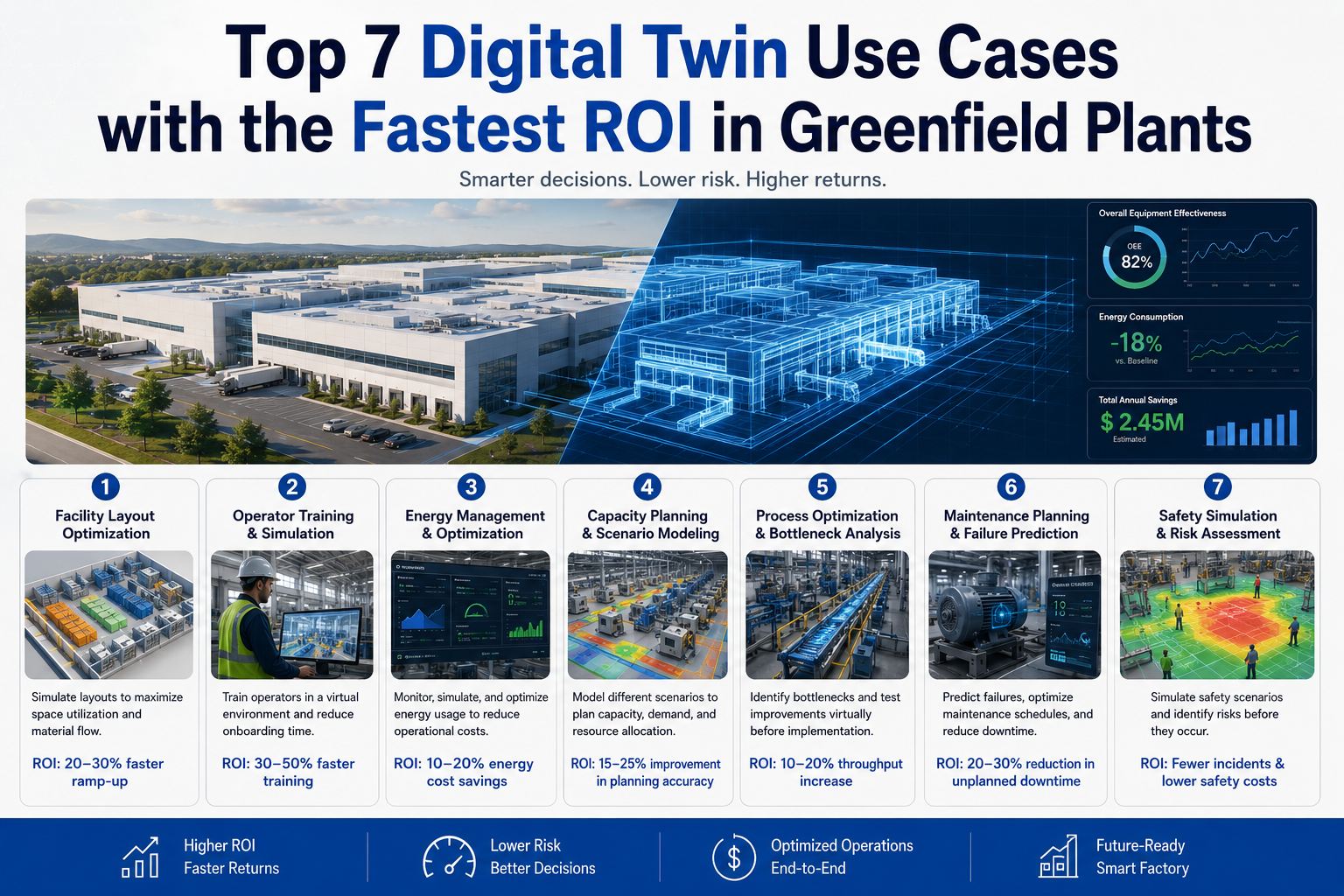
Most digital twin pilots fail not because the technology underdelivers, but because the wrong use case was picked first. The fastest-ROI use cases pay back in 9 to 16 months and deliver 200 to 500% returns in year one. The slowest take 24 to 36 months and produce a stalled pilot cut at the next budget review. The difference is choosing use cases where the cost of the current pain is measurable, the data already flows, and corrective action can happen without organizational restructuring. The seven ranked below are what disciplined greenfield builders deploy first. Book a digital twin consultation to map them against your facility.
Predictive Maintenance Twin
Facility Layout Optimization
Energy Management Simulation
Capacity & Scheduling Twin
Operator Training Simulation
Safety & Incident Simulation
Virtual Commissioning
1. Predictive Maintenance Twin — Fastest Payback at 9–12 Months
The single highest-ROI digital twin use case is asset-level predictive maintenance. Sensor data from motors, pumps, compressors, and rotating equipment feeds a live model that forecasts failures 14 to 21 days in advance — converting reactive emergency work into planned maintenance windows.
Why it's #1: The cost of unplanned downtime is already on every plant's books. The greenfield advantage is enormous — sensors are designed into the equipment from day one rather than retrofitted. A 200-asset plant typically identifies $1.2M–$3.5M in annual savings from downtime avoidance alone.
2. Facility Layout Optimization — $1.5M Documented Savings
Greenfield plants can simulate every layout decision before a single concrete pour. AGV fleet sizing, conveyor routing, material flow paths, workstation positioning — all tested virtually against production volume scenarios. One electronics manufacturer saved $1.5M by reducing planned AGV fleet from 25 vehicles to 10 through twin simulation alone.
Greenfield-exclusive advantage: Layout changes after construction cost 10–50× more than design-stage changes. Twin simulation during design lets you test 20 layout variants in days rather than committing to one and discovering its bottlenecks after commissioning.
3. Energy Management Simulation — 20–30% Energy Cost Reduction
Energy twins model the consumption profile of every asset and the entire plant. Simulations identify the optimal production schedule for energy cost (off-peak shifting, demand-charge avoidance), the over-provisioned utilities, and the equipment running outside efficient operating ranges.
Why it scales fast: Energy data is already metered at most plants. Combined with production schedule data, the twin identifies waste within weeks of go-live. The savings flow directly to operating margin and Scope 2 emissions reporting.
Want these 7 use cases prioritized against your specific facility? Book a digital twin consultation — we will rank them by ROI on your data before deployment begins.
4. Capacity & Scheduling Twin — 7% Monthly Cost Compression
A capacity twin models material flow, machine utilization, shift patterns, and changeover sequences against demand forecasts. McKinsey research shows digital twins compress monthly operating costs by up to 7% through scheduling optimization alone — by avoiding overtime, sequencing changeovers efficiently, and balancing line load.
Hidden benefit: The twin enables "what-if" scheduling — testing the impact of demand surges, supplier delays, or new SKU introductions before committing physical resources. This decision-support value compounds beyond the direct cost reduction.
5. Operator Training Simulation — 40–60% Faster Competency
New operators learn on a virtual factory floor before touching real equipment. Simulated fault scenarios — overpressure events, motor trip sequences, process upsets — build competence safely. Training time drops 40–60%, equipment misuse incidents fall, and senior operators can advise remotely using the twin as a shared operational view.
Workforce reality: Skilled labor is the #1 reshoring constraint in 2026. A training twin lets greenfield plants ramp from concept to full production capacity faster — and brings new hires to competency in weeks rather than months.
6. Safety & Incident Simulation — Pre-Startup Hazard Validation
A safety twin runs failure scenarios virtually — overpressure, runaway reactions, motor trips, evacuation routes, emergency response sequences. Every hazard the OSHA process safety management standard requires you to evaluate can be tested in the twin before the plant is commissioned, with documented evidence trail.
Why it pays back: The OSHA penalty for one willful safety violation runs $165,514. A single prevented incident from twin-based hazard simulation typically funds the entire twin program for the year. Insurance premium implications often follow.
7. Virtual Commissioning — 20–30% Turnaround Compression
Virtual commissioning runs the entire startup sequence in the twin before the physical plant fires up. Control logic is tested against simulated equipment, PLC code is validated against twin behavior, and operator response is rehearsed against virtual fault scenarios. Greenfield plants using virtual commissioning compress startup duration by 20–30% and eliminate the rework that typically follows physical commissioning.
Greenfield-perfect fit: Virtual commissioning requires a twin built before physical plant exists — which is exactly what greenfield projects produce. The same twin that validates PLC code becomes the operational digital twin after startup, multiplying value.
The 7 Use Cases Side-by-Side: Cost vs Payback vs Year-1 Return
Picking 1 or 2 use cases to start matters more than picking 7. The matrix below summarizes the trade-off between pilot cost, payback window, and year-1 ROI — so the CFO can validate the case before deployment.
Expert Perspective: Why 75% of Twin Pilots Stall — and How to Avoid It
Gartner reports that 75% of organizations implementing digital twins struggle to scale beyond initial pilots. The technology works — the failure mode is implementation strategy. The pilots that stall picked the wrong use case first, defined success too broadly, or tried to model the whole plant before proving value on one asset class. The pilots that scale picked a single high-cost pain point — typically predictive maintenance on the 20 most expensive assets — proved 200 to 500% Y1 ROI on that scope, then expanded incrementally. The greenfield advantage is that you can sequence this from day one. The asset twin gets built into the sensor specification during design. The layout twin lives inside the construction documents. The energy twin connects to the utility design. The training twin lives in the operator readiness program. None of these are afterthoughts. They are line items in the project plan.
— iFactory Greenfield Consulting, Digital Twin Practice 2025 to 2026
Ready to pick the 2 use cases that pay back fastest on your facility? Talk to our digital twin team — we will rank all 7 against your specific data.