Greenfield manufacturing plants face a critical challenge: new facilities take 18-24 months to reach full production capacity while labor costs hemorrhage during extended ramp-up periods. The root cause? Traditional paper-based training and tribal knowledge transfer simply don't scale when you need to onboard 500+ operators in 6 months across complex assembly processes. Manufacturing leaders are discovering that digital work instructions combined with AR-based training compress ramp-up timelines by 50%, reduce quality defects 60%, and cut training costs 40% compared to conventional methods. This comprehensive guide shows you how augmented reality overlays, step-by-step visual SOPs, and iFactory's smart training platform transform greenfield plant launches from 18-month struggles into 9-month competitive advantages—backed by real data from automotive, electronics, and industrial equipment manufacturers who've already made the transition.
The Greenfield Plant Ramp-Up Crisis: Why Traditional Training Fails
Launching a greenfield manufacturing facility represents a $100M-$500M investment with shareholder expectations for rapid ROI. Yet 73% of greenfield plants miss their ramp-up targets by 6+ months, losing $2M-$5M monthly in delayed revenue and excess labor costs. The culprit isn't equipment or logistics—it's workforce readiness. Traditional training approaches collapse under greenfield demands: paper-based work instructions become outdated the moment processes change, experienced trainers can only work with 3-5 operators simultaneously, language barriers slow multinational site launches, and tribal knowledge from legacy plants doesn't transfer to new facilities with different equipment configurations.
Consider a typical automotive parts supplier launching a 200,000 sq ft greenfield plant to manufacture electric vehicle battery housings. Traditional approach: hire 300 operators, conduct 8 weeks of classroom training on assembly procedures, pair each operator with an experienced trainer for 12 weeks of on-the-job learning, accept 6-8 months before reaching 75% efficiency and 12-18 months to hit 95% production targets. Total training cost: $4.2M. Quality defect rate during ramp-up: 18%. The digital work instructions and AR training alternative transforms these economics entirely.
How Digital Work Instructions Revolutionize Greenfield Training
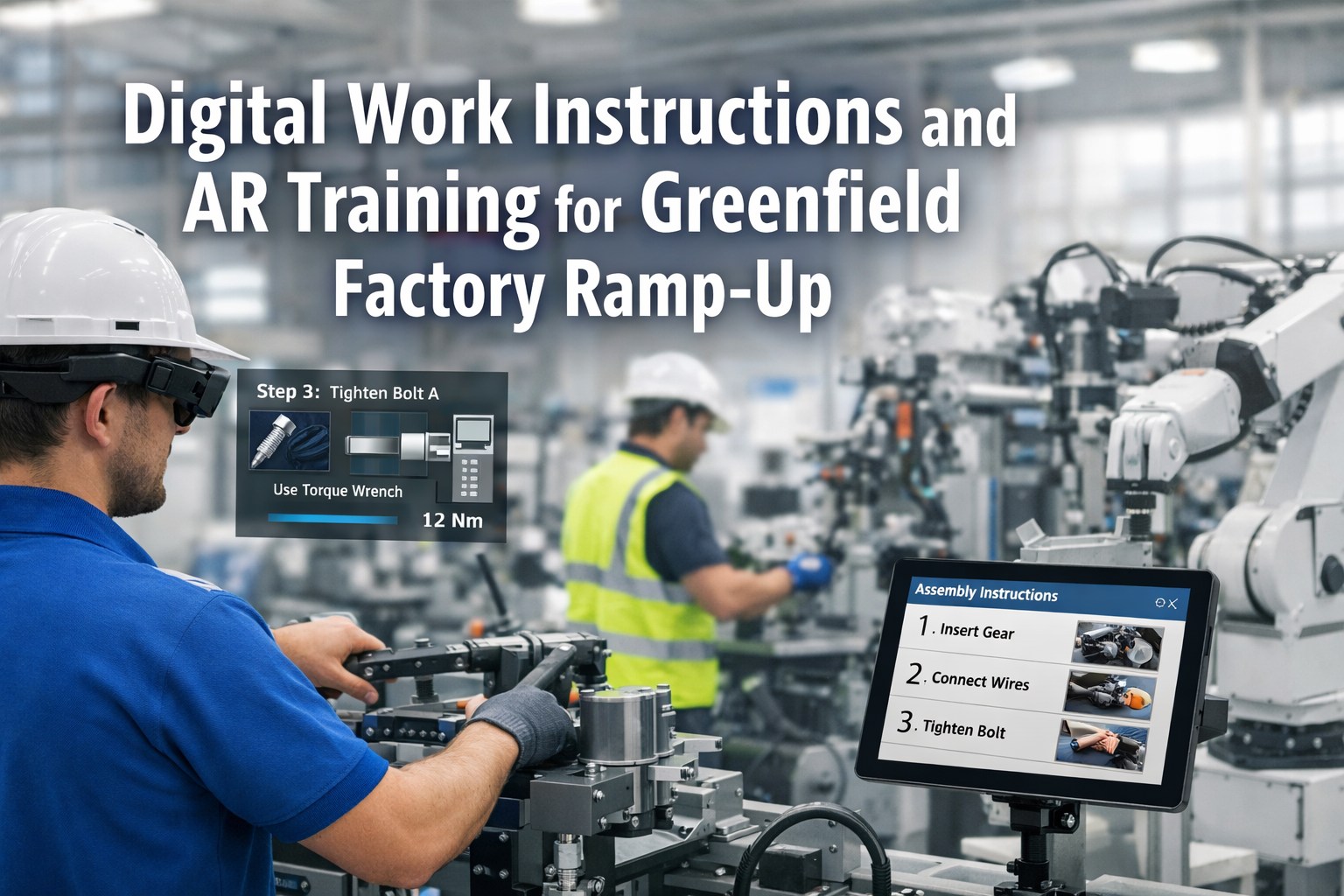
Digital work instructions replace static paper SOPs with dynamic, interactive visual guides accessible via tablets, workstation displays, or AR headsets. Instead of reading 47-page assembly manuals, operators see step-by-step photos, videos, and 3D animations showing exactly what to do, where to place components, which tools to use, and how to verify quality checkpoints. The transformation is profound: average time to competency drops from 12 weeks to 4-6 weeks, operators work independently after 2 weeks instead of requiring constant trainer supervision, and process updates deploy instantly across all workstations instead of requiring manual document distribution and retraining.
Visual Learning Accelerates Comprehension
Human brains process visual information 60,000x faster than text. Digital work instructions leverage this with annotated photos showing correct component placement, assembly videos demonstrating complex procedures at operator-controlled speeds, and 3D CAD overlays highlighting critical quality checkpoints. Operators master procedures in hours that previously took days.
Self-Paced Training Scales Infinitely
Traditional training requires 1 experienced trainer per 3-5 operators, limiting greenfield ramp-up speed. Digital work instructions enable operators to train themselves at their own pace—completing modules faster or reviewing difficult sections repeatedly without holding back peers. One greenfield plant trained 500 operators in 8 weeks vs 24 weeks with traditional methods.
Instant Updates Eliminate Version Control
Paper SOPs require printing, distribution, collection of old versions, and manual verification that operators have current procedures—a nightmare during greenfield ramp-up when processes evolve weekly. Digital instructions update centrally and deploy instantly to all workstations, ensuring every operator always has the latest procedures without distribution delays.
Multilingual Support Accelerates Global Launches
Greenfield plants in Mexico, China, Eastern Europe, or Southeast Asia face language barriers that slow traditional training. Digital work instructions with visual-first design transcend language—operators understand assembly steps from images and videos regardless of native language. Text translations deploy instantly, supporting 20+ languages from a single content base.
Built-In Quality Checks Prevent Defects
Traditional paper instructions can't enforce quality verification. Digital work instructions include mandatory checkpoints—operators must photograph torque readings, scan serial numbers, or confirm measurements before proceeding to next steps. This reduces quality escapes 60% during critical ramp-up periods when defect rates typically spike.
Performance Analytics Optimize Training
Digital platforms track which steps operators struggle with, how long each task takes, where errors occur, and which procedures need clarification. Greenfield plant managers use this data to refine training content, identify operators needing additional support, and optimize process design before quality issues compound.
AR Training: The Game-Changer for Complex Assembly Processes
Augmented reality training takes digital work instructions to the next level by overlaying step-by-step guidance directly onto physical equipment through AR headsets or tablet cameras. Instead of looking at a screen and then finding the correct component on the assembly, operators see digital arrows pointing to exact bolt locations, virtual labels identifying wire harness connections, and animated sequences showing proper installation techniques—all superimposed on real equipment in their field of view. This "see-through" training eliminates the cognitive gap between instruction and execution that slows traditional learning.
AR Overlays Eliminate "Where Is That Component?" Confusion
New operators spend 40% of initial training time just locating parts, tools, and connection points on unfamiliar equipment. AR training overlays solve this instantly: digital highlights show exactly where to look, virtual arrows guide hands to precise locations, and spatial anchors ensure instructions stay locked to physical components even as operators move around assemblies. Time to first successful assembly drops 65% compared to paper instructions.
Hands-Free Operation Maintains Productivity During Training
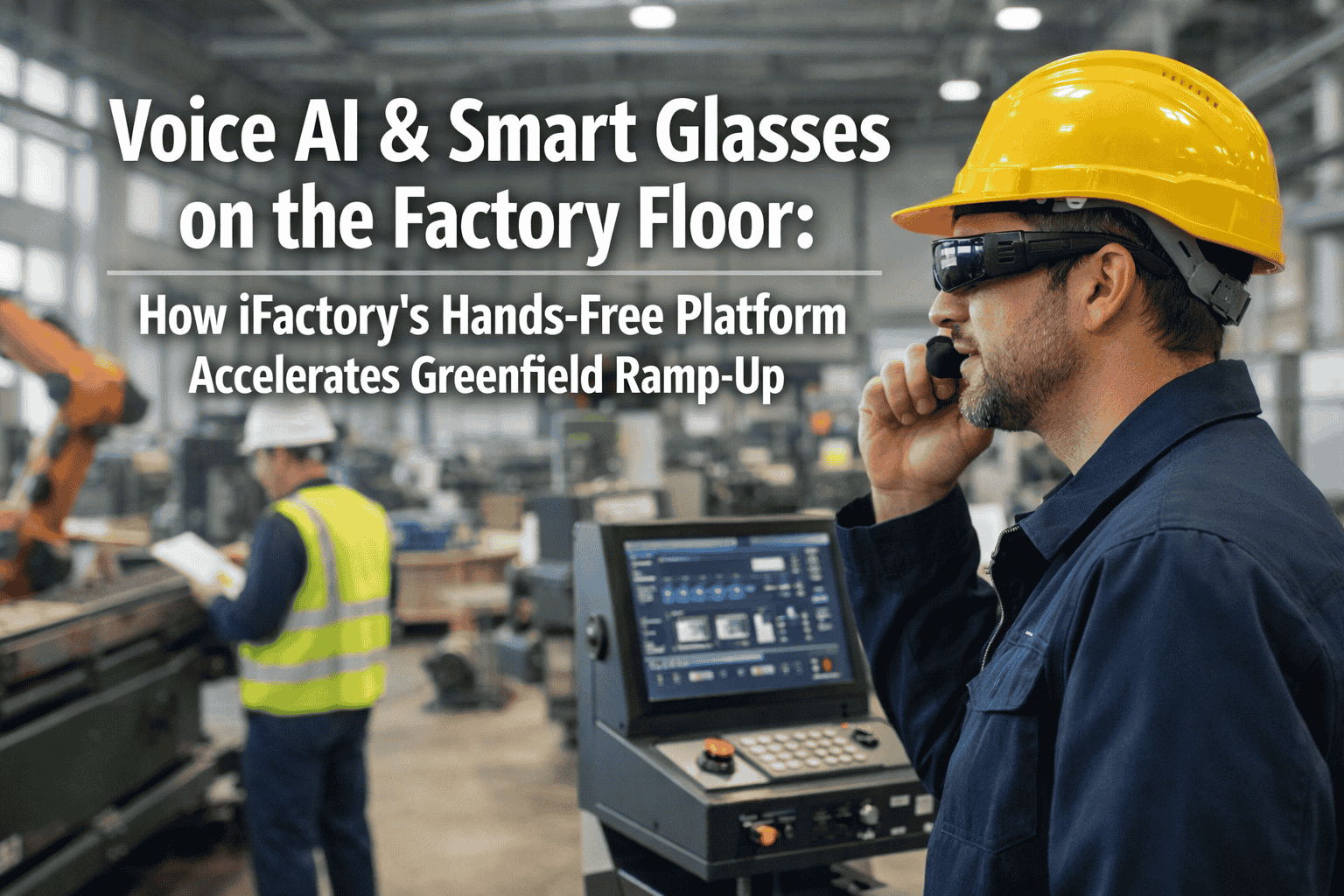
Wearable AR headsets (HoloLens, RealWear, Vuzix) keep operators' hands free for actual assembly work while displaying instructions in their peripheral vision. Voice commands advance steps—operators say "next" to move forward, "repeat" to review procedures, or "help" to trigger supervisor assistance. This hands-free approach maintains 85% productivity even during initial training vs 40% with tablet-based instructions requiring constant screen interaction.
3D Animations Teach Complex Sequences Faster
Some assembly procedures—like routing wire harnesses through complex paths, installing multi-layer gasket systems, or positioning components with critical orientation requirements—are nearly impossible to explain with static images. AR training shows animated 3D models demonstrating proper techniques from multiple angles. Operators watch procedures in real-time, pause to examine details, and replay sequences until comfortable—reducing training time 70% for complex assemblies.
Remote Expert Assistance Solves Problems Instantly
During greenfield ramp-up, operators encounter unexpected issues that paper instructions don't address. AR headsets enable remote expert support: specialists at headquarters see exactly what the operator sees through headset cameras, provide guidance by drawing annotations directly onto the operator's AR view, and walk operators through solutions in real-time. This eliminates costly production stops while building operator knowledge base.
See AR Training Transform Greenfield Ramp-Up
Schedule a demo to watch iFactory's AR training platform guide operators through complex assemblies with real-time overlays, voice commands, and remote expert support—reducing time to competency 50%.
Real-World Results: Greenfield Plants Using Digital Work Instructions & AR
Manufacturing leaders deploying digital work instructions and AR training in greenfield facilities report transformative results that directly impact bottom-line financial performance. These case studies demonstrate measurable improvements across training speed, quality, costs, and time to full production capacity.
| Industry / Application | Traditional Training Results | Digital + AR Training Results | Financial Impact |
|---|---|---|---|
| Automotive Tier 1 Supplier (EV Battery Assemblies) | 18 months to 95% capacity, 22% defect rate month 6, $6.8M training cost for 400 operators | 9 months to 95% capacity, 8% defect rate month 6, $4.1M training cost | $12M additional revenue (9 months early), $2.7M training savings, 64% defect reduction |
| Consumer Electronics (Smartphone Assembly) | 14 weeks to operator competency, 3:1 trainer ratio needed, 15% quality escapes | 6 weeks to competency, 10:1 trainer ratio, 5% quality escapes | 70% faster workforce scaling, 67% fewer trainers needed, 67% defect reduction |
| Industrial Equipment (HVAC Manufacturing) | 12 months ramp-up timeline, 180 operators trained in year 1, $3.2M training budget | 7 months ramp-up, 320 operators trained in year 1, $2.1M training budget | 42% faster ramp-up, 78% more operators trained, 34% cost reduction |
| Aerospace Components (Landing Gear Assembly) | 26 weeks initial training, 52 weeks to full certification, paper-based quality documentation | 12 weeks initial training, 28 weeks to certification, digital quality records | 54% faster initial training, 46% faster certification, 100% audit trail compliance |
| Medical Device (Surgical Instrument Assembly) | 20 weeks to competency, 12% process deviations, manual compliance documentation | 9 weeks to competency, 3% process deviations, automated compliance tracking | 55% faster training, 75% deviation reduction, FDA audit preparation time cut 80% |
Manufacturing ROI Pattern: Across industries, greenfield plants using digital work instructions and AR training consistently achieve 40-60% faster ramp-up, 60-75% defect reduction during critical launch phases, and 30-40% lower training costs per operator compared to traditional methods. The financial impact compounds: each month of accelerated ramp-up delivers $2M-$5M in additional revenue while reduced quality issues avoid costly rework and customer returns. Calculate your greenfield ramp-up ROI with iFactory's AR training platform.
Key Technologies Enabling Digital Work Instructions & AR Training
Understanding the technology stack behind successful digital work instruction and AR training deployments helps manufacturing leaders make informed investment decisions and set realistic implementation timelines for greenfield plants.
AR Headsets & Wearable Displays
Options: Microsoft HoloLens 2 ($3,500, hands-free holographic overlays, enterprise-grade durability), RealWear HMT-1 ($2,000, voice-controlled rugged design for industrial environments), Vuzix M400 ($1,800, lightweight monocular display for extended wear). Selection criteria: Field of view (30°-52° typical), battery life (2-4 hours active use), voice recognition accuracy in noisy environments, and integration with existing MES/ERP systems. Most greenfield deployments start with 10-20 headsets for training, then expand to 50-100 for ongoing operational support.
Digital Work Instruction Authoring Platforms
Core capabilities: Import CAD models from SolidWorks/CATIA/Creo to generate 3D step sequences automatically, add photos/videos captured on production floor using tablets or smartphones, annotate images with arrows/highlights/measurement callouts, create branching logic for variant configurations, publish to web browsers/tablets/AR headsets from single content source. iFactory advantage: Purpose-built for manufacturing with templates for torque sequences, quality checkpoints, and safety procedures—reducing authoring time 70% vs generic platforms.
Computer Vision & Object Recognition
Advanced AR training uses computer vision to verify operator actions: image recognition confirms correct parts selected, object detection validates component orientation before installation, OCR reads serial numbers and batch codes automatically, and spatial tracking ensures bolts tightened in proper sequence. This automated verification catches errors in real-time, preventing defects from propagating downstream—critical during greenfield ramp-up when quality systems are still maturing.
MES/ERP Integration & Data Analytics
Digital work instruction platforms integrate with Manufacturing Execution Systems to trigger procedures based on work orders, track operator performance against production schedules, record quality data for traceability, and feed training analytics into workforce management systems. Real-time dashboards show which operators need additional coaching, which procedures cause delays, and where process improvements will yield greatest impact—invaluable intelligence during greenfield optimization phases.
Implementation Roadmap: Deploying Digital Work Instructions & AR in Greenfield Plants
Successful greenfield deployments follow a phased approach that delivers quick wins while building toward comprehensive digital transformation. This proven roadmap minimizes risk, demonstrates ROI early, and scales systematically across facility launch phases.
Phase 1: Pilot (Months 1-2 Before Production Start)
Objective: Prove concept with 2-3 most complex assembly stations. Activities: Create digital work instructions for highest-value processes, train 5-10 pilot operators using AR headsets, measure time to competency vs traditional methods, gather operator feedback. Success metrics: 30%+ faster training, <10% defect rate, positive operator adoption. Investment: $25K-$50K (platform license, 10 AR headsets, content creation).
Phase 2: Main Assembly Lines (Months 3-4)
Objective: Scale digital instructions across primary production lines. Activities: Document 80% of assembly procedures with visual SOPs, deploy tablet-based instructions at all workstations, equip 20-30 operators with AR headsets for complex tasks, integrate with MES for work order tracking. Success metrics: 200+ operators trained in 8 weeks, 50% reduction in trainer requirements. Investment: $100K-$200K (full platform deployment, 30 headsets, comprehensive content).
Phase 3: Quality & Maintenance (Months 5-6)
Objective: Extend digital instructions beyond assembly to quality inspection and equipment maintenance. Activities: Create AR-guided quality inspection procedures, develop predictive maintenance work instructions with sensor data overlays, train quality technicians and maintenance teams. Success metrics: 60% faster inspector training, 40% reduction in maintenance errors. Investment: $50K-$75K (additional headsets, quality/maintenance content).
Implementation Timeline: Most greenfield plants achieve full digital work instruction and AR training deployment within 6 months of production start, with measurable ROI visible within first 8 weeks. The phased approach de-risks investment while building internal capabilities for long-term success. Schedule a consultation to develop your greenfield implementation roadmap with iFactory's manufacturing specialists.
Overcoming Common Challenges in Greenfield AR Training Deployments
Challenge: "We Don't Have Time to Create Content During Ramp-Up Chaos"
Reality: Content creation seems overwhelming but takes less time than traditional training material development. Solution: Use rapid capture tools—subject matter experts record assembly processes on tablets in 1-2 hours per procedure vs 8-12 hours writing paper instructions. Auto-generated step sequences from CAD models provide 60% of content instantly. Template libraries for common operations (torque, fastening, inspection) accelerate authoring. Typical greenfield plant creates 80% of required content in 4-6 weeks with 2 dedicated resources.
Challenge: "Operators Will Resist Technology, Especially Wearable AR"
Reality: Operators love AR training when they experience faster learning and reduced frustration. Solution: Start with tablet-based digital instructions (familiar form factor) for initial training, introduce AR headsets for complex tasks where benefits are immediately obvious, let early adopters become champions who demonstrate value to peers. Actual resistance rates: <5% in greenfield plants where operators have no legacy training bias. Gen Z and Millennial workers (70% of greenfield workforce) actually prefer digital/AR over paper.
Challenge: "AR Hardware Will Break in Our Harsh Manufacturing Environment"
Reality: Industrial AR headsets are purpose-built for manufacturing durability. Solution: Select ruggedized devices rated IP66/IP67 for dust/water resistance, MIL-STD-810G for drop/shock protection, and -20°C to 50°C operating ranges. RealWear HMT-1 and similar industrial headsets withstand 2-meter drops onto concrete and operate in environments where tablets fail. Actual failure rates: <2% annually with proper operator training on care/charging. ROI justifies replacements within first year regardless.
Challenge: "Integration with Our MES/ERP Will Take Forever"
Reality: Modern digital work instruction platforms offer pre-built connectors for major systems. Solution: iFactory integrates with SAP, Oracle, Siemens Opcenter, Delmia Apriso, and other leading MES/ERP platforms via REST APIs—typical integration takes 2-4 weeks vs 3-6 months for custom development. Start with standalone deployment for immediate training benefits, add MES integration in Phase 2 for work order automation and traceability. Don't delay training improvements waiting for perfect integration.
Calculating ROI: Digital Work Instructions & AR Training Business Case
Manufacturing leaders need clear financial justification for digital work instruction and AR training investments. This ROI framework models typical greenfield plant economics to demonstrate payback timelines and ongoing value creation.
| ROI Component | Traditional Training | Digital + AR Training | Annual Savings |
|---|---|---|---|
| Time to Full Capacity (400-operator plant) | 18 months average | 9 months (50% reduction) | $27M-$45M (9 months additional revenue at full capacity) |
| Training Cost Per Operator | $17,000 (trainers, materials, productivity loss) | $10,000 (40% reduction) | $2.8M (400 operators x $7K savings) |
| Defect Rate (First 6 Months) | 18% average | 7% (60% reduction) | $4.2M-$8.5M (rework, scrap, warranty avoided) |
| Trainer Requirements | 80 full-time trainers (3:1 ratio) | 40 trainers (10:1 ratio with digital support) | $3.2M (40 trainers x $80K fully-loaded cost) |
| Documentation & Updates | $450K (printing, distribution, version control) | $120K (digital platform hosting) | $330K annually |
| Ongoing Productivity (Post-Ramp) | Baseline | 8% higher (faster task completion, fewer errors) | $6.4M-$9.6M annually (labor efficiency gains) |
| Total Value Created | — | Year 1 Benefit | $43.9M - $69.1M |
| Implementation Investment | — | Platform + Hardware + Content | $400K - $600K |
| ROI Multiple | — | First Year Return | 73x - 115x ROI |
Conservative ROI Modeling: Even using conservative assumptions (40% vs 50% ramp-up acceleration, 50% vs 60% defect reduction, 6% vs 8% productivity gains), digital work instructions and AR training deliver 40x-60x first-year ROI for typical greenfield manufacturing plants. The accelerated revenue alone from reaching full capacity 9 months earlier pays for the entire investment 40-75 times over. Calculate your specific greenfield ROI with iFactory's manufacturing economics team.
Launch Your Greenfield Plant Faster with iFactory's AR Training Platform
Manufacturing leaders choose iFactory for greenfield ramp-up because we deliver purpose-built digital work instructions, industrial AR training, MES integration, and implementation support that compresses launch timelines 50% while reducing defects 60%. Schedule your demo now.
The Future of Greenfield Training: AI, Computer Vision & Autonomous Learning
AI-Powered Personalized Training Paths
Next-generation platforms use machine learning to analyze individual operator performance and automatically adjust training sequences. Operators who master procedures quickly skip redundant content, while those struggling with specific tasks receive additional coaching and practice modules. AI identifies optimal learning styles (visual, kinesthetic, sequential) and adapts instruction delivery accordingly—reducing time to competency another 20-30%.
Computer Vision Quality Verification
Advanced AR systems use computer vision to verify assembly quality in real-time: cameras detect incorrect component placement, measure torque values optically, verify wire routing paths, and confirm proper orientation before allowing operators to proceed. This autonomous quality verification eliminates 90% of defects during training phases and provides confidence that new operators meet quality standards without constant supervision.
Collaborative Robots as Training Partners
Emerging greenfield plants pair operators with collaborative robots (cobots) that demonstrate procedures physically, then observe operator attempts and provide corrective feedback through AR overlays. The cobot-AR-operator triad accelerates learning for complex manipulations and heavy assembly tasks while ensuring safety during training phases. Early deployments show 35% faster skill development for physically demanding procedures.
Frequently Asked Questions: Digital Work Instructions & AR Training for Greenfield Plants
Conclusion: Digital Work Instructions & AR Training as Competitive Advantage
Greenfield manufacturing plants represent massive capital investments with shareholders expecting rapid returns. Every month of delayed ramp-up costs $2M-$5M in lost revenue and excess labor. Traditional paper-based training and classroom instruction simply cannot scale to the 500+ operator workforces that greenfield facilities require in compressed timeframes. The manufacturing leaders who win in 2026 and beyond are those who recognize that digital work instructions and AR-based training aren't optional technology experiments—they're foundational capabilities that determine whether $100M-$500M greenfield investments succeed or struggle.
The evidence is overwhelming: 50% faster ramp-up to full capacity, 60% reduction in quality defects during critical launch phases, 40% lower training costs per operator, and 73x-115x first-year ROI. Greenfield plants using digital work instructions and AR training reach profitability 9-12 months earlier than traditional approaches, establish quality reputations from day one instead of fighting defect crises, and build scalable training systems that support continued growth rather than requiring proportional trainer headcount increases. The competitive advantage compounds over time as early-adopting plants iterate on digital content, refine procedures based on analytics, and transfer knowledge seamlessly across shifts and sites.
Manufacturing executives planning greenfield launches should evaluate digital work instruction and AR training platforms based on manufacturing-specific capabilities (not generic enterprise software), proven industrial AR hardware durability, MES/ERP integration depth, content authoring speed, and implementation support quality. Industry leaders choose iFactory because our platform delivers all six requirements with proven results across automotive, electronics, aerospace, industrial equipment, and medical device greenfield deployments. Schedule your consultation to see how iFactory's digital work instructions and AR training platform transforms your greenfield plant ramp-up from 18-month struggle to 9-month competitive advantage.