Voice AI & Smart Glasses for Greenfield Factory Ramp-Up
By Riley Quinn on April 13, 2026
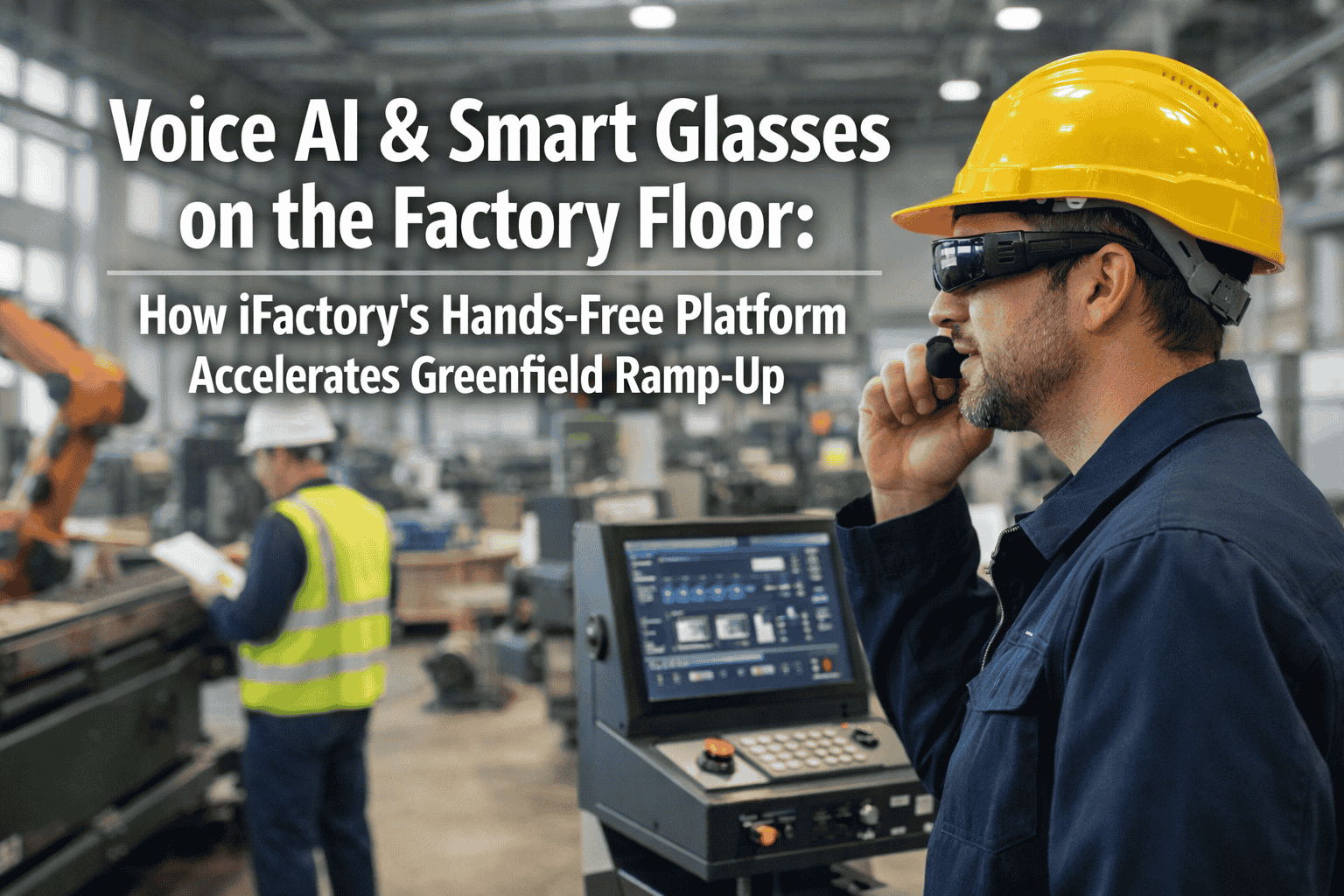
Your operators shouldn't need to stop working to check a dashboard. They shouldn't flip through 200-page manuals while standing on a ladder. And they definitely shouldn't wait 3 weeks for tribal knowledge transfer from the one technician who knows how the system actually works. In 2026, the factories ramping up fastest are the ones where operators simply ask a question—and get the answer instantly, hands-free, in their native language. Voice AI and smart glasses aren't futuristic concepts anymore. They're the difference between an 18-month greenfield ramp-up struggle and a 9-month competitive advantage.
The Hands-Free Factory Revolution
When your operators can talk to your factory, everything accelerates.
"Show me the maintenance history for this pump"
"Create a work order for bearing replacement"
"What's the current OEE for Line 3?"
50%
Faster Ramp-Up
40%
Training Cost Reduction
32%
Fewer Maintenance Errors
25%
First-Time-Fix Improvement
Why Greenfield Plants Need Hands-Free Operations
Greenfield facilities take 18-24 months to reach full production capacity—and 73% miss their ramp-up targets by 6+ months. The culprit isn't equipment. It's workforce readiness. Traditional training collapses under greenfield demands: paper manuals become outdated instantly, experienced trainers can only work with 3-5 operators at once, and tribal knowledge doesn't transfer to new facilities with different equipment configurations.
Stop Losing $2M-$5M Monthly to Delayed Ramp-Up
iFactory's voice AI platform lets your operators query machine data, trigger work orders, and access maintenance guides hands-free from day one—no training manuals, no dashboard hunting, no delays.
Voice AI in 2026 isn't your phone's voice assistant. Industrial voice platforms are built for 85-100dB noise environments, understand manufacturing terminology without retraining, and process commands in under 200 milliseconds—fast enough for real-time factory floor decisions.
1
Operator Speaks
"Show torque spec for motor assembly station 7"
2
Edge AI Processes
Local processing in under 10ms, no cloud round-trip required
3
Info Displayed
Specs appear on smart glasses display, hands stay on task
Planning a greenfield facility launch? Book a consultation to see how voice AI accelerates your ramp-up timeline.
Smart Glasses: The Connected Worker's Command Center
Industrial smart glasses like the RealWear Navigator 520 are purpose-built for harsh manufacturing conditions—IP66 dust and water resistance, operation up to 50°C, and voice control tuned for noisy environments. These aren't consumer gadgets. They're rugged tools that keep operators connected without stopping work.
WORK ORDER #4521
Step 1: Isolate power
Step 2: Remove cover
Step 3: Replace bearing
100% Voice Control
No touchscreen needed—"next step," "take photo," "call expert"
Remote Expert Access
Live video calls with specialists who see exactly what you see
Digital Work Orders
Step-by-step instructions pushed directly from CMMS
Industrial Rugged
IP66 rated, drop-tested, operates up to 50°C
The Greenfield Advantage: Day-One Productivity
Traditional greenfield ramp-up requires hiring operators months early, running 8 weeks of classroom training, then pairing each new hire with experienced trainers for hands-on learning. Voice AI and smart glasses compress this timeline dramatically—operators train themselves at their own pace, with guidance appearing exactly when and where they need it.
Traditional Approach
18-24 Months to Full Capacity
8 weeks classroom
12 weeks shadowing
6+ months supervised production
1 trainer per 3-5 operatorsPaper manuals outdated instantlyLanguage barriers
Voice AI + Smart Glasses
9-12 Months to Full Capacity
2 weeks orientation
Self-paced AR training
Guided production with real-time support
500 operators in 8 weeksInstructions update instantly120+ languages supported
Want to see the ROI for your greenfield project? Connect with our team for a customized assessment.
Expert Review
"The shift from screens to voice interfaces represents a fundamental change in how humans interact with complex systems. Audio is becoming the primary interface for the next technological era—with profound implications for manufacturing, logistics, and field operations."
— Industrial AI Strategy Analysis, 2026
$51.5B
Industrial wearables market by 2036
86%
Employers view AI as dominant driver of transformation
80%
Achieved quantifiable value from connected worker platforms
Integration With Your Existing Systems
Voice AI and smart glasses connect directly to your CMMS, MES, ERP, and SCADA systems through standard APIs and protocols. No rip-and-replace required. Your operators get hands-free access to the data that's already in your systems—just delivered when and where they need it.
The greenfield factories winning in 2026 aren't the ones with the most advanced equipment—they're the ones where every operator has instant, hands-free access to the information they need. Voice AI and smart glasses compress 18-month ramp-ups into 9-month competitive advantages, cut training costs by 40%, and reduce maintenance errors by 32%. The technology is mature. The ROI is proven. The only question is whether you'll deploy it before your competitors do.
Your Competitors Are Already Going Hands-Free
While you're still training operators with paper manuals, leading manufacturers are deploying voice AI and smart glasses that deliver instant answers to any question. Don't let your greenfield ramp-up fall behind.
How does voice AI work in noisy factory environments?
Industrial voice AI platforms are specifically designed for harsh acoustic environments. Systems like those integrated with RealWear smart glasses use advanced noise cancellation that works in 85-100dB environments—the noise level near compressors, rolling mills, and casthouse operations. Edge AI processing happens locally in under 10 milliseconds, eliminating the 1-3 second cloud round-trips that make consumer voice assistants unusable in industrial settings. The voice models also understand manufacturing terminology, part numbers, and industry jargon without requiring custom training.
What smart glasses are suitable for manufacturing environments?
Consumer-grade smart glasses are not appropriate for heavy manufacturing. Purpose-built industrial devices like the RealWear Navigator 520 carry IP66 dust and water ingress ratings, MIL-STD-810H impact resistance certification, and operate reliably in temperatures up to 50°C. They're 100% voice-controlled—operators say "next step," "take photo," or "call expert" without touching anything. The devices also attach to standard safety helmets and weigh only a few hundred grams, making them practical for full-shift wear.
How does voice AI integrate with our existing CMMS?
Voice AI platforms connect to CMMS systems via mobile API—the same connection path used by smartphone apps. If your CMMS has a mobile app or a REST API, integration with AR wearable platforms is technically straightforward. Operators can query work order status, create new work orders by voice, access maintenance history, and mark tasks complete—all hands-free. The CMMS pushes work orders directly to the smart glasses display, and completed tasks sync back automatically.
What ROI can we expect from voice AI deployment?
Manufacturing firms report 32% reduction in maintenance error rates with AR smart glasses, 25% improvement in first-time-fix rates, and 40-60% reduction in training time for new workers. One greenfield plant trained 500 operators in 8 weeks versus 24 weeks with traditional methods. Connected worker platforms typically deliver 15-30% operational cost savings through reduced downtime, better material usage, and optimized maintenance. Most organizations achieve 60-70% of projected savings within the first quarter post-implementation.
How long does it take to deploy voice AI in a greenfield facility?
Deployment timeline depends on integration complexity, but most manufacturers report operators are productive on AR-assisted work orders within one or two shifts of first use. The devices require minimal training because they're voice-controlled—no touchscreens to navigate, no logins to type, no apps to find. For greenfield plants, the voice AI platform can be configured during the commissioning phase so operators have full access to digital work instructions, maintenance guides, and real-time machine data from day one of production.