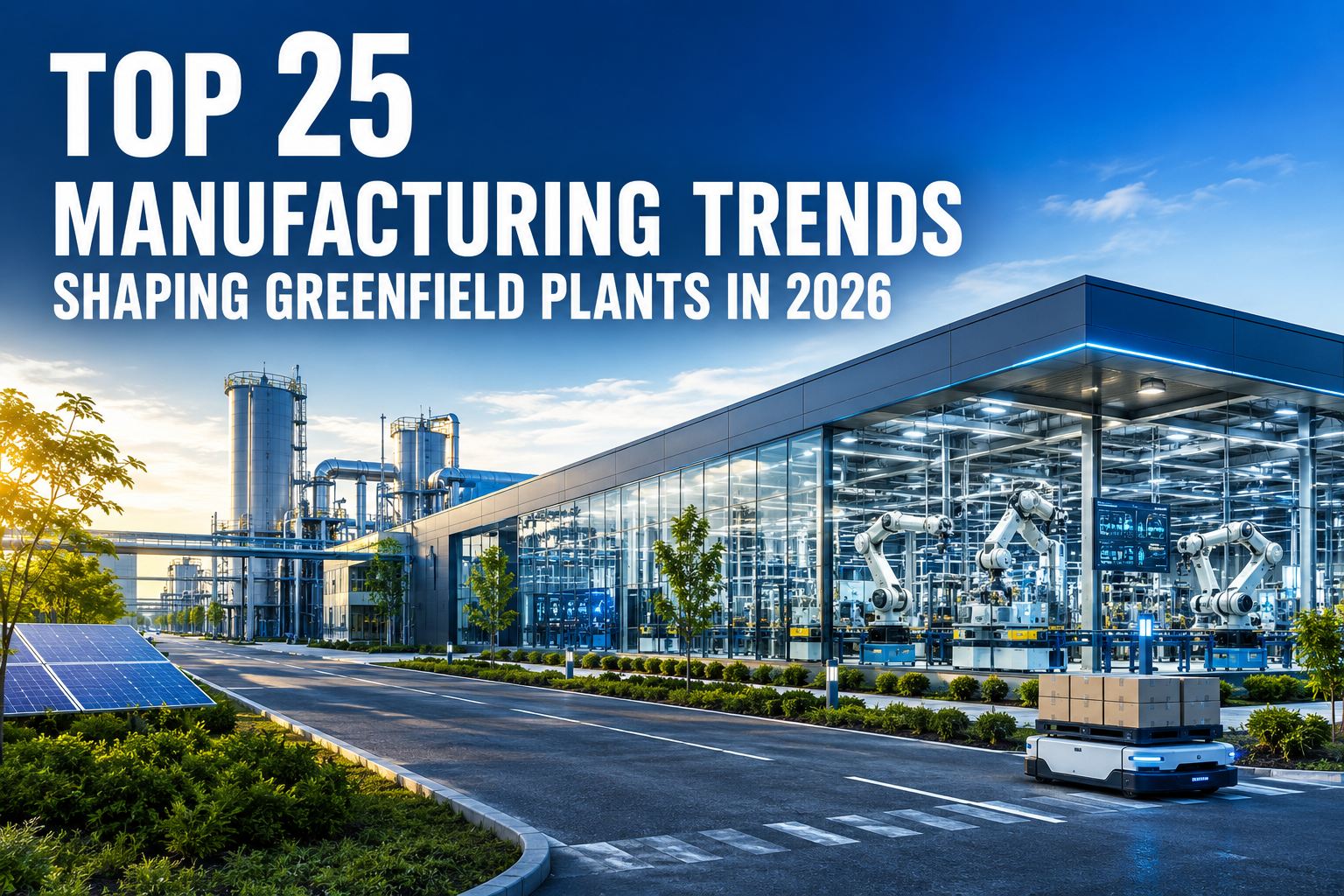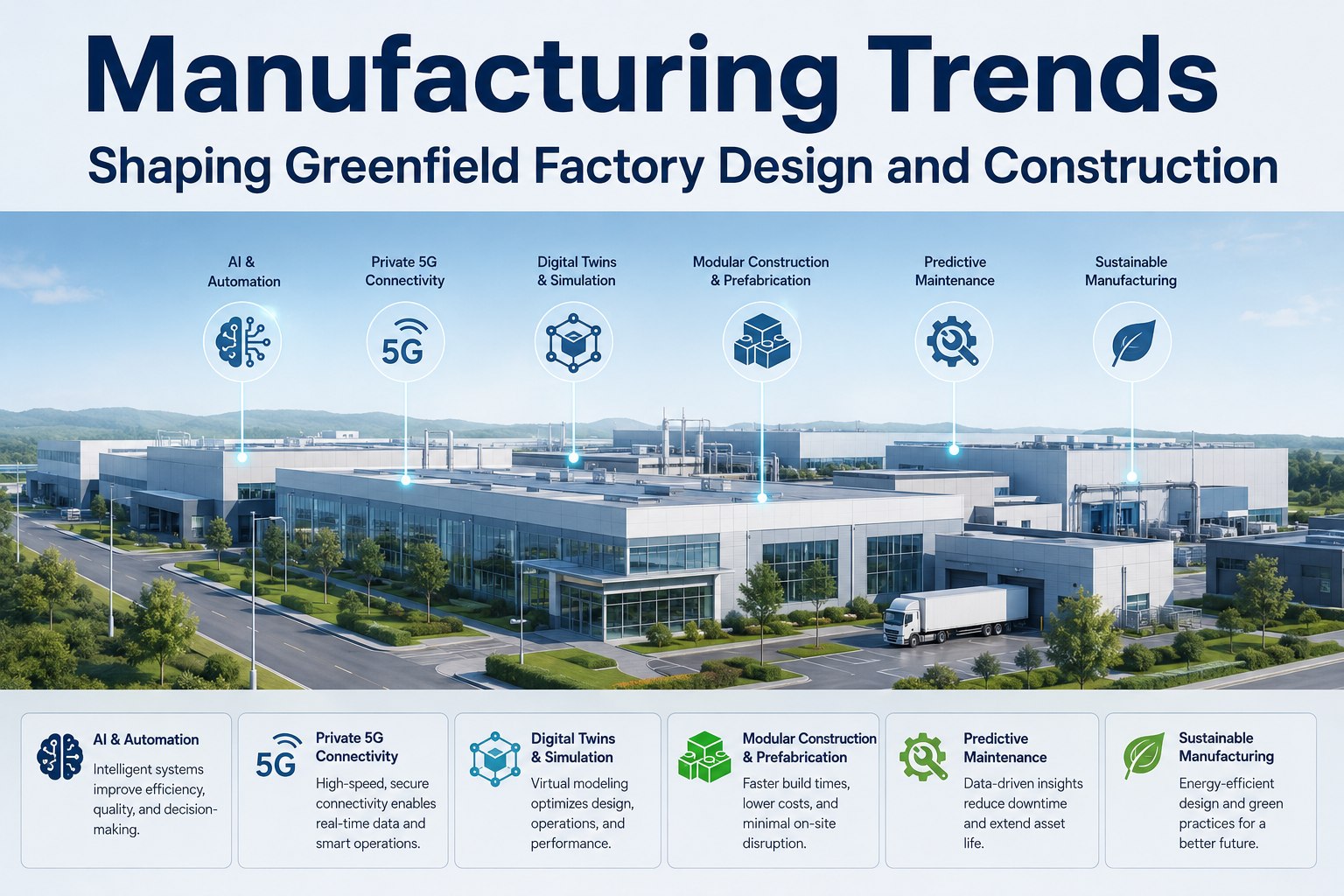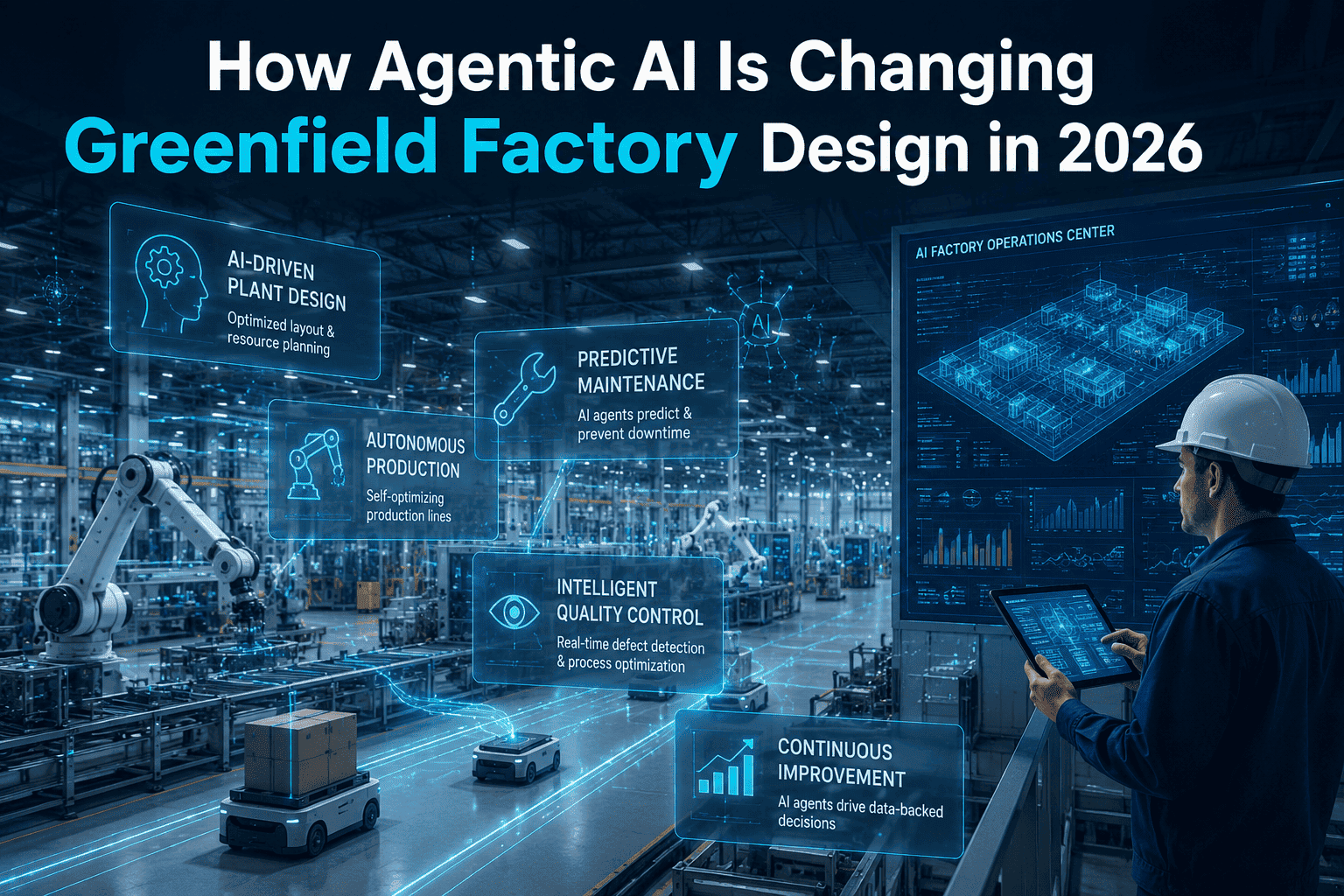
The greenfield factory of 2026 is not the factory of 2024 with better sensors. It is a fundamentally different architecture —software-defined, agent-driven, and autonomously optimizing. The shift from "human-in-the-loop" to "human-on-the-loop" is no longer theoretical. Samsung announced at MWC 2026 that it will transition all global manufacturing into AI-driven factories by 2030. Deloitte projects a fourfold increase in agentic AI adoption in manufacturing — from 6% to 24% — in 2026 alone. 41% of manufacturers are now prioritizing AI vision systems, LLM interest surged from 16% to 35% year-over-year, and the percentage of manufacturers with no plans to adopt emerging tech dropped from 21% to 17%. If you're planning a greenfield facility, the technology decisions you make today will define your competitiveness for the next two decades. Here are the trends that will shape those decisions — and what iFactory is building for.
01 Agentic AI: From Copilots to Autonomous Factory Agents
The defining shift of 2026. Manufacturing AI moves from "ask me a question" to "give me a goal and I'll handle it."
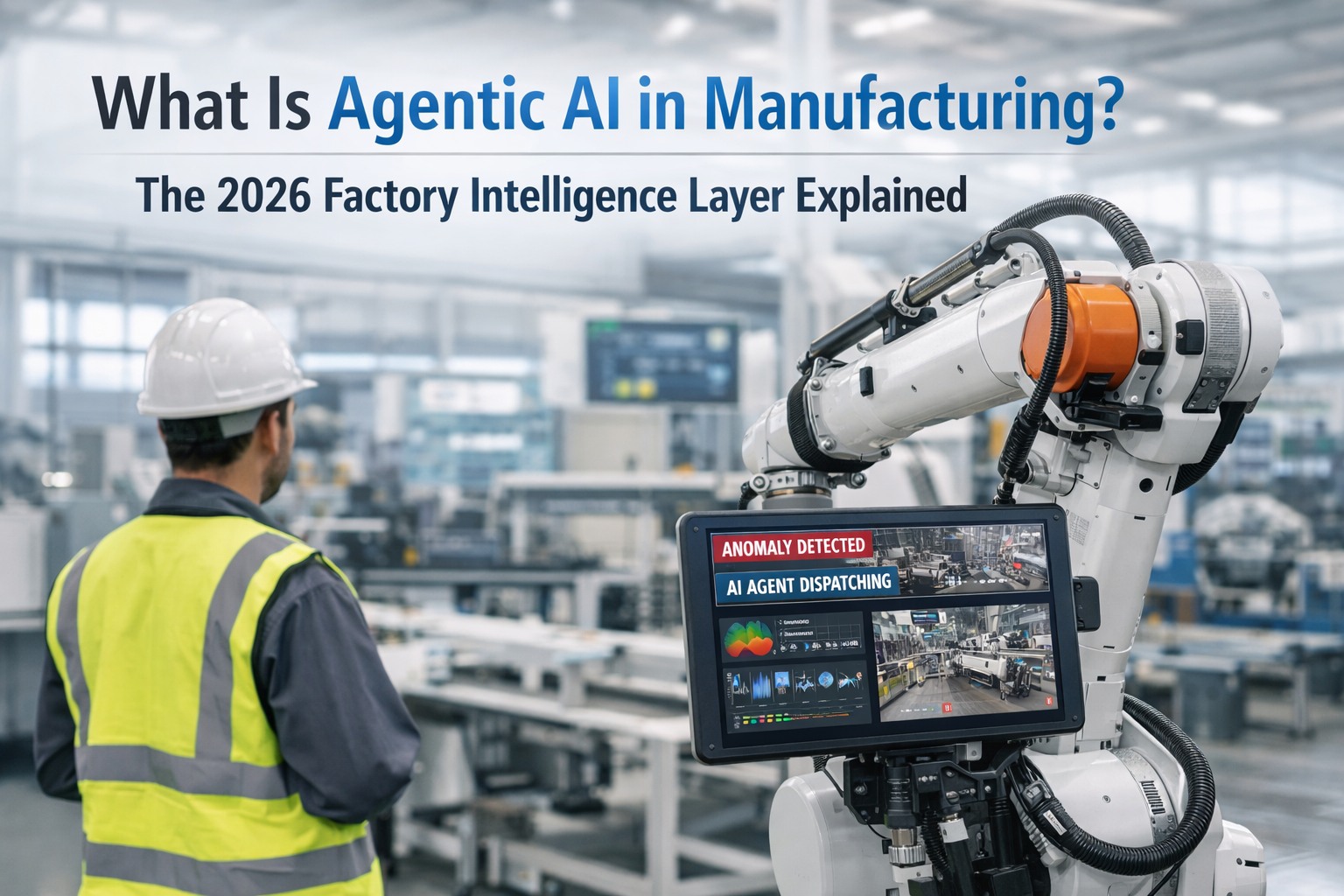
For years, factory AI was predictive — systems flagged a potential bearing failure for a human engineer to investigate. The bottleneck was always the human in the loop. Agentic AI eliminates that bottleneck. These systems observe factory conditions through sensors and data feeds, reason through multi-dimensional variables (production schedules, inventory levels, energy costs, quality metrics), and execute corrective actions autonomously.
Deloitte predicts agentic AI adoption in manufacturing will quadruple in 2026, from 6% to 24%. The acceleration is driven by trade volatility demanding real-time supply chain re-optimization, a retiring workforce taking decades of tribal knowledge with them, and AI maturity moving from "assistant" to "agent."
An AI agent in a greenfield factory doesn't just predict equipment failure — it ingests sensor data, production schedules, and maintenance history to draft a specific repair plan, order parts, assign technicians, and reschedule production around the downtime window. No human interpretation required.
Our greenfield consulting framework now includes agentic AI architecture as a core design layer — covering data infrastructure, Unified Namespace (UNS) implementation, and AI agent deployment strategy from initial facility design.
Planning a greenfield facility? Book a 30-minute strategy call to discuss how agentic AI architecture fits into your factory design from day one.
02 Physical AI & Humanoid Robots: The Factory Gets a Body
AI gains physical form. 58% of manufacturers are already using physical AI — and interest in humanoid robots climbed from 8% to 13% YoY.
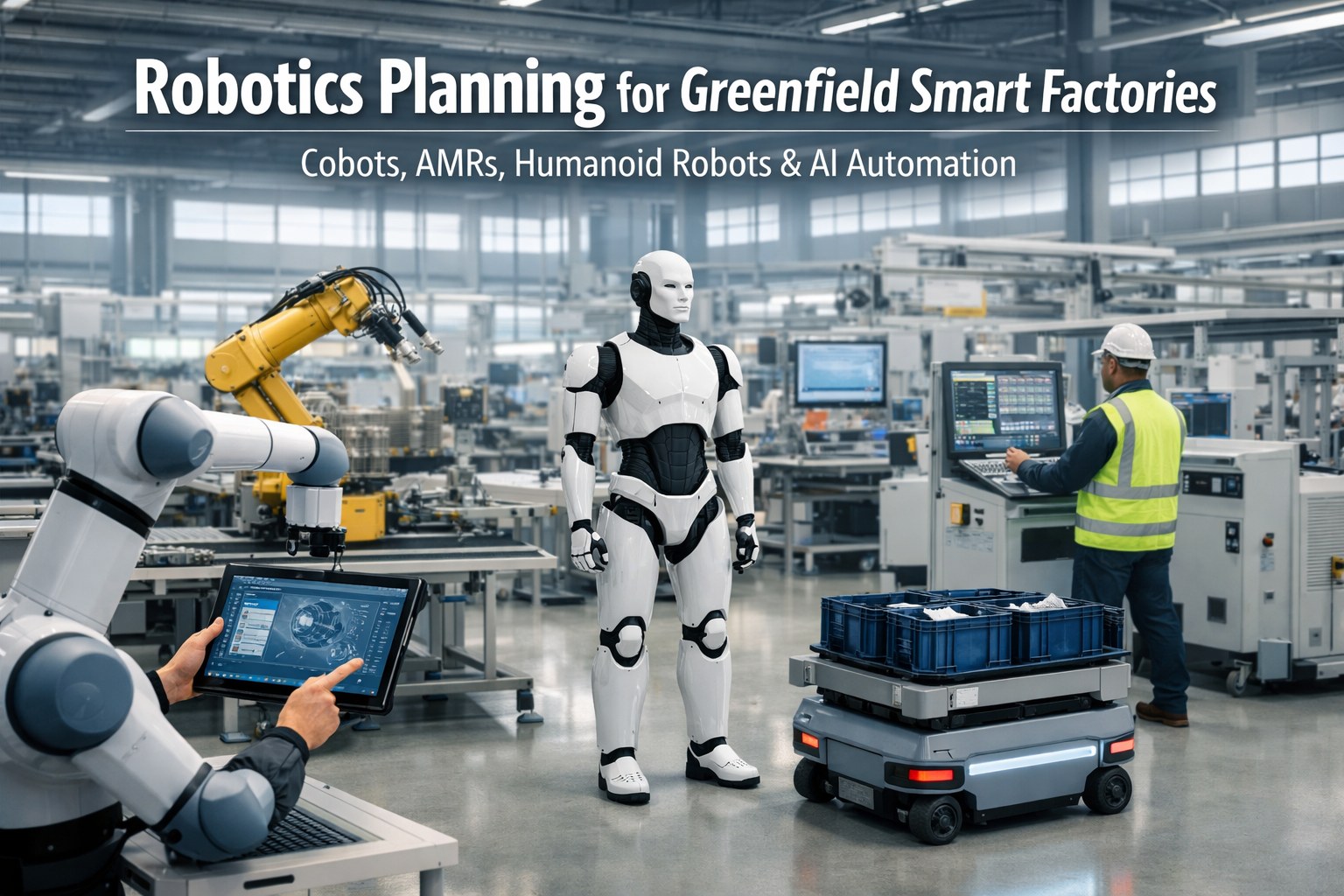
Physical AI refers to robotic systems enhanced by AI that can perceive, adapt, and act in unstructured environments. This includes cobots with force-sensing and vision, AI-guided AMRs, and the emerging class of humanoid robots designed to operate in environments built for humans. Samsung's MWC 2026 announcement explicitly includes deployment of humanoid robots for line operations, logistics robots for autonomous material handling, and assembly robots for precision tasks — all coordinated by agentic AI.
The global robotics market reached $50 billion in 2025, growing at 14% CAGR toward $111 billion by 2030. The cobot segment alone is projected to more than double from $2.9 billion to $7 billion by 2030 (27.5% CAGR). The humanoid robot market — while early at $70 million in 2025 — is forecast to reach $6.5 billion by 2030 (138% CAGR). BMW, Mercedes-Benz, and Tesla are already piloting humanoids on production lines.
Greenfield layouts must now accommodate mixed human-robot-humanoid collaboration zones. Our consulting includes physical AI readiness assessments — safety zone design, power infrastructure for charging, and communication backbone for fleet coordination.
03 Software-Defined Automation: The Factory as Code
Interest in AI-programming rose from 31% to 35% in 2026. The competitive advantage of a factory is no longer hardware — it's the sophistication of its software layer.
Software-defined automation decouples factory logic from hardware. Production recipes, quality parameters, scheduling rules, and maintenance triggers become software configurations that can be updated, tested in digital twins, and deployed across facilities without physical retooling. This is the manufacturing equivalent of cloud-native architecture — and it's what enables the speed of agentic AI.
Rockwell Automation announced plans to build its largest-ever factory in Wisconsin, designed as a showcase for software-defined operations. The Unified Namespace (UNS) — a single, event-driven data bus that connects every sensor, PLC, MES, ERP, and AI agent — is emerging as the foundational architecture. Without UNS, agentic AI lacks the contextualized data it needs to reason correctly.
Every greenfield design now includes UNS architecture, Industrial DataOps strategy, and IT/OT convergence planning as non-negotiable foundations — because software-defined automation requires these before a single robot is specified.
Need help designing a software-defined factory architecture? Schedule a consultation — we'll walk through UNS design, IT/OT convergence, and how to build agentic-ready data infrastructure.
04 Autonomous Digital Twins: From Simulation to Self-Optimization
Digital twins are no longer passive replicas. In 2026, they become the operational brains of the factory — running AI agents in simulation before deploying to production.
The Digital Twin Consortium added four new testbeds in 2026, spanning autonomous manufacturing and quantum-powered optimization. Digital twins now serve as the primary environment for strategic decision-making — engineers stress-test radical production changes in the virtual space before any physical machine is engaged. This "sim-to-real" workflow de-risks massive capital investments.
The documented benefits are substantial: 40% reduction in unplanned downtime, 60% faster time-to-market, 35% improvement in OEE, 25% fewer quality defects, 30% lower maintenance costs, and 20-35% reduction in energy consumption. Implementation costs range from $200K-$500K for focused applications to $1-5M for comprehensive enterprise deployments — but the ROI timeline is accelerating as AI integration matures.
The convergence with edge AI is the key 2026 development. Moving simulation and inference to edge devices near the factory floor enables real-time data processing that cloud-only architectures cannot achieve. Federated learning allows edge devices across multiple sites to learn from each other without sharing sensitive production data.
iFactory's greenfield approach includes digital twin strategy from concept design — specifying edge computing infrastructure, sensor placement for twin synchronization, and AI model deployment architecture that supports autonomous twin operations from day one.
05 Quantum-Enhanced Scheduling & Optimization
Not yet mainstream — but no longer theoretical. Early manufacturers are using quantum-classical hybrids for scheduling problems that classical computers can't solve at scale.
Production scheduling with multiple machines, jobs, constraints, and changeovers is an NP-hard optimization problem — exponentially complex as variables increase. Classical computers reach their limits on real-world factory scheduling. Quantum computing offers a fundamentally different approach: BASF demonstrated a 7,200-fold scheduling-time compression in a proof of concept (from 10 hours to 5 seconds). IonQ and Oak Ridge National Lab used a 36-qubit system to solve generation scheduling across 24 time periods and 26 generators.
Quantum error correction research accelerated dramatically — 120 peer-reviewed papers published in the first 10 months of 2025, up from 36 in 2024. Experts anticipate 100-200 high-fidelity qubits as early as 2026, a threshold that could unlock larger-scale industrial optimization. Siemens and IQM are already using quantum reservoir computing for digital twin enhancement in chemical reactor control.
We're designing greenfield data architectures that are quantum-ready — ensuring scheduling engines and optimization pipelines can integrate hybrid quantum-classical solvers as they mature, without infrastructure rework.
Curious about quantum-ready factory design? Book a demo to see how iFactory's greenfield architecture supports future quantum integration alongside today's AI optimization.
06 Industry 5.0 & the Human-Centric Factory
The narrative flips: more automation creates better human jobs, not fewer. Strategic Job Redesign replaces the "machines vs. humans" debate.
Industry 5.0 adds three pillars to the Industry 4.0 foundation: human-centricity, sustainability, and resilience. The 2026 reality is that as factories become more software-defined, human roles shift from execution to oversight, exception handling, and creative problem-solving. Manufacturers are decomposing traditional roles into granular tasks, delegating high-precision or high-risk actions to cobots and agents, and elevating human workers into tech-enabled roles.
Generative AI is becoming the primary tool for digitizing tribal knowledge as the "Silver Tsunami" of retirements accelerates. AI tools ingest video of an expert performing a task and automatically generate SOPs and guided actions. New operators receive real-time guidance via computer vision overlays — "deskilling" complex tasks so that the knowledge isn't lost when the expert retires.
80% of manufacturers now plan to allocate 20% or more of their improvement budgets to smart manufacturing and foundational data tools. The skepticism gap is closing: companies with no plans to adopt emerging tech fell from 21% to 17% YoY. Staying stationary is no longer a viable strategy.
Our greenfield consulting includes workforce transition planning, AR/AI-guided training infrastructure, and collaborative workspace design that embodies Industry 5.0 principles — ensuring the human experience is designed with the same rigor as the automation architecture.
Build a Factory That's Ready for 2030, Not Just 2026
Our greenfield consulting integrates every trend on this page — agentic AI, physical AI, software-defined architecture, digital twins, quantum-ready scheduling, and Industry 5.0 workforce design.
Technology Readiness Matrix: Where Each Trend Stands in 2026
Not every trend is at the same maturity level. This matrix helps greenfield planners decide what to build now, what to prepare infrastructure for, and what to monitor.
| Technology Trend | 2026 Maturity | Greenfield Action | Investment Horizon | Key Metric |
|---|---|---|---|---|
| Agentic AI | Early Production | Design data architecture + UNS now | Immediate (2026-2027) | 6% → 24% adoption (Deloitte) |
| AI Vision Systems | Mainstream | Specify per line; highest ROI | Immediate (deploy at launch) | 41% manufacturer priority (A3) |
| Cobots & Physical AI | Mainstream | Design collaboration zones | Immediate (deploy at launch) | 58% currently using (Deloitte) |
| Humanoid Robots | Pilot Stage | Design flex zones; monitor OEMs | Mid-term (2027-2029) | 8% → 13% interest YoY |
| Software-Defined Automation | Early Production | Build UNS + IT/OT convergence | Immediate (foundational) | 31% → 35% AI-programming interest |
| Autonomous Digital Twins | Growth | Specify edge infra + sensor mesh | Immediate (2026-2027) | 40% downtime reduction documented |
| Quantum Scheduling | R&D / Proof of Concept | Design quantum-ready data pipes | Long-term (2028-2030+) | 7,200x speedup (BASF PoC) |
| Industry 5.0 / Workforce | Framework Stage | Plan training infra + AR systems | Immediate (cultural shift) | 80% allocating 20%+ budget to smart mfg |
Want a custom technology readiness assessment for your greenfield project? Schedule a free strategy session — we'll map these trends to your specific industry, production volume, and timeline.
Greenfield vs. Brownfield: Why 2026 Trends Favor New Builds
Legacy facilities face structural barriers to adopting these trends. Greenfield projects have a unique window of advantage:
| Capability | Brownfield (Retrofit) | Greenfield (New Build) | Greenfield Advantage |
|---|---|---|---|
| Agentic AI Integration | Requires UNS retrofit of legacy PLCs/SCADA | UNS designed natively into architecture | 12-18 months faster to production AI agents |
| Physical AI / Humanoid Zones | Constrained by existing floor plans and power | Collaboration zones, charging, and comms built-in | 50-70% lower integration cost |
| Software-Defined Operations | IT/OT silos deeply entrenched | Converged from day one | No migration debt |
| Digital Twin Synchronization | Sensor retrofits, data gaps, partial coverage | Full sensor mesh designed to spec | Complete twin fidelity from commissioning |
| Edge AI Infrastructure | Networking upgrades, power constraints | 5G/WiFi 6E, edge racks, power spec'd in | Real-time inference from day one |
| Quantum-Ready Data Architecture | Legacy data formats require transformation | Modern, structured, API-first design | Plug-in quantum solvers without rework |
| Energy Optimization (Digital Twin) | Metering retrofits, partial visibility | Full energy digital twin from design phase | Virtual Power Plant capability from launch |
Frequently Asked Questions
The Factory of 2030 Is Being Designed Right Now
Don't lock your greenfield into yesterday's architecture. Book a strategy call to explore how these six trends shape your facility design, automation roadmap, and competitive advantage.