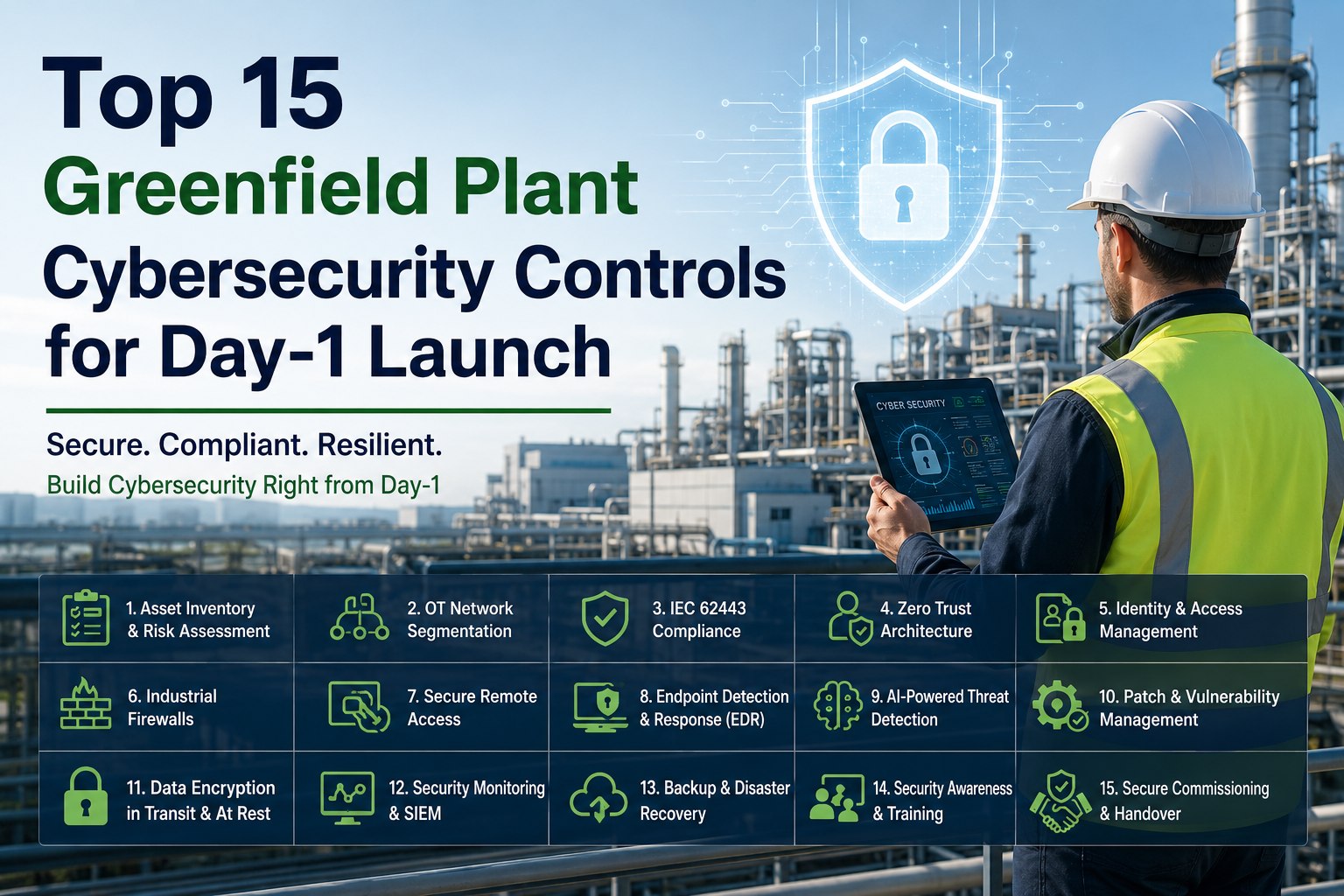
OT Cybersecurity for Greenfield Plants: Zero-Trust From Day One | iFactory
By Riley Quinn on April 16, 2026
OT cyber incidents targeting manufacturing rose 56% in 2025—reaching 1,466 documented attacks. Ransomware groups now track 119 active operations against industrial organizations, up from 80 in 2024. And here's the brutal truth: 80% of manufacturers still operate critical OT systems with known vulnerabilities. For greenfield plants, this isn't a legacy problem to inherit—it's a catastrophe you can prevent. The plants that embed zero-trust architecture, ICS protection, and secure CMMS from day one will operate safely. The ones that treat cybersecurity as a post-commissioning afterthought will join the 3,300+ industrial organizations breached last year.
The 2026 OT Threat Landscape
Manufacturing is the #1 cyberattack target—for the fourth consecutive year
56%
Attack Surge
1,466
Documented Incidents
80%
Plants with Vulnerabilities
119
Ransomware Groups
42
Days Dwell Time
Why Greenfield Plants Have a Unique Advantage
Brownfield facilities struggle to retrofit zero-trust principles into 20-year-old PLCs and legacy SCADA systems. Greenfield projects have no such constraints. You can architect security into every layer from the design phase—before the first cable is run, before the first PLC is programmed, before the first CMMS work order is created.
Legacy Challenge
Brownfield
Retrofitting security into existing plants
Legacy PLCs can't support modern authentication
Flat networks with no segmentation
Retrofit costs 3-5x more than design-in
Production downtime during upgrades
Reality:68% run systems 15+ years old
VS
Build it right from day one
Strategic Advantage
Greenfield
Security architected from the ground up
Zero-trust architecture from day one
Proper network segmentation built-in
Security costs included in project budget
No operational disruption to implement
Opportunity:Design security in, not bolt it on
Don't Inherit Yesterday's Vulnerabilities
BusCMMS is built with zero-trust security architecture from the ground up—role-based access control, encrypted data, secure API integrations, and full audit trails.
Zero-Trust Architecture for Industrial Control Systems
Zero trust in OT environments means one thing: never trust, always verify. Every device, every user, every connection must prove its identity before accessing any resource. For greenfield plants, this isn't about retrofitting—it's about building the architecture correctly from the start.
L5
Enterprise Network
ERP, Email, Cloud Services with enterprise-grade security controls
MFASSOTLS 1.3
Industrial DMZ
L4
Site Business Planning
CMMS, Historian, MES—the bridge between IT and OT
RBACAudit LogsAPI Security
OT Firewall
L3
Manufacturing Operations
SCADA, HMI, Engineering Workstations
Micro-segmentationProtocol Allow-lists
L0-L2
Process Control & Field Devices
PLCs, DCS, RTUs, Sensors, Actuators
Identity GatewaysJump Hosts
Building a greenfield facility? Book a demo to see how BusCMMS integrates with your zero-trust architecture.
The Three Pillars of Greenfield OT Security
Every greenfield cybersecurity strategy must address three interconnected domains. Miss any one, and your entire security posture has a gap that attackers will find.
01
Identity & Access Control
Every user, device, and system must authenticate before accessing any OT resource. MFA, RBAC, PKI Certificates, PAM.
02
Network Segmentation
Separate OT from IT. Separate safety from control. Industrial DMZ, micro-segmentation, OT firewalls, data diodes.
03
Continuous Monitoring
You can't protect what you can't see. Asset inventory, passive monitoring, anomaly detection, SIEM integration.
CMMS Security: The Overlooked Attack Surface
Your CMMS sits at the intersection of IT and OT—with access to asset data, maintenance schedules, technician credentials, and often direct integration with PLCs and SCADA systems. A compromised CMMS can give attackers the operational intelligence they need to cause maximum damage.
Manipulate Schedules
Attack Vector 1
Delay critical safety inspections or create false work orders to gain physical access to your facility.
Direct impact on safety compliance
Steal Asset Intelligence
Attack Vector 2
Map your entire asset inventory, firmware versions, and vulnerabilities for targeted attacks.
Reconnaissance for future attacks
Harvest Credentials
Attack Vector 3
Use technician accounts and stored passwords to pivot into SCADA and PLC systems.
Lateral movement into OT
Trigger Safety Incidents
Attack Vector 4
Tamper with safety inspection records and regulatory compliance documentation.
Compliance and liability risk
Concerned about your CMMS security posture? Book a demo to see how BusCMMS protects your maintenance data.
Expert Review
"You can't retrofit modern authentication into every 20-year-old PLC, but you can enforce identity-aware gateways, strict jump-host access, micro-segmentation and protocol allow-lists. These deliver the benefits of zero-trust without requiring intrusive changes to legacy assets."
— Industrial Cybersecurity Expert, 2026
$4.88M
Average Data Breach Cost
40%
OT Incidents Cause Disruption
119
Ransomware Groups Target OT
Greenfield OT Security Checklist
Use this checklist during your greenfield planning phase to ensure cybersecurity is embedded from design through commissioning.
Design Phase
Security architecture based on IEC 62443 / NIST 800-82
Network segmentation plan with Industrial DMZ
Secure remote access architecture defined
CMMS vendor security assessment completed
Procurement Phase
Security requirements in all vendor contracts
PLCs/DCS with secure-by-design features
OT-aware firewalls and monitoring tools
PKI/certificate management solution selected
Commissioning Phase
Complete OT asset inventory in CMMS
All default passwords changed
Penetration testing completed
Incident response plan documented and tested
Need help building your greenfield security architecture? Book a demo to explore secure CMMS solutions.
Conclusion
Greenfield plants have a once-in-a-lifetime opportunity to build cybersecurity into their DNA. The 56% surge in manufacturing cyberattacks isn't slowing down—it's accelerating. The plants that embed zero-trust architecture, protect their ICS environments, and deploy secure CMMS from day one will operate safely while their competitors scramble to retrofit defenses after the breach. Don't wait until you're one of the 3,300 organizations attacked this year. Build it right from the start.
Build Your Greenfield Plant on a Secure Foundation
BusCMMS provides enterprise-grade security from day one: zero-trust access controls, encrypted data at rest and in transit, SOC 2 compliance, and seamless integration with your OT security stack.
What is zero-trust architecture for OT environments?
Zero-trust architecture operates on the principle of "never trust, always verify." In OT environments, this means every user, device, and connection must authenticate and be authorized before accessing any resource—regardless of whether they're inside or outside the network perimeter.
Why is CMMS security critical for OT cybersecurity?
CMMS platforms sit at the intersection of IT and OT networks, holding sensitive operational data including complete asset inventories, firmware versions, maintenance schedules, and technician credentials. A compromised CMMS gives attackers the operational intelligence they need to cause physical damage.
What security standards apply to greenfield manufacturing plants?
The two most broadly applicable frameworks are IEC 62443 and NIST SP 800-82. For greenfield projects, these standards should inform your security architecture from the design phase—not be applied retroactively after commissioning.
How do I secure remote access to OT systems?
Secure remote access requires: a dedicated jump host, multi-factor authentication, session recording and audit logging, time-limited access windows, and network segmentation that prevents direct access to control systems.
What should I look for in a secure CMMS?
A secure CMMS should include: role-based access control (RBAC), multi-factor authentication (MFA), single sign-on (SSO), data encryption, comprehensive audit logs, SOC 2 or ISO 27001 compliance, secure APIs, and regular penetration testing.