Picture your production planner at 7 AM on a Monday. There is a demand spike from a key customer, two machines on the critical path are showing stress signals, a key material is running three days late, and last quarter's schedule — built on spreadsheets and best guesses — says nothing useful about any of it. This is not a failure of your team. It is a failure of the planning system. Traditional production planning was designed for a world that no longer exists.
AI-driven production planning replaces that world with something entirely different — a live, continuously learning intelligence layer that sees demand before it arrives, optimises every constraint in real time, and turns your greenfield factory into a precision machine from the very first production run.
15%
More capacity unlocked — same floor, same workforce, same machines
Deloitte Smart Manufacturing Survey, 2025
85–95%
Forecast accuracy with AI vs. 70–79% industry average
Industry benchmark
20–30%
Reduction in operational costs from AI-driven automation
McKinsey COO Survey, 2025
250%
ROI from AI supply chain and inventory optimisation
Atlantic Research, 2025
AI-Based Production Planning & Capacity Optimisation
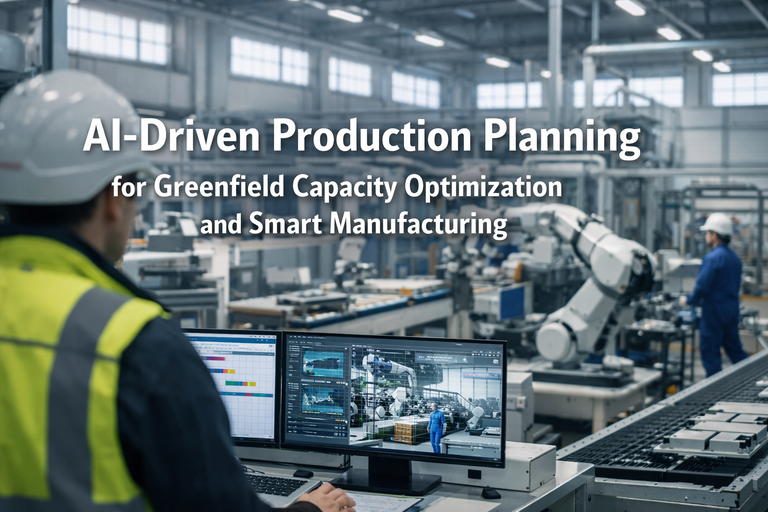
AI-Driven Production Planning for Greenfield Capacity Optimisation and Smart Manufacturing
How AI transforms greenfield production — from static schedules and guesswork into dynamic, data-driven capacity intelligence that delivers more output, less waste, and zero planning surprises
The Problem with How Factories Plan Today
Most manufacturers enter their greenfield facility with a planning process borrowed from their last plant — and their last plant had the same problem the one before it did. Production plans are built monthly. Schedules are locked weekly. Reality changes daily. The gap between plan and floor is where profitability disappears.
01
Spreadsheet Planning in a Volatile World
Traditional forecasting uses last quarter's data to predict next quarter's demand. It ignores real-time signals — market shifts, supply disruptions, competitor moves — until they have already damaged the schedule.
→
02
Capacity Rated, Not Measured
ERP systems calculate capacity from nameplate rates set at implementation — not from actual OEE measured today. The number in the system and the number on the floor are never the same, yet every schedule is built on the fiction.
→
03
Siloed Data, Siloed Decisions
Demand planners, production schedulers, maintenance teams, and procurement operate from different data at different refresh rates. No single person sees the whole picture. Decisions that should connect never do.
→
!
The Result
Missed deliveries. Idle capacity. Emergency changeovers. Excess inventory sitting beside stock-out warnings. And a planning team working harder than ever to fix problems that should never have happened.
Is your greenfield production plan already working against you? Get a free capacity assessment from iFactory experts.
What AI-Driven Production Planning Actually Changes
AI does not just speed up the existing planning process — it fundamentally restructures what planning is. Instead of a monthly cycle of estimates and adjustments, you get a continuously recalibrating intelligence engine that connects demand, capacity, maintenance, and supply into one living model.
Layer 1
Demand Forecasting Intelligence
AI ingests historical orders, real-time sales signals, market trends, weather data, and promotional calendars to predict demand 85–95% accurately — weeks and months ahead. Models retrain automatically as new data arrives.
50% reduction in forecast errors
Layer 2
True Capacity Modelling
Capacity calculated from live PLC data — actual OEE this shift, not last year's standard rate. Every maintenance window, changeover, and speed loss is reflected in real time, giving schedulers a truthful constraint model to optimise against.
15% more capacity from the same assets
Layer 3
Dynamic Scheduling Engine
AI sequences jobs to minimise changeovers, meet due dates, and respect every operational constraint simultaneously — labour availability, material supply, maintenance windows. When disruptions occur, schedules resequence automatically in minutes, not days.
20% improvement in on-time delivery
Layer 4
Scenario Planning & What-If Simulation
Before committing to a plan, AI simulates thousands of scenarios — demand surges, vendor failures, machine breakdowns, overtime options — and quantifies the cost and schedule impact of each. Planners choose from ranked options, not guesses.
40% faster planning cycles
Capacity Optimisation: Finding the Output You Are Already Losing
The most immediate financial return from AI planning comes not from building new capacity — it comes from recovering the capacity you already have but cannot see. Every factory has a gap between rated capacity and true available output. AI measures it, identifies the causes, and eliminates them systematically.
Where Capacity Is Lost in a Typical Greenfield Facility
After Planned Downtime
87%
-13% scheduled maintenance & changeovers
After Unplanned Downtime
71%
-16% breakdowns & unscheduled stoppages
After Speed & Quality Losses
58%
-13% speed reduction & quality rejects
AI-Optimised OEE Target
78%+
+20% recovered with AI planning
World-class OEE for discrete manufacturing: 85%. Average without AI: 55–65%. AI planning closes that gap — recovering output worth millions annually from assets already purchased and installed.
Demand Forecasting: The Foundation of Every Good Plan
You cannot optimise what you cannot predict. The quality of every downstream decision — schedule, inventory, staffing, procurement — depends entirely on the accuracy of the demand signal it is built from. AI replaces the educated guesses of spreadsheet forecasting with a model that learns continuously from every signal available.
Traditional Forecasting
Based on last period's actuals
Monthly or quarterly updates
Misses seasonality & promotions
No external signal integration
70–79% accuracy at best
Static until manually revised
Average Accuracy: ~74%
VS
AI Demand Forecasting
Learns from years of order history + live signals
Continuous real-time recalibration
Captures promotions, weather, market trends
Integrates ERP, POS, supplier, and macro data
85–95% accuracy, improving over time
Auto-adjusts the moment signals change
Average Accuracy: 85–95%
35%
Decrease in inventory levels (McKinsey)
15%
Reduction in logistics costs
65%
Improvement in service levels vs. competitors
90%+
On-time delivery maintained even during supply disruptions
See AI Production Planning on Live Factory Data
iFactory's AI planning engine models your real capacity, builds demand-linked schedules, and runs scenario simulations — so you can see exactly what your greenfield facility is capable of before production starts.
Book a Free Demo
Smart Scheduling: From Rigid Plans to Adaptive Intelligence
Traditional scheduling produces a plan. AI scheduling produces a living, continuously updated response to reality. The difference is not speed — it is the ability to simultaneously optimise across every constraint the factory operates under, and to reoptimise instantly when those constraints change.
01
Constraint-Aware Job Sequencing
AI sequences work orders to minimise setup time and changeover costs while respecting labour shifts, material availability, tooling constraints, and due date priorities — simultaneously, across every machine on every line.
22% reduction in setup costs from intelligent grouping
02
Real-Time Disruption Response
When a machine degrades, a supplier is late, or a priority order arrives, the AI resequences all affected jobs automatically — evaluating overtime, cross-training, subcontracting, and priority trade-offs in minutes.
On-time delivery maintained above 90% during disruptions
03
Maintenance-Aligned Scheduling
Planned maintenance windows are embedded into the schedule as hard constraints. Predictive alerts from equipment sensors trigger maintenance during natural demand valleys — eliminating the conflict between uptime and reliability.
Maintenance during low-demand periods, zero production sacrifice
04
Multi-Plant Load Balancing
For organisations with multiple greenfield sites, AI identifies spare capacity across the network and recommends job allocation between facilities — achieving 5–10% network-level capacity improvements without capital investment.
5–10% network capacity gain from cross-site balancing
The Financial Case: What AI Planning Delivers
AI Production Planning — Documented Results
200–400%
ROI from AI planning & optimisation in manufacturing
Atlantic Research, 2025
15%
More capacity unlocked from existing assets without CAPEX
Deloitte, 2025
50%
Fewer forecast errors vs. traditional planning methods
Industry benchmark
35%
Lower inventory levels through demand-aligned production
McKinsey supply chain analysis
10–15%
Increase in production output — same resources, better planning
API4AI Industry Report, 2025
12–18 mo
Typical payback period with 78% of executives reporting measurable returns
Atlantic / McKinsey, 2025
Production Planning by Industry: Where the Gains Are Largest
Semiconductor & High-Tech
Challenge: Thousands of process steps, extreme yield sensitivity, and 4–7 year facility timelines where planning errors compound for years.
AI impact: Lot scheduling optimisation, yield-driven capacity allocation, and what-if simulation for technology ramps.
Highest planning complexity
Pharma & Biotech
Challenge: Regulatory batch records, cleaning validation windows, and GMP compliance create rigid scheduling constraints that humans cannot optimise manually.
AI impact: Constraint-aware batch scheduling, campaign optimisation, and compliance-linked capacity modelling.
Compliance-critical scheduling
EV & Battery Gigafactories
Challenge: Ramp schedules under intense competitive pressure require balancing material supply, formation cycling constraints, and energy demand peaks simultaneously.
AI impact: Ramp-rate optimisation, formation capacity modelling, and real-time schedule adjustment during supply volatility.
Speed-to-volume critical
Chemical & Continuous Process
Challenge: Continuous processes have narrow windows for planned maintenance. A scheduling error forces either production curtailment or a safety-critical unplanned shutdown.
AI impact: Campaign planning aligned to maintenance predictions, turnaround optimisation, and utility demand forecasting.
Zero-margin scheduling precision
Frequently Asked Questions
How is AI production planning different from what our ERP already does?
ERP systems plan from rated capacity and historical averages — the numbers entered during implementation, not the reality on the floor today. AI plans from live OEE, real-time demand signals, and actual equipment health data. It also reoptimises continuously, whereas ERP produces a plan that is obsolete the moment conditions change. The result is a schedule that reflects what your factory can actually do — not what someone assumed it could do three years ago.
When in a greenfield project should AI planning be implemented?
The ideal moment is before production begins — during the commissioning and ramp-up phase. This allows the AI to establish OEE baselines, calibrate capacity models, and begin learning demand patterns before you are under customer delivery pressure. Greenfield facilities that implement AI planning from day one reach target OEE 30–40% faster than those that retrofit planning tools after problems emerge.
What data does AI production planning need to work effectively?
Core inputs are production history (actual run rates, downtime events, changeover durations), demand data (orders, forecasts, seasonality patterns), and equipment data from PLCs and SCADA systems. AI planning improves as more data accumulates — it begins generating useful insights within weeks and reaches high accuracy within 3–6 months of operation. iFactory connects to SAP, Oracle, Microsoft Dynamics, and over 50 other ERP systems via pre-built connectors.
Does AI planning replace production planners and schedulers?
No — it transforms what they do. AI handles the computational burden of optimising across thousands of variables and constraints, freeing planners from hours of spreadsheet work per day. Planners focus on strategic decisions: approving AI-generated schedules, managing customer exceptions, evaluating scenario recommendations, and interpreting capacity data for business decisions. Most operations teams report that AI planning makes them significantly more effective — not redundant.
iFactory AI Production Planning
Your Greenfield Factory Deserves a Plan That Learns
Static schedules, rated capacity, and monthly planning cycles are not competitive tools for a modern greenfield facility. iFactory's AI planning engine gives you live capacity intelligence, demand-linked scheduling, and scenario simulation — so you capture every unit of output your factory is capable of.
15%
More capacity, no CAPEX
500+
Facilities trust iFactory