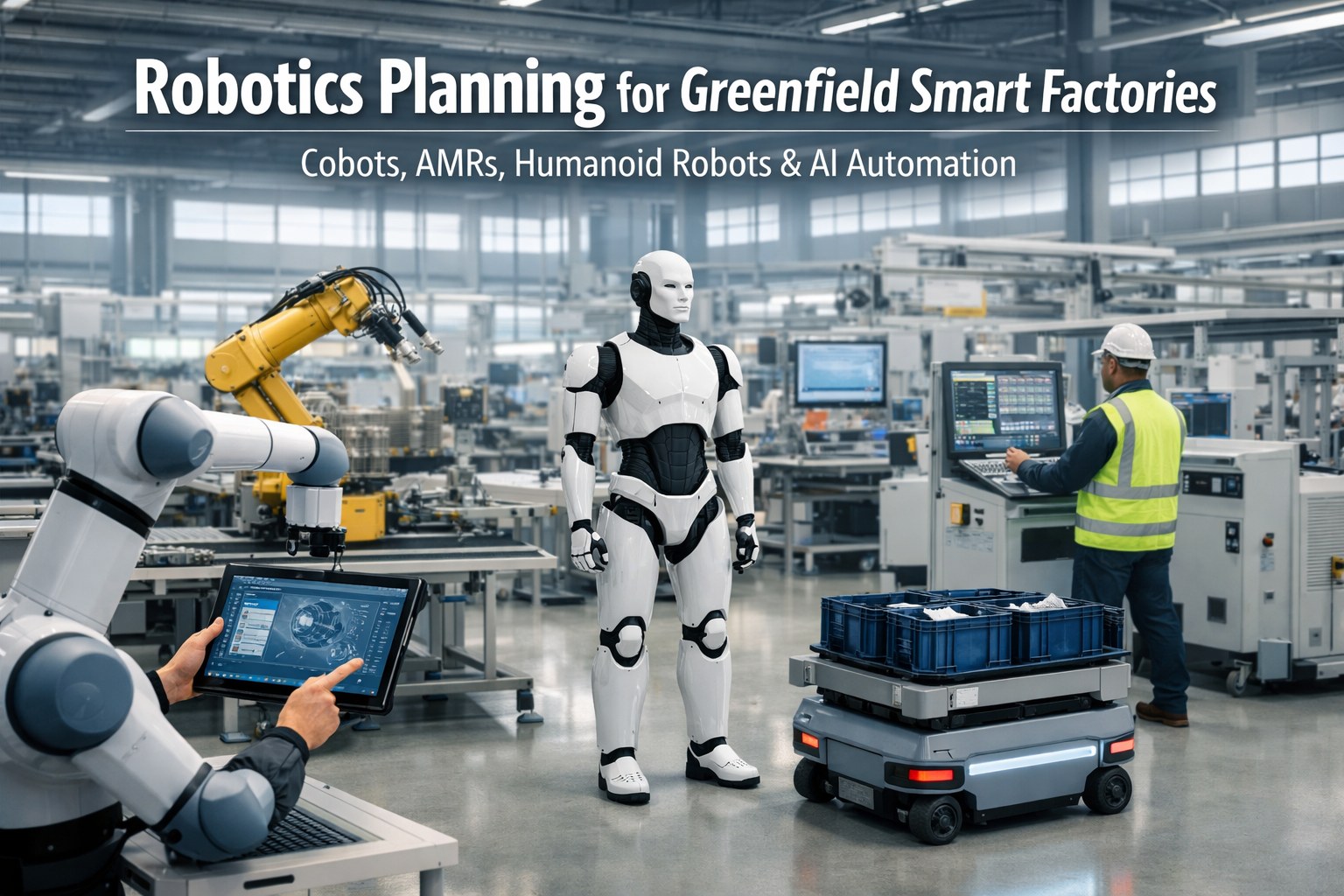
Robotics Planning for Greenfield Smart Factories: Cobots, AMRs, Humanoid Robots & AI Automation

By David Cook on March 2, 2026

robotics-planning-greenfield-smart-factories-cobots-amrs-humanoids

In 2024, 542,000 industrial robots were installed globally — more than double the number from a decade ago — and 4.66 million robots are now operational worldwide. Yet most greenfield factory teams still treat robotics as a line-item in the equipment budget instead of an architectural decision that shapes the entire plant. This guide covers the three robot categories transforming greenfield manufacturing — cobots, AMRs, and humanoid robots — with practical deployment strategies, safety frameworks, and the AI integration layer that ties them all together.

GREENFIELD ROBOTICS PLANNING GUIDE
542K Industrial Robots Installed Globally in 2024
4.66M Robots Now in Operational Use Worldwide
622K Unfilled U.S. Manufacturing Jobs (2025)
$7.3B Robotics Deal Value in H1 2025
AUTOMATION 74% ASIA SHARE
COBOTS
AMRs
HUMANOIDS

Why greenfield robotics planning is different: Brownfield factories retrofit robots into existing floor plans, power grids, and safety zones — all compromises. Greenfield gives you a clean slate to design robot workcells, AMR traffic lanes, charging infrastructure, and human-robot collaboration zones into the facility from day one. The decisions you make during design determine whether your plant operates at world-class automation levels or fights integration problems for years.

The 3 Robot Categories Reshaping Greenfield Manufacturing

DEPLOY NOW
Collaborative Robots (Cobots)
100K+ Cobots shipped (Universal Robots alone)
<12mo Typical payback period

Cobots work alongside humans without safety cages, using built-in force limiting and speed monitoring to prevent injuries. They handle assembly, pick-and-place, machine tending, welding, and quality inspection — and can be reprogrammed for new tasks in hours, not weeks. For greenfield factories, cobots are the fastest path to automation ROI because they deploy incrementally: start with one workcell, prove the value, then scale.

Assembly Pick & Place Machine Tending Welding Quality Inspection Packaging
DEPLOY NOW
Autonomous Mobile Robots (AMRs)
$4.56B AMR market projected by 2030
15.1% Market CAGR (2025-2030)

AMRs use LiDAR and SLAM navigation to move materials autonomously — no magnetic strips, no fixed paths. They handle raw material delivery, WIP transfers, finished goods staging, and dock loading across 24/7 operations. Fleet orchestration software coordinates dozens or hundreds of units in real-time, managing traffic, task priority, and charging rotation. Greenfield factories can design AMR lanes and charging stations into the floor plan from the start.

Material Transport WIP Transfer Dock Loading Inventory Flow Line-Side Delivery
EMERGING — PLAN AHEAD
Humanoid Robots
$2.5B VC investment in humanoids (2024)
$38B Projected market by 2035 (Goldman Sachs)

Humanoid robots — bipedal systems with dexterous manipulation and AI-powered reasoning — are being piloted by BMW, Mercedes-Benz, Amazon, and Tesla. They're designed to work in human-built spaces without facility modifications. However, current battery life limits operation to about 2 hours, safety certification is evolving, and most deployments remain cordoned off from human workers. For greenfield planners: design infrastructure that can accommodate humanoids when the technology matures.

Tote Handling Assembly Assist Logistics Inspection

Plan Your Robotics Strategy With Real-Time Data

iFactory integrates with cobots, AMR fleets, and industrial robots — giving executives a unified dashboard for robot utilization, throughput, and predictive maintenance from day one.

Cobots vs. AMRs vs. Humanoids: The Decision Matrix


Cobots
AMRs
Humanoids
Readiness
Production-ready
Production-ready
Pilot stage
Deployment Time
Days to weeks
Weeks to months
Months to years
ROI Payback
<12 months
12-18 months
Unproven at scale
Human Collaboration
Cage-free, side-by-side
Shared spaces, auto-avoidance
Cordoned zones (current)
Primary Use Cases
Assembly, welding, inspection, machine tending
Material transport, logistics, dock loading
Tote handling, general-purpose tasks
Safety Standards
ISO 10218, ISO/TS 15066
ISO 3691-4
Evolving (new ISO standards)
Greenfield Strategy
Deploy during ramp-up
Deploy during commissioning
Design infrastructure now

The 5-Step Greenfield Robotics Planning Framework

01
Facility Design Phase

Map Automation Zones Into the Floor Plan

Before steel goes up, identify every process that will be automated and map robot workcells, AMR lanes, charging stations, safety zones, and human collaboration areas into the facility layout. This is the greenfield advantage — brownfield teams spend months retrofitting these elements around existing equipment. You design them in from day one.

Cobot Workcells
Open-plan cells with power, pneumatics, and data drops pre-installed at each station
AMR Traffic Lanes
Dedicated routes with smooth flooring, wide turns, and charging bays at strategic intervals
Safety Perimeters
Zones designed per ISO 10218 and ISO/TS 15066 with area scanners and light curtains
Human-Robot Zones
Shared workspaces with ergonomic design for collaborative operations and handoff points
02
Selection Phase

Match Robot Types to Production Requirements

Not every task needs automation, and not every automation task needs a robot. Map each production process against five criteria: cycle time requirements, payload, precision tolerance, changeover frequency, and human collaboration needs. Tasks requiring high flexibility and human proximity point to cobots. Material movement points to AMRs. High-speed, heavy-payload, repetitive tasks may still call for traditional industrial robots behind safety fencing.

03
Integration Phase

Connect Robots to MES, SCADA, and ERP

Robots that don't report data are just expensive machines. Every cobot, AMR, and industrial robot must feed operational data — cycle times, throughput, fault codes, utilization rates — into your MES and SCADA systems. This integration enables real-time OEE tracking, automated maintenance triggers, and AI-powered production optimization. In greenfield, specify OPC UA and MQTT connectivity in every robot procurement contract.

iFactory Integration: iFactory connects to robot controllers, AMR fleet software, and PLCs through standard APIs — aggregating robot data into unified dashboards that auto-calculate OEE, MTBF, and utilization per workcell.
04
Safety Phase

Implement ISO Safety Compliance From Design

Robot safety isn't a bolt-on certification — it's an architectural decision. Cobots must comply with ISO 10218 (robot safety) and ISO/TS 15066 (collaborative operation limits). AMRs follow ISO 3691-4 for industrial truck safety. Humanoid robots face evolving standards focused on fall hazards and bipedal stability. For greenfield, embed safety infrastructure — area scanners, emergency stops, safety-rated PLCs — into the facility design during construction.

ISO 10218
Industrial robot safety requirements — applies to all robot systems
ISO/TS 15066
Collaborative robot force and speed limits — defines safe human contact thresholds
ISO 3691-4
Driverless industrial truck safety — applies to AMRs and AGVs
IEC 62443
Industrial cybersecurity — protects networked robot systems from digital threats
05
Optimization Phase

Deploy AI for Continuous Robot Fleet Optimization

Once robots are operational and feeding data, AI transforms raw telemetry into predictive intelligence: forecasting motor failures before they cause downtime, optimizing AMR traffic flow based on production patterns, and dynamically rebalancing cobot workloads across shifts. This is where the real competitive advantage emerges — not from having robots, but from having robots that get smarter every day.

The greenfield robotics principle: The factories seeing the fastest automation ROI aren't deploying the most robots — they're deploying the right robots in the right sequence. Start with cobots and AMRs that deliver proven ROI today, design infrastructure that accommodates humanoids tomorrow, and connect everything through an AI-powered intelligence layer that turns robot data into executive-level decisions.

Frequently Asked Questions

Start with cobots and AMRs — both are production-ready, deliver ROI within 12-18 months, and don't require the facility to be redesigned. Cobots handle assembly, welding, inspection, and machine tending alongside human workers. AMRs automate material transport across the plant 24/7. Humanoid robots should be planned for architecturally (power, data, floor space) but are not yet ready for large-scale production deployment.
There's no universal number — it depends on your production processes, cycle times, and changeover frequency. The proven approach is to start with 2-5 cobots on your highest-volume or most repetitive tasks, measure the productivity and quality impact, then scale based on data. Plants using cobots consistently report 12-22% productivity gains per workcell. AI-enabled cobots are the fastest-growing category, representing 15% of 2025 deployments.
Not at production scale — yet. BMW, Mercedes-Benz, Amazon, and Tesla are running pilot programs, but most humanoid deployments remain cordoned off from human workers and operate for only about 2 hours on a single battery charge. Goldman Sachs projects a $38 billion humanoid market by 2035, and $2.5 billion in VC was invested in 2024. For greenfield planners, the strategy is to design infrastructure that can accommodate humanoids when the technology matures, while deploying cobots and AMRs for immediate value.
The core standards are ISO 10218 (industrial robot safety), ISO/TS 15066 (collaborative robot force limits for human contact), ISO 3691-4 (AMR safety), and IEC 62443 (industrial cybersecurity). For greenfield factories, safety compliance starts during design — embedding area scanners, safety-rated PLCs, emergency stops, and properly zoned human-robot collaboration areas into the facility layout rather than retrofitting them after equipment arrives.
iFactory serves as the intelligence layer connecting all robot types — cobots, AMRs, and industrial robots — to your MES, SCADA, and ERP systems. It auto-calculates OEE, MTBF, and utilization per workcell, monitors robot health for predictive maintenance, and provides executive dashboards showing real-time robot fleet performance. iFactory deploys during construction so dashboards are operational from commissioning day one.

Build Your Robotics-Ready Smart Factory

iFactory gives greenfield executives a unified platform for robot fleet monitoring, predictive maintenance, OEE analytics, and MES integration — configured during construction, operational from day one.

Planning robotics for your greenfield smart factory? Book your free iFactory demo and see how AI-powered dashboards unify cobot, AMR, and industrial robot data into executive-level plant intelligence — from commissioning day one.

Share This Story, Choose Your Platform!