Lights-Out Manufacturing: Design Your Greenfield Factory | iFactory
By Riley Quinn on April 16, 2026
Most manufacturing plants still depend on shift workers, manual oversight, and human intervention to keep production running. But the economics are shifting fast—labor costs are rising, skilled technicians are harder to find, and global competitors are deploying fully autonomous production lines that run 24 hours a day, 7 days a week, with the lights literally off. For U.S. manufacturers planning a greenfield facility, lights-out factory design isn't a futuristic concept anymore. It's a strategic decision you make at the blueprint stage—because retrofitting autonomous systems into an existing plant costs 3–5× more than building them in from the start.
Autonomous Manufacturing Design
The Lights-Out Factory Advantage
Design 24/7 autonomous production into your greenfield plant—and eliminate labor dependency from day one
What "Lights-Out" Actually Means in Modern Manufacturing
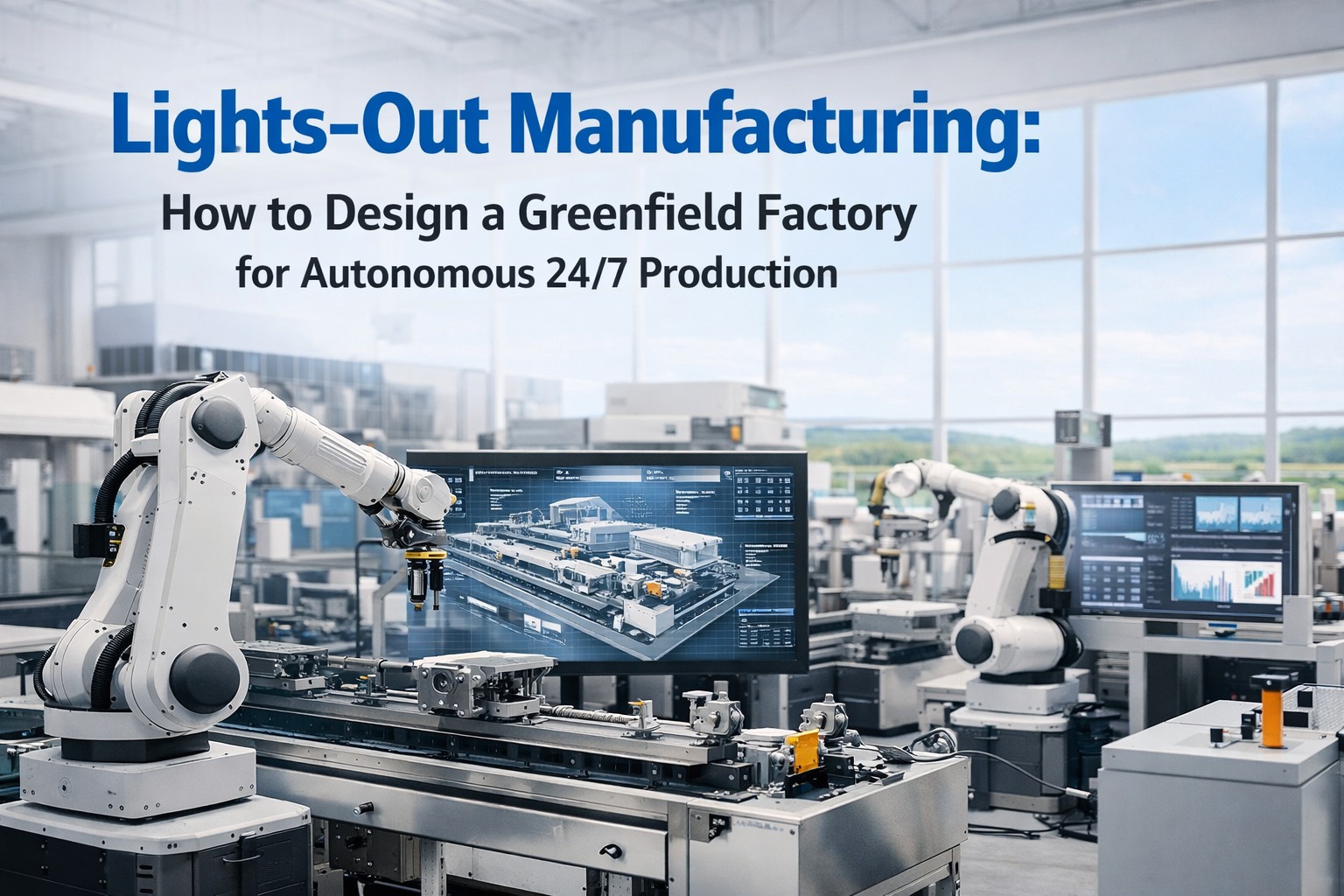
The term "lights-out factory" originated in the 1980s when FANUC opened a robot-manufacturing plant in Japan that operated in complete darkness—no humans, no lights needed. Today the concept has evolved far beyond a marketing phrase. A true lights-out facility is a system of interdependent autonomous layers: robotic material handling, AI-driven quality control, self-correcting process control, predictive maintenance, and a manufacturing execution system (MES) that orchestrates all of them without human direction.
It's important to be clear: fully lights-out operation is the goal state, not always the starting point. Most greenfield plants adopting this approach today target "lights-dim" operations—running 85–95% autonomously with minimal supervisory staff monitoring remotely. The architecture is identical; the degree of human intervention simply decreases as the system learns and matures.
The Autonomy Spectrum: From Conventional to Fully Lights-Out
Conventional
Manual ops, shift-dependent
Assisted
Partial automation, human QC
Lights-Dim
85–95% autonomous, remote monitoring
Lights-Out
Fully autonomous, 24/7 unmanned
The Six Technology Layers of a Lights-Out Factory Architecture
Autonomous manufacturing isn't a single technology—it's a deliberate stack of interdependent systems. Each layer must be specified during the greenfield design phase, because the physical infrastructure (power, network, floor layout, structural supports) has to be built to accommodate these systems from day one.
01
Industrial Robotics & Cobots
Physical Execution Layer
Articulated arms, AMRs (autonomous mobile robots), and collaborative robots handle material movement, assembly, welding, pick-and-place, and packaging. In a greenfield design, floor layouts are optimized for robot travel paths, charging stations, and tool-change positions—not human ergonomics.
02
Industrial IoT Sensor Network
Data Collection Layer
Thousands of edge sensors—vibration, temperature, vision, pressure, flow—feed continuous streams of machine-state data to the plant's intelligence layer. IIoT infrastructure must be specified during design: conduit routing, wireless access point placement, edge compute node locations, and network redundancy.
03
AI Orchestration & MES Platform
Intelligence Layer
The AI brain of the plant. A smart manufacturing execution system (MES) coordinates production scheduling, quality decisions, machine prioritization, and exception handling without human approval loops. AI models trained on production data learn to optimize throughput, yield, and OEE continuously.
04
Autonomous Quality Control
Inspection & Verification Layer
Machine vision systems with AI inference engines inspect 100% of output at line speed—detecting dimensional deviations, surface defects, and assembly errors in milliseconds. Autonomous QC replaces end-of-line human inspection and feeds defect data back into process control loops for real-time correction.
05
Predictive Maintenance & CMMS Integration
Reliability Layer
Autonomous factories cannot tolerate surprise breakdowns. AI-driven predictive maintenance analyzes equipment health signals—vibration spectra, thermal signatures, lubrication analysis—to flag impending failures days or weeks in advance. Integrated CMMS platforms auto-generate work orders and schedule robotic maintenance tasks during planned micro-stoppages.
06
Digital Twin & Simulation Environment
Virtual Replica Layer
A real-time digital twin mirrors every asset, process, and material flow in the physical plant. AI tests production schedule changes, maintenance scenarios, and process adjustments in the virtual model before executing them on the floor—eliminating costly trial-and-error on live production.
Designing a greenfield plant and evaluating autonomous manufacturing platforms? Schedule a plant architecture review to see how iFactory's MES and digital twin stack integrates all six layers from commissioning day one.
Lights-Out vs. Conventional Factory: A Direct Comparison
The business case for lights-out design becomes clearest when you compare it head-to-head against conventional manufacturing across the metrics that determine long-term competitiveness. This isn't a technology debate—it's a cost structure debate.
Lights-Out vs. Conventional Factory — Key Metrics
Metric
Conventional Factory
Lights-Out Factory
Operating Hours
16–20 hrs/day (2–3 shifts)
8,760 hrs/year (24/7)
Direct Labor Cost
$45–$85/hr per worker
30–50% reduction
OEE (Overall Equipment Effectiveness)
55–65% typical
80–92% achievable
Quality Defect Rate
0.5–2% typical
0.01–0.1% with AI vision
Unplanned Downtime
8–12% of production time
2–4% with predictive maintenance
Energy Consumption
Baseline (unoptimized)
20–35% lower (AI-optimized)
Scalability
Constrained by hiring cycles
Instant: add robots, not headcount
Response to Demand Spikes
Overtime, temp labor
Extended autonomous run cycles
The ROI Architecture: Where the Financial Returns Come From
A lights-out greenfield plant generates returns across four distinct value streams simultaneously. Understanding this multi-layered ROI is essential when building the business case for autonomous manufacturing investment—because presenting it as a single labor-savings argument understates the true financial impact by roughly half.
30–50%
Labor Cost Reduction
Elimination of direct labor on autonomous lines, reduced supervision, lower workers' comp and benefits obligations. Remaining workforce shifts to higher-value roles.
25–40%
OEE Improvement
Extended run hours, faster changeovers, elimination of shift-change losses, and AI-driven schedule optimization drive throughput gains without additional capital.
60–90%
Scrap & Rework Reduction
AI vision systems catch defects at source, process control loops self-correct in real time, and digital twin simulation eliminates trial-and-error during product changeovers.
20–35%
Energy Cost Savings
AI load scheduling, demand charge management, and equipment-level power optimization—coordinated across the entire facility—deliver compounding utility savings.
Independent analysis of fully autonomous greenfield facilities projects 200–250% ROI over a 5-year horizon when all four value streams are captured—versus 60–80% for conventional plants with partial automation.
Want a custom ROI model for your autonomous greenfield plant? Book a lights-out factory planning session and iFactory's team will model the four value streams against your specific production profile.
Start Designing Your Autonomous Factory Today
iFactory's AI-powered MES and digital twin platform is purpose-built for lights-out greenfield plants—integrating robotic fleet management, predictive maintenance, autonomous quality control, and real-time production orchestration into one unified system.
Critical Design Decisions for a Greenfield Lights-Out Plant
The difference between a successful lights-out deployment and an expensive underperformer almost always traces back to decisions made during the design and procurement phases—not during commissioning.
Physical Infrastructure
Floor flatness specification (FF/FL ratings) — AMRs require tighter tolerances than forklift-based layouts. Specify during slab design.
Robot anchor point provisions — Pre-pour embedded plates and conduit sleeves where articulated arms will be mounted.
Lighting design for machine vision — Eliminate shadows and variable light levels in inspection zones. LED arrays with consistent CRI ratings.
Safety zone demarcation infrastructure — Laser curtains, area scanners, and interlocked safety fencing positions determined by robot envelope modeling.
Network & Connectivity
Private 5G or industrial Wi-Fi 6 — Low-latency, high-bandwidth wireless is non-negotiable for AMR navigation and real-time control loops.
Edge compute infrastructure — On-premises servers for time-sensitive AI inference. Cloud for analytics and digital twin synchronization.
OT/IT network segmentation — Operational technology networks must be isolated from corporate IT for security and reliability.
Redundant network paths — Single points of network failure are production stoppages in an unmanned facility. Design dual-path fiber rings.
Software & Integration
Open API architecture for MES — Avoid vendor-locked systems. Lights-out plants evolve; the MES must integrate new robots and sensors over time.
CMMS integration for autonomous work orders — Predictive maintenance signals must auto-trigger maintenance scheduling without human dispatch.
Digital twin commissioning protocol — Validate all automation sequences in the virtual model before live equipment commissioning begins.
Remote monitoring & exception dashboard — Supervisory staff must have real-time visibility into all plant systems from any location.
Evaluating MES and digital twin platforms for your autonomous greenfield project? Request a platform walkthrough to see how iFactory's architecture meets every requirement on this checklist out of the box.
Expert Perspective on Autonomous Manufacturing
"The manufacturers who will dominate the next decade aren't building better conventional factories—they're building facilities that are fundamentally different in architecture. The greenfield moment is irreplaceable: every decision you defer to a retrofit costs you 3 to 10 times more and delivers half the operational benefit. Lights-out isn't where you end up; it's where you design from."
— Advanced Manufacturing Research Consortium, Industrial AI Report 2025
78%
Of new auto plants spec autonomous material handling
3–5×
Cost premium for retrofit vs. greenfield automation
92%
OEE achieved by top-quartile lights-out facilities
Implementation Timeline: From Greenfield Design to Lights-Out Operations
One of the most common misconceptions about lights-out manufacturing is that it requires years of conventional operation before autonomous systems can be introduced. With a purpose-built greenfield design, autonomous operations can begin during commissioning—not as an afterthought.
Phase 1
Months 1–6
Architecture Design & Platform Selection
Define autonomy targets, select MES and digital twin platform, specify robot types and quantities, finalize IIoT sensor strategy, complete network infrastructure design, and establish CMMS integration requirements.
Digital Twin SelectionMES SpecificationRobot Procurement
Phase 2
Months 6–18
Construction & Infrastructure Build-Out
Physical plant construction with autonomous-first specifications: pre-poured anchor points, conduit routing for IIoT, network infrastructure installation, safety zone demarcation, and machine vision lighting systems.
Build and validate the plant digital twin before live equipment commissioning. Simulate all production sequences, test exception-handling logic, train AI quality models on sample parts, and validate predictive maintenance baselines.
Virtual CommissioningAI Model TrainingException Logic Testing
Phase 4
Months 22–30
Live Commissioning & Ramp to Lights-Dim Operations
Equipment installation and integration against validated digital twin sequences. First production runs with supervisory staff on-site. Progressive reduction of human touchpoints as AI confidence levels are established. Target: 85–90% autonomous operation.
AI systems continuously learn from production data to improve scheduling, quality prediction, and maintenance accuracy. Human touchpoints are systematically eliminated as confidence thresholds are exceeded. Target: 95%+ autonomous operation across all shifts.
Continuous AI LearningFull Autonomy TargetRemote Monitoring Only
Planning a greenfield autonomous plant in the next 12–24 months? Start the architecture conversation now—iFactory's platform is designed to compress commissioning timelines significantly through digital twin pre-validation.
Conclusion
Lights-out manufacturing isn't coming—it's already operating in automotive, electronics, pharmaceutical, and consumer goods facilities around the world. The question for U.S. manufacturers planning a new greenfield plant isn't whether autonomous production is viable. It's whether you design your plant to compete with facilities running at 92% OEE, 24 hours a day, with 40% lower labor costs—or whether you build a conventional facility that starts behind and never catches up.
The architecture decisions are made once, at the beginning. The physical infrastructure is poured into concrete. The technology stack is specified into long-term contracts. Getting it right at the design stage isn't just an engineering challenge—it's a competitive strategy that compounds for the entire life of the facility. iFactory's AI-powered MES and digital twin platform is purpose-built to integrate all six layers of lights-out manufacturing from commissioning day one, giving greenfield plants the autonomous foundation they need to operate at the top of their industry.
Build the Autonomous Factory Your Competitors Can't Match
iFactory's integrated MES, digital twin, and predictive maintenance platform is purpose-built for lights-out greenfield plants. From design phase through commissioning and continuous optimization—we help you build 24/7 autonomous production from day one.
What industries are best suited for lights-out factory design?
Lights-out manufacturing delivers the strongest ROI in high-volume, highly repeatable production environments: automotive components, consumer electronics, pharmaceutical packaging, precision machined parts, and food and beverage. Industries requiring significant human judgment in unstructured environments may target lights-dim rather than fully lights-out operations, but still benefit substantially from the autonomous architecture.
How does predictive maintenance work in an unmanned facility?
In a lights-out plant, predictive maintenance is the reliability backbone. IIoT sensors continuously monitor equipment health signals—vibration, temperature, current draw, lubrication condition—and AI models analyze these streams to forecast failure probabilities. When a threshold is exceeded, the system automatically generates a CMMS work order, schedules the maintenance task into a planned micro-stoppage window, and in some cases dispatches a maintenance robot or alerts a remote technician.
What is a digital twin and why is it critical for lights-out manufacturing?
A digital twin is a real-time virtual replica of your physical plant—every machine, robot, material flow, and process represented in simulation. In a lights-out facility, the digital twin validates automation sequences before they're executed on live equipment (eliminating costly trial-and-error), and provides a safe environment for AI systems to test scheduling changes and maintenance scenarios before deploying them to the floor.
How many people does a lights-out factory actually need?
A well-designed lights-out greenfield plant running at 90–95% autonomous operation typically requires 70–85% fewer direct labor hours than a comparable conventional facility. The remaining workforce shifts from machine operation to remote monitoring, exception handling, maintenance engineering, and continuous improvement—higher-skill, higher-value positions. A plant that previously required 200 production workers might operate with 25–40 people in supervisory and technical roles.
What is the typical payback period for a lights-out greenfield investment?
Payback periods for lights-out greenfield automation typically range from 3–7 years depending on production volume, labor market, and the degree of autonomy achieved. Facilities in high-labor-cost markets with high-volume, repeatable production see the fastest payback—sometimes under 4 years. The multi-stream ROI model consistently outperforms single-variable justifications, with independent studies projecting 200–250% ROI over a 5-year horizon for comprehensive lights-out implementations.