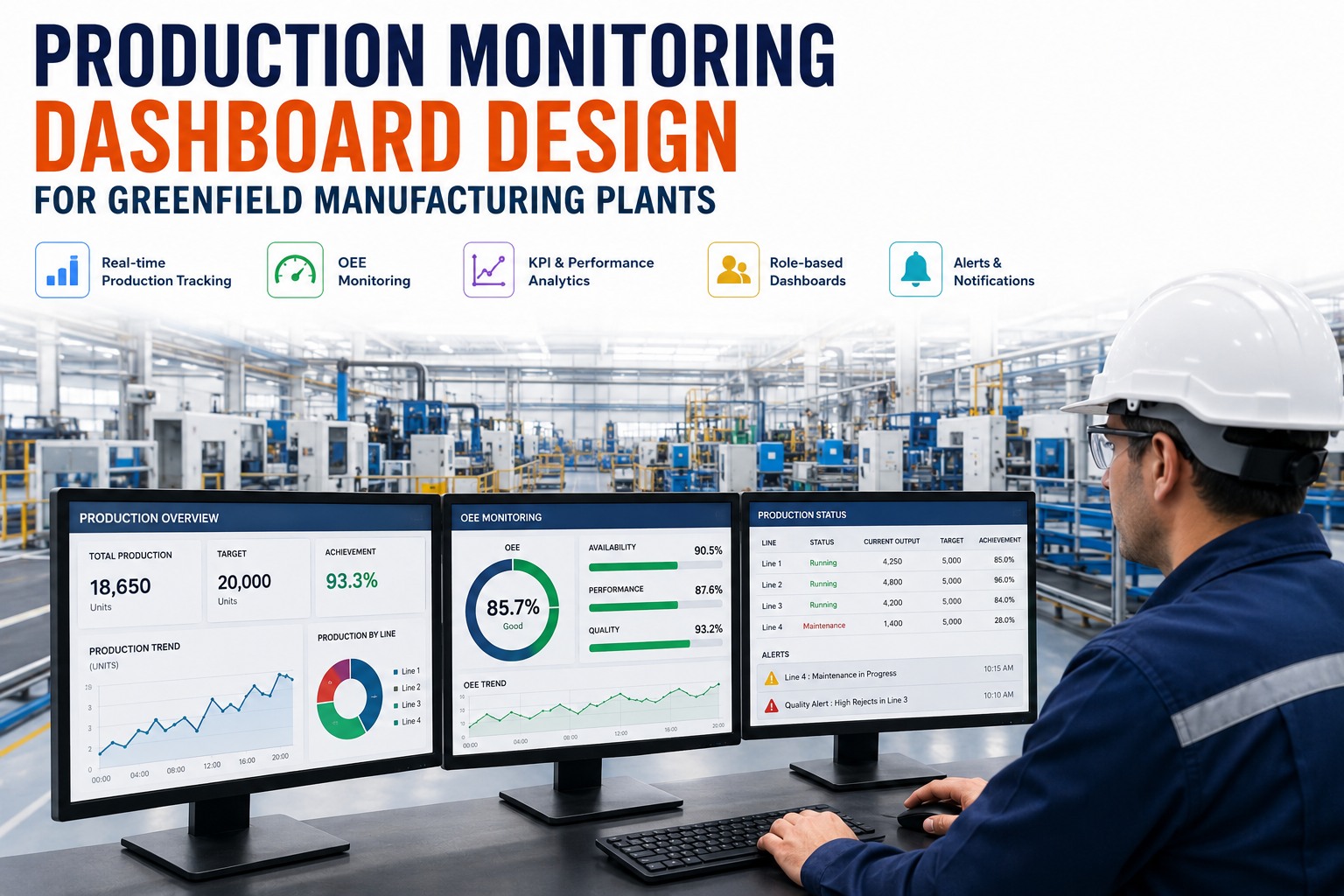
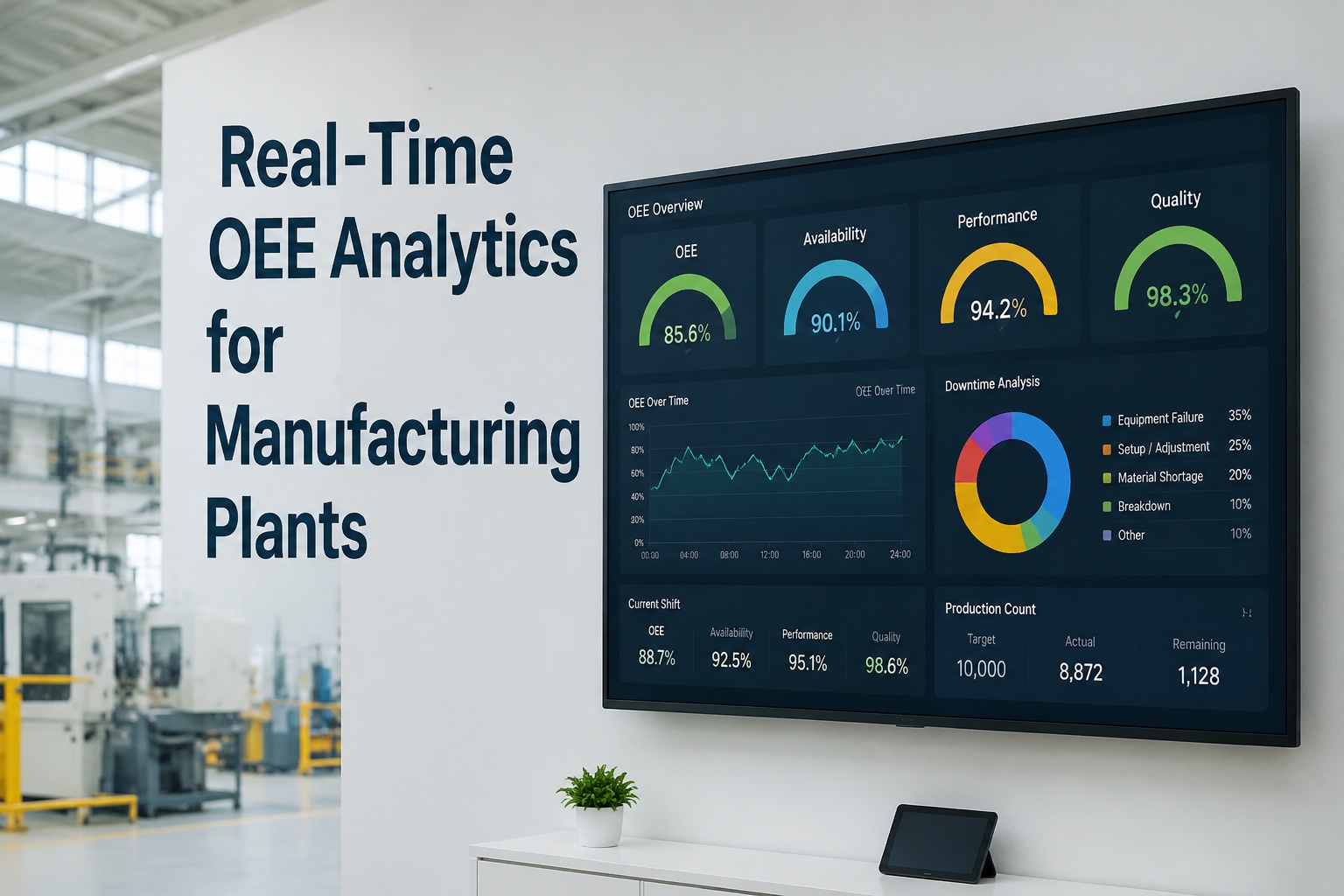
Most manufacturers spend years retrofitting IoT sensors onto equipment that was never designed for connectivity—fighting cable routing, power availability, protocol mismatches, and data silos. Greenfield factories skip the entire retrofit struggle by designing sensor infrastructure, edge computing, network architecture, and real-time dashboards into the building from day one. The result: production visibility from the first shift, not the first anniversary. This guide covers the four-layer IoT architecture, the specific sensors and edge hardware that deliver real-time OEE, downtime analytics, and quality monitoring, and the dashboard hierarchy that puts the right data in front of the right person. Book a demo to see how iFactory designs day-one production visibility into greenfield manufacturing layouts.
Smart Factory Architecture
Real-Time Production Visibility From Day One
Four layers that turn a greenfield building into a data-driven factory
4
Dashboards
Operator, supervisor, plant manager, C-suite — right data to right role
3
Intelligence Platform
OEE analytics, predictive alerts, root-cause AI, quality intelligence
2
Edge Computing
Local processing, protocol translation, real-time inference, data filtering
1
Sensor Layer
Vibration, temperature, power, flow, vision, pressure — every machine connected
The Greenfield Advantage: Why Day-One Visibility Changes Everything
Retrofit IoT projects fight the building every step of the way—routing cables through finished ceilings, finding power near machines that were placed without sensors in mind, and bridging protocol gaps between decades-old PLCs and modern analytics platforms. Greenfield design eliminates all of these obstacles by building connectivity infrastructure into the facility from the start.
30 days
to meaningful visibility
Visibility From the First Production Shift
When sensor mounts, cable trays, power drops, and network infrastructure are pre-installed during construction, IoT deployment collapses from months to days. Connect sensors to pre-provisioned ports, configure dashboards, and start streaming data on the same day equipment is commissioned.
10x
cheaper than retrofit
Infrastructure Cost Collapses During Construction
Running conduit, pulling cable, and installing power drops during construction costs a fraction of retrofitting them into a finished facility. Ethernet drops to every machine, dedicated sensor power circuits, and edge computing enclosures designed into the building eliminate the brutal retrofit costs that derail brownfield IoT projects.
Every Machine Connected — No Exceptions
Retrofit projects always leave gaps—machines in hard-to-reach locations, legacy equipment without digital interfaces, areas where cable routing is physically impossible. Greenfield design specifies connectivity for every machine position in the floor plan, including legacy equipment interfaces, before the building is constructed.
Planning a greenfield factory and want visibility from day one? Book an IoT architecture demo to see how sensor infrastructure designs into your floor plan.
The 4-Layer IoT Architecture for Production Visibility
Real-time production visibility isn't one technology—it's four layers working together. Each layer has specific greenfield design requirements that must be specified before construction to ensure seamless deployment during commissioning.
Every data point starts with a sensor. Vibration sensors on rotating equipment, temperature probes on thermal processes, power meters on motor circuits, flow meters on utilities, and vision cameras on inspection stations. Greenfield design specifies sensor mounting positions, cable routing, and power drops for every machine in the floor plan.
VibrationTemperaturePowerFlowPressureVisionHumidity
Greenfield spec: sensor mount positions, cable trays to every machine, dedicated 24V DC power circuits
Edge gateways process data locally—translating protocols (OPC-UA, Modbus, MQTT), running real-time inference models, filtering redundant data, and buffering during network outages. Edge computing reduces cloud bandwidth by 60%+ and delivers sub-millisecond response for time-critical quality decisions.
OPC-UAMQTTModbusProtocol translationLocal AI inference
Greenfield spec: edge enclosures per zone, Ethernet backbone, UPS-backed power, cooling provisions
The AI-native platform ingests data from all edge gateways and generates production intelligence: real-time OEE across every machine, automated downtime classification, predictive maintenance alerts, quality SPC with adaptive limits, and root-cause correlation across process variables.
Real-time OEEDowntime analyticsPredictive maintenanceQuality SPCRoot-cause AI
Greenfield spec: on-prem server room or plant-edge compute, UPS, HVAC, network redundancy
Different roles need different views. Operators see machine-level status and alerts. Supervisors see line-level OEE and downtime paretos. Plant managers see shift summaries and trend analysis. Executives see multi-plant benchmarks and financial impact. Each view is purpose-designed for decision speed at that level.
Operator HMILine andon boardsSupervisor tabletsManager dashboardsExecutive reports
Greenfield spec: large-format displays per line, Wi-Fi/LTE for mobile access, TV mounting positions
Design Day-One Visibility Into Your Greenfield Factory
iFactory's greenfield consultants specify the complete IoT architecture—sensor layout, edge computing, intelligence platform, and dashboard hierarchy—designed into the building before construction begins.
What Real-Time Dashboards Show: Floor to C-Suite
The most common IoT failure isn't technology—it's putting the wrong data in front of the wrong person. An operator doesn't need multi-plant benchmarks. A CEO doesn't need cycle-time scatter plots. Here's the dashboard hierarchy that makes production visibility actionable at every level.
Operator
Machine status (running/stopped/faulted), current cycle time vs. target, quality alerts, corrective action guidance
Machine HMI, line andon board
Supervisor
Line OEE (A × P × Q), downtime Pareto, top 5 loss reasons, shift-to-shift comparison
Tablet, wall display
Plant Manager
Plant-wide OEE trends, throughput vs. plan, maintenance backlog, quality Cpk, energy consumption
Desktop dashboard, daily digest
Executive
Multi-plant benchmarking, cost-per-unit trends, capacity utilization, CAPEX ROI tracking
Executive portal, weekly report
Want a dashboard hierarchy designed for your organizational structure? Schedule a visibility architecture demo with our greenfield team.
Expert Perspective
"Most manufacturers see meaningful visibility improvements within 30 days of connecting critical systems on a pilot line. Live OEE dashboards, automated downtime tracking, and real-time throughput monitoring deliver immediate value. The greenfield advantage is that you don't need a pilot—you design the entire facility for visibility from the start."
— Factory Data Integration Best Practice, 2026
22%
reduction in machine downtime with IoT monitoring
18%
energy reduction with real-time consumption tracking
15%
resource utilization gain with IoT-enabled manufacturing
Ready to build visibility into your greenfield factory? Request a consultation to get your IoT architecture designed before construction begins.
Conclusion: Build the Nervous System Before You Build the Body
Your factory's IoT infrastructure is its nervous system—the network that carries signals from every machine, sensor, and process point to the intelligence platform that makes sense of it all. In a retrofit, you're performing surgery on a living patient, routing cables through finished walls and finding power where there is none. In a greenfield, you design the nervous system into the body from the start: sensor mounts at every machine position, cable trays running to every zone, edge computing enclosures pre-installed, and dashboards streaming data from the first production shift. The factories that achieve real-time visibility from day one aren't luckier or better funded—they planned the IoT architecture into the building before concrete was poured.
Design Your Smart Factory From the Ground Up
iFactory's greenfield consultants specify the complete IoT architecture—from sensor layout through dashboard design—built into your facility before construction.
Frequently Asked Questions
How quickly can a greenfield factory achieve real-time production visibility?
When IoT infrastructure (sensor mounts, cable trays, network backbone, edge computing) is designed into the building during construction, production visibility activates within 30 days of equipment commissioning—often on the first production shift. Retrofit projects typically take 6–18 months to achieve the same coverage because they fight existing building constraints.
Book a consultation to see how day-one visibility designs into your greenfield layout.
What is edge computing and why does it matter for factory IoT?
Edge computing processes data locally at the factory rather than sending everything to the cloud. Edge gateways translate protocols (OPC-UA, Modbus, MQTT), run real-time AI inference, filter redundant data (reducing cloud bandwidth by 60%+), and buffer data during network outages. For time-critical quality decisions that need sub-millisecond response, edge computing is essential—you can't afford 50–200ms cloud round-trip latency for process control.
What sensors are needed for real-time OEE monitoring?
At minimum: current transformers or power meters to detect machine running/stopped/idle states (Availability), cycle counters or part sensors to measure actual vs. target throughput (Performance), and reject sensors or quality inspection data to track defect rates (Quality). For deeper insights, add vibration sensors for predictive maintenance, temperature probes for thermal process monitoring, and flow meters for utility consumption tracking.
How much does greenfield IoT infrastructure cost compared to retrofit?
Greenfield IoT infrastructure costs approximately 10x less than equivalent retrofit deployment. Running conduit, pulling cable, and installing power drops during construction is a fraction of the cost of doing the same work in a finished facility. The biggest savings come from cable routing (no ceiling tear-outs), power provisioning (no panel upgrades), and network infrastructure (Ethernet drops installed during rough-in vs. post-construction wireless workarounds).
Can legacy equipment be connected to IoT monitoring systems?
Yes. Modern IoT platforms support 250+ industrial communication protocols. Even machines without digital interfaces can be monitored using external sensors: current transformers detect running states from power draw, vibration sensors track equipment health, and retrofit cycle counters measure throughput. In greenfield design, you specify sensor mounting positions and cable routing for legacy equipment positions in advance—eliminating the access challenges that plague brownfield IoT projects.