Every pump you specify for a new plant is a twenty-year decision. Long after the purchase price is forgotten, that pump keeps drawing power every hour it runs — and across its life, energy, not the sticker, is where almost all the money goes. Choose the wrong type and you inherit cavitation, seal failures, and a machine fighting its own system. Choose the wrong size and you pay an efficiency penalty on every shift. A greenfield plant is the one moment to get both right before anything is bolted down. This guide walks through selecting, sizing, and smart-monitoring industrial pumps for a modern factory.
Specifying pumps for a new plant? Book a 30-minute pump selection consultation to size and monitor them for efficiency from day one.
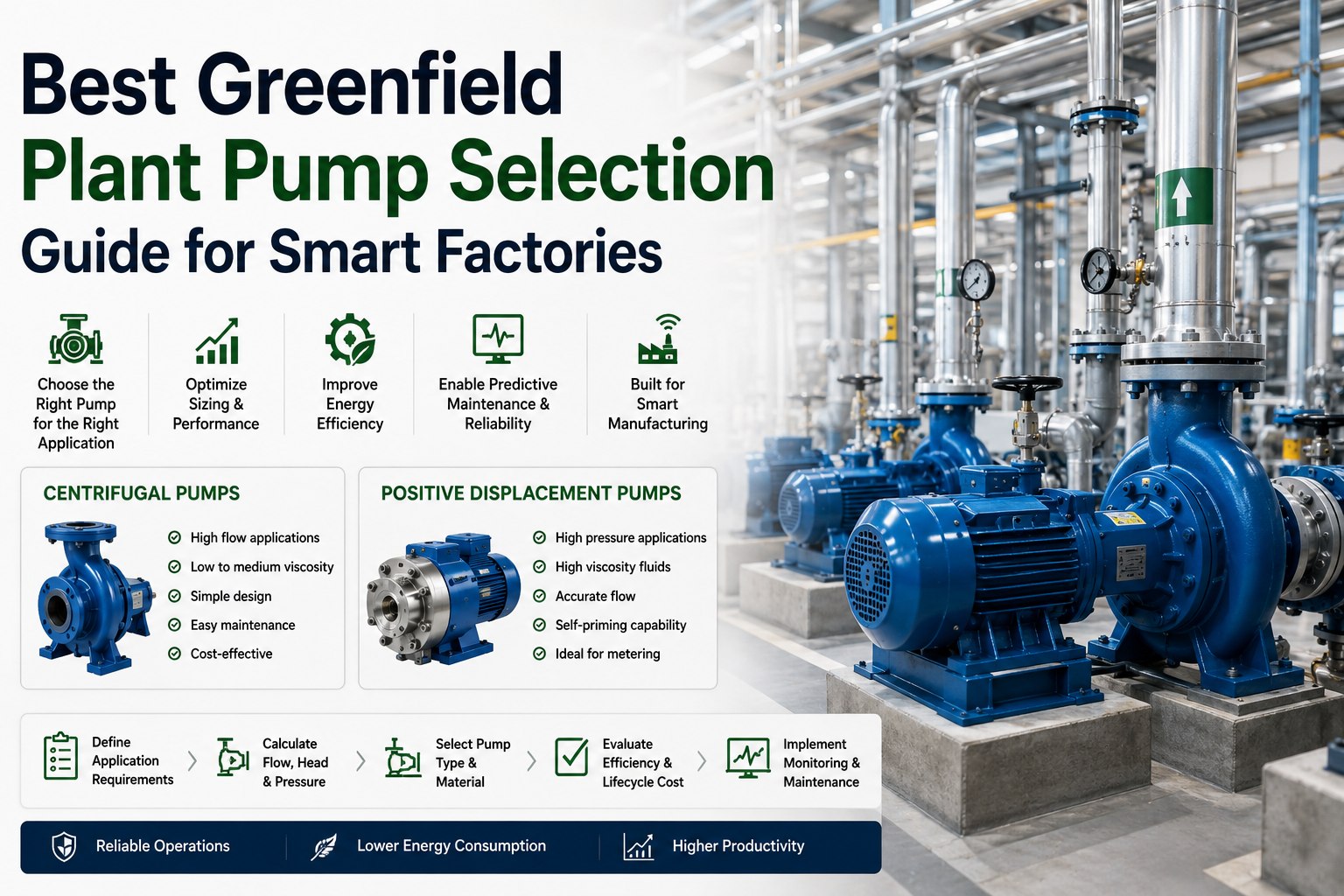
Pick the Pump Family Before Anything Else
Centrifugal
High flow · low–moderate pressure · thin, clean fluids · rides the system curve
Positive Displacement
Precise, constant flow · high pressure · viscous & shear-sensitive fluids · metering
The family decision comes first. Get it wrong and you buy cavitation, seal failures, and a pump that wastes energy fighting its own piping.
Why Pump Selection Is a 20-Year Decision
Pumps are quietly one of the largest electricity consumers in any plant, and the purchase price is the smallest part of what they cost. Over a pump's working life, energy can account for the overwhelming majority of total cost — so a few points of efficiency, locked in or lost at selection, compound into a fortune over two decades. Because energy dwarfs the purchase price, the selection deserves real engineering up front rather than a catalog guess. If you want it scoped for your duty points, you can map it with a rotating-equipment specialist.
of global industrial electricity is used by pump systems
of a pump's lifecycle cost is energy — not the purchase price
overall efficiency many pump systems actually run at today
Centrifugal vs Positive Displacement: The Selection Matrix
Both move fluid, but they behave in opposite ways under pressure. The right choice is dictated by your fluid and your duty, not by which pump is "better."
Unsure which family fits your process fluids? Book a selection workshop and we will match pump type to every duty in your plant.
Size It Right: The Curve, the BEP, and the Cost of Oversizing
Once the family is chosen, sizing decides the efficiency. A centrifugal pump's duty point is where its curve crosses the system curve — and you want that crossing to sit near the Best Efficiency Point (BEP). Run far from the BEP and efficiency falls while vibration, recirculation, and wear climb.
An oversized pump pushes the operating point left of the BEP, where it throttles against its own valve and burns energy for no extra output. The fix is to right-size from the start, then trim the impeller or add a variable-frequency drive so the pump runs where it is efficient — while keeping enough margin on suction pressure to avoid cavitation.
From Selection to Smart: Efficiency and Predictive Maintenance
Selecting and sizing well sets the ceiling; instrumentation keeps the pump near it for twenty years. In a smart plant, every pump is watched, and small problems surface as data long before they become downtime.
Condition Monitoring
Vibration, temperature, flow, and power watched continuously to catch bearing and seal wear early.
Cavitation & NPSH Alerts
Spot the pressure and vibration signature of cavitation before it erodes the impeller.
Energy & VFD Optimization
Match speed to demand to kill throttling losses, and flag any drift away from the BEP.
Right-Sizing Data
Real duty-point data exposes oversized pumps that are candidates for trimming or replacement.
Want every pump monitored from day one? Book a predictive-maintenance demo and see pump health and energy on one screen.
Specify Pumps That Stay Efficient for Decades
iFactory helps greenfield teams select and size pumps to their duty points, then monitors vibration, energy, and cavitation on one platform — so the efficiency you design in is the efficiency you keep.
Expert Perspective
The most common and most expensive mistake we see is the oversized centrifugal pump. Someone adds a safety margin at selection, then another, and the plant ends up with a pump that spends its whole life throttled back, running left of its best efficiency point, eating energy and chewing through seals. The irony is that the cube law works against you here: throttling a pump to cut flow barely saves any power, while slowing it with a drive saves almost half. On a greenfield plant you can size to the real duty point, fit a drive where demand varies, and instrument it from day one — so the pump runs where it is efficient and tells you the moment it stops.
— Rotating Equipment Practice, iFactory Engineering Team
power saved by a 20% speed cut on a drive (ideal case)
power saved by throttling for the same flow cut
typical payback on right-sizing an oversized pump
The Bottom Line
A pump is cheap to buy and expensive to run, so the money is made or lost at selection and sizing. Pick the family your fluid and pressure demand — centrifugal for high flow and thin fluids, positive displacement for high pressure, viscosity, and precision. Size the duty point near the BEP, and use a drive or a trimmed impeller instead of a throttling valve. Then instrument every pump so efficiency and health stay visible for its whole life. A greenfield plant lets you do all of it deliberately, before the concrete sets — and that is how pumps stop being a hidden cost and start being a quiet advantage.
Build a Plant Where Every Pump Earns Its Energy
From type selection and BEP sizing to VFD optimization and predictive maintenance, iFactory helps greenfield teams design pump systems that are efficient by design and stay that way — monitored, right-sized, and reliable from the first run.
Frequently Asked Questions
Centrifugal or positive displacement — how do I choose?
Match the pump to the fluid and the duty. Centrifugal pumps suit high flow at low to moderate pressure with thin, clean fluids, and their flow varies with system pressure. Positive displacement pumps suit high pressure, viscous or shear-sensitive fluids, and applications needing precise, constant flow such as metering and dosing. If your fluid is water-like and the flow is steady, centrifugal usually wins; if it is thick, abrasive, or must be dosed exactly, positive displacement is the safer choice.
What is the best efficiency point (BEP) and why does it matter?
The BEP is the flow and head where a centrifugal pump converts the most energy into useful work, with the lowest hydraulic losses. Operating near it gives the best energy use, the least vibration, and the longest component life. Running far from the BEP — usually because the pump is oversized — drops efficiency and accelerates wear on seals and bearings, which is why duty points should be set close to the BEP at design time.
Why is oversizing a pump a problem?
An oversized pump produces more flow and head than the system needs, so it is throttled back with a valve that simply dissipates the excess as heat. The pump then runs left of its best efficiency point, wasting energy while suffering higher vibration, recirculation, and seal wear. Because energy dominates lifecycle cost, that penalty repeats every hour for decades — which is why right-sizing pays back quickly.
How much energy can a variable-frequency drive save on a pump?
For centrifugal pumps, the affinity laws mean power falls roughly with the cube of speed, so a 20 percent speed reduction can cut power by close to half in the ideal case — far more than the 5 to 10 percent throttling achieves for the same flow. Real savings are somewhat lower when the system has significant static head, and pumps generally cannot run below about 40 percent speed, so the actual figure should be modeled against your system curve.
How does iFactory help with pump selection and reliability?
iFactory's greenfield advisory helps select and size pumps to their duty points, and its platform then monitors vibration, temperature, flow, energy, and cavitation to keep them efficient and catch failures early. The same data exposes oversized pumps and drift from the BEP so you can act before energy or downtime adds up. You can book a consultation to plan it for your facility.