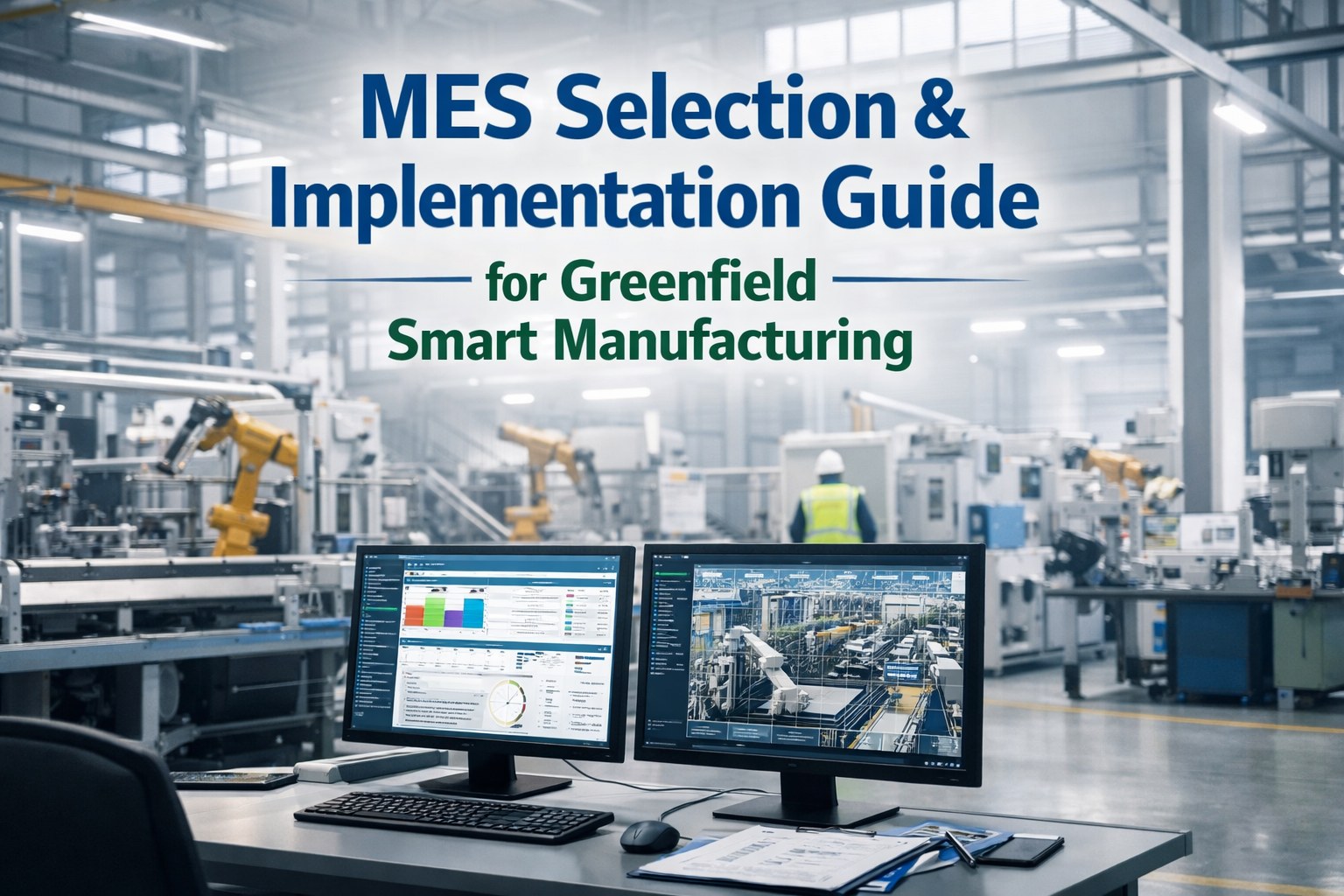
MES Selection & Implementation Guide for Greenfield Smart Manufacturing
By James C on March 1, 2026
The global MES market hit $14.89 billion in 2024 and is racing toward $41.78 billion by 2032 — yet the majority of greenfield MES implementations still fail or require major rework within the first year. The problem isn't the technology. It's that teams select MES platforms after construction starts, bolt on SCADA and ERP integrations as afterthoughts, and discover on go-live day that their OT and IT layers don't talk to each other. This guide walks greenfield executives through every decision — from vendor evaluation through production go-live — in the sequence that actually works.
GREENFIELD MES IMPLEMENTATION GUIDE
$41.8BProjected MES Market Size by 2032
14.1%MES Market CAGR (2025-2032)
41%Of Smart Factories Use MES Platforms
60%Report Reduced Downtime Post-MES
ERP
MES
SCADA
Why greenfield MES is different: Brownfield MES retrofits work around legacy systems, inherited data structures, and entrenched processes. Greenfield gives you a once-in-a-decade opportunity to architect your MES, SCADA, and ERP integration from scratch — with clean data, modern APIs, and zero technical debt. Get it right during construction, and your factory launches with full digital visibility. Get it wrong, and you're doing a brownfield retrofit on a brand-new plant.
What is MES and Why Greenfield Factories Need It From Day Zero
The Smart Factory Software Stack
Level 4
ERP
Business planning, financials, supply chain, customer orders
API / OPC UA
Level 3
MES
Production execution, scheduling, quality, traceability, work orders
Machine control, sensor data, actuators, field devices
A Manufacturing Execution System sits at Level 3 of the ISA-95 automation pyramid — between your ERP (business planning) and your SCADA/PLC layer (machine control). It's the system that translates "make 10,000 units of Product X by Friday" into actual production instructions, tracks every step in real-time, enforces quality checks, manages work orders, and feeds performance data back up to the executive layer. Without MES, you have a planning system that doesn't know what's happening on the floor, and a control system that doesn't know what the business needs. The gap between these two layers is where production visibility, quality control, and scheduling accuracy go to die.
The 6-Phase Greenfield MES Implementation Roadmap
01
Months 1-2
Business Blueprint & Requirements Definition
Before evaluating a single vendor, define what your MES must do. Map every production process, quality checkpoint, and data handoff. Document your integration requirements with ERP, SCADA, PLCs, and warehouse systems. Identify regulatory and traceability needs specific to your industry. This blueprint becomes the evaluation scorecard — without it, you're comparing vendor demos instead of comparing solutions to your actual requirements.
Key Deliverables
Production process maps for every line and work center
Data model: what gets tracked, where it flows, who consumes it
Regulatory and compliance requirements (FDA, ISO, GMP)
02
Months 2-4
MES Vendor Evaluation & Selection
The MES market is split between enterprise integrators (73% market share) offering bundled solutions with ERP and SCADA, and pure-play vendors growing at 15.4% CAGR with specialized, modular platforms. For greenfield factories, the decision hinges on three factors: how well the MES integrates with your chosen SCADA and ERP, whether it supports cloud or hybrid deployment, and how fast it can be configured during your construction timeline.
No native SCADA connectivity — relies on third-party bridges
On-premises only with no cloud migration path
Vendor has no greenfield deployment references
Implementation timeline exceeds your construction schedule
Locked into proprietary data formats
03
Months 4-8
OT/IT Architecture Design & Integration Planning
This is where most greenfield MES projects succeed or fail. Your OT (Operational Technology) layer — PLCs, SCADA, sensors, field devices — must seamlessly exchange data with your IT layer — MES, ERP, analytics, cloud platforms. Modern interoperability standards like OPC UA and MQTT simplify this, but the integration architecture must be designed before equipment arrives, not after it's installed.
Integration Architecture Blueprint
OT Layer
PLCs, Sensors, Drives, HMIs, SCADA, Historians
OPC UA
MQTT
REST API
IT Layer
MES, ERP, WMS, Analytics, Cloud, Digital Twin
Greenfield Advantage: In greenfield, you specify OPC UA compliance in your OEM equipment procurement contracts — ensuring every machine ships with standardized data interfaces. Brownfield teams spend months reverse-engineering proprietary protocols. You don't have to.
Need Help Architecting Your MES Stack?
iFactory deploys alongside your construction timeline — configuring MES dashboards, SCADA integrations, and KPI calculations before your first shift starts.
Leading greenfield programs now configure and test MES in a virtual environment before the physical plant is complete. Digital twin platforms let you simulate production workflows, validate data flows between MES-SCADA-ERP, and train operators — all while construction is still underway. This approach can trim commissioning time by up to 30% and catch integration defects months before they'd surface on a live production floor.
Testing Milestones
Sandbox environment: full MES configured with simulated data
Factory Acceptance Tests (FAT) with each OEM equipment vendor
End-to-end integration test: ERP order to MES to SCADA to PLC
User acceptance testing (UAT) with production and quality teams
05
Months 12-14
Phased Go-Live & Production Ramp-Up
Never deploy MES across all lines simultaneously. The proven approach is to start with one production line or work center, validate everything in live production, then roll out zone by zone. This phased method minimizes disruption, catches issues at small scale, and builds operator confidence before the full plant depends on the system.
A
Pilot Line
Single line, full MES functionality. Validate work orders, quality tracking, OEE calculations, and SCADA data flows in real production conditions.
B
Zone Expansion
Roll out to adjacent production zones. Add ERP integration for scheduling and material consumption. Enable cross-line performance comparisons.
C
Full Plant Coverage
All lines, all work centers, all shifts on MES. Executive dashboards fully operational. Predictive analytics and AI models begin learning from production data.
06
Month 14+
Continuous Optimization & AI-Powered Intelligence
Go-live is just the beginning. With clean MES data flowing from every machine and process, you now have the foundation for predictive maintenance, AI-driven quality optimization, and real-time production intelligence. The factories that win don't just install MES — they build a continuous improvement loop where data drives decisions at every level, from the operator to the boardroom.
The pattern that separates successful MES implementations from failed ones: Teams that start the business blueprint during early construction and involve plant operations staff in every phase avoid the most common failure mode — deploying a system designed on assumptions that don't match actual production reality. The MES should be shaped by the people who will use it every day.
MES Vendor Comparison: What to Evaluate
Enterprise Integrators
Pure-Play MES Vendors
Cloud-Native Platforms
Market Share
~73% of market
Growing at 15.4% CAGR
Fastest-growing segment
Best For
Large enterprises with existing SAP/Siemens ecosystems
Specialized industries needing deep MES functionality
Greenfield factories wanting fast deployment
ERP Integration
Native (same vendor)
API-based
API-first design
SCADA Connectivity
Native (same vendor)
OPC UA / MQTT
OPC UA / MQTT
Deployment Speed
6-18 months
3-9 months
4-12 weeks
Typical Cost
$500K - $5M+
$100K - $1M
$50K - $500K
Greenfield Fit
Good if locked into ecosystem
Good for specialized needs
Ideal for speed and flexibility
The 5 Core MES Modules Every Greenfield Factory Needs
01
Production Scheduling & Dispatch
Imports orders from ERP, generates optimized production schedules, and dispatches work orders to the floor. Handles changeover sequencing, priority management, and real-time rescheduling when disruptions occur.
02
Real-Time Production Tracking
Monitors every unit from raw material through finished goods. Tracks WIP status, cycle times, throughput rates, and production counts — feeding live data to dashboards and KPI calculations.
03
Quality Management & Traceability
Enforces in-process quality checks, manages non-conformances, and creates full genealogy traceability from raw material lot to shipped product. Critical for regulated industries and customer audit readiness.
04
Performance Analytics & OEE
Auto-calculates OEE, availability, performance, and quality metrics from machine data. Identifies the Six Big Losses, benchmarks lines and shifts, and drives continuous improvement with data — not opinions.
05
Maintenance Integration & Asset Management
Links MES to CMMS for automated work order generation based on equipment events. Tracks MTBF, MTTR, and planned maintenance percentage. Feeds AI predictive maintenance models with clean, structured data.
See All 5 Modules Live in iFactory
iFactory delivers production scheduling, real-time tracking, quality management, OEE analytics, and maintenance integration in one unified platform — configured during construction, operational from day one.
Common MES Implementation Mistakes (And How to Avoid Them)
Mistake
Selecting MES after equipment is installed — forcing the system to adapt to hardware limitations instead of designing both together.
Solution
Start MES selection during engineering design. Include OPC UA compliance in OEM procurement specifications.
Mistake
Big-bang deployment across all lines on day one — creating too many variables to troubleshoot when issues surface.
Solution
Phase the rollout: pilot one line, validate integrations, then expand zone by zone with proven configurations.
Mistake
Mapping legacy processes into the new MES instead of redesigning workflows to leverage modern system capabilities.
Solution
Use the greenfield advantage: design processes around MES capabilities. Adopt standard solutions over custom workarounds.
Mistake
Excluding plant operations staff from the blueprint and design phases — then wondering why the system doesn't match production reality.
Solution
Build a cross-functional project team with production, quality, maintenance, and IT from day one. They shape the system; the system serves them.
Frequently Asked Questions
Costs vary dramatically based on scale and vendor type. Enterprise integrator solutions (Siemens, SAP) typically range from $500K to $5M+ for a full plant deployment. Pure-play MES vendors range from $100K to $1M. Cloud-native platforms like iFactory can be deployed for $50K-$500K with subscription-based pricing that aligns cost to actual usage. Implementation services (configuration, integration, training) often represent 40-60% of total project cost.
A well-planned greenfield MES implementation aligned to the construction timeline typically takes 12-16 months from blueprint to full go-live. Cloud-native platforms can compress pilot deployment to 4-12 weeks. The key advantage of greenfield is that MES configuration runs in parallel with construction — so you're not adding months to your production start date. Enterprise integrator deployments can take 6-18 months for configuration and testing alone.
SCADA (Supervisory Control and Data Acquisition) operates at Level 2 — it monitors and controls physical equipment in real-time: temperatures, pressures, motor speeds, alarm states. MES operates at Level 3 — it manages production execution: work orders, scheduling, quality, traceability, and performance analytics. SCADA tells you what the machine is doing right now. MES tells you what the machine should be doing, whether it's meeting production targets, and what to do next. Both are essential, and they must exchange data seamlessly through OPC UA or MQTT protocols.
For greenfield factories, cloud or hybrid MES deployments offer significant advantages: lower upfront infrastructure cost, faster deployment, automatic updates, and the ability to begin configuration before the physical plant is built. Hybrid models keep time-critical SCADA data on-premises while running MES analytics and dashboards in the cloud. Approximately 47% of factories adopted cloud-native MES solutions in 2023-2024, reflecting growing confidence in cloud security and reliability for production-critical applications.
iFactory is designed specifically for greenfield and smart factory deployments. It provides production scheduling, real-time tracking, quality management, OEE analytics, and CMMS integration in one unified cloud platform. iFactory connects to SCADA and PLCs via OPC UA, integrates with ERP through standard APIs, and configures during the construction phase — so executive dashboards are operational from commissioning day one. AI-powered predictive analytics begin learning equipment behavior immediately.
Start Your MES Journey With the Right Architecture
iFactory's cloud-native MES platform deploys alongside your construction timeline — giving greenfield executives full production visibility, SCADA integration, and AI-powered analytics from day one.
Planning MES for your greenfield smart factory? Book your free iFactory demo and see how a cloud-native MES platform integrates with SCADA, ERP, and AI analytics — configured during construction, not after launch.