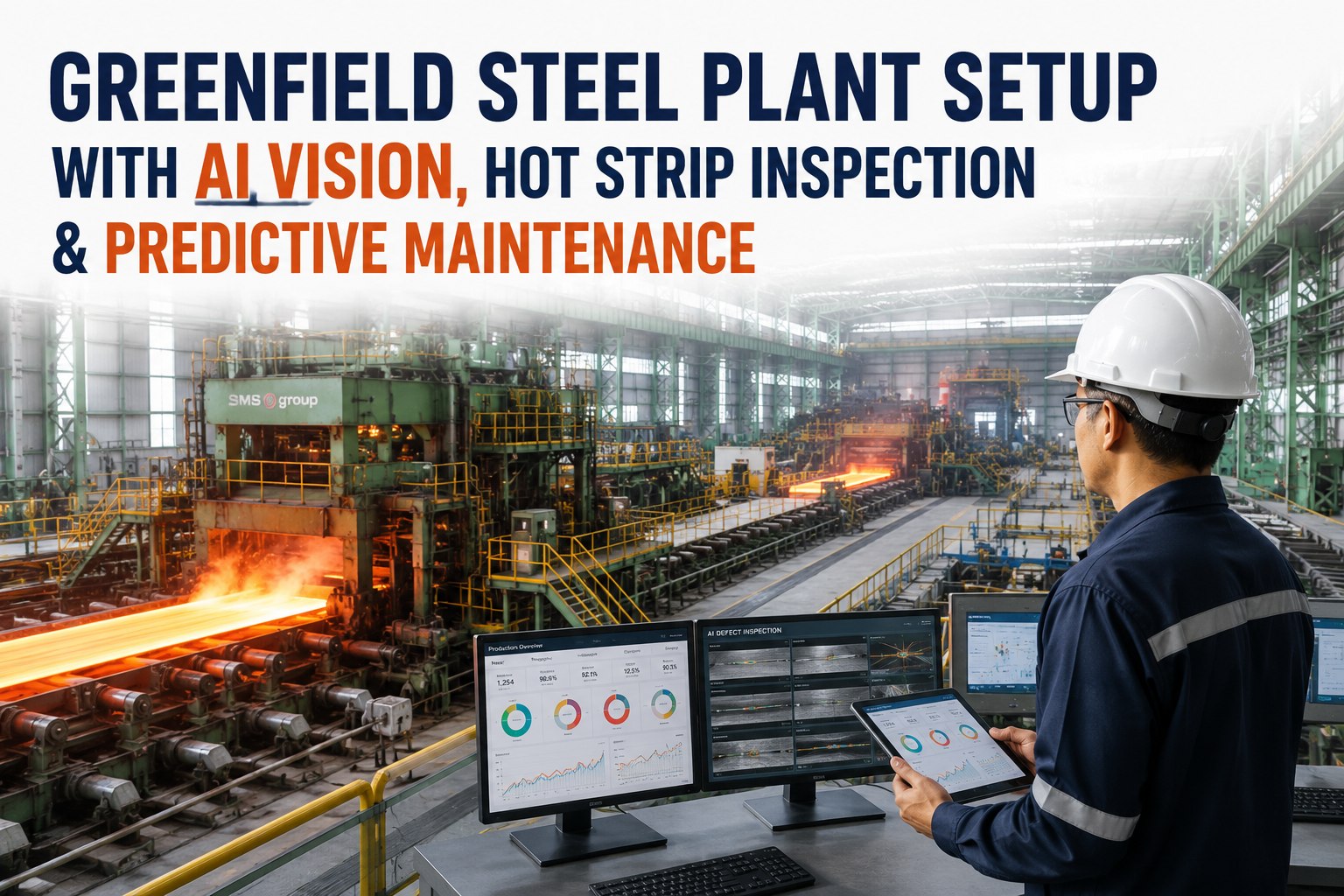
In a steel plant, a defect born at the caster can travel three or four process stages before anyone sees it — and by then it is buried in a coil already promised to an automotive customer. A greenfield mill is the rare chance to put intelligent eyes and condition sensors on the line as it is built, so the caster, the hot strip mill, and the finishing lines are all watched from the first heat. The result is fewer quality escapes, fewer surprise breakouts, and a maintenance program that catches a failing bearing weeks before it stops the mill. Here is how to set it up.
Planning a greenfield steel mill? Book a 30-minute digital-plant consultation to design AI vision and predictive maintenance into the line from day one.
AI Eyes at Every Stage of the Line
Caster
Mold & slab monitoring
Slab
Surface inspection
Hot Strip Mill
Defect detection
Finishing
Grade gating
One digital thread runs the whole line — line-scan cameras and condition sensors feeding a single platform, so a defect or a degrading bearing is flagged the moment it appears, not stages later.
Why Steel Plants Go Digital From Day One
Steel is unforgiving in two directions at once. On quality, a trained inspector at the hot strip mill exit catches only a fraction of surface defects at line speed, and the ones that escape ship as automotive stamping cracks and paint-adhesion failures worth millions in claims. On reliability, equipment is interdependent — a worn mill guide marks an entire coil batch, and a caster bearing can cascade into a breakout in under a minute. That gap between when a defect is created and when it is caught is where steel mills lose money. Closing it from day one is the case for going digital at a greenfield site, and you can scope it with a steel specialist.
daily cost of an unplanned furnace or mill outage
surface defects a human catches at line speed, versus 94–98% for AI
of hot-strip-mill downtime traces to rolling-mill bearing failures
AI Monitoring Across the Steel Line
Each stage of the line has its own defect signatures and its own inspection challenge. Here is what AI vision watches as steel moves from molten metal to finished coil.
Mold level and thermocouple patterns are tracked as steel solidifies, with surface monitoring on the strand itself.
Surface and corner cracks plus inclusion streaks are caught here — three to four process stages before they would reach a customer.
Full-width surface inspection through heat and steam at line speed — the largest impact zone, where most surface defects originate or become visible.
Ultra-low-contrast defects and coating uniformity are checked here, where grade classification determines the revenue a coil earns.
Want surface inspection scoped for your grades and line speed? Book an AI vision workshop and we will map detection to each stage of your line.
Predictive Maintenance for Steel's Hardest-Working Assets
Surface inspection protects quality; predictive maintenance protects uptime. In a mill where equipment is interdependent, catching degradation early on these assets prevents a single failure from cascading across a bay.
Continuous Caster
Mold level and thermocouple patterns plus segment-roller vibration, watched at the edge for machine-speed response.
Breakout alarm 30–90s aheadMill Drives & Rolls
Work-roll bearing vibration signatures, motor-current load imbalance, and hydraulic AGC response times.
Bearing failure 2–6 weeks aheadReheat Furnace
Shell thermal mapping, skid-pipe cooling flow, and refractory wear tracked per heat.
Refractory degradation trendedCranes & Motors
Ladle-crane drive anomalies and motor thermal and current trending across material-flow bays.
Faults before a bay stopsOne Platform for Quality and Uptime
iFactory unifies AI surface inspection and predictive maintenance on one platform — turning every coil into a documented quality record and every defect pattern into a work order on the upstream equipment causing it, with OT data inside your perimeter.
The Greenfield Steel Digital Setup Roadmap
Building the digital line cleanly is a sequence run in parallel with construction, so inspection and monitoring are live the day the first heat is cast.
Map the line and asset criticality
Catalog every stage and asset from caster to coil, ranked by quality impact and downtime consequence.
Instrument from commissioning
Design line-scan cameras at the caster, mill, and finishing lines plus vibration, thermal, and current sensors on drives and rolls into the build.
Process at the edge
Run inference at the machine — breakout and cobble alarms need sub-200ms response, not a cloud round-trip — and integrate with Level 2 and SCADA.
Train vision and PdM models
Build surface-defect classifiers for each stage and condition models for bearings, rolls, furnaces, and casters.
Close the defect-to-maintenance loop
Route recurring defect patterns to automatic work orders on the upstream equipment causing them, before the next campaign produces downgraded coil.
Unify dashboards and go live
Stand up coil-level quality records, grade gating, and reliability dashboards so the line runs on data from the first heat.
Ready to sequence this against your build? Book an implementation session and leave with a phased digital plan for your project team.
Expert Perspective
The hardest defects to catch in steel are not the obvious ones — they are the periodic roll mark every few meters from a worn bearing, or the alumina streak from a tundish nozzle that is technically visible at the mill exit but sits below what a human can reliably see at nine hundred meters a minute. Those are the ones that ship and come back as a tier-one automotive claim. The value of building vision and condition monitoring into a greenfield line is that the same system that spots the streak also tells you which roll or nozzle to change — so you fix the cause, not just the coil.
— Steel Quality & Reliability Practice, iFactory Engineering Team
AI surface-defect detection accuracy at line speed
advance warning on rolling-mill bearing failures
edge alert speed for a caster breakout versus a cloud round-trip
The Bottom Line
A steel mill makes or loses money in two places: the defects it ships and the failures it does not see coming. A greenfield project is the chance to address both before the first heat — instrumenting the caster, the hot strip mill, and the finishing lines with AI vision while wiring condition monitoring into every critical drive and roll. Build it on one platform, process the time-critical alarms at the edge, and close the loop from detected defect to maintenance action, and the plant starts life catching problems at the source instead of in a customer's stamping press.
Set Up Your Steel Plant Digital From Day One
From line mapping and edge inference to surface-defect models and reliability dashboards, iFactory helps greenfield steel teams stand up vision and predictive maintenance on one platform — live with the line, not retrofitted years later.
Frequently Asked Questions
What does AI vision inspect in a steel plant?
AI vision inspects the whole line — surface and corner cracks at the caster and slab, cracks, scale, and roll marks at the hot strip mill, and scratches, embedded scale, and coating uniformity at finishing. Because it covers nearly the full surface at line speed, it catches the low-contrast and periodic defects that human inspectors miss, and traces each one back to its source stage.
Why is hot strip mill surface inspection so important?
The hot strip mill is the largest impact zone, where most surface defects either originate or first become visible, yet it runs through heat and steam at speeds far beyond human inspection capability. A person evaluates only a small fraction of the surface at line speed, so defects escape into coils and surface downstream as customer claims. AI vision closes that coverage gap.
What equipment benefits most from predictive maintenance in a steel plant?
Rolling-mill drives and rolls benefit most, since bearing failures drive a large share of hot-strip downtime and can be predicted weeks ahead from vibration. Continuous casters, reheat furnaces, and ladle cranes are also high-value because their failures cascade across interdependent equipment, turning one fault into a plant-wide stoppage.
How does AI prevent caster breakouts?
By recognizing breakout precursors in mold thermocouple and level patterns, AI can raise an alarm tens of seconds before a breakout occurs. Because a caster breakout can develop in under a minute, the alarm has to run at the machine on the edge rather than through a cloud round-trip, giving operators time to slow or stop the strand and avoid a costly event.
How does iFactory support a greenfield steel plant setup?
iFactory helps map the line, instrument cameras and sensors during construction, and process time-critical alarms at the edge, then runs surface inspection and predictive maintenance on one platform that links defects to the upstream equipment causing them. You can book a greenfield consultation to plan it for your mill.