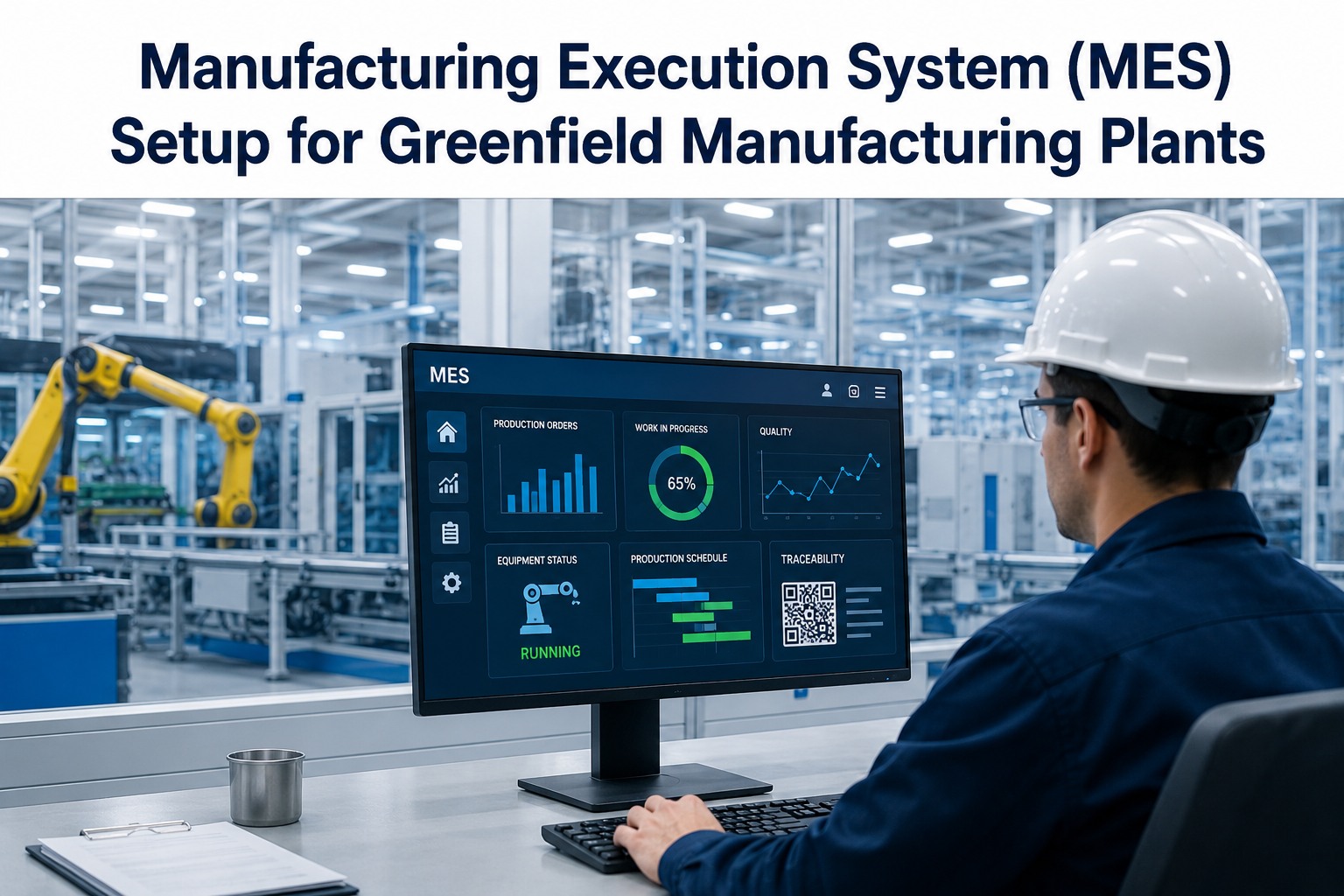
An ERP system knows what your plant should make, and a PLC knows how one machine behaves — but neither can tell you, in real time, what is actually happening on the floor. That is the job of a Manufacturing Execution System. Sitting at Level 3 of the automation stack, an MES turns production orders into tracked, traceable, paperless execution: work-in-progress visibility, electronic batch records, live scheduling, and genealogy that follows every unit. For a greenfield plant, designing the MES in from day one — rather than retrofitting it onto a running line — is the difference between a clean digital backbone and years of integration debt.
Designing the digital backbone for a new plant? Book a 30-minute MES strategy consultation to map your modules, integrations, and go-live to your build.
Where an MES Fits
The MES is the command-and-control layer that bridges business intent with production reality — translating ERP orders into shop-floor execution and feeding live results back up.
What an MES Actually Does on Day One
An MES is not one feature but a set of modules that, together, replace clipboards, spreadsheets, and tribal knowledge with a single source of production truth. These are the core capabilities a greenfield plant should expect live from the first shift. If you want them mapped to your product flow, you can review the setup with an MES specialist.
Work-in-Progress Tracking
Real-time status of every batch, order, and work unit on the floor — full WIP visibility for inventory and priority decisions.
Electronic Batch Records
Paperless, enforced records that speed batch release, satisfy FDA 21 CFR Part 11, and cut recall scope by 70–90%.
Scheduling & Dispatching
Detailed production scheduling that balances people, material, and equipment, then dispatches work in the right sequence.
Traceability & Genealogy
Full forward and backward traceability and as-built genealogy — so any unit can be traced to its materials, equipment, and operators.
Quality Management
In-line quality checks, enforced workflows, and non-conformance handling that catch deviations before they propagate.
OEE & Performance Analysis
Availability, performance, and quality captured automatically — accurate, real-time OEE instead of manual spreadsheets.
Why Greenfield Is the Best Time to Deploy MES
Most MES projects struggle not because of the software but because they are retrofitted onto a live plant, where the data is messy, the integrations are bolted on, and operators already have entrenched habits. A greenfield site removes every one of those obstacles. You build the data model once, wire the integrations in during construction, and train operators before the first shift — so the MES is part of the plant, not an afterthought layered on top.
Building greenfield and want MES in from the start? Book an MES design workshop and we will align your modules and integrations with your construction schedule.
The Greenfield MES Setup Roadmap
A clean deployment follows a deliberate sequence. Run these seven steps in parallel with your plant build so the MES goes live the day production starts.
-
1
Define requirements and scope
Write a user requirements spec mapped to ISA-95 levels and the four operations models — production, quality, maintenance, and inventory.
-
2
Model your processes and data
Define products, routings, equipment, and materials in a clean, B2MML-ready data model that every integration will share.
-
3
Select the platform and architecture
Choose an ISA-95-aligned MES and decide cloud, edge, or hybrid based on latency, data residency, and IT strategy.
-
4
Configure the core modules
Stand up WIP tracking, electronic batch records, scheduling, quality, traceability, and OEE against your modeled processes.
-
5
Integrate ERP, SCADA, and PLC
Wire Level 4 to Level 3 to Level 2 using B2MML so orders flow down and results flow up without manual re-keying.
-
6
Validate and test
Run end-to-end testing — and full computer-system validation for regulated industries — before any live production data flows.
-
7
Train and go live with commissioning
Train operators during commissioning so the MES is second nature on day one, then ramp with live performance data from the first shift.
Want this roadmap sequenced against your startup date? Book an MES implementation session and leave with a phased plan you can hand to your project team.
Build Your MES Into the Plant, Not Onto It
iFactory connects MES execution to maintenance, quality, and asset workflows in one platform — WIP tracking, electronic records, scheduling, traceability, and ERP integration configured alongside your build, live from the first shift.
Expert Perspective
The reason most MES projects underdeliver is rarely the software — it is that they are retrofitted onto a plant that has already settled into its habits, with data and integrations patched together after the fact. Greenfield erases that problem. When you define the data model once, build the ERP and control integrations during construction, and train operators before they ever touch a paper traveler, the MES becomes invisible in the best way. The teams that win treat it as plant infrastructure, designed in at the same time as the piping.
— MES Implementation Practice, iFactory Engineering Team
OEE uplift MES typically delivers
recall-scope reduction from electronic batch records
common payback for a well-scoped MES
The Bottom Line
An MES is the layer that makes a modern plant legible — turning ERP orders into tracked, traceable, paperless execution and feeding real performance back to the business. The single biggest advantage a greenfield project has is timing: build the data model, integrations, and operator habits in from day one, and you skip the messy retrofit that derails so many MES programs. Spec it alongside the piping and the controls, validate it before production data flows, and your plant starts life with a clean digital backbone instead of years of integration debt.
Set Up MES Right From Day One
From ISA-95 data modeling to ERP integration and module configuration, iFactory helps greenfield teams stand up an MES that goes live with the plant — and connects execution to maintenance and quality in one system.
Frequently Asked Questions
What is a Manufacturing Execution System (MES)?
An MES is the real-time software layer that manages and records what happens on the shop floor. It captures live production data, enforces workflows, and tracks materials and labor — delivering the operational visibility that ERP cannot see and control systems cannot interpret. Core functions include scheduling, WIP tracking, electronic batch records, quality, traceability, and OEE.
Where does MES sit relative to ERP and SCADA?
Under the ISA-95 standard, MES occupies Level 3 of the automation hierarchy, directly between ERP at Level 4 and SCADA at Level 2. It translates business orders from ERP into shop-floor execution, then feeds production results back up. That bridging role is exactly why MES is the connective tissue of a digital plant.
Why deploy MES in a greenfield plant rather than later?
A greenfield site lets you build a clean data model once, wire integrations in during construction, and train operators before go-live. Retrofitting an MES onto a running plant means reconciling legacy data, bolting on integrations, and overcoming entrenched habits, often with production interruptions. Designing it in avoids that integration debt entirely.
What does MES integration with ERP involve?
It connects Level 4 to Level 3 so production orders flow down and performance results flow up without manual re-keying. Most integrations use B2MML, the XML schema based on ISA-95 information models, which major ERP vendors support. Done well, the ERP and MES share one consistent view of products, materials, and orders.
How does iFactory help set up MES for a greenfield plant?
iFactory helps define the ISA-95 data model, configure core modules, and integrate ERP and control systems alongside your build, then connects execution to maintenance and quality in one platform. That keeps the MES live from the first shift rather than retrofitted later. You can book an MES strategy consultation to plan it for your facility.