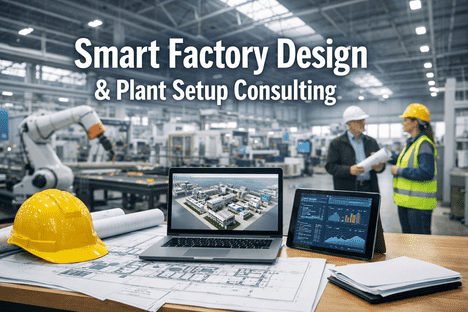
Greenfield Plant Setup Consulting for Smart Factory Design and Implementation
By Josh Brook on April 21, 2026
A smart factory is not a factory with sensors bolted on. It is a plant where every decision — from the physical layout of the production floor to the network segmentation that separates the PLCs from the ERP system to the way an AI model receives batch data from a single vibration sensor — has been engineered from the first CAD line with data flow, operational agility, and long-term evolvability as first-class design constraints. Most greenfield plants being built in 2026 will not achieve this. They will hit 40-60% under-budgeted IT/OT infrastructure. They will flatten their network architecture into an insecure single-VLAN shop floor because the initial project plan was silent on ISA-95 levels. They will install MES systems that cannot ingest data from their SCADA layer because system selection happened before architecture. They will commission 10-30+ trades with no virtual validation, then lose 3-9 months of schedule to software integration errors that could have been caught in simulation. iFactory's Plant Setup Consulting engages deep in the engineering and implementation phases — not the strategic pre-investment phase. We own the detailed design review, the IT/OT architecture specification, the layout optimization, the automation stack selection, and the virtual commissioning workstream that collectively determine whether your plant opens as a capable smart factory or as a traditional plant with sensors retrofitted later at 10x the cost. This page walks through exactly what that delivery looks like — the design principles, the architectural frameworks (ISA-95, Purdue, IEC 62443), the layout patterns, the automation spectrum, and the six smart-factory pillars we specify for every build.
Greenfield Plant Setup Consulting for Smart Factory Design and Implementation
Engineering-grade design advisory covering plant layout, automation architecture, ISA-95 IT/OT stack, virtual commissioning, and smart factory implementation — so the plant you build is a capable Industry 4.0 facility on day one, not a legacy plant needing retrofit on day two.
The 5 Design Principles Every Smart Factory Follows
Before layouts, before automation, before IT/OT architecture. Every successful smart factory build is governed by five design principles that traditional plant engineering does not enforce. Skip any one of these principles and you end up with a plant that produces fine but cannot evolve — which in a 20-30 year operating life is the same as a plant that fails.
01
Data-First Architecture
Every sensor, PLC, machine, and workstation is specified as a data source — not just a functional asset. Data contracts are defined before equipment selection. Standardized schemas are enforced across suppliers.
02
Modular Expandability
Production cells, MES modules, and network zones are designed to be added or swapped without re-architecting the plant. Day-one capacity typically runs at 60-70% of designed ceiling — headroom is engineered in, not bolted on.
03
Security-by-Design
ISA-95 levels and IEC 62443 zones and conduits are specified during architectural design, not during cybersecurity review after commissioning. Segmentation is structural — not a firewall retrofit.
04
Human-Machine Symmetry
Operators, technicians, and engineers are designed into the system as first-class interfaces. Cobot workcells are spaced for safe interaction. HMIs are specified per role. Training is scoped parallel to system design.
05
Virtual-First Validation
Every major design decision is tested in a digital twin before physical construction. Layout throughput, material flow, automation sequencing, and MES integration validated virtually to catch errors when they are still cheap.
The ISA-95 / Purdue Reference Architecture
Every plant we design is architected against the ISA-95 standard (ANSI/ISA-95.00.01-2025 update) and its Purdue Reference Model foundation. These are not academic frameworks. They are the industry-standard way to structurally separate concerns, secure the shop floor, and make the plant evolvable over a 20-30 year operating life. Flat network architectures — where everything shares one VLAN — are impractical to secure, painful to upgrade, and create permanent friction between IT and OT teams. The layered model below is what good looks like.
ISA-95 Functional Hierarchy · 5 Levels from Physical Process to Enterprise
Layout Topology — 5 Patterns for Different Plant Types
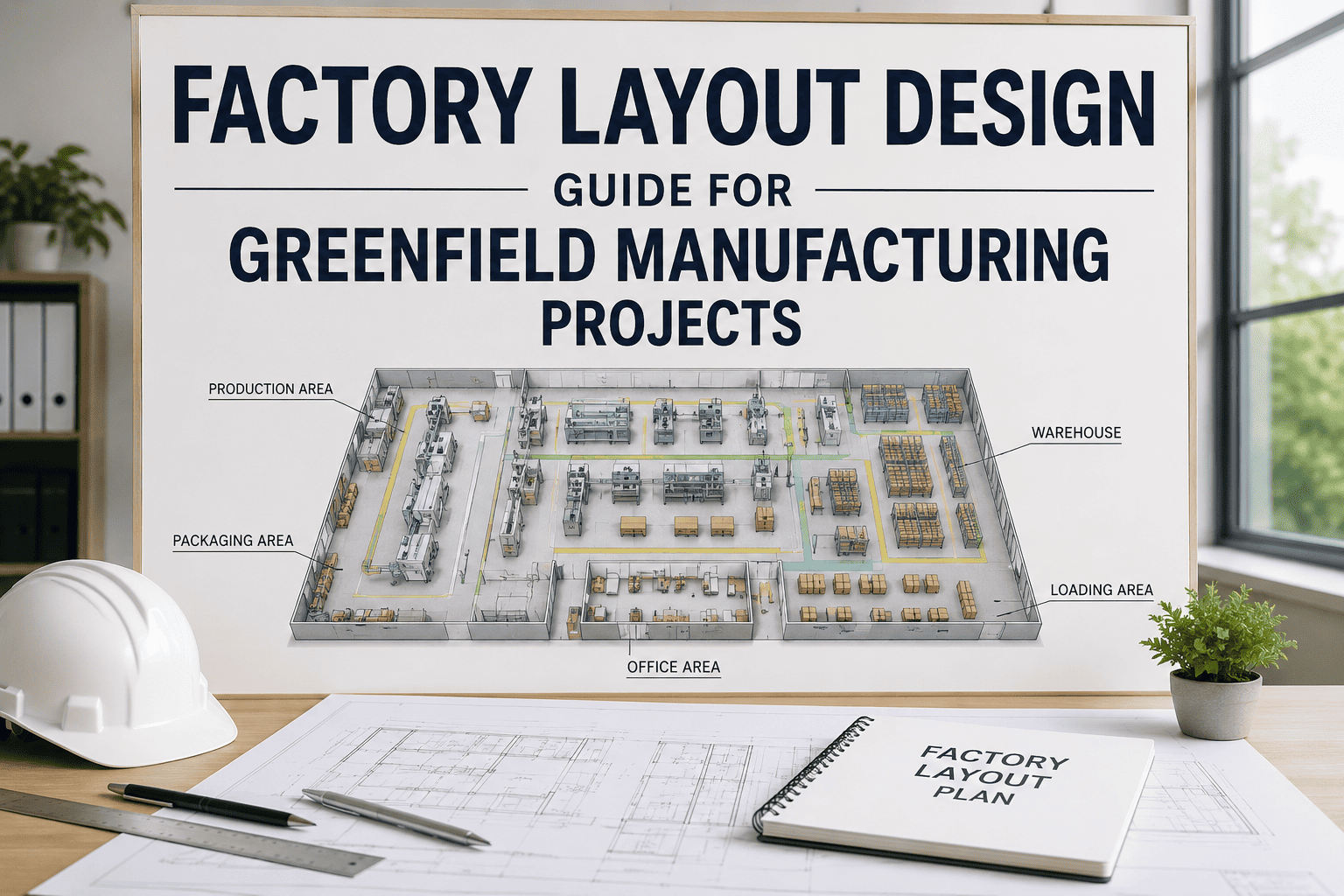
Plant layout is not picked from a catalog. It is engineered against production mix, product complexity, changeover frequency, material flow economics, and long-term flexibility requirements. Below are the five dominant topology patterns iFactory specifies, each with the production context it suits best. Choosing the wrong pattern is one of the most expensive design errors in a greenfield build — and one of the hardest to reverse after construction.
Linear Line
Best for · High-volume standardized products
Sequential stations with linear material flow. Maximum throughput, minimal WIP, simple material handling. Changeovers expensive.
Hybrid architecture combining cellular clusters around central automation backbone. Supports multi-product, reconfigurable, digital-twin-optimized operations.
Modern EV plants · biopharma · reshoring projects
The Automation Spectrum — Where Your Plant Should Sit
Automation is not a single decision. It is a spectrum from hard-tooled fixed automation at one end to cognitive AI-driven autonomous systems at the other. Greenfield plants rarely sit at a single point on this spectrum — most successful smart factories combine fixed automation for high-volume standardized steps, flexible robotics for mixed work, and AI-driven autonomous subsystems for quality inspection and predictive operations. The right mix depends on product mix, volume per SKU, and rate-of-change assumptions for the next 10 years.
Tier 1
Fixed Automation
Hard-tooled, single-product, high-volume. Lowest cost per unit at scale, zero flexibility. Typical for bottle filling, engine block machining, beverage labeling.
Flexibility · Low
Volume · Very High
Tier 2
Programmable Automation
PLC-driven, batch-changeable. Same equipment reconfigurable between product variants. Typical for batch pharma, food processing, CNC manufacturing cells.
Flexibility · Medium
Volume · High per batch
Tier 3
Flexible Automation
Robot arms, cobots, AMRs, vision-guided pick-and-place. Continuous reconfiguration between products. Typical for mixed-model automotive, electronics assembly, warehouse fulfillment.
Flexibility · High
Volume · Flexible
Tier 4
Cognitive Automation
AI vision inspection, autonomous defect learning, generative process control, self-optimizing digital twins. The cutting edge of Industry 4.0 plant design.
Flexibility · Autonomous
Volume · Adaptive
The 6 Smart Factory Pillars We Specify for Every Build
A plant does not become a smart factory because it has a digital twin. It becomes a smart factory when six specific capability pillars are engineered from the first architectural review. These are the six pillars iFactory specifies as mandatory inclusion in every greenfield plant design — each with acceptance criteria, integration points, and long-term evolvability requirements defined before the first equipment PO is issued.
01
Connected Shop Floor
Every asset wired or wirelessly connected to industrial data network. OPC-UA, MQTT, EtherNet/IP, Profinet standardized. No islanded equipment permitted in design review.
Spec · < 5% unmonitored assets at commissioning
02
Unified Data Platform
Single source of truth historian and data lake. Time-series, batch, event, and transactional data normalized via ISA-95 schemas. Metadata contextualization from Level 0 to Level 4.
Spec · all critical parameters 1-second or better resolution
03
Edge-to-Cloud Compute
Edge compute at Levels 1-2 for deterministic control and sub-100ms AI inference. Cloud compute at Level 4 for cross-plant analytics, ML training, digital twin simulation.
Spec · NVIDIA Jetson or equivalent at each production cell
04
MES / SCADA / CMMS Stack
Level 3 operations systems specified, pre-configured, and integration-tested before equipment installation. MES workflows modeled against production processes. CMMS pre-populated with asset master data.
Spec · full Level 3 stack live at commissioning, not post-startup
05
AI Analytics Layer
Predictive maintenance, AI quality inspection, SPC with drift detection, energy optimization models. Each AI capability with training data pipeline designed during plant construction.
Spec · AI models trained on shadow-run data before go-live
06
Cybersecurity by Design
IEC 62443 zones and conduits specified architecturally. DMZ between Level 3 and Level 4. Zero-trust principles across IT/OT boundary. Remote access brokered, not routed.
Spec · IEC 62443 SL-2 minimum at commissioning
Virtual Commissioning — Catching Errors Before They Land
The single highest-leverage move in modern plant setup is virtual commissioning. Traditional commissioning consumes 25% of project development time but produces 70% of the schedule-breaking problems. Virtual commissioning moves that integration testing into a digital twin — MES, SCADA, PLC logic, robot sequences, material handling, all simulated against the plant design before equipment arrives on site. Errors surface in software where they cost pennies to fix, not on the floor where they cost weeks.
Traditional Commissioning
1
Equipment delivered and installed — no prior integration testing
2
PLC programs and MES workflows written against physical equipment
3
Integration errors surface one at a time during startup attempts
4
Each fix requires vendor callout, downtime, rewriting, retesting
5
Schedule slips 3-9 months on average · software errors account for 70% of delays
Outcome · Schedule crisis · Budget overrun · Late ramp
Virtual Commissioning
1
Digital twin built from CAD during engineering phase
2
PLC programs and MES workflows written and tested against twin
3
Integration errors caught in simulation · rewritten in software
4
Equipment arrives with pre-validated control logic
5
Physical commissioning compressed by 50%+ · errors eliminated upstream
Outcome · On-schedule startup · Ramp begins on plan
Our Delivery Model — From Design Through Startup
iFactory's Plant Setup Consulting is structured as six deliverable workstreams running in parallel with your base-build construction. Each workstream has defined deliverables, entry-exit criteria, and hand-off points with your engineering firm, OEMs, and systems integrators. We are not a replacement for your project management office. We are the design authority, architecture owner, and virtual commissioning lead — the three roles most greenfield projects critically under-resource.
WS 01
Design Authority
Layout optimization, material flow modeling, capacity sizing, throughput simulation. Digital twin built from your CAD and product mix. Design decisions documented with traceability.
ISA-95 level-by-level specification. IEC 62443 zones and conduits. Network segmentation design. MES, SCADA, CMMS selection and integration architecture.
Deliverables · Architecture document, vendor matrix, integration plan
WS 03
Automation Strategy
Fixed vs programmable vs flexible vs cognitive mix per production cell. Robot, cobot, AMR specifications. Vision system requirements. AI capability roadmap.
Deliverables · Automation spec, vendor shortlist, ROI validation
WS 04
Virtual Commissioning
Digital twin integration of PLC programs, MES workflows, robot sequences. End-to-end testing before equipment installation. Error identification and remediation.
Deliverables · Test reports, validated control logic, go-live readiness
WS 05
Smart Factory Integration
6-pillar specification enforcement. Predictive maintenance, SPC, AI quality inspection, energy monitoring systems configured parallel to physical build. Training data pipelines designed.
Deliverables · 6 pillars live at commissioning, not retrofit
WS 06
Startup & Ramp Analytics
Real-time OEE tracking from first production shift. Ramp analytics identify bottleneck causes. CMMS pre-populated. Operator training integrated. Continuous optimization through stable production.
How is plant setup consulting different from greenfield project consulting?
Greenfield project consulting is strategic — feasibility, site selection, business case, investment thesis, phase-gated program management. Plant setup consulting is execution-level — physical layout design, ISA-95 IT/OT architecture, automation stack selection, virtual commissioning, smart factory pillar implementation. You typically need both on a greenfield build, but plant setup engages later in the lifecycle (Phase 2 onward) and stays engaged through Phase 4 ramp. Book a demo to see which engagement fits your current project stage.
What is the ISA-95 model and why does it matter for plant design?
ISA-95 (ANSI/ISA-95.00.01-2025, IEC 62264) is the industry-standard architectural framework for layered integration of enterprise and control systems. It defines 5 functional levels: Level 0 physical process, Level 1 intelligent devices (PLCs), Level 2 control systems (SCADA/DCS), Level 3 manufacturing operations (MES), Level 4 enterprise (ERP), plus a Level 3.5 DMZ. Plants designed without explicit ISA-95 architecture end up with flat networks that are impractical to secure, painful to upgrade, and create permanent friction between IT and OT teams. The 2025 update specifically addresses modular architectures, containerized workloads, and data-centric integration patterns.
Which layout topology should we use for our plant?
Depends on your production mix, volume per SKU, and flexibility requirements. Linear line for high-volume standardized products (automotive assembly, beverage). U-shape for lean cell manufacturing and one-piece flow. Cellular for mixed-product manufacturing with fast changeovers. Matrix/grid for AMR-served flexible production (semiconductor, advanced automotive). Flex/hybrid combining cellular clusters with automation backbone for modern EV plants, biopharma, and reshoring projects. We model throughput under multiple topologies before recommending.
What is virtual commissioning and why is it so important?
Virtual commissioning moves PLC program testing, MES integration validation, and robot sequence verification into a digital twin simulation before equipment arrives on site. Traditional commissioning consumes 25% of project time but produces 70% of schedule-breaking delays — because integration errors surface only when physical equipment tries to run. Virtual commissioning catches those errors in software where they cost pennies, not on the floor where they cost weeks. This single practice can compress physical commissioning by 50% or more. Ask support about virtual commissioning implementation.
What are the 6 smart factory pillars iFactory specifies?
1) Connected Shop Floor — every asset data-networked with OPC-UA, MQTT, EtherNet/IP, Profinet standardized. 2) Unified Data Platform — single historian and data lake with ISA-95 schemas. 3) Edge-to-Cloud Compute — deterministic control at edge, analytics at cloud. 4) MES/SCADA/CMMS Stack — Level 3 operations systems pre-configured and integration-tested before installation. 5) AI Analytics Layer — predictive maintenance, quality inspection, SPC, energy optimization with training pipelines designed during construction. 6) Cybersecurity by Design — IEC 62443 zones and conduits, DMZ between Levels 3 and 4, zero-trust IT/OT boundary.
How does plant setup consulting integrate with our engineering firm and OEMs?
We work alongside them, not instead of them. Your engineering firm handles civil, structural, and MEP design. Your OEMs deliver and install equipment. Your systems integrators configure their platforms. iFactory owns three specific roles that most greenfield projects critically under-resource: design authority (throughput and flow decisions), architecture owner (ISA-95, IEC 62443, vendor-neutral integration), and virtual commissioning lead (simulation-first validation). These three roles determine whether your plant opens as a smart factory or as a traditional plant needing retrofit on day two.
The Plant You Build in 2026 Will Operate Until 2050 · Design Accordingly
Book a Plant Setup Design Review. Architect the Plant You Actually Want.
Whether you are in early engineering, finalizing automation specifications, preparing for virtual commissioning, or managing startup and ramp, we will walk through your current design, identify the ISA-95 and smart factory gaps that will constrain operations for the next 20 years, and map the highest-leverage design decisions remaining from this point forward.