Industrial AI Vision Systems for Greenfield Production Lines
By Riley Quinn on March 16, 2026
Day one of production. Your brand-new $50 million greenfield plant is humming—state-of-the-art equipment, optimized layouts, trained operators. Then quality reports come in: 4.2% defect rate. Your customer requires 0.5%. Within a week, you're shipping rework, issuing credits, and explaining to leadership why the "perfect" new facility is bleeding money. Here's the reality: without AI vision systems built into your production lines from the start, you're essentially running a modern factory with 1990s quality control. Manual inspection catches 80-85% of defects on a good day. AI vision catches 99%+, every shift, without fatigue, without excuses.
$20.4B
Machine Vision Market in 2024
Growing to $26.7B by 2033 at 8.3% CAGR
— Grand View Research / MarketsandMarkets 2025
99%+
AI vision detection accuracy vs. 80-85% manual
50%
defect reduction with AI-powered inspection
6-12 mo
typical ROI payback period
Why Greenfield Plants Have a Vision Advantage
Building a new facility gives you something retrofits never can: the ability to design quality into your DNA from day one. AI vision systems integrated during construction eliminate the integration headaches, workarounds, and compromises that plague brownfield implementations.
Optimized Camera Placement
Design lighting, angles, and mounting points specifically for vision systems—no compromises or blind spots
Native MES/ERP Integration
Build data pipelines from scratch—no legacy system workarounds or API compatibility issues
Quality Culture from Day One
Train operators on AI-assisted inspection from the start—no "we've always done it this way" resistance
Faster Time to Quality
Achieve target defect rates in weeks, not months—AI learns your products during commissioning
How AI Vision Actually Works on the Production Line
Forget the marketing hype about "machine learning magic." Here's what actually happens when an AI vision system inspects your products—and why it outperforms everything that came before.
1
High-Speed Capture
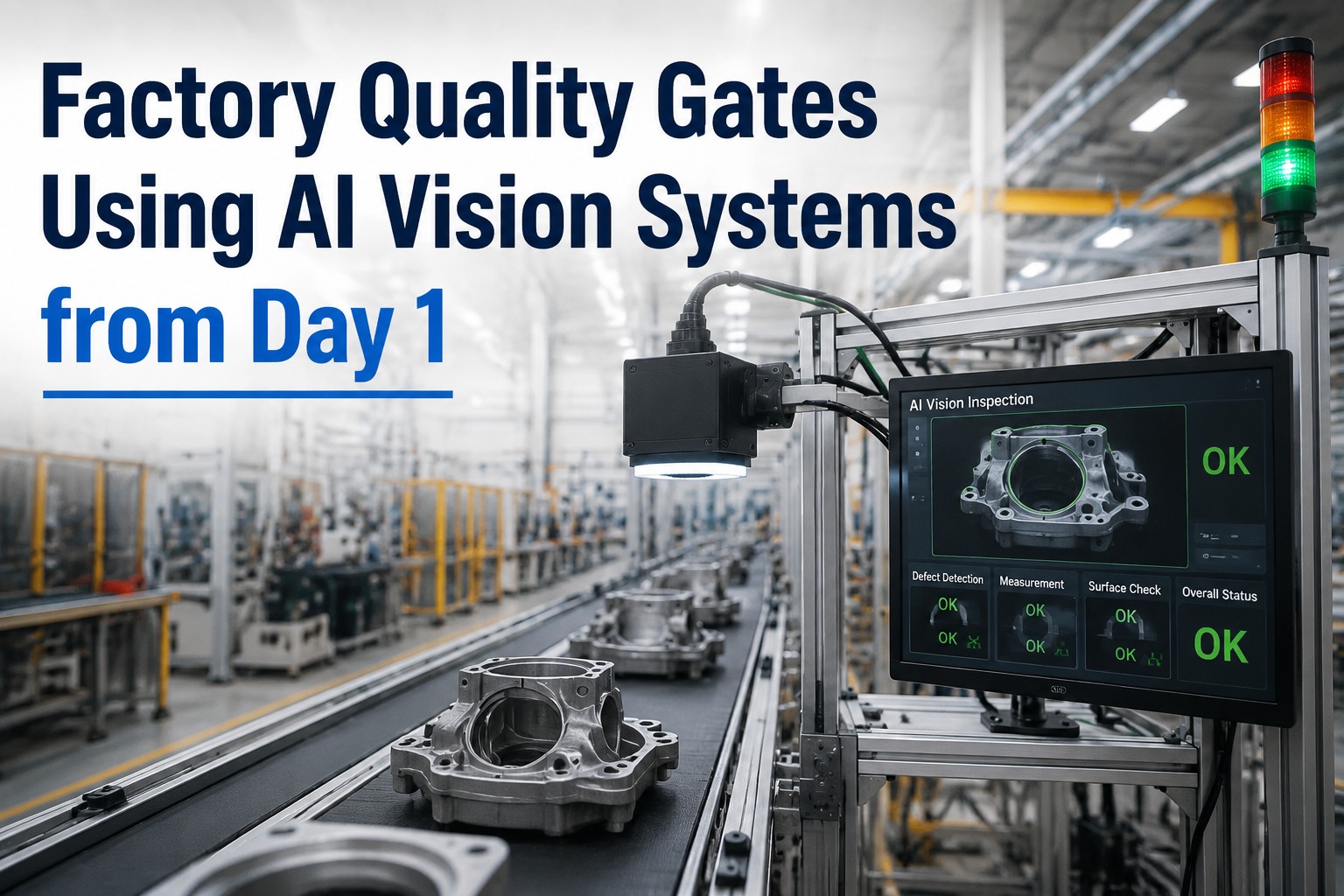
Industrial cameras capture 100+ frames per second with resolution down to micron-level detail. Line-scan cameras inspect 100% of moving surfaces at full production speed.
Up to 80 FPS real-time processing
2
Deep Learning Analysis
Neural networks trained on thousands of defect images identify anomalies that rule-based systems miss. The AI learns patterns—not just thresholds.
4x accuracy vs. traditional AOI
3
Real-Time Decision
Edge computing processes images directly on camera hardware—defects flagged in milliseconds. No cloud latency, no network dependency.
Sub-second defect classification
4
Automated Response
Defective parts automatically rejected, sorted, or flagged. Data feeds directly to MES for root cause analysis and process adjustment.
The Defect Types AI Vision Catches That Humans Miss
Human inspectors aren't the problem—human biology is. Eyes fatigue after 20 minutes. Attention drifts. Micro-defects are literally invisible. AI vision systems don't have these limitations, catching defects that would otherwise escape to customers.
Surface Scratches
Hairline scratches invisible to naked eye detected at micron resolution
Human: 60-70%AI: 98%+
Micro-Cracks
Subsurface cracks and stress fractures caught before catastrophic failure
Human: 40-50%AI: 95%+
Color Anomalies
Subtle discoloration, staining, and coating inconsistencies flagged instantly
Human: 70-80%AI: 99%+
Dimensional Errors
Sub-millimeter measurement accuracy for tolerances humans can't perceive
Human: 50-60%AI: 97%+
Missing Components
Absent parts, wrong orientations, and assembly errors caught in milliseconds
Human: 85-90%AI: 99.5%+
Contamination
Foreign particles, debris, and contamination detected before packaging
Human: 55-65%AI: 96%+
Your New Facility Deserves New Technology
iFactory's AI-powered vision platform integrates seamlessly with greenfield production lines—delivering 99%+ defect detection from your first day of production.
The numbers don't lie. Manufacturers across industries are documenting dramatic improvements in quality, efficiency, and profitability after implementing AI vision systems.
Automotive Components
High false rejection rates disrupting production flow
37%fewer defects
22%OEE increase
28%less downtime
Electronics Assembly
Micro-cracks in solder joints causing field failures
30%fewer escapes
12%FPY increase
8 moROI payback
Steel Manufacturing
Surface defects escaping manual inspection at speed
Investment vs. Returns: Typical AI Vision Implementation
Year 1 Investment
Hardware (cameras, lighting, compute)$50K - $150K
Software & integration$30K - $80K
Training & deployment$10K - $25K
Total Initial Investment$90K - $255K
Annual Returns
Labor cost reduction (50%)$100K - $200K
Scrap & rework reduction$150K - $350K
Customer return reduction$50K - $150K
Total Annual Savings$300K - $700K
Typical ROI Payback
6-12 Months
Intel documented $2M annual savings. A major steel producer achieved 7-month payback with $2.1M yearly returns.
Expert Perspective
"AI-driven visual inspection systems can spot surface scratches, misalignments, missing components, micro-cracks, incorrect labels, foreign contaminants, and subtle texture anomalies across metals, PCBs, pharmaceuticals, and textiles. Unlike human inspectors—whose accuracy declines with fatigue—AI runs 24/7 at line speed, delivering repeatable detection rates that routinely exceed 95%."
— Boston Consulting Group / Industry Analysis 2025
iFactory's AI vision platform integrates with your production lines from day one—catching defects humans miss, eliminating quality escapes, and delivering ROI in months, not years.
What is an industrial AI vision system and how does it work?
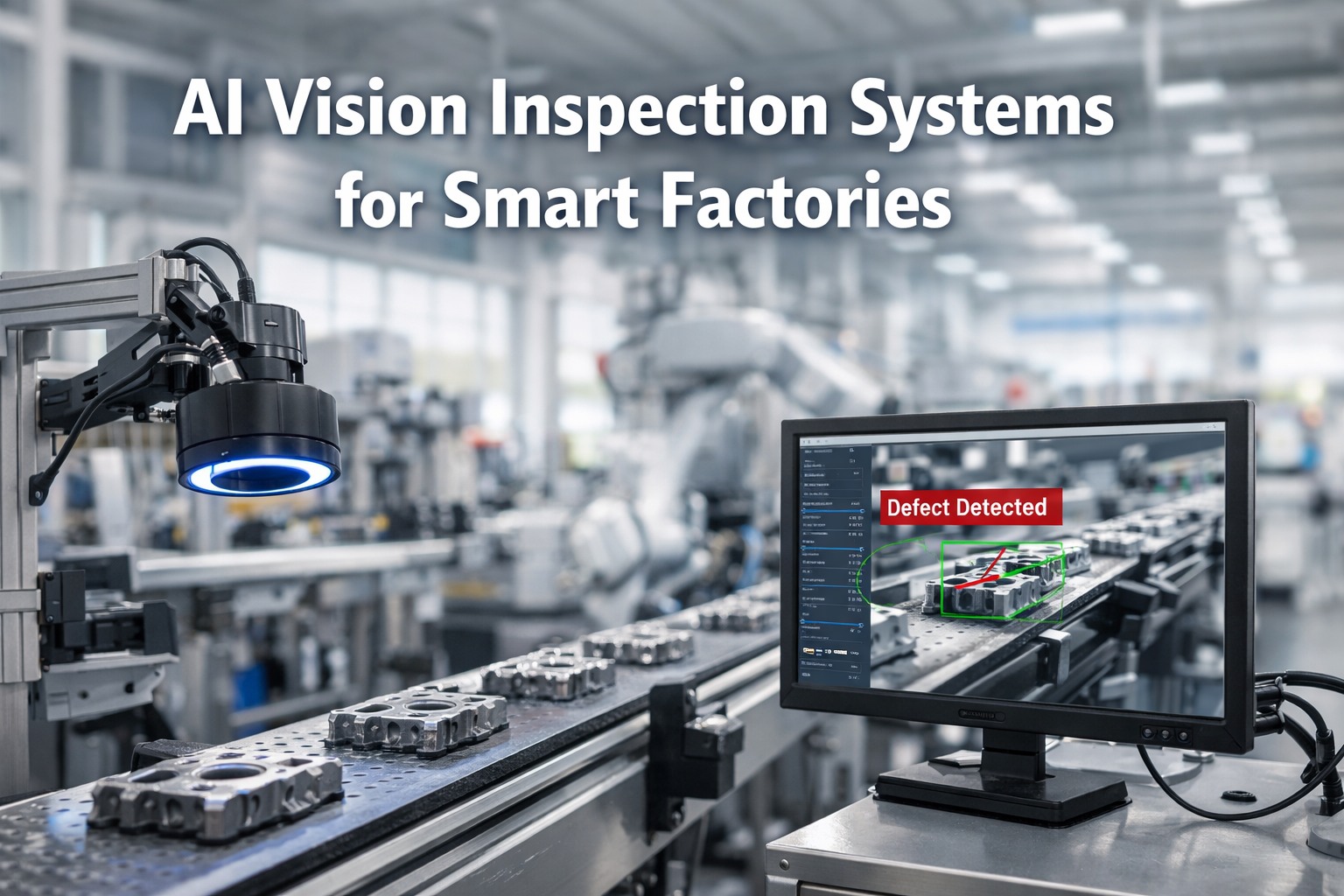
An industrial AI vision system combines high-speed cameras with deep learning algorithms to automatically inspect products for defects. Unlike traditional rule-based systems that use fixed thresholds, AI vision learns from thousands of images to recognize patterns—including subtle anomalies that rule-based systems miss. The system captures images at up to 80+ frames per second, processes them using neural networks running on edge computing hardware, and makes pass/fail decisions in milliseconds. This enables 100% inspection at full production speeds with accuracy exceeding 99%.
Why are greenfield facilities ideal for AI vision implementation?
Greenfield plants offer a unique advantage: you can design camera placement, lighting, and data infrastructure specifically for vision systems rather than retrofitting around existing equipment. This eliminates common integration challenges like blind spots, lighting interference, and legacy system compatibility. You also avoid the cultural resistance of "we've always done it this way"—operators learn AI-assisted inspection from day one. Result: faster deployment, better accuracy, and lower total cost of ownership compared to brownfield implementations.
What defect detection accuracy can I expect from AI vision?
Modern AI vision systems consistently achieve 95-99%+ detection accuracy, compared to 80-85% for manual inspection. The exact rate depends on defect type and product complexity. Surface defects like scratches reach 98%+, dimensional errors 97%+, and missing components 99.5%+. Critically, AI maintains this accuracy 24/7 without the fatigue-related degradation that affects human inspectors. One major steel manufacturer improved detection from 70% to 98.5% after implementing AI vision.
What's the typical ROI timeline for AI vision systems?
Most manufacturers achieve full ROI within 6-12 months through combined savings in labor costs (typically 50% reduction in QC staffing), scrap and rework reduction, and elimination of customer returns. Intel documented $2 million in annual savings from AI vision. A major steel producer achieved 7-month payback with $2.1 million yearly returns. The initial investment of $90K-$255K typically yields $300K-$700K in annual savings, with returns compounding as the AI learns your specific production environment.
How does AI vision integrate with existing MES and quality systems?
AI vision systems connect via standard protocols (OPC-UA, REST APIs, database connections) to MES, ERP, and quality management platforms. Defect data automatically feeds into your production systems for real-time SPC charts, root cause analysis, and automatic work order generation. For greenfield facilities, this integration can be designed from the start—eliminating the API compatibility issues and data synchronization challenges common in retrofit scenarios. The result is true closed-loop quality control.