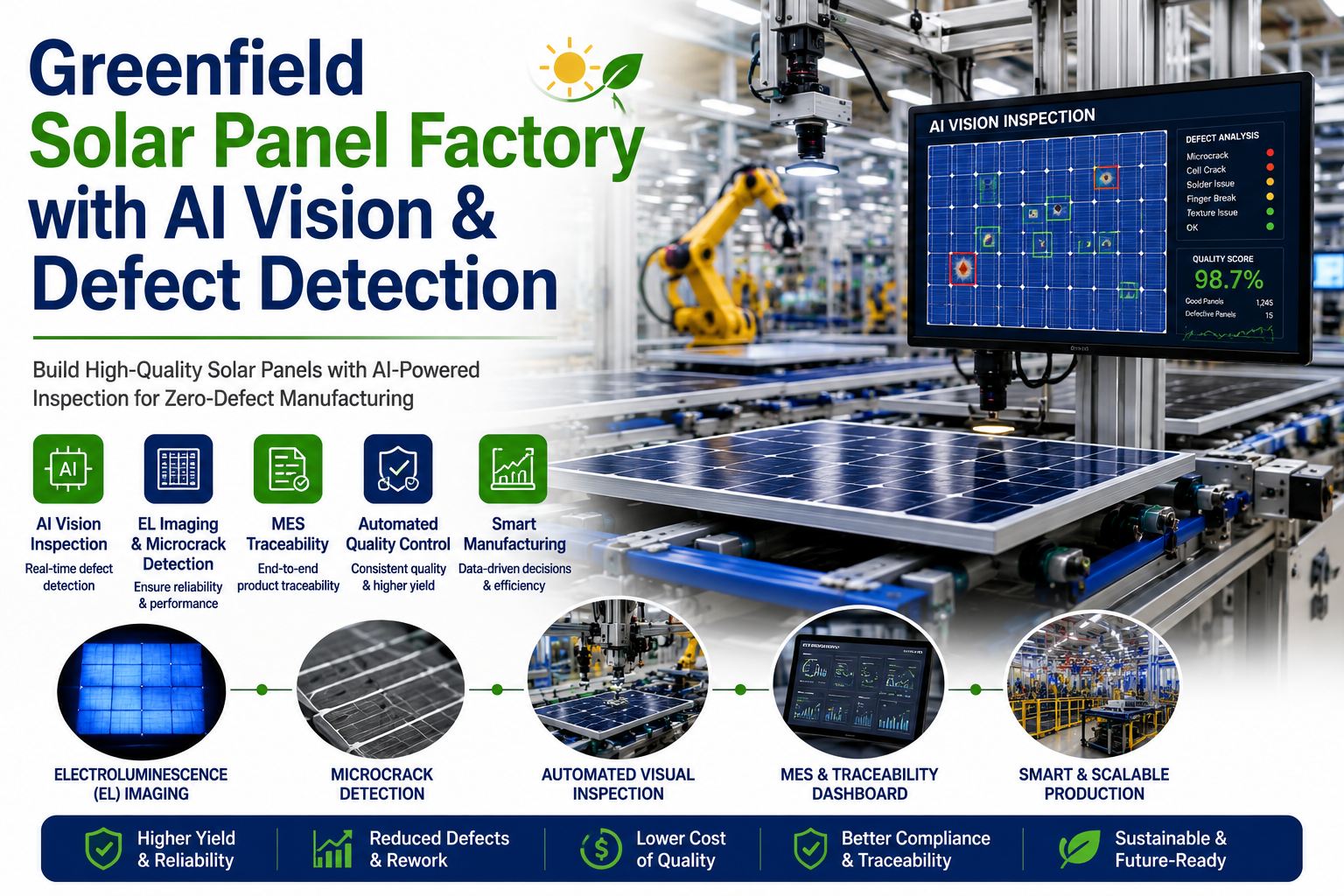
A solar module can leave the line looking flawless and still be failing. The cracks that matter in photovoltaic manufacturing are ten to a hundred microns wide — invisible to a camera, invisible to an inspector, and quietly growing every time the panel heats and cools in the field until output drops and hot spots form. The only way to see them is to look inside the cell with electroluminescence, and the only way to do it on every module at line speed is with AI. A greenfield solar factory can build that capability in from the start. This guide covers how to set up AI vision and defect detection in a new PV plant.
Building a new solar factory? Book a 30-minute PV digital consultation to design AI vision and EL defect detection into the line from day one.
Catching the Cracks the Eye Can't See
Microcracks show as dark, inactive regions under electroluminescence — current can't flow through them. AI flags each one, cell by cell, on every module.
Why Solar Manufacturing Lives or Dies on Defect Detection
Photovoltaic modules carry 25- to 30-year warranties, and their reliability is set on the production line. A microcrack born during stringing or lamination may pass every visible-light check and every flash test, then expand under years of thermal cycling into lost power and hot spots in the field. The damage to yield, warranty exposure, and bankability is enormous, and it traces back to defects no one could see. Because lamination is irreversible, a crack missed upstream becomes a scrapped module downstream — which is why a greenfield plant should design inspection in at every stage. If you want it scoped for your line, you can map it with a PV manufacturing specialist.
microcrack width — invisible to the naked eye and standard cameras
of early microcracks missed by conventional visual inspection
power output that undetected microcracks can erode each year
EL Imaging and the Defects It Reveals
Electroluminescence works by forward-biasing the module and capturing the near-infrared light the cells emit in darkness. Healthy silicon glows; cracked or inactive regions stay dark because current cannot reach them. AI models trained on crack morphologies then classify the type, extent, and likely propagation of every defect, cell by cell.
Microcracks
Hairline fractures from handling, stringing, or lamination that grow into power loss.
Inactive Cells
Dark regions where current cannot flow, taking the cell partly or fully offline.
Finger & Busbar Breaks
Interrupted gridlines and broken busbars from printing and stringing.
Soldering Defects
Weak or misplaced interconnections between cells that raise resistance.
Shunts & Resistive Faults
Leakage paths that waste current and create localized hot-spot risk.
EVA Voids & Bubbles
Encapsulant gaps from lamination that later admit moisture and degrade output.
Want EL inspection mapped to your cell and module line? Book an AI vision workshop and we will model the defect coverage for your product mix.
Inspection Checkpoints and MES Traceability
Cracks enter at specific stages, so inspection has to sit at those stages — especially before lamination, the point of no return. Running EL at the right checkpoints catches scrap before it compounds, and a serial on every module ties each defect back to the step that caused it.
Cell Sort & Test
Incoming cell quality and binning
Stringing
Busbar & finger AOI, first crack risk
ELLamination
Irreversible — catch cracks before scrap
ELFraming & JB
Handling and assembly checks
Final Test
Flash test plus final EL
ELThe Greenfield Solar Digital Roadmap
Design the inspection and data layer into the line from the layout stage, so quality intelligence is live the day the first module is built.
-
1
Build inspection stations into the layout
Design AOI and EL cameras into stringing, lamination, and final test from the start, sized to match line throughput so inspection never becomes the bottleneck.
-
2
Run EL where cracks enter
Place EL post-stringing and post-lamination, where most cracks originate, so defects are caught before the irreversible step turns them into scrapped modules.
-
3
Deploy AI defect models
Classify crack type, severity, and propagation per cell, and cut the false positives that plague rule-based threshold inspection.
-
4
Serialize for MES traceability
Track every module from cell to crate, tie each defect to its stage and batch, and drive yield analysis from the data.
-
5
Unify on one platform
Connect inspection, quality, yield, and maintenance in one MES and CMMS, live with the plant from the first module.
Ready to sequence this against your build? Book an implementation session and leave with a phased digital plan for your solar project team.
See Every Crack, Trace Every Module
iFactory's AI vision platform analyzes EL and optical inspection across the cell and module line — classifying microcracks and defects per cell, and tying every result to a serialized module so quality holds happen before scrap, not after shipment.
Expert Perspective
The trap in solar manufacturing is that the worst defects are also the most invisible. A module with a network of microcracks reads as good power on the flash test and looks perfect to the eye, so it ships — and the loss shows up years later as degraded output and a warranty claim. EL inspection with AI is what makes that defect visible at the moment it is created, on the line, on every module. On a greenfield plant the move is to put EL at stringing and lamination from day one, because once a cracked cell is laminated it is scrap. Catching it one station earlier is the difference between a rework and a write-off.
— Solar & PV Practice, iFactory Engineering Team
typical payback on AI vision inspection
modules inspected with automated EL, not sampled
contact placement tolerance at the stringer
The Bottom Line
In solar manufacturing, the defects that destroy long-term value are the ones you cannot see — microcracks born at stringing and lamination that pass every visible check and fail in the field. Electroluminescence makes them visible, and AI makes that inspection possible on every module at line speed. A greenfield plant gets to design that in: EL at the stages where cracks enter, AI models that classify them per cell, and a serial that traces every defect to its source. Build it from day one and the plant ships modules that are not just bright on a flash test, but sound all the way through.
Build a Solar Factory That Ships Only Sound Modules
From EL microcrack detection and AI defect classification to MES traceability and yield analysis, iFactory helps greenfield PV teams stand up quality intelligence on one platform — live with the line, catching defects before they become scrap or warranty claims.
Frequently Asked Questions
What is electroluminescence (EL) imaging and why is it used in solar manufacturing?
EL imaging forward-biases a solar cell or module and captures the near-infrared light it emits in darkness. Healthy silicon glows, while cracked or inactive regions appear dark because current cannot flow through them. This reveals microcracks, inactive cells, shunts, and soldering defects that are invisible to standard cameras and that a flash test alone may not catch, making EL the core defect-detection method in PV production.
What are microcracks and why do they matter?
Microcracks are hairline fractures in silicon cells, often just 10 to 100 micrometers wide and invisible to the eye. They form during wafer handling, stringing, lamination, and transport, and they grow under thermal and mechanical stress in the field. Left undetected, they can erode module power output by up to about 2.5 percent per year and create hot spots, undermining both performance and warranty reliability.
Where in the production line do cell cracks happen?
Most cell cracks are introduced during stringing, where cells are soldered into strings, and during lamination. Lamination is effectively irreversible, so a crack that enters before or during that step usually means the whole module must be scrapped. That is why EL inspection is placed post-stringing and post-lamination — to catch defects before they become unrecoverable.
How does AI vision improve PV inspection over manual or rule-based methods?
Manual sampling inspects only a fraction of output and misses most early microcracks, while rule-based threshold systems generate high false-positive rates. AI models trained on crack morphologies inspect 100 percent of modules, classify defect type and severity per cell, estimate how a crack is likely to propagate, and distinguish acceptable process variation from genuine defects — improving both detection and yield.
How does iFactory help build a greenfield solar factory?
iFactory helps design AOI and EL inspection into the line, deploys AI models that classify defects per cell, and serializes every module for MES traceability and yield analysis, all on one platform that connects quality and maintenance. Built in from day one, it goes live with the plant. You can book a solar consultation to plan it for your facility.