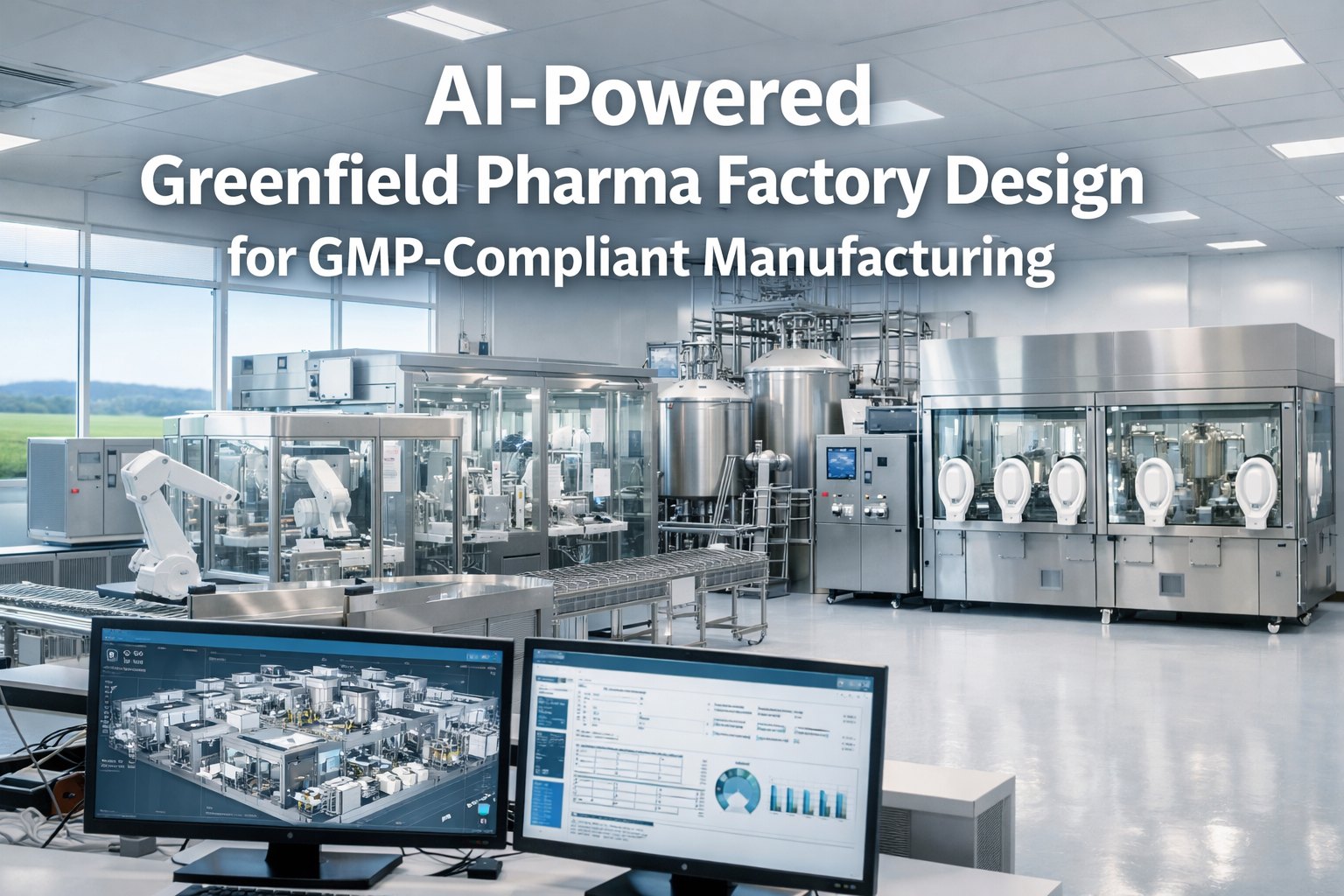
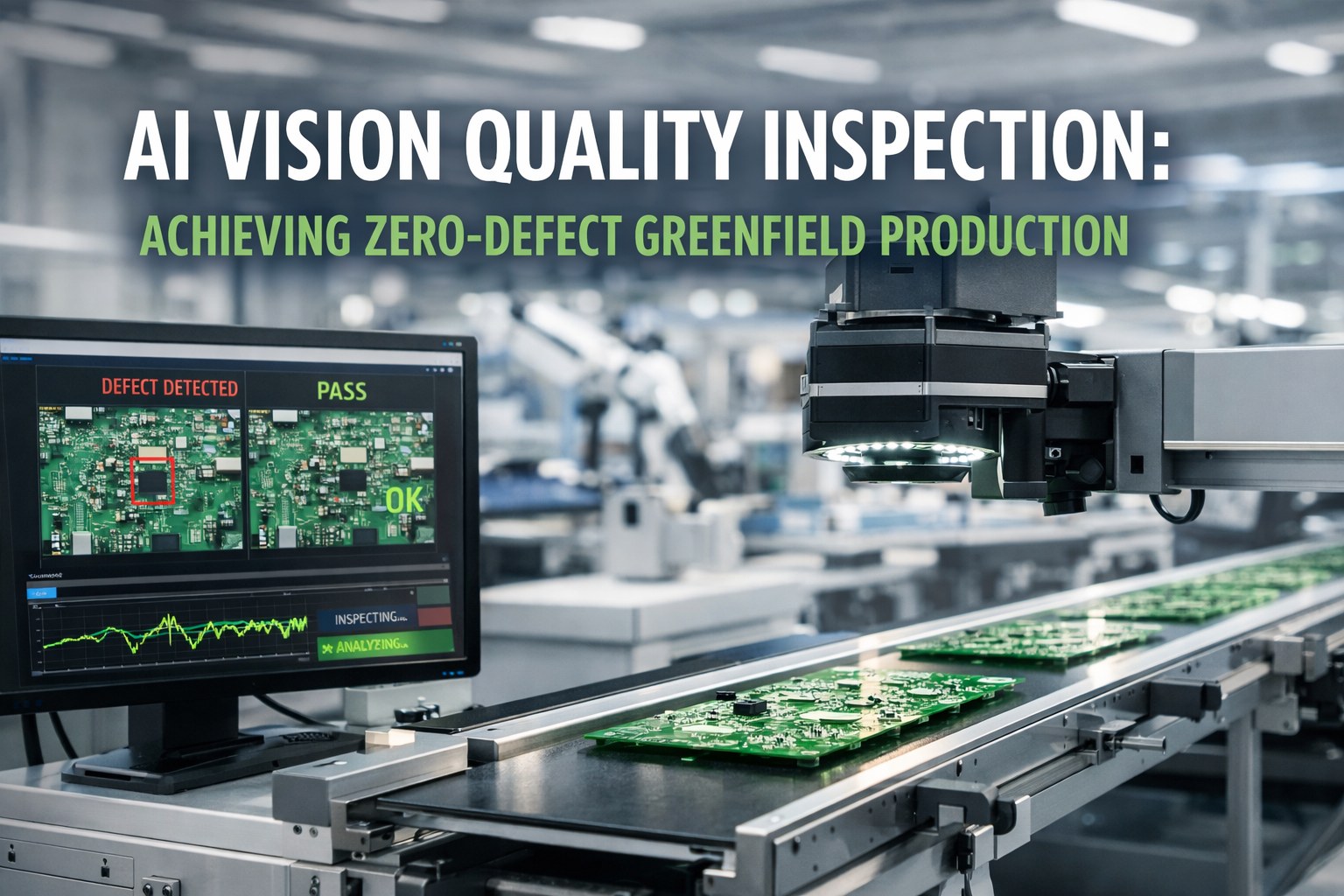
Pharmaceutical manufacturing demands the highest inspection standards of any industry. A single missed defect — a cracked tablet, a particulate in a vial, a misread label — can trigger FDA warning letters, product recalls costing $10-15M, and patient safety risks. Yet retrofitting AI vision into a validated GMP cleanroom requires facility requalification costing $500K-$2M and months of production delays. When you design AI vision into your greenfield GMP facility from the start, cleanroom-compatible cameras are integrated into the room design, validated algorithms are qualified alongside the equipment, and 21 CFR Part 11 audit trails are built into the data architecture before the first batch runs. AI vision in pharma now achieves 97%+ defect detection (mAP) at production speed, with documented results of 60% reduction in customer complaints and defect escape rates dropping from 0.8% to 0.06%. The January 2025 FDA draft guidance on AI in pharmaceutical manufacturing provides a clear framework for validated deployment. Plan Your Pharma Vision System
Why Retrofit Fails in Validated Pharma Facilities
Cleanroom Requalification
Installing cameras in a qualified ISO 7 cleanroom requires opening walls, routing cables, and introducing new equipment — triggering full room requalification (IQ/OQ/PQ). Cost: $200K-$500K per room. Duration: 2-4 months of restricted production. In greenfield, camera ports, cable routing, and mounting points are built into the cleanroom design and qualified together with the room.
Validation Lifecycle Reset
Adding AI vision to an existing validated production line triggers change control, impact assessment, and potentially full line revalidation. Every connected system must be regression-tested. In greenfield, vision systems are included in the initial validation master plan — qualified once, correctly, as part of the original commissioning.
FDA Warning Letter Risk
The January 2025 FDA draft guidance requires transparent data lineage, representativeness analysis, and bias detection for AI in pharma. Bolting AI onto existing systems without proper validation documentation invites 483 observations. In greenfield, 21 CFR Part 11 compliance is designed into the data architecture from the start — audit trails, electronic signatures, and validated models.
Particle Generation Concern
Cameras, cables, and mounting hardware introduced into cleanroom environments must be verified not to generate particles. Retrofit installations often use non-cleanroom-rated equipment with temporary enclosures. In greenfield, all vision components are specified as cleanroom-compatible from the start — stainless steel housings, smooth-surface cables, and sealed IP69K connectors.
Building a new pharma facility? Plan Your Pharma Vision System — we design GMP-compliant vision inspection into your cleanroom layout with validated algorithms and FDA audit-ready documentation from day one.
Product-by-Product Inspection Matrix
| Product Form | Defect Types | Camera / Lighting | Speed | AI Accuracy | Regulatory Requirement |
|---|---|---|---|---|---|
| Tablets | Cracks, chips, discoloration, broken edges, wrong shape, contamination | Area scan + multi-spectral LED; dark field for surface defects | 100K+ tablets/hr | 97%+ (mAP); <1% false reject | cGMP 21 CFR 211; USP visual inspection |
| Capsules | Deformation, cracks, split seams, color mismatch, fill variation | Area scan + dome lighting (reduce glare on gelatin) | 80K+ capsules/hr | 96%+ detection | cGMP; EU GMP Annex 1 for sterile |
| Vials (Injectables) | Particulates, fill level, stopper placement, cap crimping, cracks, cosmetic defects | High-res area scan + backlight (particulate); side light (cosmetic) | 300-600 vials/min | 95-99%+ (Amgen deep learning validated) | USP 〈790〉; EU GMP Annex 1; 21 CFR 211.94 |
| Syringes (Pre-filled) | Plunger position, fill volume, needle guard, particulates, label | 360° multi-camera array; backlight + side light | 200-400 units/min | 98%+ for critical defects | EU GMP Annex 1; ISO 11040; cGMP |
| Blister Packs | Missing tablets, wrong color, seal integrity, foil damage, cavity defects | Area scan top + bottom; transmitted light for seal | 200-400 blisters/min | 97%+ (mAP); 79+ FPS real-time | cGMP; serialization per DSCSA |
| Labels / Cartons | Missing label, skew, wrong text, unreadable barcode, missing leaflet | Line scan + OCR/OCV; barcode grading camera | Line speed (up to 300/min) | 99.9%+ OCR accuracy | 21 CFR Part 11; DSCSA; EU FMD |
Cleanroom-Compatible Camera Specification
ISO 5-7 Cleanroom (Grade A-C)
Stainless steel 316L camera housings with electro-polished surfaces. IP69K rated — withstands CIP/SIP wash-down and vaporized hydrogen peroxide decontamination. Optical-grade glass window with anti-fog coating. No external fans — passively cooled to avoid particle generation. Smooth-jacketed cables with FDA-compliant materials. All mounting hardware: 316L stainless steel.
ISO 8 Cleanroom (Grade D)
IP67 camera enclosures acceptable. Standard industrial cameras with sealed housings. Cable routing through sealed conduit or clean cable tray. Regular cleaning protocol for lens windows. M12 connectors with stainless steel coupling rings. Less stringent than Grade A-C but still requiring particle verification during qualification.
Lighting for Transparent/Reflective Pharma Products
Transmitted backlight for particulate detection in clear vials and ampoules — particles appear as dark spots on bright background. Dome lighting for capsules and coated tablets — eliminates glare from glossy surfaces. Multi-spectral LED (blue, green, red, UV) for color verification and detecting defects invisible under white light. Strobed LED for high-speed lines — freezes motion without continuous heat generation.
Edge Compute in Pharma
GPU inference hardware outside the cleanroom — in an adjacent technical corridor or server room. Fiber connections from camera to GPU with no electrical components inside the classified area (fiber is inherently particle-free and EMI-immune). Edge inference latency under 200ms for real-time eject decisions. Validated software with version control, change management, and rollback capability.
21 CFR Part 11 Data Architecture
Every inspection result traced to the operator, camera, AI model version, and timestamp. User authentication with unique IDs — no shared accounts. Electronic signatures for manual overrides and re-inspections with reason codes.
Inspection images stored in lossless format with metadata. Defect classifications displayed clearly in audit reports. Historical data retrievable for the entire product lifecycle (minimum 1 year past expiry for US; longer for EU).
Results recorded at the time of inspection — no batch-end data entry. Timestamps synchronized across all cameras and systems (NTP). Real-time data flow: camera → GPU → result → database with no manual intermediate steps.
Raw inspection images and AI inference results stored as original records. No editing of original data — corrections logged as amendments with audit trail. Database with write-once-read-many (WORM) storage for regulatory records.
Validated data pipeline ensures accuracy. 100% inspection (no sampling gaps). Consistent format across all inspection stations. Backed up with disaster recovery. Available for FDA/EMA inspection within 24 hours of request.
Need 21 CFR Part 11 compliant vision data architecture? Plan Your Pharma Vision System — we design ALCOA+ compliant data flows, audit trails, and storage architecture as part of the greenfield vision blueprint.
Validation: IQ/OQ/PQ for AI Vision
Verify all hardware installed per specification: camera models, lens types, lighting, mounting positions, cable routing, GPU hardware, software versions. Document serial numbers, calibration certificates, and network configurations. Confirm cleanroom compatibility (particle counts before and after installation).
Challenge the AI system with known-good and known-defective samples spanning the full defect catalog. Verify detection rates meet acceptance criteria (e.g., 95%+ detection, <2% false reject). Test at operating speed, environmental conditions (temperature, humidity), and with multiple product variants. Verify 21 CFR Part 11 functions: audit trail, electronic signatures, user access controls.
Run the system under actual production conditions for a defined number of batches (typically 3 consecutive batches). Compare AI inspection results against manual inspection by trained operators. Statistical analysis of detection sensitivity, specificity, and false reject rate. Document that the system consistently meets its intended use under real-world conditions.
Change control for any AI model updates, software patches, or hardware replacements. Periodic review of model performance (drift detection, false positive/negative trending). Re-validation triggered by product changes, line speed changes, or model retraining. Version control with rollback capability — every model version archived and auditable.
Key Benefits & ROI
Validated from First Batch — Not Revalidated After Retrofit
iFactory designs GMP-compliant AI vision inspection for pharma greenfield facilities — cleanroom-rated cameras, validated AI algorithms, 21 CFR Part 11 data architecture, and IQ/OQ/PQ documentation — all integrated into your facility design before construction.
Frequently Asked Questions
A 483 Observation Costs More Than a Greenfield Vision System
Design GMP-compliant AI vision into your facility before the first cleanroom wall goes up. Validated algorithms, audit-ready data, and zero retrofit risk.