A glass furnace runs at 1,550°C continuously for 12 to 18 years between rebuilds. A single hour of downtime mid-campaign costs $200,000 to $400,000 in lost production. A bubble defect undetected at the tin bath flows through to the cutting line, where the entire ribbon section is scrapped. A 10% increase in cullet usage reduces furnace energy by 3% and emissions by 7% — but only when batch and cullet feeding are precisely controlled by AI in real time. Float glass plants designed without AI vision inspection, furnace AI control, and predictive maintenance built into the foundation are running 2010-era economics in a 2026 cost environment. In a greenfield plant, all three are designed into the building, the floor, and the network from day one — not added as expensive retrofits after commissioning. Book a greenfield glass plant consultation to validate your float line layout, AI vision station design, and furnace control architecture before construction begins.
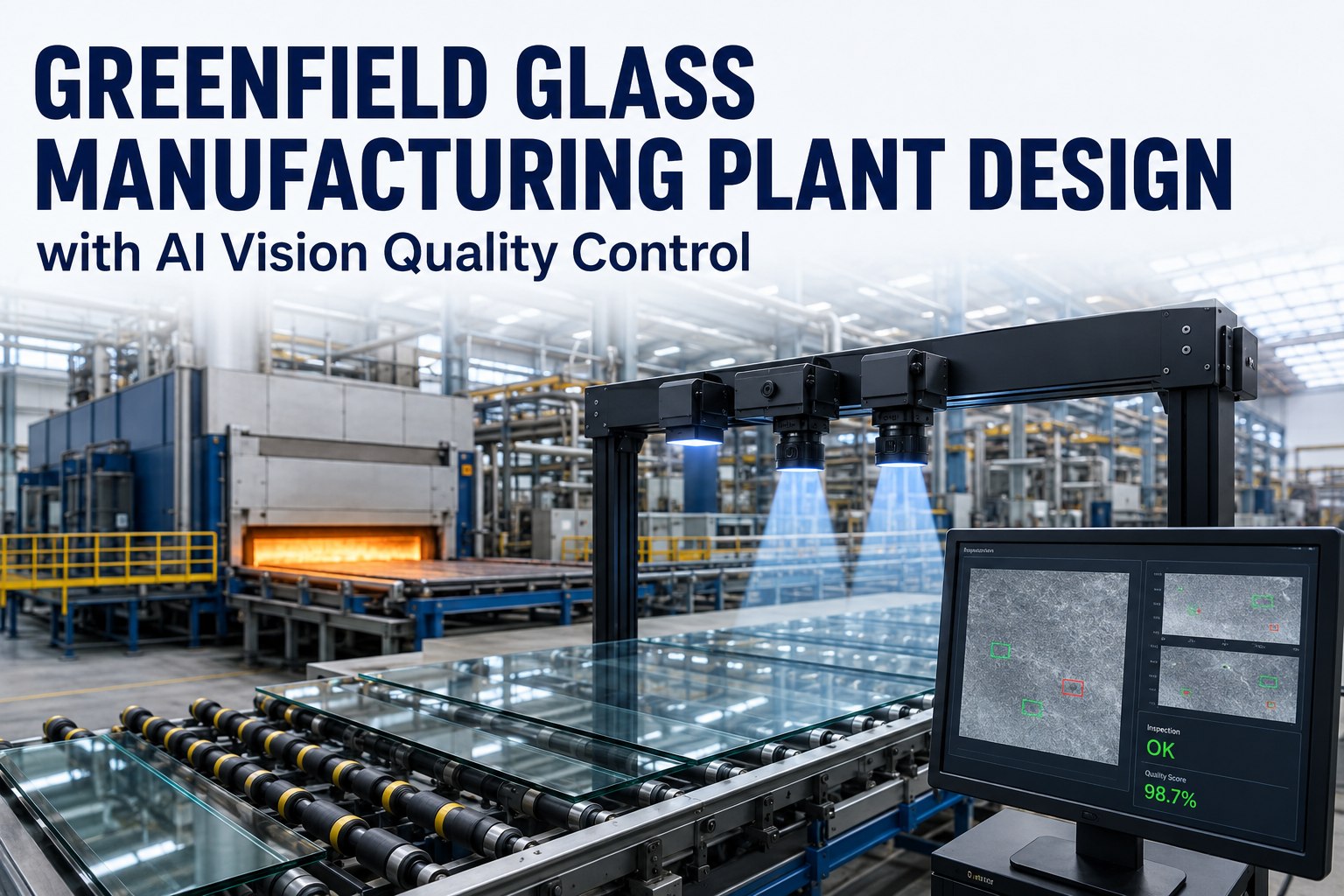
Greenfield Glass Manufacturing Plant Design — AI Vision & Furnace Intelligence 2026
The Float Glass Line — Six Stages, One Continuous Ribbon, Three AI Defenses
1
Batch House & Cullet
Ambient
Raw materials (silica sand, soda ash, limestone, dolomite) blended with cullet. Weighing and mixing precision drives furnace stability.
AI control: Real-time batch composition adjustment for cullet ratio optimisation
2
Furnace (Melting + Refining)
1,550°C
Continuous regenerative or hybrid electric melter. 12 to 18 year campaign life. Highest energy consumer in the plant — 60 to 70% of total.
AI control: Combustion optimisation, refractory wear prediction, NOx reduction
3
Tin Bath (Float Forming)
1,000°C → 600°C
Molten glass floats on molten tin to form a flat ribbon of controlled thickness (0.4 to 25 mm). Atmosphere control (95% N₂ / 5% H₂) prevents tin oxidation.
AI vision: First defect inspection layer — bubbles, stones, optical distortion
4
Annealing Lehr
600°C → 100°C
Controlled cooling over 100 to 200 m to relieve internal stress. Stress profile directly affects downstream cutting yield.
AI vision: Stress pattern verification, ribbon thickness measurement
5
Inspection & Quality Gate
Ambient
Full ribbon AI vision scan at line speed (up to 25 m/min). Defect map generated per square metre — drives downstream cutting plan.
AI vision: Full defect taxonomy detection at 99.5%+ accuracy
6
Cutting, Stacking & Dispatch
Ambient
Online cutting around detected defects. Stacking, labelling, and traceability code applied. Cullet diversion of off-spec ribbon back to batch house.
AI optimisation: Cutting plan maximises yield around defect map
12–18 yrFurnace campaign life — every hour of unplanned downtime is irreplaceable
60–70%Of total plant energy consumed by the furnace alone
99.5%+AI vision defect detection accuracy vs. ~85% manual inspection
60%Carbon reduction from hybrid electric furnace (Libbey Toledo case)
The Glass Defect Taxonomy: What AI Vision Must Detect at Line Speed
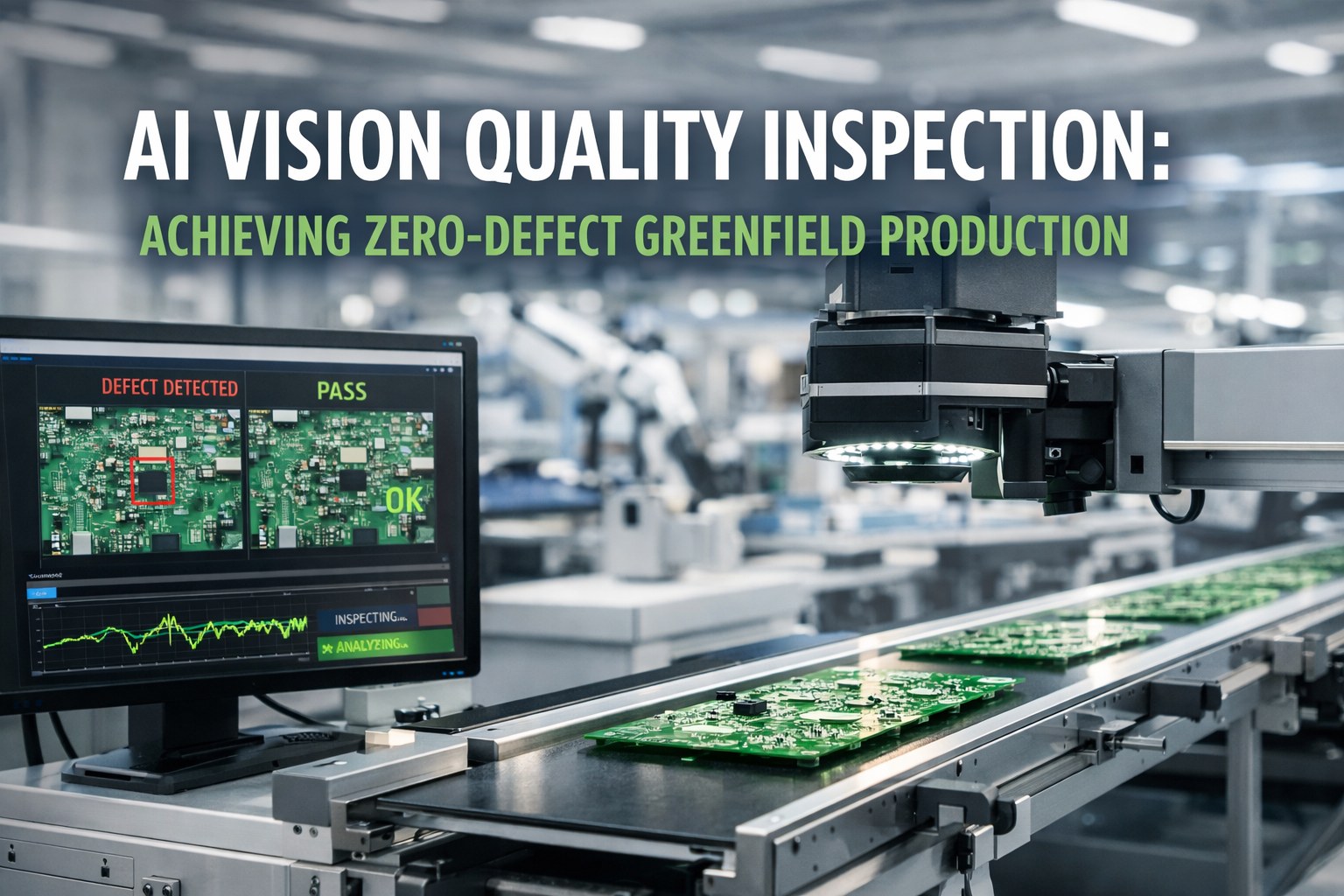
Glass defects originate at every stage of the float line — and each defect class requires a different AI vision approach to detect. A bubble caused by furnace refining failure looks nothing like a tin pickup defect from the bath, which looks nothing like a stone from refractory wear. A modern AI vision system runs multiple model inferences per ribbon section, classifying each defect by type and origin in real time — generating not just a quality reject, but a process control signal pointing back to the upstream stage that needs adjustment.
Furnace Origin
Bubbles (Seeds & Blisters)
Incomplete refining — temperature, residence time, or fining agent issue
Stones
Refractory erosion or unmelted batch material reaching the ribbon
Cord & Striae
Inhomogeneous glass composition — batch mixing or thermal gradient issue
Tin Bath Origin
Tin Pickup & Drip
Atmosphere oxidation — H₂/N₂ ratio drift or roof tin condensation
Open Bubble (Pinhole)
Bath atmosphere or top roller damage to ribbon surface
Optical Distortion
Thickness variation from forming roller misalignment
Annealing Origin
Internal Stress Pattern
Cooling rate deviation — lehr zone temperature profile drift
Roll Mark / Scratch
Lehr roller wear, surface contamination, or thermal cracking
Edge Cracks
Thermal shock at ribbon edge — lehr entry condition
Need AI vision station design for your float line at greenfield? Book a glass plant consultation — we will produce the camera, lighting, and edge compute specification per defect class before line layout is finalised.
Furnace AI: Where the Biggest Energy and Reliability Gains Live
The furnace is the single largest energy consumer in any glass plant — and the single hardest asset to maintain. A 12 to 18 year campaign with no shutdown opportunity means every maintenance decision is a one-shot judgement call. AI control changes that math: continuous monitoring of combustion, refractory condition, and energy flow allows precise interventions that extend campaign life, reduce fuel consumption, and stabilise glass quality simultaneously. The case studies below come from active industry deployments.
Pillar 1
Combustion Optimisation
Up to 8–10% fuel reduction
AI models analyse historical furnace data — temperature profiles, fuel-to-air ratios, batch composition — and adjust burner setpoints in real time. Saint-Gobain documented measurable cost savings and high single-digit emission reductions across multiple plants.
Sensor needs: Burner thermocouples, oxygen probes, batch composition feed, exhaust gas analysers
Pillar 2
Refractory Wear Prediction
Extends campaign by 6–12 months
AI detects subtle performance deviations in burners and refractory linings — temperature drift patterns, fuel-air ratio shifts — that precede observable wear. Maintenance interventions become surgical: targeted repair work during planned outages.
Sensor needs: Crown thermocouples, throat thermal imaging, refractory wall temperature grid
Pillar 3
Cullet & Batch Optimisation
3% energy + 7% emissions per 10% cullet increase
AI adjusts cullet ratio dynamically against quality targets — maximising cullet use (which reduces melting energy) without compromising glass homogeneity. AI sorters identify glass colour and composition in incoming cullet streams to maintain batch consistency.
Sensor needs: Cullet sorting cameras, batch weight feedback, glass colour sensors, NIR spectrometers
Design Furnace AI Control Into Your Greenfield Plant — Not Bolted On After Commissioning
iFactory's greenfield glass plant consultation covers furnace AI control architecture, AI vision station specification per defect class, predictive maintenance sensor schedule, MES and cullet management integration, and ISO 50001 energy reporting design — all delivered before construction drawings are finalised.
AI Vision Inspection Stations: Camera, Lighting, Edge Compute by Stage
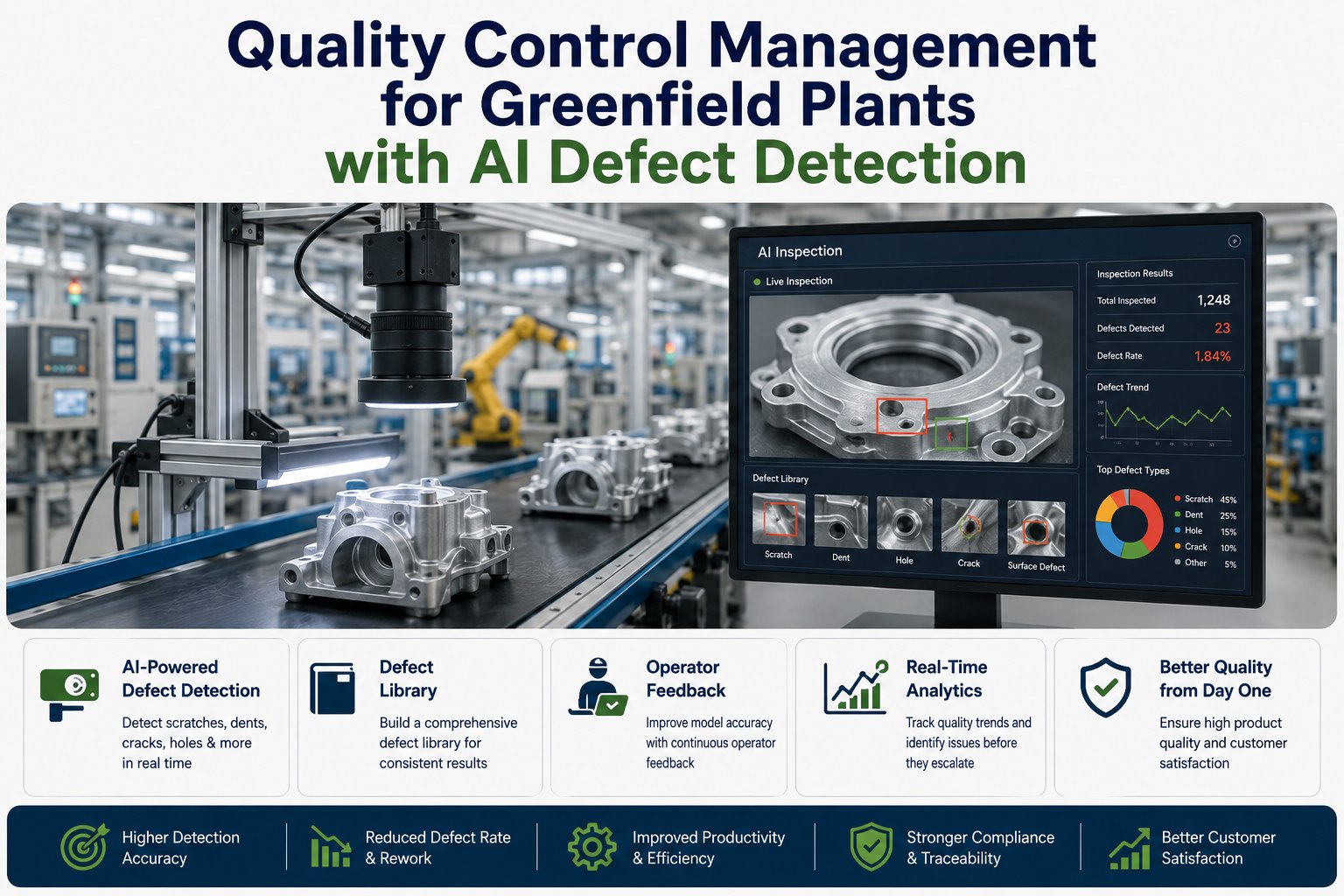
A modern float glass plant deploys AI vision at three distinct stages — each with different lighting, camera, and edge compute requirements. Putting all vision at the end of the line catches defects too late to act on them at source. Putting vision only at the tin bath misses defects that originate downstream. The correct architecture has vision at multiple stages with shared defect data flowing back to upstream process control — every detected defect is also a process signal.
Stage 3 — Tin Bath Exit
Detects: Bubbles, stones, cord, tin pickup precursors
CameraLine-scan or matrix CMOS, 4K resolution, 200+ fps
LightingTransmitted LED + polarised structured light for stress detection
Edge computeNVIDIA Jetson AGX or equivalent for real-time inference at line speed
Process loop: Defects feed back to furnace combustion AI within seconds
Stage 4 — Annealing Lehr
Detects: Stress pattern anomalies, thickness variation, lehr roll marks
CameraPolariscope cameras for stress visualisation + thickness laser triangulation
LightingCrossed polarised LED, IR thermal imaging for lehr profile
Edge computeEdge GPU for stress map analysis + thermal correlation
Process loop: Stress map feeds back to lehr zone temperature setpoints
Stage 5 — Quality Gate
Detects: Full defect taxonomy, defect coordinates per square metre, optical distortion
CameraMulti-angle high-resolution arrays — reflected, transmitted, oblique
LightingMulti-mode LED with darkfield, brightfield, polarised modes
Edge computeServer-class GPU cluster for ensemble model inference + defect map generation
Process loop: Defect map drives cutting plan optimisation in real time
Expert Perspective: Why Glass Plants Built Without AI Native Design Will Lose
Glass is one of the most extreme manufacturing categories for AI economics. A furnace that fails mid-campaign costs $200K+ per hour. A defect rate one percentage point above benchmark wipes out a quarter's margin. A 3% fuel saving is the difference between a profitable and unprofitable plant in a high gas price environment. AGC and Saint-Gobain are documenting 90%+ OEE and double-digit defect reduction from AI deployments — gains that fund the next campaign rebuild and the next plant. Plants designed without AI vision station provision, without furnace sensor infrastructure, without edge GPU capacity in the network design will spend the next decade catching up — at retrofit costs 5 to 10x the greenfield specification cost. Greenfield is not the easier window for AI in glass. It is the only competitive window.
— iFactory Greenfield Consulting, Glass & Process Industries Practice 2025 to 2026
$200–400K
Per-hour cost of unplanned furnace downtime mid-campaign
90%+
OEE achieved by AI-driven glass plants — AGC documented case
10–20%
Recurring defect rate reduction from AI process correlation
Ready to design AI vision, furnace control, and predictive maintenance into your float glass plant from day one? Talk to our glass plant engineering team — we will produce the AI architecture brief before construction drawings are finalised.
Design Your Greenfield Glass Plant for AI Native Quality, Furnace Reliability & Energy Recovery
iFactory's greenfield glass plant consultation covers float line process layout, batch and cullet management automation, furnace AI control architecture (combustion, refractory, energy), AI vision station design across all 3 inspection stages, predictive maintenance sensor schedule, MES integration, and ISO 50001 energy reporting — all delivered before construction drawings are finalised.
Frequently Asked Questions
Why does AI vision inspection need to be designed into a float glass line at greenfield rather than retrofitted?
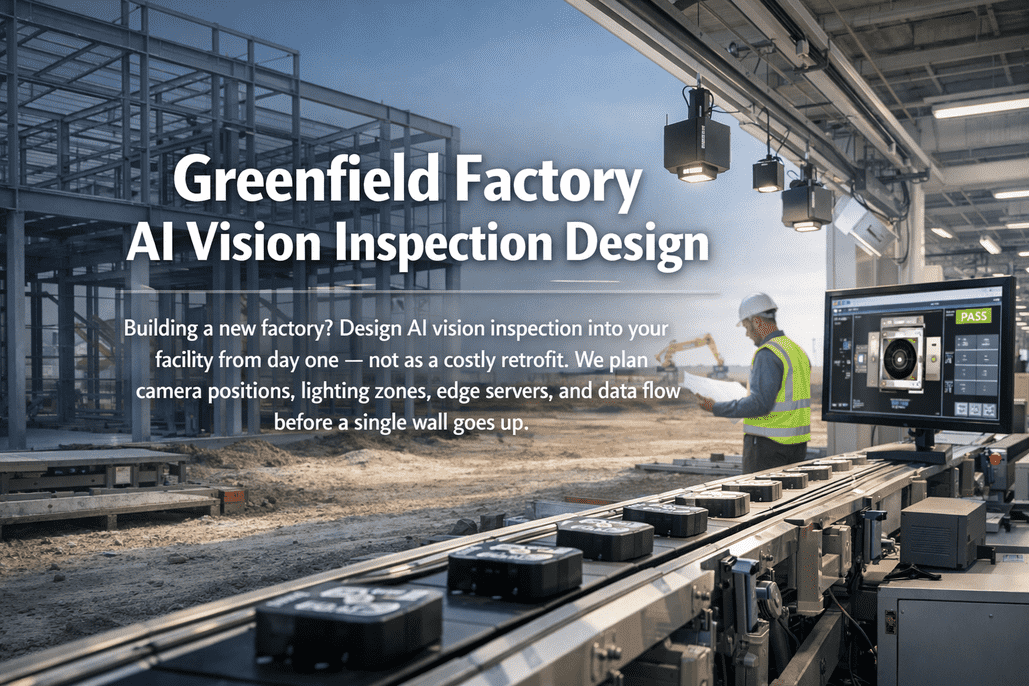
AI vision in float glass requires camera mounting points in three distinct locations — tin bath exit, annealing lehr, and the quality gate — each with specific lighting geometry, polarisation requirements, and edge compute capacity. Retrofitting these into an operating float line means either disrupting a furnace campaign (which is unacceptable given the 12 to 18 year campaign life) or installing compromised camera positions that miss the defect classes the vision system is meant to catch. In a greenfield plant, the camera mounting brackets, polarised lighting fixtures, edge compute cabinets, and fibre optic data links are all specified during structural and electrical design — installed during construction with no operational impact. The greenfield cost is 20 to 30% of retrofit cost and produces a vision system that is fully effective from the first ribbon.
What energy savings can AI deliver in a float glass furnace?
Documented AI furnace deployments produce 5 to 10% fuel reduction through combustion optimisation alone — AI adjusts burner setpoints, fuel-air ratio, and zone temperatures in real time based on historical correlation with quality outcomes. Saint-Gobain reported measurable cost savings and high single-digit emission reductions across multiple plants. Cullet optimisation adds another lever: every 10% increase in cullet usage delivers approximately 3% energy reduction and 7% emissions reduction. Total energy savings of 10 to 15% are achievable when combustion AI, cullet optimisation, and oxygen-enriched combustion are all designed into the plant. Hybrid electric furnaces — such as the Libbey Toledo conversion — can reduce carbon emissions by 60% but require dedicated AI control for the electric melting zones, which must be specified at design.
What defect detection accuracy can AI vision actually achieve on a float glass line?
AGC documented AI-driven quality control systems achieving detection accuracy beyond 95%, with measurable scrap rate reductions exceeding 10% in some facilities. Modern AI vision systems trained on float glass-specific defect taxonomies routinely achieve 99.5%+ detection accuracy across the major defect categories — bubbles, stones, cord, tin pickup, optical distortion, and stress pattern anomalies. The accuracy advantage over manual inspection is most pronounced at line speed (up to 25 m/min for thin float ribbon) where human inspectors physically cannot maintain the visual scanning rate required. AI also correlates defect patterns with upstream process data — furnace temperature fluctuations, raw material inconsistencies, bath atmosphere drift — reducing recurring defect rates by 15 to 20% through targeted process correction rather than just rejection.
How does predictive maintenance work on a glass furnace given that you cannot stop it during a campaign?
Predictive maintenance on a glass furnace is precisely valuable because you cannot stop it during a campaign — every maintenance decision is a one-shot judgement during a brief planned outage. AI predictive maintenance monitors crown thermocouples, throat thermal imaging, refractory wall temperature grids, and electrode current signatures to detect subtle wear patterns that precede observable degradation. The output is not "the furnace will fail in 3 days" but "this specific refractory section is degrading 30% faster than the historical baseline — schedule patch repair at the next planned outage window in week 14." This precision allows surgical maintenance during the brief windows available without unplanned shutdown — and typically extends campaign life by 6 to 12 months beyond standard practice, which is worth tens of millions in glass production output.
How does iFactory's greenfield glass plant consultation work?
iFactory's consultation covers your float line process design and layout review, batch house and cullet management automation specification, furnace AI control architecture including combustion optimisation, refractory wear prediction, and energy reporting, AI vision station design per inspection stage (camera, lighting, polarisation, edge compute), predictive maintenance sensor schedule for furnace, lehr, and downstream equipment, MES integration architecture for defect-to-process feedback loops, cullet sorting and quality control automation, and ISO 50001 energy reporting design. All outputs are specification documents your structural, mechanical, electrical, and controls engineers work from directly.
Book your greenfield glass plant consultation here.