Heat stress, toxic gas exposure, lone worker emergencies, fatigue-driven errors — every one of these develops silently in an industrial environment. By the time a supervisor's walking round detects the problem, the intervention window has often closed. Wearables change that physics: continuous biosignal monitoring, location tracking, fall detection, AR-guided procedure delivery, and AI-driven alerting move worker safety from a periodic supervisor check to a real-time defensive system. The global industrial wearables market reached $8.24B in 2025 and is projected to hit $51.5B by 2036, driven heavily by manufacturing greenfield deployments. In a new plant, the wearables strategy is not retrofitted around an existing workforce — it is designed into the network, training, and safety architecture from day one. Book a greenfield wearables strategy consultation to specify device categories, network coverage, and integration architecture before the workforce is onboarded.
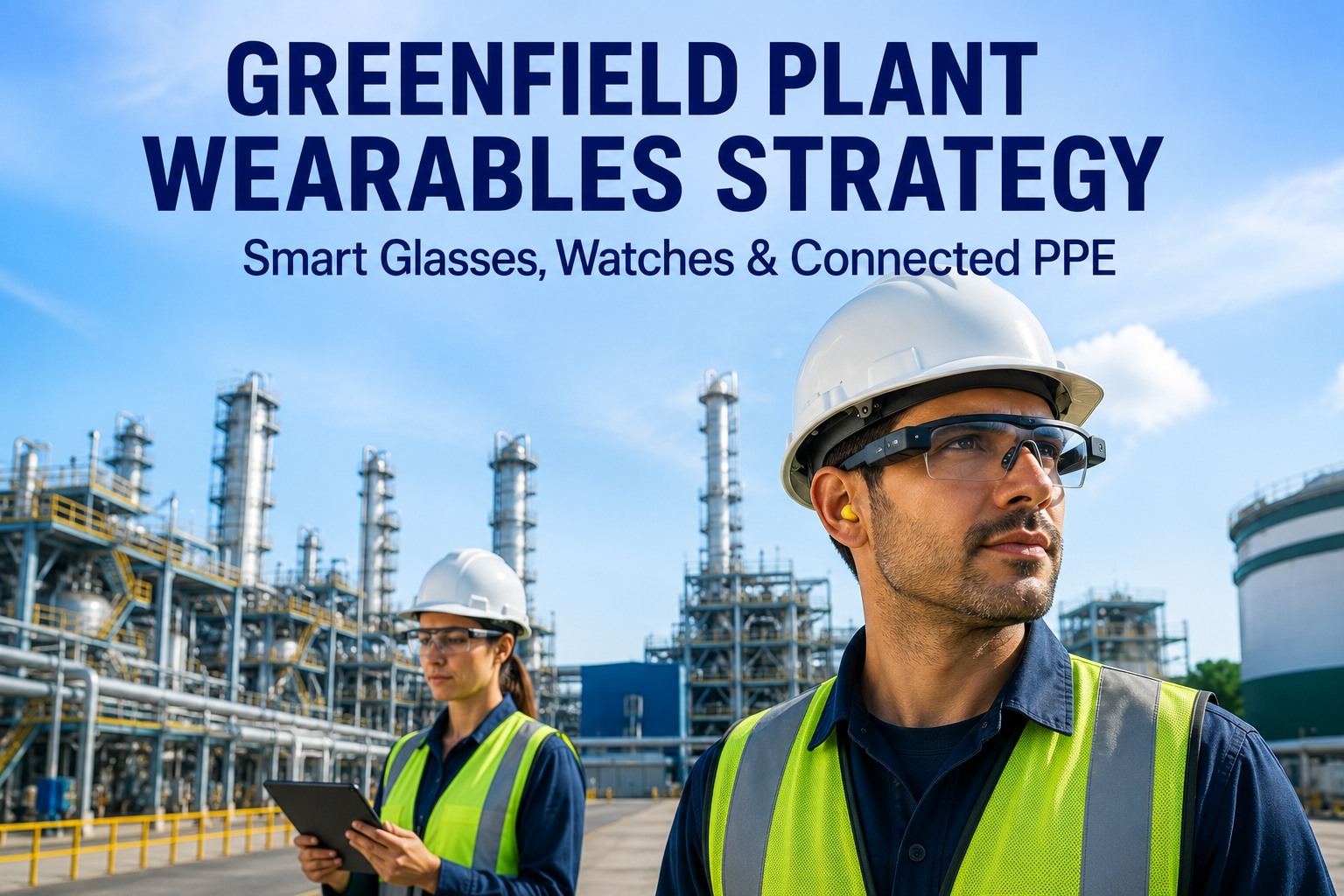
Greenfield Plant Wearables Strategy — Smart Glasses, Watches & Connected PPE
Where Each Wearable Goes — and What Each One Sees
1
Smart Helmet
Impact detection, fall sensors, head temperature, AR display option
2
AR Smart Glasses
Hands-free work instructions, remote expert video, CMMS data overlay, lock-out/tag-out prompts
3
Smart Vest / Chest Patch
Core temperature, heart rate, respiration, ECG, posture, gas sensors
4
Smart Watch / Wristband
Heart rate variability, fatigue scoring, shift alerts, two-way notifications
5
Smart Belt / Lone Worker Tag
RTLS location, lone-worker check-ins, fall detection, panic alarm, gas detection
6
Connected Safety Boots
Step count, fall arrest detection, hazardous zone breach, slip events
$1.38B → $3.77BSmart PPE market growth from 2025 to 2032
13%Of workplace injuries involve fatigue as a contributing factor
15–30 minHeat stress predicted before symptoms become visible
$79KAverage cost of one heat-related workplace injury
Hazard-to-Wearable Mapping: Which Risks Each Device Category Solves
Buying wearables before classifying hazards is the most common deployment error. A plant with high heat exposure needs biosignal patches first, not AR glasses. A plant with frequent lone-worker excursions needs RTLS-enabled belts before smart helmets. The right architecture starts with hazard mapping — then matches the wearable category to each risk class. In a greenfield plant, this mapping is completed during process risk assessment, before the network and CMMS integration brief is finalised.
Heat Stress
Boiler rooms, casthouse, outdoor summer ops, smelters, foundries
Smart Vest / Chest Patch
Smart Watch
Wet bulb sensor
Core body temp + heart rate + sweat — predicts heat stress 15 to 30 min before symptoms
Fatigue & Drowsiness
12-hour shifts, control rooms, mobile equipment operators, night shifts
Smart Watch
Chest Patch (HRV)
Cabin alertness sensors
HRV trend and response-time testing detect fatigue signatures hours before performance drop
Falls & Slips
Catwalks, ladders, scaffolding, wet processing floors, working at height
Smart Helmet
Smart Belt
Connected Boots
Multi-axis accelerometer + gyroscope distinguishes true falls from normal motion — auto-escalation if not cancelled in 30s
Toxic Gas Exposure
Chemical plants, refineries, water treatment, confined space, oil & gas
Personal Gas Detector
Smart Belt
Helmet-mounted sensor
Detects H₂S, CO, O₂ deficiency, VOCs in real time — auto-alarms worker, supervisor, and emergency response
Lone Worker Emergencies
Maintenance rounds, tank entries, remote zones, after-hours work, large warehouses
RTLS Smart Belt
Smart Watch
Panic button
No-motion detection + scheduled check-ins + panic button — escalates to dispatcher within seconds
Procedure Complexity
High-skill maintenance, new technician onboarding, LOTO procedures, troubleshooting
AR Smart Glasses
Helmet-mount AR
Step-by-step visual overlays, remote expert video, CMMS integration, torque specs in field of view
Need a hazard-to-wearable mapping exercise for your greenfield safety brief? Book a wearables strategy consultation — we will map your facility hazard profile to the correct device categories before procurement begins.
The Greenfield Deployment Stack: What Must Be Designed In Before Devices Are Bought
The fastest path to a failed wearables programme is buying devices before specifying the supporting infrastructure. Devices are the visible 20% of the deployment. The other 80% — network coverage, data platform, CMMS/MES integration, alarm escalation, and worker change management — must be designed in at greenfield, before a single device is procured. Each layer below either enables or blocks the layer above.
Layer 5
Worker Experience & Change Management
Onboarding training, comfort and fit validation, privacy policy, incentive design — without buy-in, devices are removed within 90 days
Layer 4
Safety Workflow & Alarm Escalation
Alarm routing rules, dispatcher console, supervisor mobile app, automatic emergency response trigger — defines what happens when a wearable fires an alert
Layer 3
Platform & Integration Layer
CMMS/MES integration, identity federation, data lake, AI analytics, dashboards — turns device data into operational decisions
Layer 2
Network Coverage
Wi-Fi 6E, private 5G, LoRaWAN, or BLE mesh — coverage map must reach every zone where workers operate, including basements, tanks, roof spaces
Layer 1
Wearable Devices
The visible layer — helmets, glasses, vests, watches, belts, boots — selected to match the hazard mapping above
Specify the Wearables Stack Before Devices Are Procured
iFactory's greenfield wearables consultation covers hazard-to-device mapping, network coverage specification, CMMS and MES integration architecture, alarm escalation workflow design, and rollout plan — all delivered before procurement begins.
AR Smart Glasses: The Maintenance Productivity Multiplier
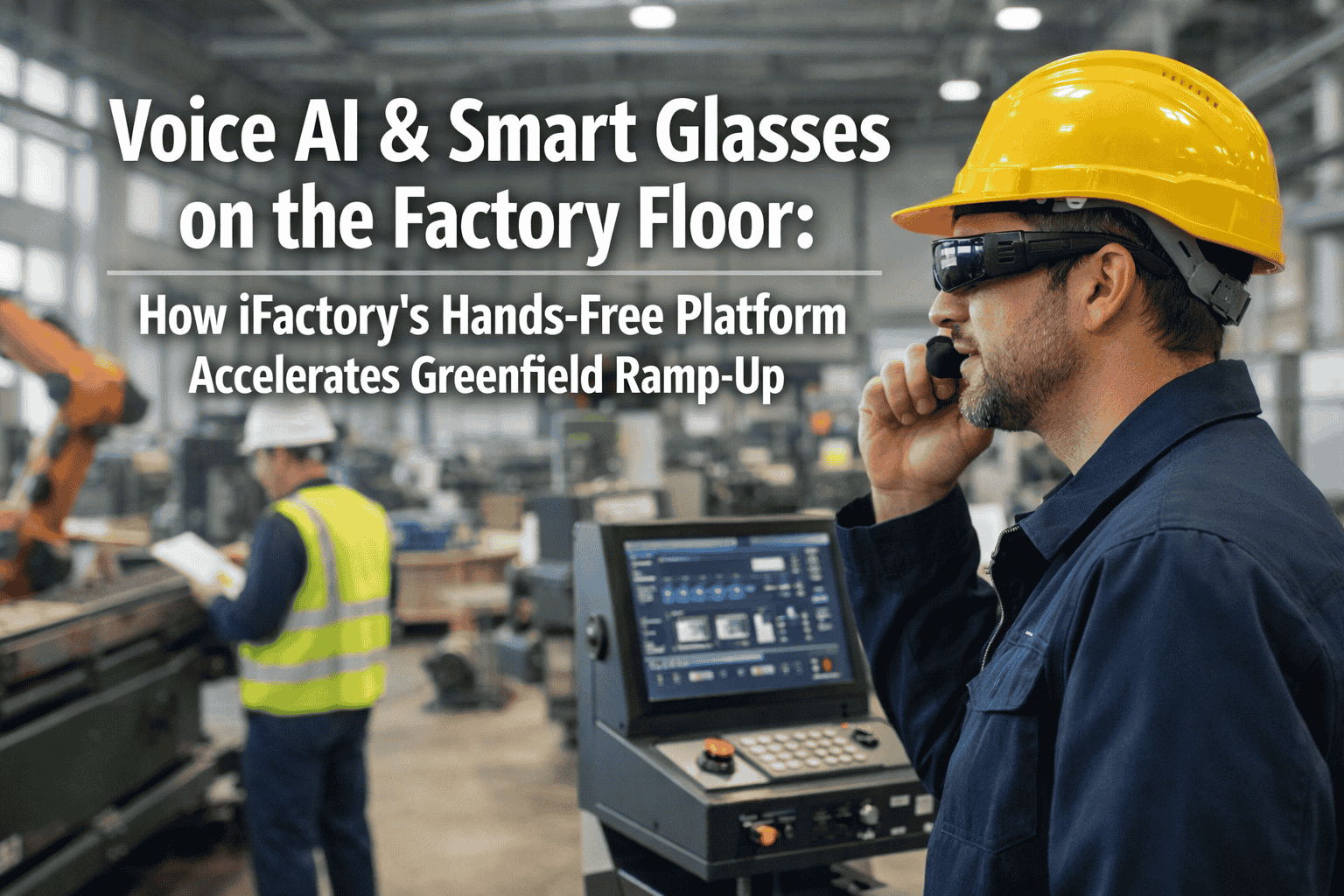
AR smart glasses are the only wearable category that delivers both productivity gain and safety improvement simultaneously. A technician on a CMMS-integrated smart glasses platform receives work orders, step-by-step overlays, torque specs, and remote expert video without ever putting down their tools. Mean time to repair drops 25 to 45%. First-time fix rates rise. Training time for new technicians collapses. But not every smart glasses product is suitable — consumer-grade devices fail in IP66 dusty, 50°C ambient, 85–100 dB factory environments. Purpose-built industrial AR (RealWear, RealWear Navigator 520, equivalent platforms) is the correct specification for greenfield manufacturing.
1
Work order pushed to glasses
CMMS sends the task directly to the technician's field of view — no phone, no clipboard
2
Step-by-step overlay guides repair
Torque specs, part IDs, lock-out checkpoints — all in field of view, hands-free
3
Remote expert sees what you see
Live video to off-site engineer, real-time annotations on technician's view — zero travel
4
Auto-documentation back to CMMS
Photos, measurements, signatures captured and posted to the work order automatically
Wearables ROI: Where the Numbers Actually Come From
Wearables ROI in industrial deployment is not a single number — it is the sum of avoided incidents, productivity gains, training cost reduction, and insurance premium impact. The combined effect on a typical 500-worker greenfield plant is in the 6 to 14 month payback range, but only when the right device categories are matched to the right hazards. Here is where the gains actually accrue.
$79K
Per heat injury avoided
Medical cost + lost productivity + insurance impact + investigation overhead
25–45%
MTTR reduction with AR glasses
AR overlay + remote expert + auto-documentation eliminates back-and-forth and rework
78%
Heat stress alert intervention success
SlateSafety data from 13,200 alerts managed in 2024 — pre-symptomatic intervention
3 yr
Zero heat incidents — Emirates Global Aluminium
Documented outcome from systematic wearable heat monitoring deployment
−40%
New technician training time
AR-guided procedures replace shadowing and reduce supervised hours required to certify
6–14 mo
Typical greenfield payback
Combined incident avoidance + MTTR gain + training cost reduction across 500-worker plant
Expert Perspective: Why Wearables Demand a Greenfield-Native Approach
Plants that deploy wearables in retrofit mode start with the device — pick a smart vest, run a pilot, struggle with network coverage, struggle with worker buy-in, struggle with CMMS integration, and quietly shelve the programme within 18 months. Plants that deploy wearables greenfield-native start with hazards, design the network for every zone where workers operate, build CMMS and alarm integration into the day-one architecture, and select devices last. The difference is not technology — it is sequence. Greenfield is the only window where you can run dense Wi-Fi 6E or private 5G in zones that no retrofit project would ever bring connectivity to (mezzanines, tank tops, basement plant rooms). It is the only window where worker change management can be embedded in the standard onboarding training rather than retrofitted into established work cultures. Wearables work brilliantly when designed in. They almost always fail when bolted on.
— iFactory Greenfield Consulting, Connected Worker Practice 2025 to 2026
$8.24B → $51.5B
Industrial wearables market growth, 2025 to 2036
94%
Wearable core temperature accuracy vs. medical-grade reference (Kenzen, McCarthy field data)
85–100 dB
Ambient noise environment industrial AR glasses must reliably operate in
Ready to design a wearables architecture into your greenfield plant before procurement starts? Talk to our connected worker team — we will produce the hazard map, network coverage brief, CMMS integration architecture, and rollout plan before device selection begins.
Build a Wearables Strategy That Survives — and Pays Back — From Day One
iFactory's greenfield wearables consultation delivers a hazard-to-device mapping document, network coverage and access architecture (Wi-Fi 6E, private 5G, BLE mesh, LoRaWAN), CMMS and MES integration design, alarm escalation workflow, worker onboarding plan, and a phased rollout schedule — all coordinated before device procurement begins.
Frequently Asked Questions
Which wearable category should a greenfield plant deploy first?
The right starting category depends on your hazard profile — not on what is fashionable. Plants with significant heat exposure (foundries, smelters, glass, cement, outdoor summer ops) should start with smart vests or chest patches that monitor core body temperature, heart rate, and sweat — predicting heat stress 15 to 30 minutes before symptoms become visible. Plants with lone worker exposure (large warehouses, after-hours maintenance, tank entries) should start with RTLS belts and smart watches that detect falls and trigger automatic escalation when a check-in is missed. Maintenance-heavy plants should start with AR smart glasses tied into the CMMS — typical 25 to 45% reduction in mean time to repair. The wrong starting category produces a low-impact pilot that quietly winds down — even if every individual device works correctly.
What network coverage is required for industrial wearables to actually work?
Coverage requirements depend on the device class. RTLS belts using BLE mesh require dense beacon networks across every operational zone. AR smart glasses require Wi-Fi 6E or private 5G with at least 50 Mbps sustained throughput per active device for video calls and CAD overlay. Health monitoring patches typically use LoRaWAN or BLE and require gateways within 50 m of any worker location. Greenfield coverage design is significantly cheaper than retrofit coverage — wireless access points and cable routes can be specified during electrical drawings and installed without operational disruption. Retrofitting dense Wi-Fi 6E into operating plant areas — particularly in zones with metal mezzanines, tank-mounted equipment, or basement utility spaces — costs 4 to 8 times more than greenfield specification and requires production interruption to install.
Are consumer-grade smart glasses suitable for heavy industrial environments?
Consumer-grade smart glasses are not appropriate for heavy manufacturing. Industrial environments include high ambient noise (85 to 100 dB near compressors and rolling mills, exceeding consumer device voice recognition tuning), high ambient temperatures (50°C+ near furnaces and casthouse operations), dust ingress (IP66 minimum required), impact exposure (MIL-STD-810H or equivalent), and 8 to 12 hour battery life requirements per shift. Purpose-built industrial AR devices such as the RealWear Navigator 520 are designed specifically for these conditions. Deploying consumer smart glasses in heavy industry produces a device that fails within 3 to 6 months and an unhappy workforce. Specify industrial AR devices that meet the environmental conditions of your specific zones.
How are worker privacy and biometric data concerns addressed in industrial wearables programmes?
Worker privacy is the most underestimated risk in any wearables programme. Biometric data — heart rate, body temperature, fatigue scores, location history — is highly sensitive personal data covered by GDPR in Europe and equivalent regulations in other jurisdictions. Best practice for greenfield programmes includes a written wearables data policy reviewed by HR and legal, anonymised data for operational analytics with personal data only accessible by occupational health, opt-in consent for non-safety-critical data collection, clear retention periods, no use of wearable data for performance reviews or disciplinary action, and worker representative involvement in policy design. Plants that skip the privacy framework face union pushback, regulatory complaints, and quiet device abandonment — and the technology gets blamed for what was actually a governance failure.
How does iFactory's greenfield wearables consultation work?
iFactory's wearables consultation covers your facility hazard map by zone and worker role, hazard-to-device category mapping document with primary and secondary device recommendations, network coverage specification per zone (Wi-Fi 6E, private 5G, BLE mesh, LoRaWAN gateway placement), CMMS and MES integration architecture for work order and alarm flow, alarm escalation workflow design from device alert through dispatcher to emergency response, worker change management and onboarding programme integration, privacy and data governance framework, and a phased rollout schedule from pilot zone through plant-wide deployment. All outputs are specification-ready before device procurement begins.
Book your greenfield wearables consultation here.