Twenty-five trends define the manufacturing landscape entering 2026 — but five of them are reshaping greenfield plant design specifically. Agentic AI is moving from copilot to autonomous decision-maker. Humanoid robots have crossed the prototype-to-production line, with Hyundai's Atlas and Siemens' Erlangen blueprint factory running real workloads. The AI-in-manufacturing market is projected to expand tenfold from $33.48B in 2024 to $366.24B by 2032. Net-zero design, reshoring, and modular plant architectures have moved from boardroom slides to capex line items. Greenfield plants designed in 2026 must accommodate these trends in their physical architecture, network topology, energy infrastructure, and workforce model — because retrofitting any of them into an operating plant costs 4 to 10× the greenfield specification cost. Book a 2026 greenfield trends consultation to map which of the 25 trends actually matter for your facility — and how to design each one into the foundation.
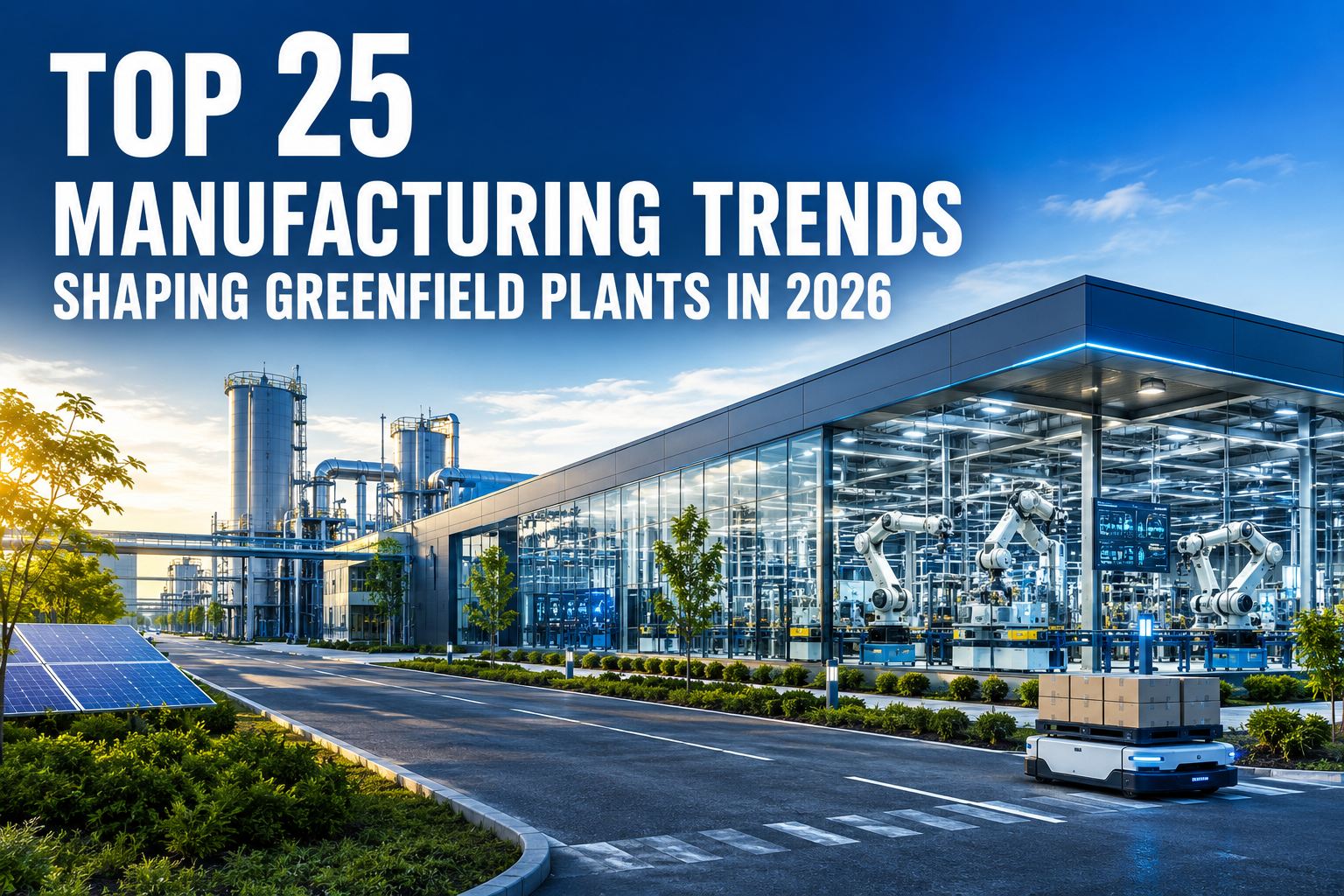
Top 25 Manufacturing Trends Shaping Greenfield Plants — 2026
Five Categories. Twenty-Five Trends. One Architecture Decision.
AI & Autonomy
5 trends
Agentic AI · Physical AI · Generative Design · Vision AI Agents · LLM Worker Copilots
Robotics & Workforce
5 trends
Humanoid Robots · Cobots · AMRs · Connected Worker · Skill-Based Training
Sustainability & ESG
5 trends
Net-Zero Design · Energy Recovery · Circular Materials · Water Reuse · Scope 3 Reporting
Plant Architecture
5 trends
Modular Factories · Digital Twin · Dark Factories · Edge Compute · Private 5G
Supply Chain & Strategy
5 trends
Reshoring · Equipment-as-a-Service · Cybersecurity · Geopolitical Resilience · Tariff Hedging
$366BAI-in-manufacturing market projection by 2032 (10× from 2024)
22%Of manufacturers plan to deploy physical AI within 2 years
$650BAdditional revenue agentic AI expected to generate by 2030 (McKinsey)
70%Of cobot orders now from non-automotive sectors
Category 1 — AI & Autonomy: Systems That Act, Not Just Recommend
The biggest shift in 2026 is that AI systems have moved from recommending to acting. Agentic AI autonomously adjusts equipment parameters, creates work orders, and re-sequences production schedules without waiting for human sign-off. This is the single most consequential trend for greenfield design: the entire data architecture, alarm escalation, and human-in-the-loop workflow must be designed for AI agents operating as plant participants — not as advisors a human reviews.
01
Agentic AI on the Plant Floor
AI agents that act autonomously on production data — adjusting setpoints, opening work orders, re-sequencing schedules. McKinsey projects $650B in additional revenue across industries by 2030.
Greenfield need: Designed-in agentic API access to PLCs, MES, CMMS from day one
02
Physical AI & Robot Autonomy
NVIDIA's "ChatGPT moment for physical AI" — 22% of manufacturers plan to use physical AI within 2 years, up from 9% today. Foundation for humanoid and mobile robot deployment.
Greenfield need: Edge GPU compute, Isaac Sim training environment, robot-ready floor plan
03
Generative Design for Process & Layout
AI generates and tests thousands of plant layout, material flow, and equipment configurations before construction. Cuts greenfield design time 30 to 50%.
Greenfield need: Generative design integrated into FEED phase, not retrofitted
04
Vision AI Agents
Vision systems that don't just detect — they classify, correlate with process data, and trigger corrective action. Defect rates drop 30 to 60% versus reactive inspection.
Greenfield need: Camera mount points + lighting fixtures + edge compute at every quality gate
05
LLM Worker Copilots
Large language models as worker assistants — voice query on tablets, AR glasses, mobile devices. Interest in AI programming rose from 31% to 35% YoY (IFR data).
Greenfield need: Wi-Fi 6E coverage, mobile device infrastructure, voice interface specification
Category 2 — Robotics & Workforce: The Boston Dynamics & Hyundai Year
Interest in humanoid robots grew from 8% to 13% YoY in the 2026 IFR survey. Hyundai's Atlas humanoid is being deployed across factories. Siemens' Erlangen blueprint plant runs Humanoid's HMND 01 wheeled humanoid on NVIDIA Jetson Thor edge compute for autonomous logistics. This is no longer speculation — it is procurement. And the plants that designed for it at greenfield are deploying first.
06
Humanoid Robots in Production
From prototype to pilot production. Hyundai, Foxconn, Boston Dynamics deploying real workloads. Articulated robots still 53% of market, but humanoids the fastest-growing segment.
Greenfield need: Walking-rated floor surfaces, charging infrastructure, edge compute density
07
Cobots Beyond Automotive
70% of cobot orders now come from non-automotive sectors. Food & Consumer Goods saw 51% YoY surge in robotics orders — driven by labor shortages.
Greenfield need: Safety zones, fenceless workcells, integrated cobot-CMMS-MES architecture
08
Autonomous Mobile Robots (AMRs)
AMRs replacing conveyors and AGVs in greenfield material handling. Lower CapEx, dynamic routing, fleet management via central AI orchestrator.
Greenfield need: Wide aisles, fleet management network, charging zone strategy
09
Connected Worker Platforms
AR smart glasses, smart vests, wearable biometrics — connecting every worker to CMMS, MES, and safety dashboards. Heat stress and fatigue prediction now standard.
Greenfield need: Network coverage everywhere workers operate — including tank tops, basements
10
Skill-Based Workforce Models
Silver tsunami forcing redesign of training. Multi-skilled operators on multiple cells. Digital twin training environments. VR-based onboarding.
Greenfield need: Training room integration with production digital twin, certification tracking in MES
Want to map which of these 10 AI and robotics trends actually apply to your facility? Book a greenfield trends consultation — we will produce a prioritised trend-to-design brief before construction starts.
Category 3 — Sustainability & ESG: Net-Zero as a Permit Condition
Net-zero design is no longer an ESG marketing item — it is increasingly a permitting condition in EU, UK, and parts of North America. Customer Scope 3 reporting requirements are flowing down to tier 1 and tier 2 suppliers. Greenfield plants designed without integrated energy recovery, water reuse, and circular materials infrastructure will face progressive operational restrictions and customer disqualification in the late 2020s.
11
Net-Zero Plant Design
Carbon-neutral by design — solar + storage, hybrid electric process heat, on-site generation. Increasingly a permit condition rather than a CSR goal.
Greenfield need: Roof solar capacity, BESS footprint, electric process heat infrastructure at FEED
12
Energy Recovery & Regenerative Systems
Braking regen on robots fed back to grid. Process heat recovery. Compressed air heat capture. Each one a CapEx line item that wasn't on plant blueprints 5 years ago.
Greenfield need: Reversible inverters, heat exchanger network, energy management system
13
Circular Materials & Modular Recycling
Robots and equipment built with modular materials for easy recycling. Cullet, scrap, and process water reuse loops integrated into plant flow.
Greenfield need: Sorting and material recovery stations integrated into production flow
14
Water Reuse & Zero-Liquid Discharge
Process water treatment and recycling loops standard. ZLD for water-stressed regions. AI-monitored chemistry and conductivity.
Greenfield need: Treatment infrastructure footprint, chemical recovery design, AI monitoring sensors
15
Scope 3 Reporting Infrastructure
Customer-driven Scope 3 reporting cascading to suppliers. Real-time emissions data from MES required by major OEMs and retailers.
Greenfield need: Energy metering at every major asset, ESG dashboard in MES, audit-ready data layer
Design Net-Zero, AI-Native & Robot-Ready Into Your Greenfield Plant — Not After Launch
iFactory's greenfield trends consultation maps the 25 trends against your facility type and produces a prioritised trend-to-design brief covering AI infrastructure, robotics readiness, sustainability architecture, plant modularity, and supply chain resilience — delivered before FEED is locked.
Category 4 — Plant Architecture: Modular, Dark, & Digital-First
The plant building itself is changing. Modular factories that can be expanded in 6 to 12 month increments are replacing mega-builds. Dark factories run autonomous shifts with skeleton supervision. Digital twins are no longer simulation tools — they are operational copies running in parallel to the physical plant. Private 5G is replacing Wi-Fi in high-density robot deployments. The architectural choices made at FEED determine which of these are accessible.
16
Modular Factories
Prefab modular plant sections enabling 6 to 12 month capacity expansion. Cost lower than greenfield, time-to-production faster than retrofit.
Greenfield need: Site plan reserves modular expansion zones, utility tie-in capacity, gridding
17
Real-Time Digital Twins
WEF Lighthouse plants report 20 to 30% productivity gains from digital twins running in parallel — testing every changeover, schedule, and speed adjustment virtually first.
Greenfield need: Digital twin platform selection at FEED, sensor schedule designed to feed twin
18
Dark / Lights-Out Factories
Fully automated production shifts running with minimal human presence. Foxconn's "scalable AI-powered workforce" model emerging across electronics, packaging, and warehousing.
Greenfield need: Robot-only zones, autonomous safety systems, remote operations centre
19
Edge Compute Density
By 2026, 75% of enterprise data created and processed outside traditional data centres. Vision AI, agentic AI, robot autonomy all require edge GPU capacity.
Greenfield need: Edge data closets, cooling capacity, fibre routes, GPU power budget
20
Private 5G & Wi-Fi 6E
Private 5G replacing Wi-Fi in high-density mobile robot deployments. Wi-Fi 6E for AR/VR worker platforms. Both are network architecture decisions at FEED.
Greenfield need: Spectrum strategy, AP placement design, antenna site survey before construction
Category 5 — Supply Chain & Strategy: Reshoring, Resilience & the New Tariff Environment
Tariffs at 40-year highs, geopolitical fracturing of supply chains, and labor cost pressures are accelerating reshoring across the US, EU, and parts of Asia. The plants going up in 2026 are increasingly in markets they will sell into — and they are designed for the supply chain uncertainty of the next decade rather than the stability of the last one.
21
Reshoring & Nearshoring
Strong reshoring push to reduce supply chain dependency. US leads with 84% of regional AI-robotics market value. Major automotive, semiconductor, battery greenfield builds in US, Mexico, EU.
Greenfield need: Site selection factoring tariff exposure, local workforce, customer proximity
22
Equipment-as-a-Service (EaaS)
Robot-as-a-Service, vision-as-a-service, predictive-maintenance-as-a-service. Shifts CapEx to OpEx, reduces upfront commitment, accelerates technology refresh.
Greenfield need: Network and data architecture supporting vendor-managed remote services
23
OT Cybersecurity by Design
Digital systems mean cyber attack surface. Manufacturing now in top 3 most-attacked sectors. Cybersecurity must be designed into the OT network — not added.
Greenfield need: Network segmentation, IEC 62443 architecture, identity federation from day one
24
Geopolitical & Supplier Resilience
Multi-source procurement, dual-vendor strategies, regional spares depots. Designed against single-region supply failure rather than optimised for lowest cost.
Greenfield need: Open-protocol equipment specifications enabling multi-vendor sourcing
25
Tariff Hedging & Cost Engineering
Steel prices up 15 to 25%, aluminum 8 to 10%, lumber 17.2% YoY in 2025. Escalation clauses, hedged sourcing, pre-purchase strategies now standard.
Greenfield need: Procurement strategy with escalation hedges, currency hedging, alternative materials
Expert Perspective: Why the 2026 Greenfield Window Is Different
The greenfield plants going up in 2026 are different from those going up in 2020 in one fundamental way: the cost of getting AI infrastructure, robot readiness, net-zero architecture, and modular expansion wrong has gone up an order of magnitude. In 2020, a plant could be retrofitted with predictive maintenance, vision inspection, and energy monitoring within 12 to 24 months at moderate cost. In 2026, retrofitting agentic AI, humanoid robot autonomy, real-time digital twins, and Scope 3 ESG reporting into an operational plant means rebuilding the network, the data architecture, and the workforce model simultaneously — at 4 to 10 times the greenfield cost. The 25 trends in this guide are not equally relevant to every facility. Food & beverage cares about cobots and AI vision more than humanoid robots. Heavy industry cares about energy recovery more than dark factories. Semiconductor cares about cleanroom automation more than reshoring. The work at FEED is filtering the 25 trends down to the 5 to 8 that actually matter for your specific facility — and designing those 5 to 8 deeply into the foundation rather than treating all 25 as equal priorities.
— iFactory Greenfield Consulting, Industrial Trends Practice 2025 to 2026
10×
AI-in-manufacturing market expansion projected 2024 to 2032
20–30%
Productivity gain at WEF Lighthouse digital-twin plants
4–10×
Retrofit cost multiplier vs. greenfield design for AI-native trends
Ready to filter the 25 trends down to the 5 to 8 that matter for your facility? Talk to our greenfield trends team — we will produce a prioritised trend-to-architecture brief before FEED is locked.
Build a 2026-Native Greenfield Plant — Not a 2020 Plant With Retrofit Risk Baked In
iFactory's greenfield trends consultation maps the 25 trends to your specific facility type and produces a prioritised architectural brief covering agentic AI infrastructure, robot readiness, net-zero design, modular expansion, edge compute capacity, private 5G or Wi-Fi 6E strategy, OT cybersecurity by design, and supply chain resilience — all delivered before FEED is locked.
Frequently Asked Questions
Which 2026 manufacturing trends most affect greenfield plant design specifically?
Five trends most directly drive greenfield architectural decisions: agentic AI (changes data architecture and human-in-loop workflow design), physical AI and humanoid robots (changes floor surface, charging infrastructure, edge compute density), net-zero plant design (changes roof loading, electrical capacity, energy management), modular factory architecture (changes site planning and utility headroom), and private 5G or Wi-Fi 6E network strategy (changes electrical conduit, AP placement, antenna routing). Each of these costs 4 to 10 times more to retrofit than to design in at FEED. The other 20 trends in the guide matter operationally but are less architecturally consequential — they can be added without rebuilding the plant, even if at meaningful cost.
Is agentic AI ready for actual production deployment, or is it still pilot-stage?
Agentic AI has moved from pilot to early production in 2026. McKinsey research projects $650 billion in additional revenue across industries by 2030, and nearly 3 in 4 companies plan to deploy agentic AI within two years according to Deloitte. The current state of the art is AI agents that autonomously adjust equipment parameters, create work orders, and re-sequence schedules without human sign-off for routine decisions, while escalating exceptions and novel situations to human operators. The plants successfully running agentic AI in production share three architectural decisions: they have unified namespace data architectures that give AI agents read-write access to MES, CMMS, and PLC data, they have governance frameworks defining which decisions agents can take autonomously, and they have audit trails for every agent action. Greenfield is the cleanest window to design these three foundations into the plant.
Should a greenfield plant in 2026 actually plan for humanoid robots, or is that still too early?
Whether to deploy humanoid robots in your specific plant depends on industry and workflow — but designing the architectural readiness for them is now a reasonable greenfield decision. Interest grew from 8% to 13% YoY in the 2026 IFR survey, 22% of manufacturers plan to deploy physical AI within two years, and concrete production deployments exist at Hyundai, Foxconn, and the Siemens Erlangen blueprint factory (running Humanoid's HMND 01 wheeled humanoid on NVIDIA Jetson Thor). The architectural cost of designing for humanoid robots — walking-rated floor surfaces, charging infrastructure, robot-ready aisles, edge GPU compute density — is small compared to the cost of retrofitting these into an operational plant. The deployment decision itself can be deferred 2 to 5 years; the architectural readiness decision must be made at greenfield.
How does reshoring affect greenfield plant site selection in 2026?
Reshoring has changed the site selection calculus on three dimensions. First, tariff exposure now matters: a plant in a high-tariff trade lane between major markets is structurally disadvantaged. Second, energy availability and grid reliability have become the number one site factor for advanced manufacturing — ahead of land cost, labor availability, and incentives. Third, customer proximity has regained importance as supply chain resilience becomes a customer purchase criterion. The US leads the AI-powered industrial robot market with 84% of regional value, driven heavily by reshoring momentum, and similar dynamics are visible in EU and parts of Asia. Greenfield plants planned without explicitly modeling tariff scenarios, energy grid scenarios, and customer proximity in the site selection model carry strategic risk that compounds over the 15 to 25 year plant life.
How does iFactory's greenfield trends consultation actually work?
iFactory's consultation reviews your facility type, target markets, regulatory environment, customer requirements, and capacity targets, then maps each of the 25 trends covered in this guide against architectural relevance for your specific plant. The output is a prioritised brief identifying the 5 to 8 trends that meaningfully change your FEED specification — typically including agentic AI infrastructure (data architecture, governance, audit trails), robot readiness (floor specification, charging, edge compute), net-zero design (energy, water, materials), modular expansion (site planning, utility headroom), edge compute capacity, network strategy (private 5G or Wi-Fi 6E), OT cybersecurity by design, and Scope 3 ESG reporting infrastructure. All outputs are specification-ready before FEED is locked.
Book your greenfield trends consultation here.