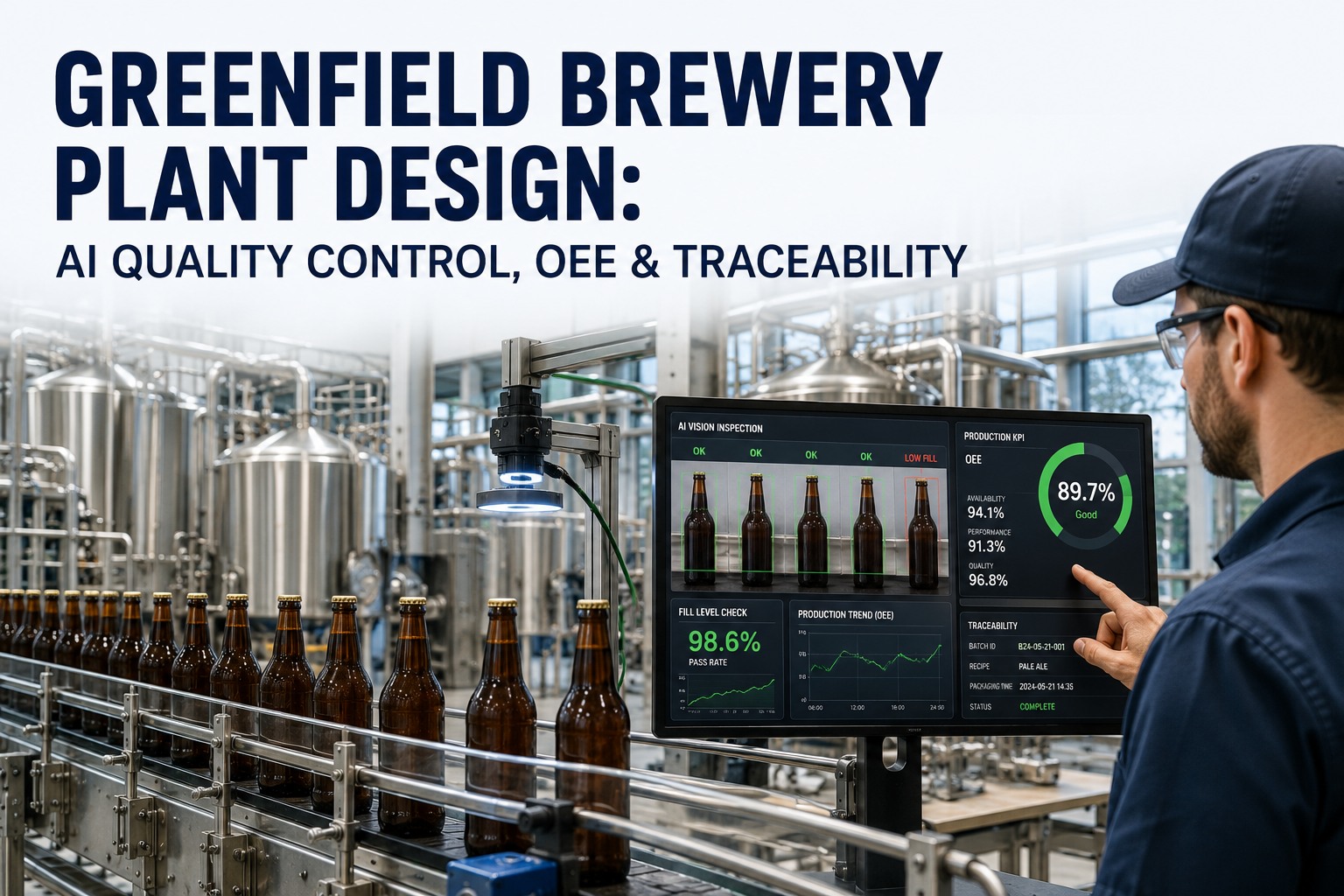
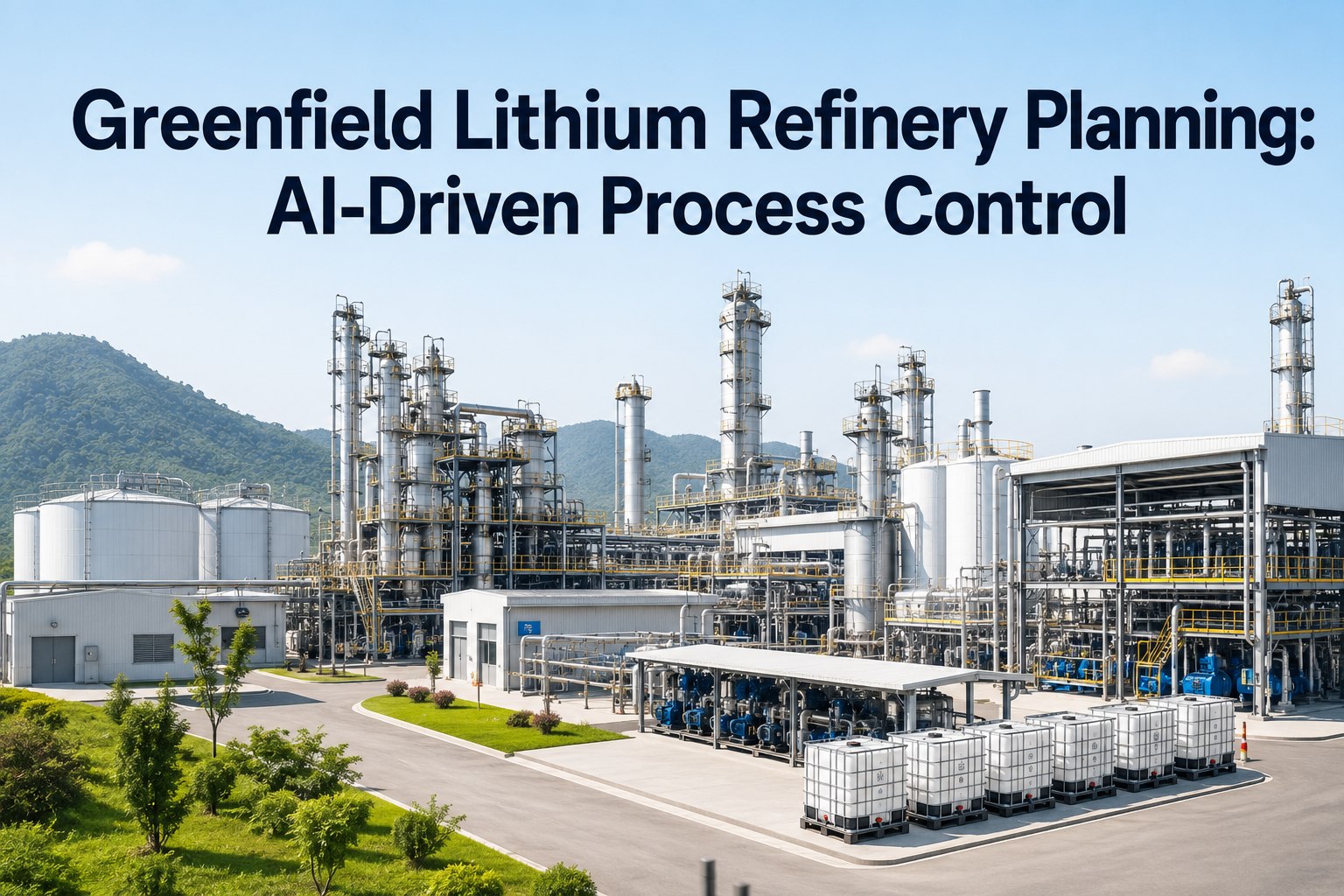
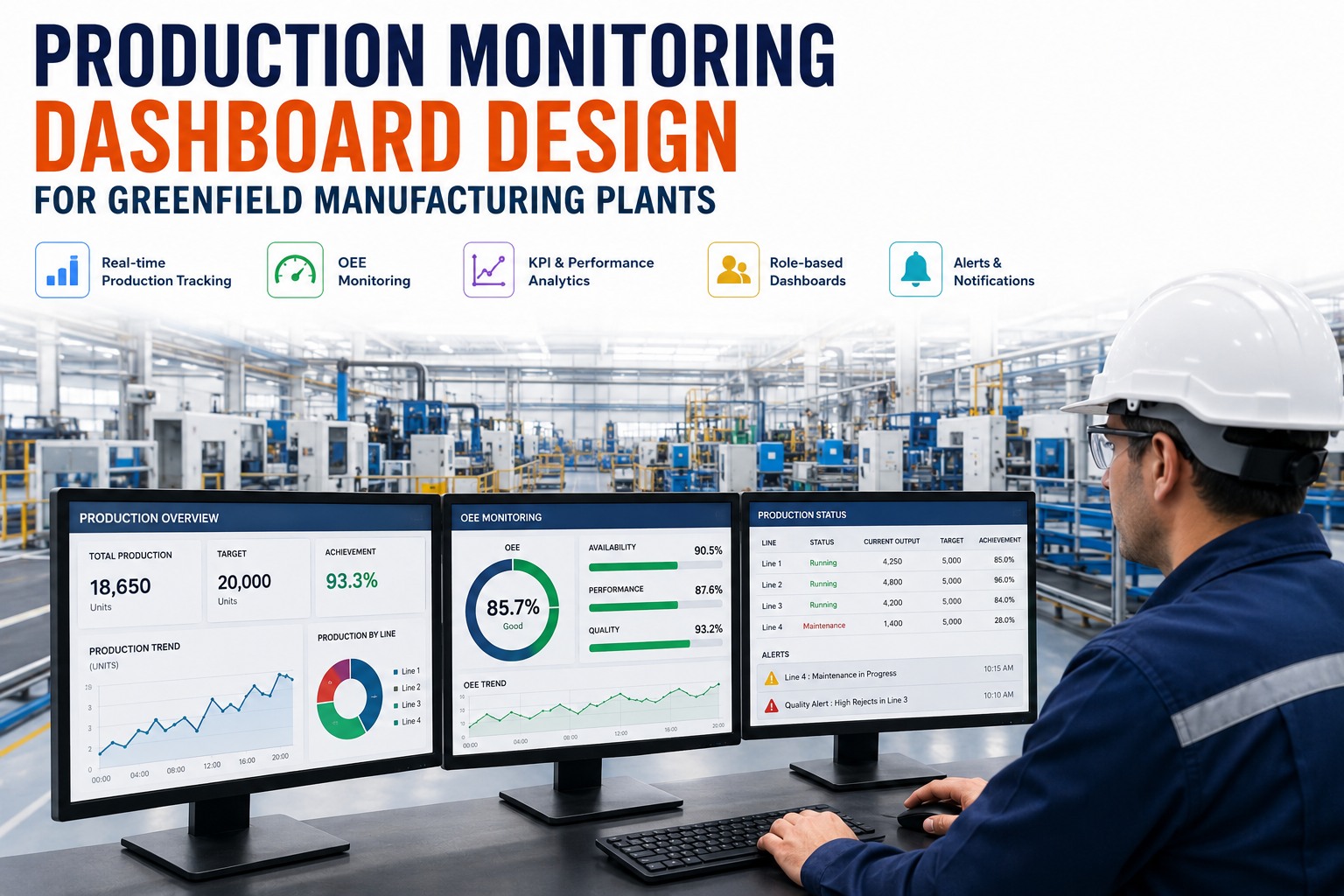
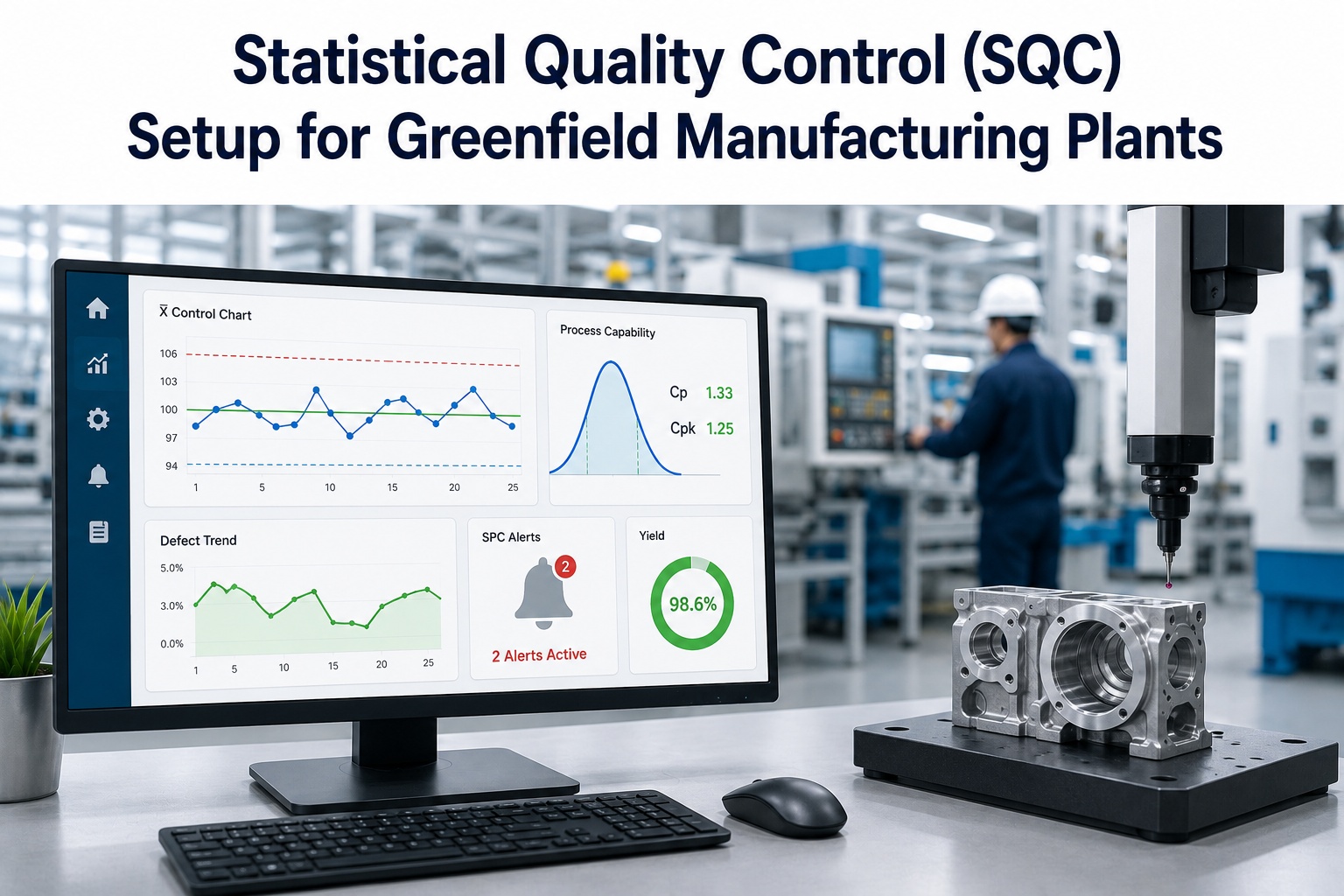
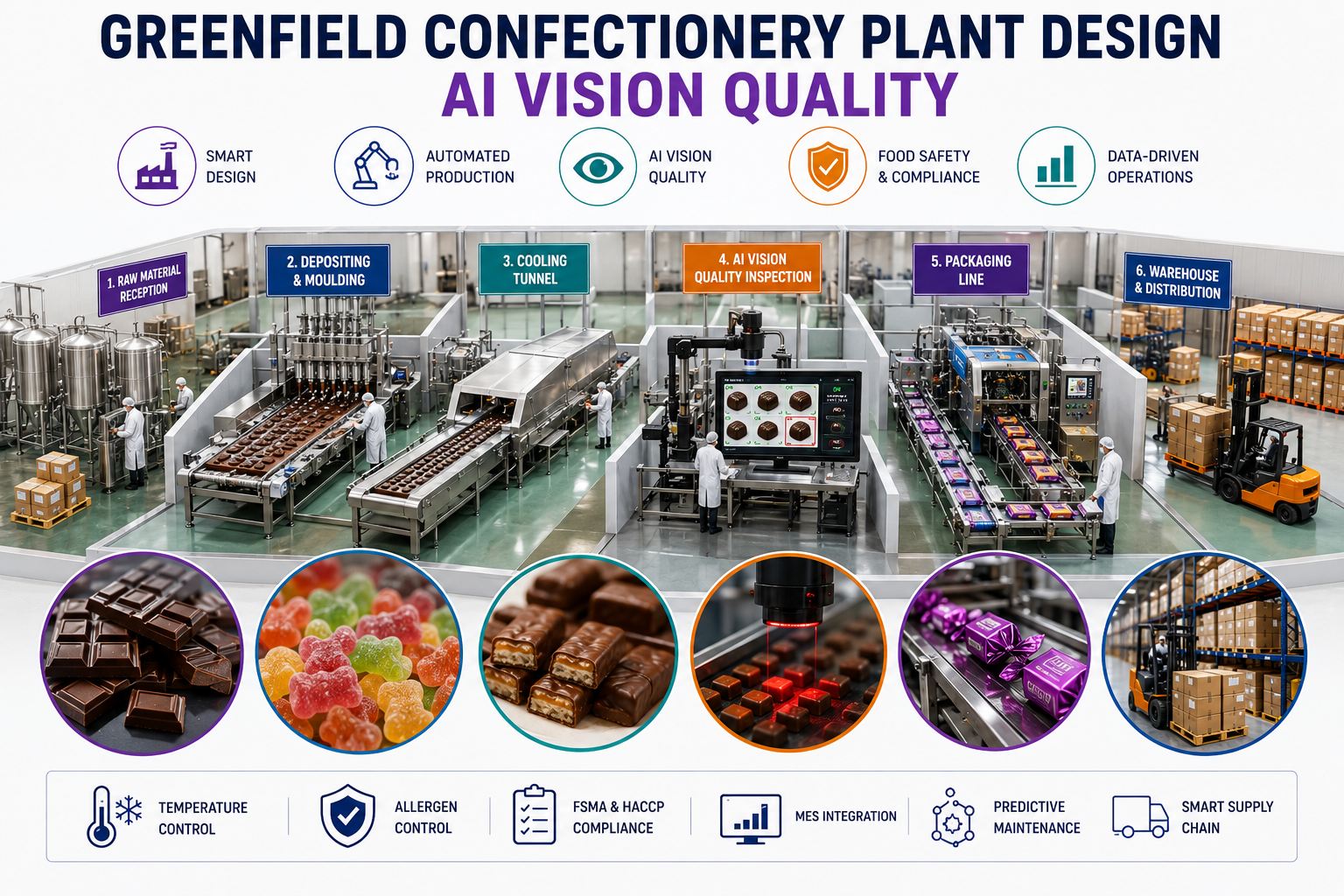
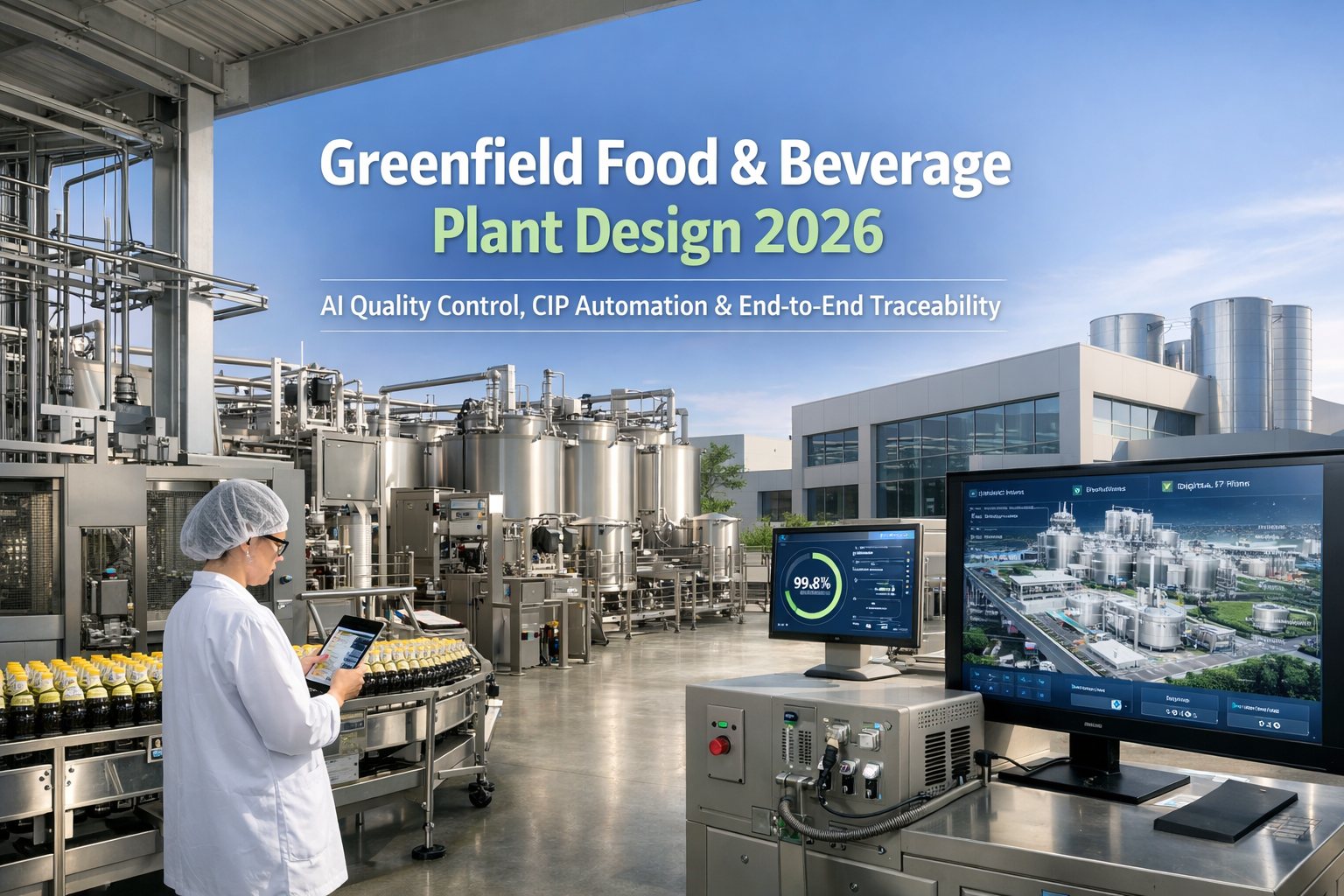
Brewing is one of the few manufacturing categories where every batch is a slightly different chemistry experiment and every bottle must taste identical. ISA-88 batch control, CIP cycle precision, dissolved CO₂ inline monitoring, AI vision fill-level inspection, and full batch genealogy from grain receipt to dispatch are not optional features for a modern brewery — they are the baseline of a plant that can actually meet 21st century quality, traceability, and OEE expectations. A craft brewery producing 5,000 HL/year now has access to automation that was only available to global brewers a decade ago. A 2026 greenfield brewery designed without ISA-88 batch architecture, CIP integration from layout stage, AI inspection on the packaging line, and unified MES/ERP integration is a brewery already behind its market on the day it opens. Book a greenfield brewery plant consultation to validate your brewhouse layout, automation architecture, and traceability design before construction drawings are finalised.
Greenfield Brewery Plant Design — AI Quality, OEE & Traceability 2026
From Grain Silo to Six-Pack — Designed as One Connected System
Brewhouse
Milling · Mashing · Lautering · Boiling · Whirlpool
PLC: Siemens S7-1500 / Allen-Bradley ControlLogix · ISA-88 recipe management
3 to 6 hours per batch
Cellar / Fermentation
Cooling · Pitching · Primary & Secondary Ferment · Maturation
Glycol valve per FV + 3 temp probes per tank (top/mid/bottom) · dissolved O₂ monitoring
7 to 28 days per batch
Filtration & Bright Beer
DE / Cross-flow filtration · Bright beer tanks · Carbonation
Inline turbidity · Dissolved CO₂ & O₂ analysers · Pressure-rated transfer
12 to 48 hours
Packaging Line
Rinsing · Filling · Crowning/Seaming · Labelling · Casing · Palletising
AI vision fill inspection · checkweigher · CO₂ control · LogixAI Perfect Fill
Real-time · 200–80,000 BPH typical range
5,000 HL+Annual production now economic for full ISA-88 automation
2–3xCIP cycle frequency vs. dry food — automation ROI is fastest in beverage
75–85%Target packaging line OEE for a well-designed modern brewery
100%Batch genealogy from grain receipt to finished case required for FDA recall response
ISA-88 Batch Control: The Architecture That Makes Every Batch Identical
ISA-88 is the international standard for batch process control — and it is the architectural foundation of any modern brewery automation system. ISA-88 separates the recipe (the what) from the equipment (the how), enabling the same beer recipe to run on different brewhouse equipment with identical results. AriZona Beverages' Keasbey greenfield plant built its entire batch control on ISA-88 with ControlLogix PLCs and Sepasoft MES — delivering closed-loop production and full SAP integration from day one. Without ISA-88, a brewery is locked into bespoke programming for every new beer or equipment change.
Tier 1
Procedural Model
The recipe — what the beer is. Defines unit procedures, operations, and phases. Brewer-editable.
Example: "IPA Recipe v3.2" — mash steps, hop schedule, fermentation profile
Tier 2
Physical Model
The equipment — what physical assets execute the recipe. Defined once, shared across all recipes.
Example: Brewhouse Unit 1 — mash tun, lauter tun, kettle, whirlpool, transfer pumps
Tier 3
Control Activity Model
The execution — recipe management, scheduling, batch reporting, equipment co-ordination at runtime.
Example: Schedule IPA batch on Brewhouse 1, monitor execution, record actual parameters
CIP Automation: The Cycle Every Brewery Runs 2 to 3 Times More Than Any Other Plant
CIP (Clean-in-Place) is the single highest-value automation investment in any brewery. Beverage lines cycle CIP 2 to 3 times more frequently than dry-food lines — every fermentation tank, every transfer, every product changeover requires a validated wash cycle. Manual CIP wastes chemicals, water, and energy on every wash and produces inconsistent cleaning results. Automated CIP with parameter-monitored cycles delivers food-safety-grade validation, IoT-monitored compliance records, and significant utility savings simultaneously.
The 5-Phase CIP Cycle — Each Phase Monitored, Each Parameter Recorded
1
Pre-Rinse
Cold water
3–5 min
Remove gross product residue, prevent caustic carryover into beer
2
Caustic Wash
1–3% NaOH at 70–80°C
15–30 min
Critical phase — removes organic soils, hop residue, protein deposits
3
Intermediate Rinse
Recovered or fresh water
5–10 min
Remove caustic, conductivity probe verifies clean rinse
4
Acid Wash
0.5–1% nitric acid at 60°C
10–15 min
Remove mineral and beerstone deposits, neutralise residual caustic
5
Final Rinse & Sanitiser
Soft water + PAA or hot sterilising
5–10 min
pH and conductivity verification, sanitise pre-production
Continuously monitored per cycle: temperature, flow rate, conductivity, chemical concentration, contact time. Every cycle generates a validated record for FSMA, BRC, and SQF audit readiness.
Need CIP cycle design and automation specification for your brewery? Book a brewery automation consultation — we will produce the CIP architecture, chemical recovery design, and IoT monitoring brief before piping drawings are finalised.
AI Vision on the Packaging Line: Where Beer Quality Meets Consumer Expectation
By the time beer reaches the packaging line, every gram of brewery effort is committed — and a single visible defect, fill-level inconsistency, or label error in front of the consumer destroys the brand equity behind the beer. AI vision inspection at packaging is the last and most consequential quality gate. Modern systems run multiple inspections per bottle or can in milliseconds — and Rockwell's LogixAI Perfect Fill uses edge AI directly inside the PLC to predict fill weights and reduce variation in real time. None of this is retrofittable cleanly: camera positions, lighting geometry, and edge compute provisioning belong in the line layout from day one.
Fill Level Verification
Vision + LogixAI Perfect Fill
Detects underfill (regulatory violation) and overfill (product giveaway) within ±0.5 ml accuracy
Eliminates 0.5 to 2% product giveaway typical of non-AI fillers
Crown / Cap / Closure
High-speed vision
Missing, tilted, damaged, or wrong-colour closure on every bottle/can
Removes 99.9%+ of seal defects before product reaches dispatch
Label Inspection
Vision + OCR + AI verification
Label position, registration, code legibility, lot/date code, allergen statement
Eliminates the costliest packaging recall trigger
Foreign Object Detection
X-ray + vision
Glass, metal, plastic in bottle prior to fill; foreign object in finished container
Critical for liability protection and FSMA Preventive Controls compliance
Carbonation Verification
Inline dissolved CO₂ sensor + AI correlation
Out-of-spec carbonation flagged before crowning — prevents flat or foam-out product
Eliminates the most common consumer complaint after off-flavour
Case Pack & Pallet
Vision + count verification
Wrong count, mixed SKU, missing units in case; pallet stack integrity
Eliminates dispatch errors and customer chargebacks
Design AI Vision, CIP Automation & Batch Genealogy Into Your Brewery From Day One
iFactory's greenfield brewery consultation covers brewhouse and cellar layout, ISA-88 batch control architecture, CIP automation specification, AI vision inspection station design, batch genealogy and MES integration, and OEE measurement architecture — all delivered before construction drawings are finalised.
Batch Genealogy: Tracing One Six-Pack Back to the Grain Silo
A recall in 2026 is no longer a phone call — it is a 24-hour FDA data request under FSMA 204. A brewery must be able to trace any case of beer in the market back through dispatch, packaging, bright beer tank, fermenter, brewhouse batch, raw material lot, and supplier. Manually, this takes days. With automated genealogy designed into the MES from day one, it takes minutes. The data flow below shows what every greenfield brewery should capture at every Critical Tracking Event.
▣
Finished Case / Pallet
SSCC code, dispatch lot, customer, ship date
▣
Packaging Run
Line, shift, pack date, AI inspection results, checkweigher data
▣
Bright Beer Tank
BBT number, transfer date, CO₂ & O₂ readings, dissolved oxygen at fill
▣
Fermenter Tank
FV number, yeast generation, ferment temp profile, OG/FG, ABV
▣
Brewhouse Batch
Batch number, recipe version, mash/boil/hop times, KOT date
▣
Raw Material Lots
Malt lot, hop lot, yeast strain, water source, adjuncts — supplier traceability
Expert Perspective: The Brewery Built Without Architecture Becomes a Spreadsheet Plant
The most common brewery we audit at year 2 of operation has bought all the right equipment — modern brewhouse, automated cellar, good packaging line — but bought every piece individually, with no overall architecture connecting them. The brewhouse PLC does not talk to the MES. The cellar fermentation profile is stored on a SCADA HMI nobody can query. CIP cycle records are printed and filed. Batch genealogy is reconstructed from spreadsheets when a customer asks. Every individual asset works correctly. The system as a whole is invisible to the brewer. The plant cannot answer simple questions like "what was the average dissolved oxygen at fill across last month's IPA batches" without 4 hours of spreadsheet work. Greenfield is the only practical window to design the brewery as one connected system rather than a collection of best-in-class assets that do not talk to each other. ISA-88 batch architecture, unified data model, MES from day one, and CIP records automatically posted to compliance — none of this is exotic technology in 2026. It is the minimum.
— iFactory Greenfield Consulting, Food & Beverage Practice 2025 to 2026
75–85%
Target packaging line OEE — well-designed modern brewery
±0.5 ml
AI Perfect Fill accuracy — eliminates 0.5 to 2% product giveaway
24 hr
FSMA recall data response window — automated genealogy is the only practical answer
Ready to design ISA-88 batch architecture, CIP automation, AI vision, and full batch genealogy into your brewery before construction begins? Talk to our brewery automation team — we will produce the architecture brief before drawings are finalised.
Design Your Greenfield Brewery as One Connected System — Not a Collection of Best-in-Class Assets
iFactory's greenfield brewery consultation covers brewhouse and cellar layout review, ISA-88 batch control architecture, CIP automation specification with parameter monitoring, AI vision inspection station design across the packaging line, batch genealogy and MES integration design, OEE measurement architecture, and ISO 22000 and FSMA compliance documentation — all delivered before construction drawings are finalised.
Frequently Asked Questions
What size brewery actually justifies full ISA-88 batch automation?
A decade ago, ISA-88 batch automation was only practical at industrial brewery scale — 50,000 HL/year and above. Today, compact modular SCADA packages, low-cost PLC platforms, and accessible MES platforms have pushed the economic threshold down significantly. A craft brewery producing 5,000 HL/year now has access to full ISA-88 architecture that delivers measurable batch-to-batch consistency, complete traceability, and OEE measurement from day one. The greater question is not "is my brewery big enough" but "can I afford to launch a 2026 brewery without batch architecture that the rest of the industry now considers standard." Manual batch records, spreadsheet traceability, and unmonitored CIP cycles are increasingly a compliance risk and an operational disadvantage even at small scale.
Why does CIP automation deliver such fast payback in a brewery specifically?
Beverage lines run CIP cycles 2 to 3 times more frequently than dry-food lines. Every tank turnover, every transfer, every product changeover, and every shift end can require a validated wash. Manual CIP wastes caustic, acid, sanitiser, water, and heat on every cycle — chemicals discharge into effluent at concentrations 20 to 40% above the optimum, water consumption is typically double what automated cycles use, and steam consumption for heating is significantly elevated. Automated CIP with conductivity-verified rinses, recovered water, and chemical recovery loops typically delivers 25 to 40% reduction in utility cost per cycle. Across a high-cycling brewery, this is one of the fastest-payback automation investments — typically 12 to 24 months — and it simultaneously delivers the audit-grade records required for FSMA, BRC, and SQF certification.
What OEE benchmark should a modern brewery packaging line target?
Modern brewery packaging lines should target 75 to 85% OEE, with world-class lines (typically high-volume bottle and can lines at global brewers) achieving 85%+ consistently. Below 70% OEE typically indicates either significant unplanned downtime (filler valve failures, capper jams, labeller adjustments), excessive changeover time, or quality losses driving rework. The biggest single OEE lever on a brewery packaging line is unplanned downtime — predictive maintenance on the filler, capper, and labeller produces the largest direct OEE improvement. The second largest lever is AI vision quality inspection — by detecting defects in real time and feeding back to fill, cap, and label systems, the quality component of OEE rises and the rejection rate falls simultaneously.
How does batch genealogy actually work for a brewery under FSMA 204?
FSMA 204 requires food and beverage manufacturers to provide traceability records to the FDA within 24 hours of a request. For a brewery, this means tracing any case in the market backwards through: dispatch SSCC, packaging run, bright beer tank fill, fermenter, brewhouse batch, and raw material lots (malt, hops, yeast, adjuncts). Doing this manually from spreadsheet records typically takes 24 to 72 hours per batch trace — beyond the FDA window. With MES batch genealogy designed into the plant from day one, every transfer is captured as a parent-child relationship in the database, every lot code is linked, and any case can be traced to source materials in minutes. The greenfield window is critical: retrofitting genealogy data capture into an operating brewery requires shutting down lines to install instrumentation and re-train operators, which most breweries cannot do.
How does iFactory's greenfield brewery plant consultation work?
iFactory's consultation covers your brewing process scope and capacity targets, brewhouse and cellar layout review, ISA-88 batch control architecture and recipe management design, CIP cycle specification with parameter monitoring and chemical recovery, packaging line layout with AI vision inspection station design (fill, cap, label, foreign object, carbonation, case pack), batch genealogy data model spanning grain receipt through dispatch, MES and ERP integration architecture, OEE measurement points and dashboards, predictive maintenance sensor schedule for fermenters, fillers, and utilities, and FSMA / BRC / SQF compliance documentation architecture. All outputs are specification-ready before construction drawings are finalised.
Book your greenfield brewery consultation here.