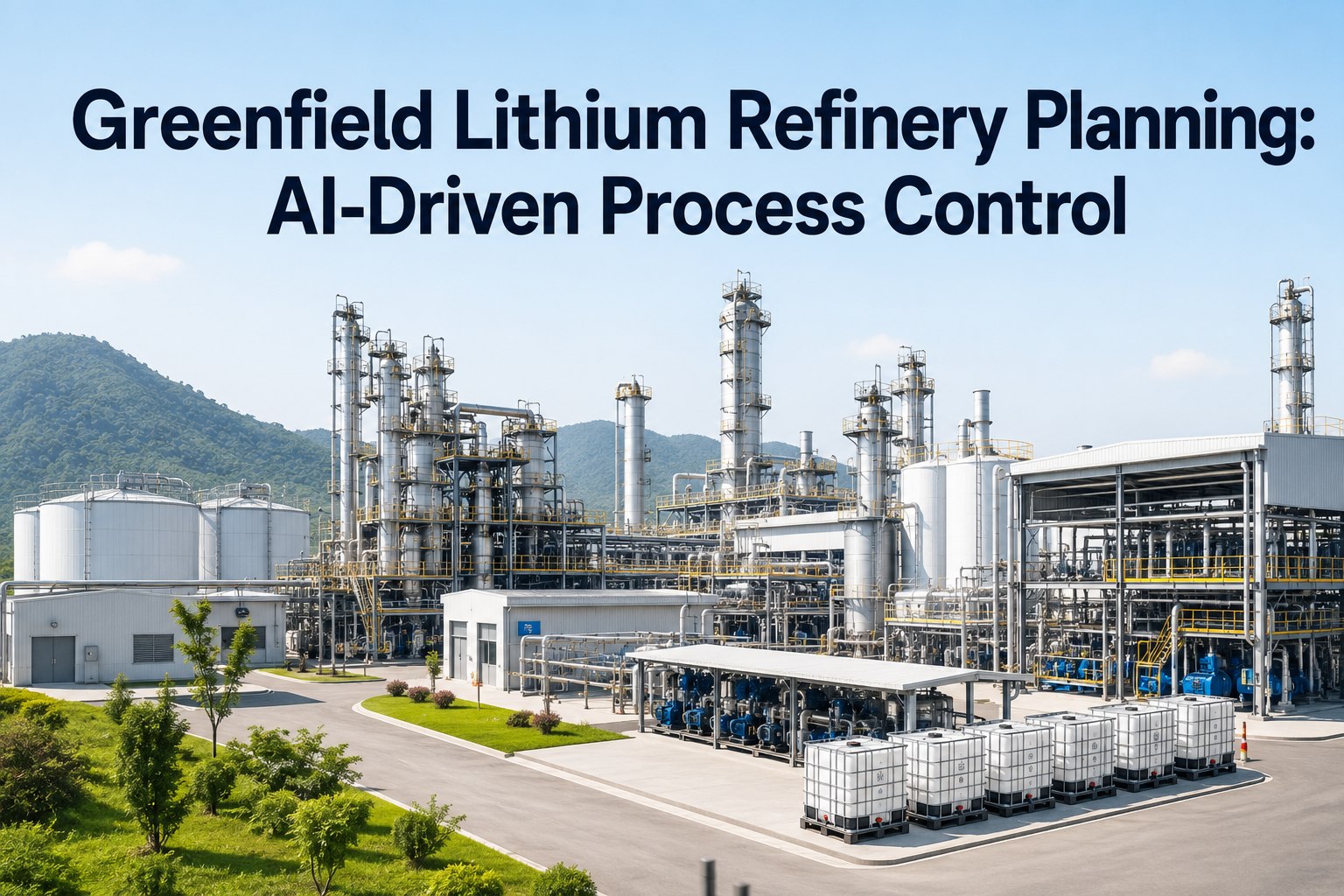
A lithium refinery is a chemistry plant where parts per million decide everything. Get the temperature, the pH, and the reagent dosing right across a dozen interacting stages, and crushed rock becomes a powder pure enough to sit inside an EV battery cell. Drift a little, and the same batch is reject — too much iron, too much magnesium, the wrong crystal size. With refining capacity, not mining, now the real bottleneck in the battery supply chain, the plants that win are the ones that hold spec automatically. A greenfield refinery can design that control in from the flowsheet. This guide covers how to plan one around AI-driven process control.
Planning a new lithium refinery? Book a 30-minute process-control consultation to design AI control into the flowsheet from day one.
Every Stage Climbs Toward 99.5% Purity
Refining is purification: at each stage impurities drop out and the product climbs toward battery-grade spec. The closer to the top, the tighter the control has to be.
Why Lithium Refining Is a Game of Parts Per Million
The resource is not the constraint — the world has plenty of spodumene and brine. The constraint is the industrial machinery that turns crushed rock into a chemical compound pure enough for a battery cell. Battery-grade lithium means 99.5% purity or better with trace impurities held to single-digit parts per million, produced continuously, batch after batch, at gigafactory scale. Because refining, not mining, is the bottleneck, the plants that hold spec automatically are the ones that fill the contracts. If you want it scoped for your flowsheet, you can map it with a process specialist.
purity that defines battery-grade lithium, with ppm trace limits
growth in refining capacity the industry needs this decade
of global lithium comes from hard-rock spodumene
Carbonate or Hydroxide: The Product Decision
A refinery's purified lithium stream can become either of two battery chemicals, and the choice shapes the whole back end of the plant. Plan it against the cathode market you intend to supply.
Lithium Carbonate
Li₂CO₃Made by: reacting purified lithium with soda ash (Na₂CO₃) and crystallizing.
Used in: LFP (lithium iron phosphate) cathodes — the fast-growing, cost-led chemistry.
Note: the more established route, with a simpler crystallization step.
Lithium Hydroxide
LiOHMade by: causticizing with lime (Ca(OH)₂) or converting from carbonate, then crystallizing.
Used in: high-nickel NMC cathodes for higher-energy EV batteries.
Note: moisture- and CO₂-sensitive, so handling and crystallization control are tighter.
Choosing your product mix and flowsheet? Book a planning workshop and we will map control strategy to your carbonate or hydroxide route.
Inside the Refinery: The Process Train
A spodumene refinery is a sequence of tightly coupled chemical stages, each feeding the next. Every stage has a few variables that decide yield and purity — and those are exactly the variables AI-driven control holds steady.
Calcination
Roasting at about 1,050°C converts hard α-spodumene to reactive β-spodumene.
AI controls: kiln temperature & residence timeAcid Roast
A sulfuric-acid bake near 250°C turns lithium into water-soluble lithium sulfate.
AI controls: acid dosing & roast temperatureWater Leach
Water dissolves the lithium sulfate into a pregnant leach solution.
AI controls: leach concentration & recoveryPurification
Precipitation and ion exchange strip out iron, aluminum, magnesium, and calcium.
AI controls: pH & reagent dosingConversion
Soda ash precipitates carbonate, or lime causticizes to hydroxide.
AI controls: stoichiometry & reaction completenessCrystallize & Dry
Controlled crystallization, washing, and drying yield the battery-grade product.
AI controls: particle size & impurity carryoverWant this train modeled with control loops for your feed? Book a process-control review and we will map AI control to every stage.
Where AI-Driven Process Control Pays Off
A refinery has too many interacting variables for fixed setpoints to hold spec through feed swings and equipment drift. This is where AI control, predictive maintenance, and a connected MES turn a fragile process into a consistent one.
Real-Time Process Optimization
Soft sensors and advanced control stabilize temperature, pH, and dosing across coupled stages — holding spec and lifting recovery as the feed varies.
Impurity & Quality Prediction
Models flag impurity breakthrough and crystallization drift before an off-spec lot is made, protecting purity and avoiding costly rework.
Predictive Maintenance
Protect kilns, pumps, agitators, centrifuges, and filters in an abrasive, corrosive plant where unplanned stops break process stability.
MES & Batch Traceability
Lot genealogy and spec compliance for every batch, feeding the provenance and quality records the EV battery supply chain now demands.
Refine to Spec, Every Batch, Automatically
iFactory brings AI process control, predictive maintenance, and batch traceability onto one platform for lithium refining — stabilizing the variables that decide purity and recovery, and protecting the equipment that keeps the line running.
Expert Perspective
What surprises people new to lithium is how little margin there is between a battery-grade product and a reject. The chemistry recovers most of the lithium, but the last stretch — driving impurities down to single-digit parts per million and crystallizing to a tight particle size — is where the value is won or lost, and it is brutally sensitive to small drifts in feed, temperature, and dosing. Fixed setpoints cannot ride that out. On a greenfield refinery you can design the control system in alongside the flowsheet, so the plant predicts an off-spec lot and corrects before it makes one. That is the difference between a refinery that fills gigafactory contracts and one that reworks batches.
— Process Industries Practice, iFactory Engineering Team
lithium recovery the acid route can reach — every point is margin
trace-impurity limits that separate battery-grade from reject
sodium-sulfate-bearing slag per tonne of product to manage
The Bottom Line
A lithium refinery makes its money in the last few parts per million, and it makes them across a chain of coupled chemical stages that no fixed setpoint can hold through real-world feed and equipment drift. Plan the product route around your cathode market, design the process train for recovery, and build AI-driven control, predictive maintenance, and batch traceability in from the flowsheet. A greenfield refinery is the rare chance to do all of it deliberately — and in a market where refining capacity is the bottleneck, the plant that holds 99.5% automatically is the plant that wins the contracts.
Plan a Refinery That Holds Spec From Day One
From product-route planning and process-train design to AI control, predictive maintenance, and battery-supply-chain traceability, iFactory helps greenfield lithium teams build a refinery that is consistent, efficient, and on-spec from the first batch.
Frequently Asked Questions
What is the difference between lithium carbonate and lithium hydroxide?
Both are battery chemicals refined from the same purified lithium stream, but they serve different cathodes. Lithium carbonate is made by reacting purified lithium with soda ash and is widely used in LFP batteries. Lithium hydroxide is made by causticizing with lime or converting from carbonate and is preferred for high-nickel NMC cathodes used in higher-energy EV batteries. Hydroxide is more sensitive to moisture and carbon dioxide, so its handling and crystallization control are tighter.
What does battery-grade lithium purity mean?
Battery-grade lithium carbonate or hydroxide is generally defined as 99.5% purity or higher, with individual trace contaminants such as iron, sodium, magnesium, and calcium held to single-digit parts per million. These limits exist because even small impurities degrade battery performance and safety, which is why refining devotes so much effort to the final purification and crystallization stages.
How is lithium refined from spodumene?
The concentrate is calcined at around 1,050°C to convert α-spodumene to the reactive β phase, then acid-roasted near 250°C to make water-soluble lithium sulfate. Water leaching dissolves the lithium, after which purification removes iron, aluminum, magnesium, and calcium. The purified solution is converted to carbonate with soda ash or to hydroxide with lime, then crystallized, washed, and dried into a battery-grade product.
Where does AI-driven process control add the most value?
In the stages with many interacting variables and tight tolerances — purification and crystallization above all. AI control stabilizes temperature, pH, and reagent dosing as the feed varies, predicts impurity breakthrough and particle-size drift before an off-spec lot is made, and optimizes recovery. Combined with predictive maintenance and a connected MES, it turns a process that is sensitive to drift into one that holds spec consistently.
How does iFactory help plan a greenfield lithium refinery?
iFactory's greenfield advisory helps design the process-control strategy alongside the flowsheet, then delivers AI process control, predictive maintenance, and batch traceability on one platform so the refinery holds purity and recovery from the first run. The same data supports the provenance records the battery supply chain requires. You can book a consultation to plan it for your project.