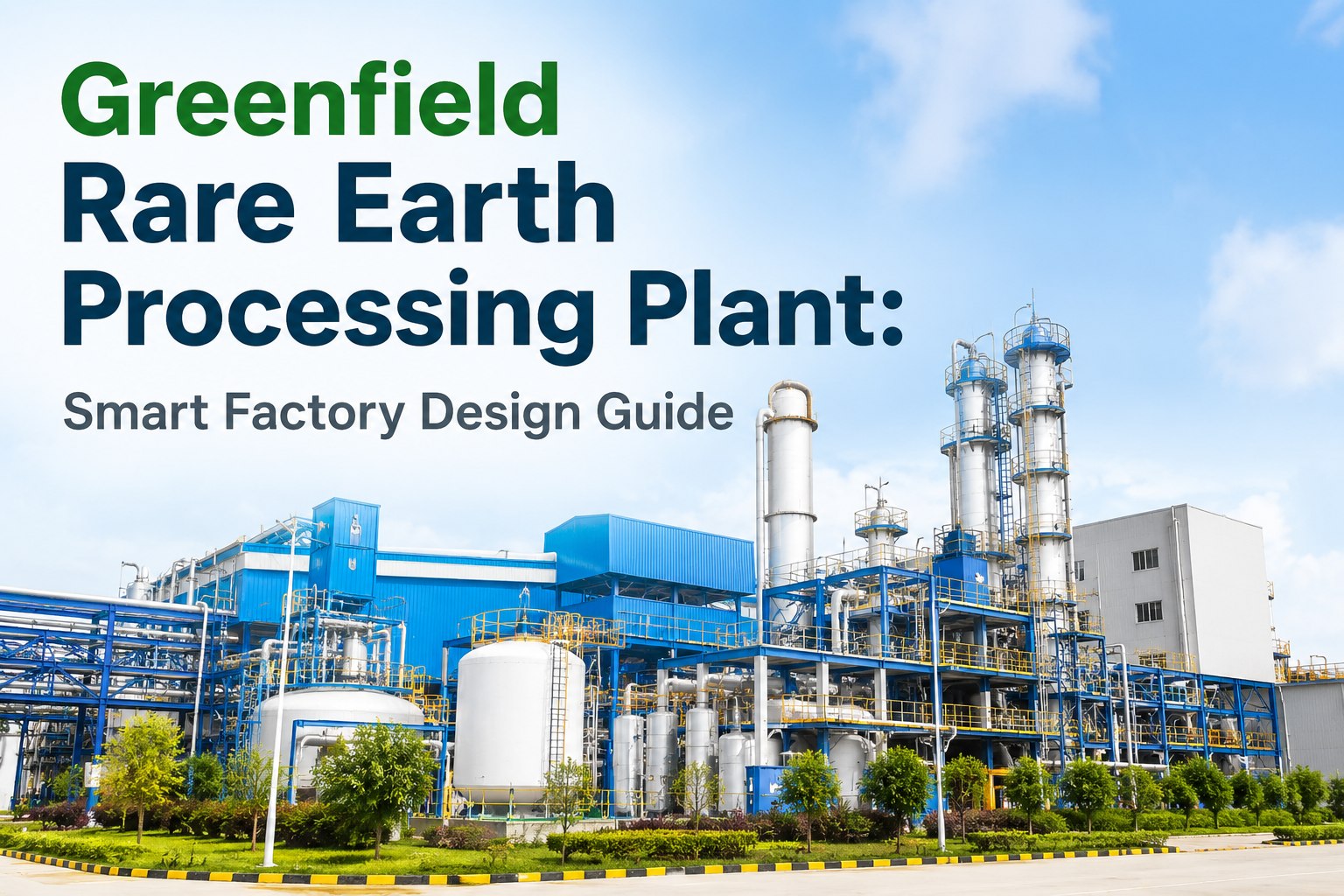
Rare earths aren't actually rare — cerium is about as common as copper. What's rare is the ability to pull fifteen near-identical elements apart from one another, a feat that takes hundreds of chemical stages and decades of accumulated know-how. Right now one country runs most of that capacity, and recent export controls on the heavy rare earths have made the rest of the world acutely aware of it. Building a greenfield separation plant in the West is a strategic act as much as an industrial one — and whether it succeeds turns on process control, predictive maintenance, and an environmental record clean enough to earn a permit. This guide covers how to design one.
Planning a rare earth separation plant? Book a 30-minute design consultation to build process control and ESG monitoring in from the flowsheet.
Pulling Apart Elements That Behave Alike
Every lanthanide partitions just slightly differently between an organic solvent and water. Multiply that tiny difference across hundreds of mixer-settler stages, and a jumbled feed becomes single-element oxides at 99.9% purity.
Why Rare Earth Separation Is the Hardest Part
The ore is not the constraint, and neither is the mining. The constraint is separation — fifteen lanthanides plus yttrium that behave so alike that telling them apart chemically takes a counter-current solvent-extraction cascade running for weeks. China spent four decades building that capability; the West is trying to rebuild it in less than one. Because the chokepoint is separation, not mining, the plants that control their cascades and clear their permits are the ones that actually produce. If you want it scoped for your feedstock, you can map it with a critical-minerals specialist.
of light rare earth separation capacity sits in one country — up to 98% for heavy
mixer-settler stages an SX circuit needs to isolate the elements
purity that individual rare earth oxides must reach for high-tech buyers
From Ore to Oxide: The Processing Flow
A rare earth plant is a hydrometallurgical sequence that turns a hardy mineral concentrate into purified oxides. Every step feeds the next, and the separation stage in the middle is where most of the cost, time, and difficulty lives.
Beneficiation
Flotation, gravity, and magnetic methods upgrade ore into a mineral concentrate — bastnäsite, monazite, or xenotime.
Cracking
An acid bake or caustic decomposition, often with high-temperature calcination, breaks the hardy mineral matrix into tractable oxides.
Leaching
Concentrated acid dissolves the rare earths into a pregnant leach solution — along with impurities that must come out next.
Impurity & Thorium Removal
Iron, aluminum, and radioactive thorium are stripped out before separation, both to protect the circuit and to handle the radioactivity safely.
Solvent Extraction Separation
The counter-current SX cascade separates the mixed stream into individual elements — the longest, hardest, most control-sensitive stage of all.
Precipitation & Calcination
Each separated element is precipitated and calcined into a high-purity rare earth oxide, ready for metal and magnet makers.
Want this flow mapped with control loops for your ore? Book a process design review and we will model the separation circuit around your feedstock.
Designing the Smart Rare Earth Plant
A separation cascade has slow dynamics and hundreds of interacting stages, which makes it punishing to run on fixed setpoints. This is where AI control, predictive maintenance, online assay, and a connected MES turn a fragile circuit into a stable one.
AI Process Control
Stabilize the cascade profile, pH, and reagent dosing across the whole circuit — holding purity and lifting recovery as the feed shifts.
Predictive Maintenance
Protect mixer-settlers, pumps, centrifuges, and calciners in a corrosive plant where one stall ripples through the entire cascade.
MES & Batch Traceability
Lot genealogy and spec records for every oxide, feeding the provenance the magnet supply chain increasingly demands.
Online Assay & Soft Sensors
Real-time composition data closes the loop on a separation that would otherwise take weeks to read from lab results alone.
Run the Cascade With Eyes Open
iFactory brings AI process control, predictive maintenance, online assay, and batch traceability onto one platform for rare earth separation — stabilizing the circuit that decides your purity and recovery, and protecting the equipment that keeps it running.
ESG and Traceability: The License to Operate
Rare earth processing is the dirtiest stretch of the supply chain, and in the West it is the environmental record — not the chemistry — that most often decides whether a plant gets built. Monazite carries radioactive thorium, the single biggest permitting barrier, on top of acid and alkali waste, wastewater, and heavy solvent use. A modern greenfield plant has to manage all of it and prove it, continuously.
Radioactive Residue Management
Safely capture, store, and document thorium and other naturally occurring radioactive material from the feed.
Wastewater & Emissions Control
Neutralize and continuously monitor acid and alkali streams, process water, and air emissions against permit limits.
Reagent & Solvent Recycling
Recover extractants and acids to cut both waste volume and operating cost, a core lever of green-chemistry design.
Provenance & ESG Traceability
Prove clean, ethical sourcing oxide by oxide for magnet buyers and regulators who now ask for it.
Need ESG and emissions monitoring designed in, not bolted on? Book a compliance-by-design session and leave with a monitoring plan for your project.
Expert Perspective
People assume rare earths are a mining story, but the value and the difficulty both sit in the separation circuit. A solvent-extraction cascade has hundreds of stages that interact, slow dynamics measured in days, and a feed that drifts — so a small upset early in the train shows up as off-spec oxide weeks later, after you have already spent the reagents and the energy. That is exactly the kind of problem that rewards continuous control and online assay over manual setpoints and lab lag. On a greenfield plant you can design the control system and the ESG monitoring in together, alongside the flowsheet, so the circuit holds purity and the plant can actually prove it is clean enough to keep its permit.
— Critical Minerals Practice, iFactory Engineering Team
higher production cost outside China today — the gap to close
the magnet-critical rare earths driving most of the demand
added Western permitting time, much of it over radioactive residues
The Bottom Line
A rare earth plant lives or dies on two things a greenfield design can get right from the start: a separation circuit that holds purity across hundreds of coupled stages, and an environmental record clean enough to earn and keep a permit. Plan the flow around your feedstock, build AI process control and online assay into the cascade, protect the equipment with predictive maintenance, and design ESG monitoring and traceability in alongside the chemistry. In a market where separation capacity — not ore — is the strategic chokepoint, the plant that runs its cascade with open eyes and proves it is clean is the one that gets built and stays built.
Design a Rare Earth Plant That Holds Spec and Its Permit
From separation-circuit design and AI process control to predictive maintenance, online assay, and ESG traceability, iFactory helps greenfield critical-minerals teams build a plant that is consistent, compliant, and clean from the first batch.
Frequently Asked Questions
Why are rare earths so hard to separate?
The lanthanides have nearly identical chemical behavior, so no single reaction cleanly isolates one from the next. Producers exploit the tiny differences in how each element partitions between an organic solvent and water, then multiply that small effect across a long counter-current cascade. Reaching commercial purity can take hundreds to over a thousand mixer-settler stages, which is why separation, not mining, is the true bottleneck.
What is solvent extraction in rare earth processing?
Solvent extraction is a liquid-liquid separation in which a mixed rare earth solution is contacted with an immiscible organic extractant in a series of mixer-settler stages. Each stage extracts, scrubs, or strips elements based on their slightly different affinities, and stages are linked counter-currently so purity builds along the cascade. It has been the dominant rare earth separation method since the 1960s because it scales and is cost-effective, despite needing many stages.
Why is thorium a problem in rare earth plants?
Many rare earth ores, monazite especially, contain thorium, a naturally occurring radioactive element that dissolves alongside the rare earths during leaching. It must be removed before separation and then stored and documented as radioactive residue. Managing that material is widely considered the single largest regulatory and permitting barrier to building rare earth processing in Western countries.
Which rare earths matter most for magnets?
Neodymium and praseodymium are the backbone of NdFeB permanent magnets used in EV motors, wind turbines, and defense systems, while dysprosium and terbium are added in smaller amounts to keep those magnets strong at high temperatures. These four are the most valuable targets of a separation plant, and monazite feedstocks tend to concentrate neodymium and praseodymium at relatively high grades.
How does iFactory help design a rare earth plant?
iFactory's greenfield advisory helps design the separation circuit and its control strategy alongside the flowsheet, then delivers AI process control, predictive maintenance, online assay, MES traceability, and ESG monitoring on one platform. That keeps the cascade on spec, protects the equipment, and produces the emissions and provenance records a Western plant needs. You can book a consultation to plan it for your project.