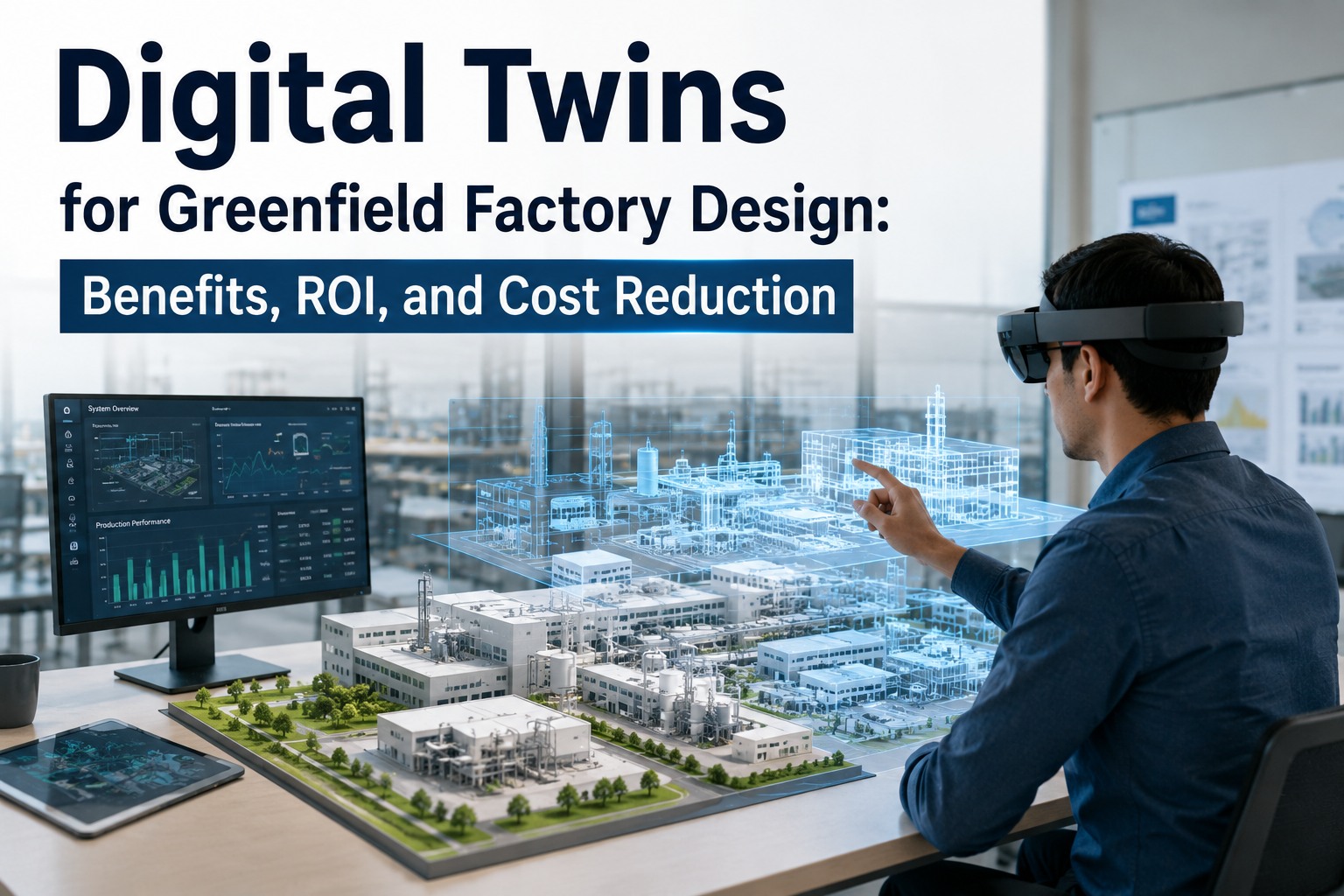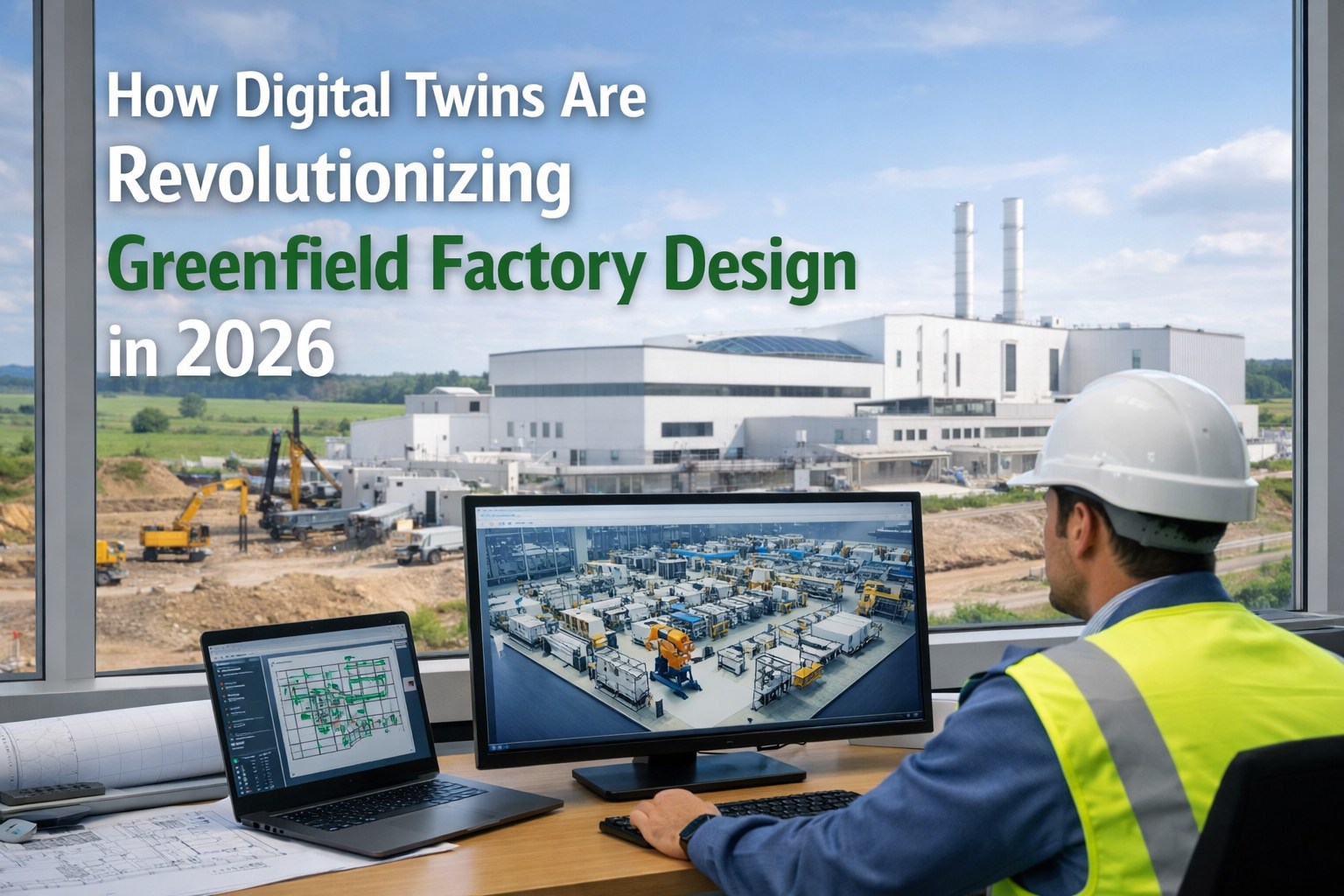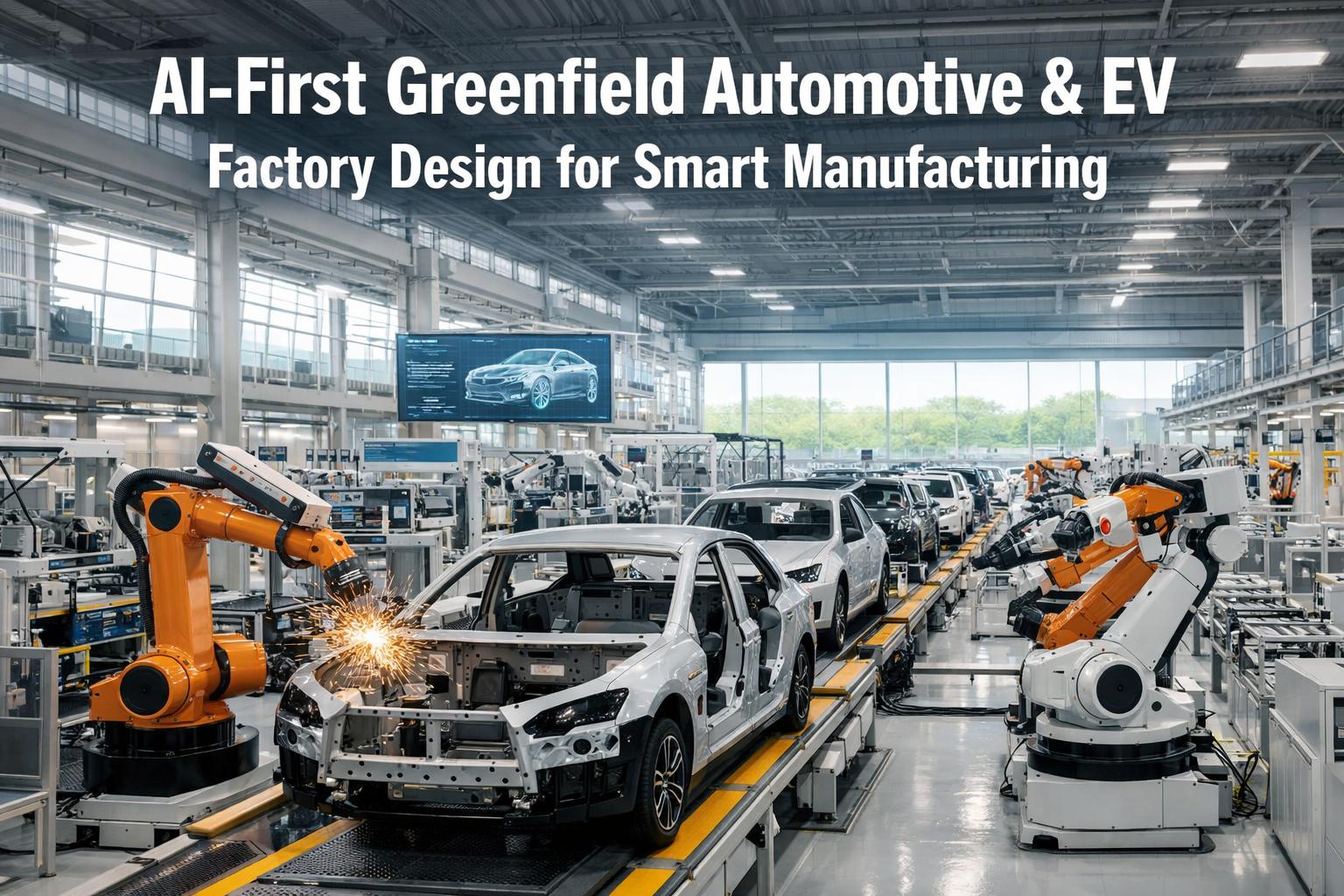
Automotive assembly line downtime costs $2.3 million per hour — that's $600 every second a line stands still. With robotics investment hitting $7.3 billion in just the first half of 2025, BMW, Mercedes-Benz, and Tesla piloting humanoid robots on their factory floors, and EV battery gigafactories reshaping how vehicles are built from the ground up, there has never been a more complex — or consequential — time to design an automotive factory. Get the automation architecture wrong, and you're building a billion-dollar facility that can't flex between ICE and EV production, can't achieve zero-defect targets, and hemorrhages money on unplanned downtime. This guide shows how AI-first greenfield design — with robotics, digital twins, predictive maintenance, and iFactory at the center — creates automotive and EV factories that produce better vehicles at lower cost from day one.
Why Automotive Greenfield Design Is Harder Than Ever — And Why AI Is the Answer
Automotive manufacturing is at an inflection point. OEMs must simultaneously build vehicles with combustion engines, hybrids, and pure EVs — often on the same production line. Battery assembly demands cleanroom-level precision. Welding, painting, and final assembly require hundreds of robots working in coordinated sequences where a single failure cascades across the entire line. And the skilled workforce to program, maintain, and optimize these systems is shrinking every year — GM reports that programming a single industrial robot takes over 100 hours of specialized engineering time.
AI-first greenfield design solves this by embedding intelligence into every layer of the factory: digital twins that simulate production before construction begins, AI-driven robotics that learn rather than get programmed, computer vision that catches defects invisible to the human eye, and predictive maintenance that prevents the $2.3M/hour downtime events that destroy automotive profitability. iFactory ties it all together — connecting your robots, sensors, and maintenance teams into one AI-powered CMMS platform.
Designing a New Automotive or EV Plant?
In 30 minutes, we'll show you how iFactory integrates predictive maintenance, robot health monitoring, and quality tracking into a single platform — configured before your first vehicle rolls off the line.
The 6 Automation Zones Every Greenfield Automotive Plant Needs
A modern automotive factory isn't one production line — it's six interconnected automation zones, each with distinct equipment, robotics, and maintenance demands. iFactory manages all six from a single platform:
Body Shop & Welding
Hundreds of welding robots executing thousands of spot welds per vehicle body. AI vision monitors weld quality in real time. iFactory tracks robot health, tip wear, and servo performance to prevent weld-quality drift before it creates downstream rework.
Paint Shop
The most environmentally controlled zone in the plant. Temperature, humidity, and particle contamination must stay within tight tolerances. iFactory monitors booth conditions, robot applicator health, and oven performance — preventing the paint defects that are the #1 cause of automotive quality escapes.
Battery Assembly (EV)
EV battery module and pack assembly demands cleanroom-level precision, thermal management, and torque-critical fastening. iFactory tracks cell-to-pack quality, formation cycling equipment health, and thermal system performance — protecting battery investments worth $10,000–$20,000 per vehicle.
General Assembly
Where hundreds of components come together — trim, seats, glass, wiring harnesses, powertrain. Cobots assist human operators. iFactory manages conveyor health, torque tool calibration, and AGV/AMR fleet maintenance to keep the line moving at target takt time.
Quality & Testing
AI-powered computer vision, laser measurement, and functional testing verify every vehicle against zero-defect targets. iFactory integrates test results with equipment maintenance data — so when a quality trend appears, the root cause traces back to the specific robot, tool, or process parameter that shifted.
Logistics & Material Flow
AGVs, AMRs, and automated kitting systems deliver parts to the line just-in-time. Fleet orchestration platforms manage routing, charging, and collision avoidance. iFactory tracks fleet health, battery degradation, and navigation system performance — preventing the logistics failures that starve production lines.
Every one of these zones feeds data into iFactory. Book a demo to see how one CMMS platform manages predictive maintenance across your entire automotive plant.
The iFactory Technology Stack for Automotive & EV Manufacturing
Automotive factories generate more data than any other manufacturing environment. iFactory is built to ingest, analyze, and act on it — connecting every robot, sensor, and work order into unified intelligence:
Why This Matters: An automotive plant with 1,000+ robots and thousands of sensors generates terabytes of data daily. Without a platform like iFactory unifying this data into predictive maintenance actions and automated work orders, your maintenance team drowns in alerts while critical failures slip through. iFactory turns data into prevented downtime. See the platform in action →
How iFactory Deploys — From Digital Twin to Full Production
iFactory integrates into your greenfield automotive timeline in parallel with construction and equipment installation — so predictive maintenance is live the moment your first robot powers on:
iFactory Designs Maintenance Intelligence Into the Plant
During facility design, iFactory maps every robot, conveyor, AGV, paint booth, and battery assembly station into a unified asset hierarchy. Sensor placements are planned. Digital twin simulation validates maintenance access paths and spare parts strategies before construction begins.
iFactory Activates as Robots and Lines Go Live
As robots are installed and commissioned, sensors are embedded and connected to iFactory. AI models begin pre-training on digital twin data. Work order automation, alert thresholds, and escalation rules are configured per zone — body shop, paint, battery, assembly, quality, and logistics.
iFactory Prevents Failures From First Vehicle
During pre-production runs, AI models learn real equipment behavior — refining predictions for welding robots, paint booth conditions, battery assembly stations, and conveyor systems. iFactory catches the commissioning-phase failures that typically plague new automotive plants during their first months of operation.
iFactory Optimizes Every Zone Continuously
AI models continuously improve with every shift of production data. Prescriptive work orders tell technicians exactly what to fix, when, with which parts. OEE optimization identifies bottleneck equipment across zones. Cross-shift and cross-plant benchmarking drives continuous improvement across your entire automotive operation.
See How iFactory Manages an Entire Automotive Plant
30 minutes. Zero obligation. We'll walk you through live dashboards showing robot health monitoring, OEE tracking, and predictive maintenance across body shop, paint, battery, assembly, and logistics — customized to your plant design.
What iFactory Delivers Per Automation Zone
Robot Health & Weld Quality
Servo current, tip wear, and weld quality trending per robot — catching degradation before it creates rework. One prevented body shop stoppage saves more than a full year of iFactory cost.
Booth & Applicator Monitoring
Temperature, humidity, particle count, and applicator health tracked continuously. iFactory correlates paint defect trends to equipment condition — turning the #1 quality escape zone into a zero-defect operation.
Formation & Thermal Systems
Battery formation cycling equipment, thermal management systems, and torque-critical fastening stations monitored to protect battery pack quality — where a single defect can mean a $10K–$20K scrap event.
Line Health & Fleet Management
Conveyor systems, torque tools, cobots, and AGV/AMR fleet health — all managed from iFactory. Predictive maintenance keeps the final assembly line moving at target takt time, every shift.
Who Needs AI-First Automotive Greenfield Design?
Purpose-built EV factories with dedicated battery assembly lines, new paint processes, and flexible platforms for multiple EV models. iFactory manages the unique maintenance demands of battery formation, thermal systems, and high-voltage equipment that legacy CMMS platforms weren't designed for.
Suppliers building new facilities for battery modules, e-axles, power electronics, and EV-specific components. High-precision equipment demands predictive maintenance from day one — iFactory prevents the quality escapes that lose supplier contracts and destroy margin.
Companies building their first production facility need to get it right the first time — there's no existing plant to fall back on. iFactory provides enterprise-grade maintenance intelligence without the enterprise-grade implementation timeline, getting startups to production-ready faster.
Cell manufacturing, module assembly, and pack integration facilities where formation cycling equipment, dry room conditions, and thermal management systems must operate within extremely tight tolerances — and a single equipment failure can scrap millions in battery inventory.
Build the Factory That Builds the Future
The automotive industry is building more new factories right now than at any point in its history — driven by the EV transition, reshoring incentives, and the need for flexible multi-platform production. The factories that win will be the ones designed with AI-first automation: digital twins that validate before construction, predictive maintenance that prevents $2.3M/hour downtime, and a single CMMS platform that connects every robot, sensor, and work order across all six automation zones. iFactory is that platform — purpose-built for the complexity, precision, and speed that automotive and EV manufacturing demands.
Your Next Vehicle Starts With Your Next Factory
30 minutes. Zero obligation. We'll show you how iFactory manages predictive maintenance across body shop, paint, battery assembly, general assembly, quality, and logistics — all from one platform. Custom demo. Your plant design.