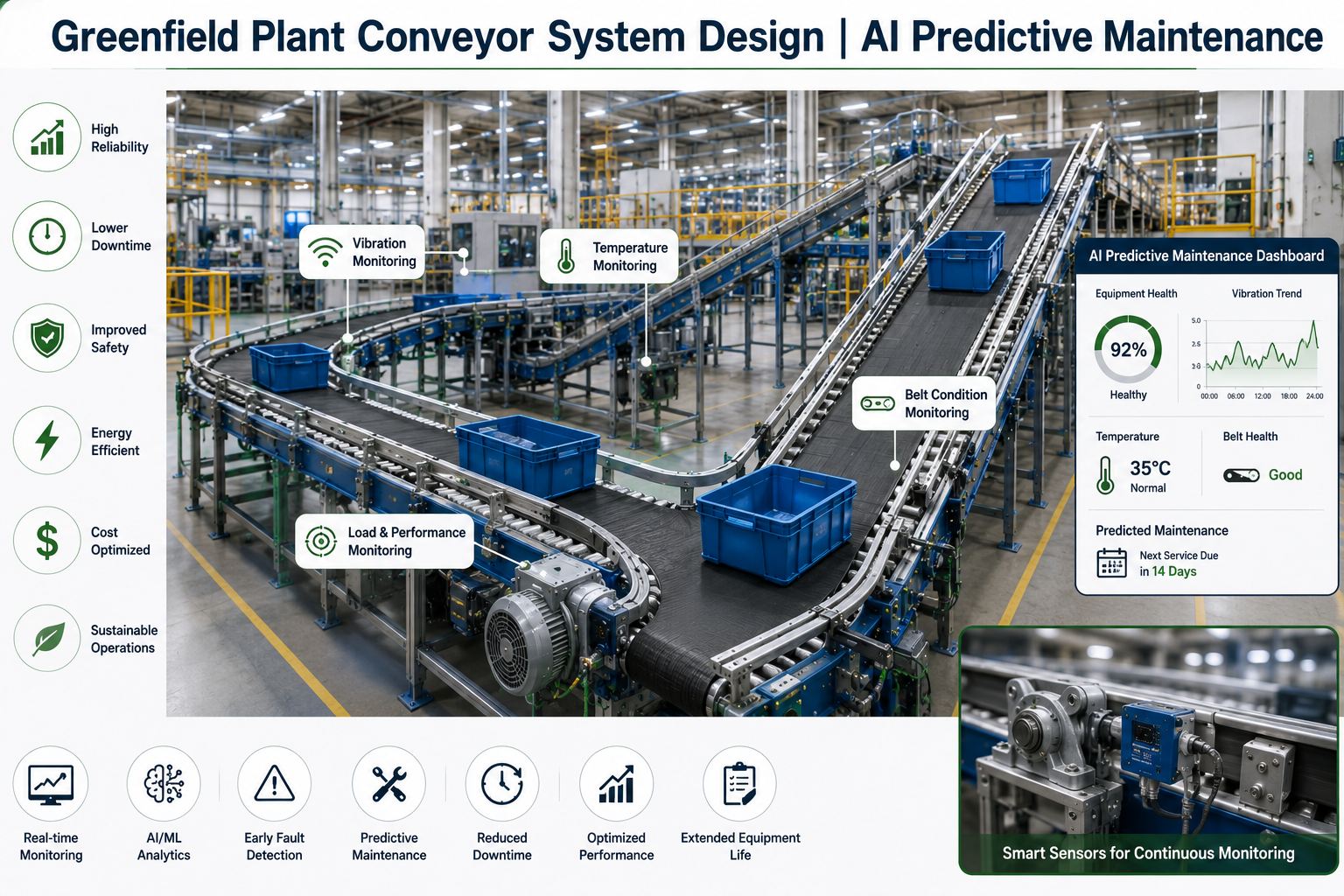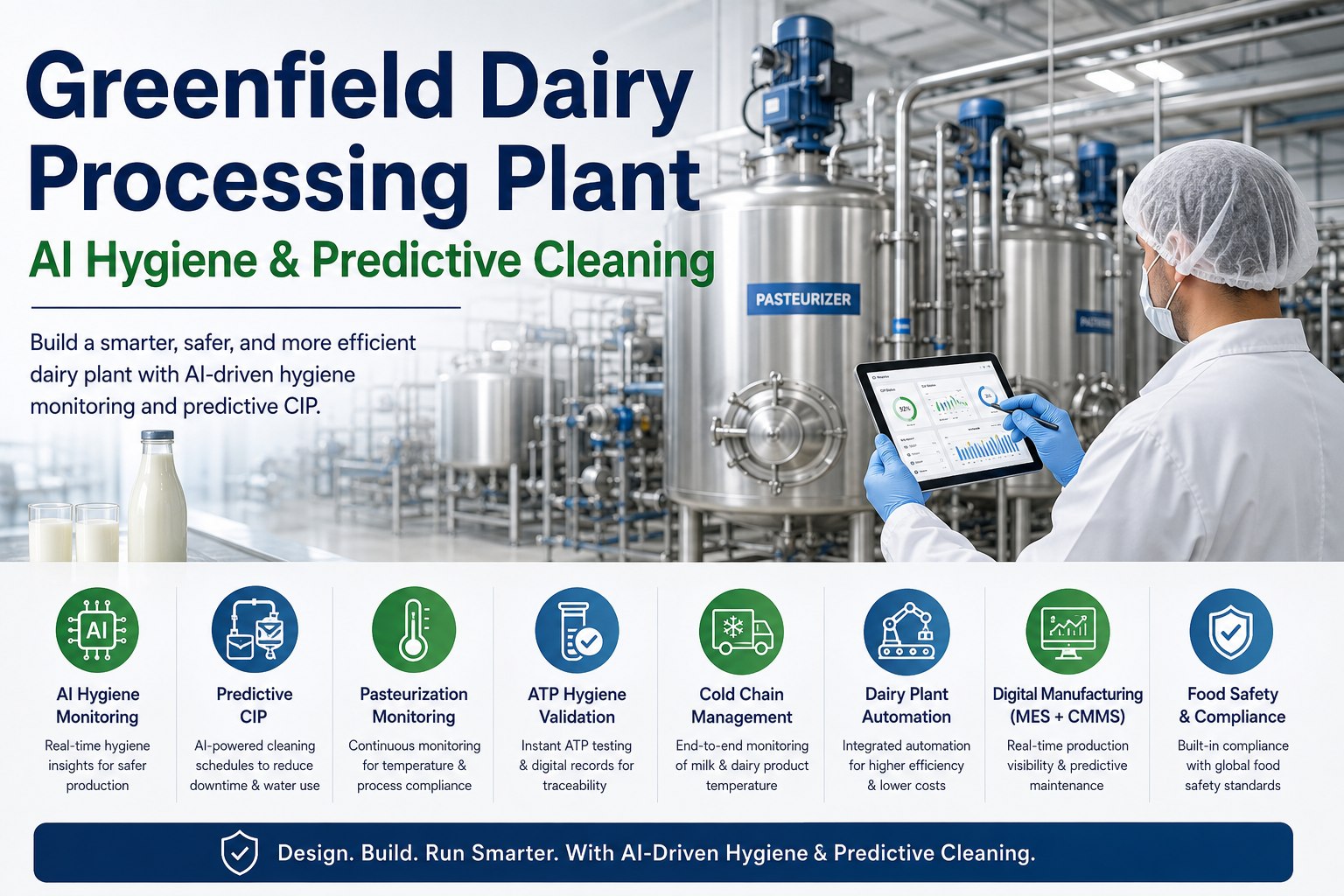
In a dairy plant, cleaning is not the downtime between production — it is production. The line that pasteurizes milk in the afternoon has to be provably clean before it runs again, and the cleaning system is the single biggest consumer of water and one of the largest users of energy in the whole facility. Run that cleaning on a fixed timer and you pour water, chemicals, and hours down the drain every cycle. A greenfield dairy plant can do better: instrument the line so it cleans until sensors confirm it is clean, then stops. This guide covers how to build AI hygiene and predictive cleaning into a new dairy plant from day one.
Building a new dairy plant? Book a 30-minute dairy digital consultation to design predictive CIP and AI hygiene into the line from day one.
Stop Cleaning When It's Clean, Not When the Timer Ends
Turbidity, conductivity, temperature, and ATP sensors confirm each stage is done, so the cycle stops early — cutting the water, chemicals, and energy of the plant's single biggest utility user, and handing time back to production.
Why Dairy Plants Are Built Different
Dairy lives or dies on hygiene. A missed pathogen becomes a recall, a brand crisis, and in the worst case a public-health event, so cleaning and pasteurization are not support functions — they are the product. That same hygiene burden is also the plant's biggest resource cost: cleaning alone accounts for more than a quarter of all water used and a large share of the energy. That makes cleaning the highest-leverage system to get right, and a greenfield build is the moment to do it. If you want it scoped against your process, you can map it with a dairy specialist.
of a dairy plant's water is used by cleaning — its single biggest use
HTST pasteurization that must be hit on every second of every run
residue sensitivity AI hygiene systems use to catch contamination
Predictive CIP: Cleaning That Knows When It's Done
A clean-in-place cycle moves through six stages. Predictive CIP sets each stage's endpoint from live sensor readings instead of a fixed timer — so the cycle is as short as cleanliness allows, and never shorter.
Pre-Rinse
A roughly 36°C flush removes visible soil and melts butterfat before it sets.
Monitors: rinse turbidityCaustic Wash
A 55–66°C alkaline solution breaks down proteins and emulsifies fats.
Monitors: conductivity, temperatureIntermediate Rinse
Clears the caustic solution from the circuit before the acid stage.
Monitors: conductivity dropAcid Wash
Removes mineral scale and protein deposits the caustic leaves behind.
Monitors: pH, conductivityFinal Rinse
Flushes the line back to clean water, clearing all cleaning chemistry.
Monitors: turbidity, conductivitySanitize
A final microbial kill leaves the line production-ready and verified.
Monitors: temperature, ATP resultWant predictive CIP modeled for your circuits? Book a CIP optimization workshop and we will map sensor-driven endpoints to every cleaning loop.
Beyond Cleaning: Hygiene, Pasteurization, and Cold Chain
Predictive CIP is the centerpiece, but a digital dairy plant protects food safety across the whole process. Three more capabilities round out the build.
AI Hygiene & ATP Validation
- Detects biological residue down to about 1 RLU
- Automatic re-clean trigger on any failed line
- Traceable, audit-ready records for every cycle
Pasteurization Monitoring
- Verifies HTST time and temperature continuously
- Automatic flow diversion on any under-temperature
- Batch-level thermal records for compliance
Cold Chain Management
- Continuous temperature monitoring through to dispatch
- Excursion alerts before product is at risk
- Shelf-life and compliance traceability
The Greenfield Dairy Digital Roadmap
Build the hygiene and monitoring layer in parallel with the process line, so cleaning and food-safety intelligence are live the day the first milk runs.
-
1
Design hygienic and instrument from commissioning
Specify seamless, 3-A-aligned equipment and build turbidity, conductivity, temperature, and flow sensors into every CIP circuit during construction.
-
2
Connect one platform
Feed CIP, pasteurizer, and cold-chain data into a single MES and CMMS so cleaning, quality, and maintenance share one record.
-
3
Configure predictive CIP
Set sensor-driven endpoints for each circuit and let the system optimize cycle time, water, and chemical use per clean.
-
4
Stand up hygiene and safety workflows
Wire ATP validation, pasteurization verification with auto-diversion, cold-chain alerts, and audit-ready records.
-
5
Integrate dashboards and go live
Unify dashboards, automatic re-clean logic, and compliance records so the plant runs clean and traceable from the first batch.
Ready to sequence this against your build? Book an implementation session and leave with a phased digital plan for your dairy project team.
Clean Smarter, Prove It Every Cycle
iFactory brings predictive CIP, AI hygiene validation, pasteurization monitoring, and cold-chain tracking onto one platform — cutting the water and chemicals of every clean while leaving an audit-ready record of every cycle.
Expert Perspective
Most dairy plants clean to a timer set years ago with a comfortable safety margin baked in, which means every single cycle runs longer than it needs to — more water, more caustic, more energy, less production time. The shift that actually moves the numbers is letting the line tell you when it is clean. Turbidity in the rinse, conductivity as the caustic clears, ATP at the end — those readings define the real endpoint, and they are usually reached well before the timer. On a greenfield plant you can instrument for that from day one, and the cleaning bill, which is the largest utility cost in the building, drops without ever compromising safety.
— Food & Dairy Practice, iFactory Engineering Team
of plant water used by CIP — the biggest single lever
ATP sensitivity for residue invisible to the eye
higher yield for automated, traceable lines versus manual
The Bottom Line
A dairy plant's biggest controllable cost and its biggest food-safety risk are the same thing: cleaning. Run it on a fixed timer and you overspend on every cycle while still relying on a margin rather than proof. Build a greenfield plant with sensors on every CIP circuit, ATP validation on every line, pasteurization verified on every run, and the cold chain watched to dispatch, and you get the opposite — cleaning that is shorter, cheaper, and provably complete. Instrument it from day one, run it on one platform, and the plant starts life clean, efficient, and audit-ready.
Build a Dairy Plant That Cleans by Proof
From predictive CIP and ATP hygiene validation to pasteurization and cold-chain monitoring, iFactory helps greenfield dairy teams stand up food-safety intelligence on one platform — live with the plant, not retrofitted later.
Frequently Asked Questions
What is predictive CIP and how is it different from standard CIP?
Standard clean-in-place runs each cleaning stage for a fixed, pre-set time with a safety margin built in. Predictive CIP instead uses live sensors — turbidity, conductivity, temperature, and ATP — to detect when each stage has actually achieved its cleaning goal, then ends it. Because the real endpoint is usually reached before the timer, cycles are shorter and use less water, chemical, and energy without reducing cleanliness.
How much water and energy does CIP use in a dairy plant?
Cleaning is the largest single water user in a dairy, accounting for around 28 percent of total water consumption, and it is one of the biggest energy users because it relies on heated water and steam. Unlike pasteurization, where heat can sometimes be recovered, CIP water is typically discarded, so shortening cycles delivers direct, repeatable savings on the plant's largest utility cost.
What is ATP validation and why does it matter?
ATP testing measures adenosine triphosphate, a marker of biological material, on a surface, reported in relative light units. The more residue present, the higher the reading, and modern systems can detect down to about one RLU. It matters because it provides objective proof that a line is clean — catching contamination that visual inspection misses, and creating the audit-ready evidence food-safety regulators require.
How does AI improve dairy pasteurization and cold chain?
For pasteurization, monitoring verifies that the required time and temperature are met on every run and automatically diverts flow if a batch runs under temperature, with full thermal records kept for compliance. For the cold chain, continuous temperature monitoring from processing through storage and dispatch raises alerts before an excursion puts product at risk, protecting both shelf life and safety.
How does iFactory help build a greenfield dairy plant?
iFactory helps instrument CIP circuits and the process line during construction, then runs predictive CIP, ATP hygiene validation, pasteurization monitoring, and cold-chain tracking on one platform with audit-ready records. Designed in from day one, the system goes live with the plant. You can book a dairy consultation to plan it for your facility.