Most crane failures in industrial plants trace back to a specification decision made before the building structural drawings were issued — or worse, after they were. Wrong duty class drives structural fatigue failure in year 10 instead of year 25. Runway beam sized for static loads only buckles under impact factor. Building clear height finalised before rigging allowance was added means the first large lift cannot be completed. In a greenfield plant, crane and building are one engineering decision, not two sequential ones. Book a greenfield crane design consultation to sequence crane specification, structural design brief, and AI monitoring architecture in the correct order before any drawings are issued.
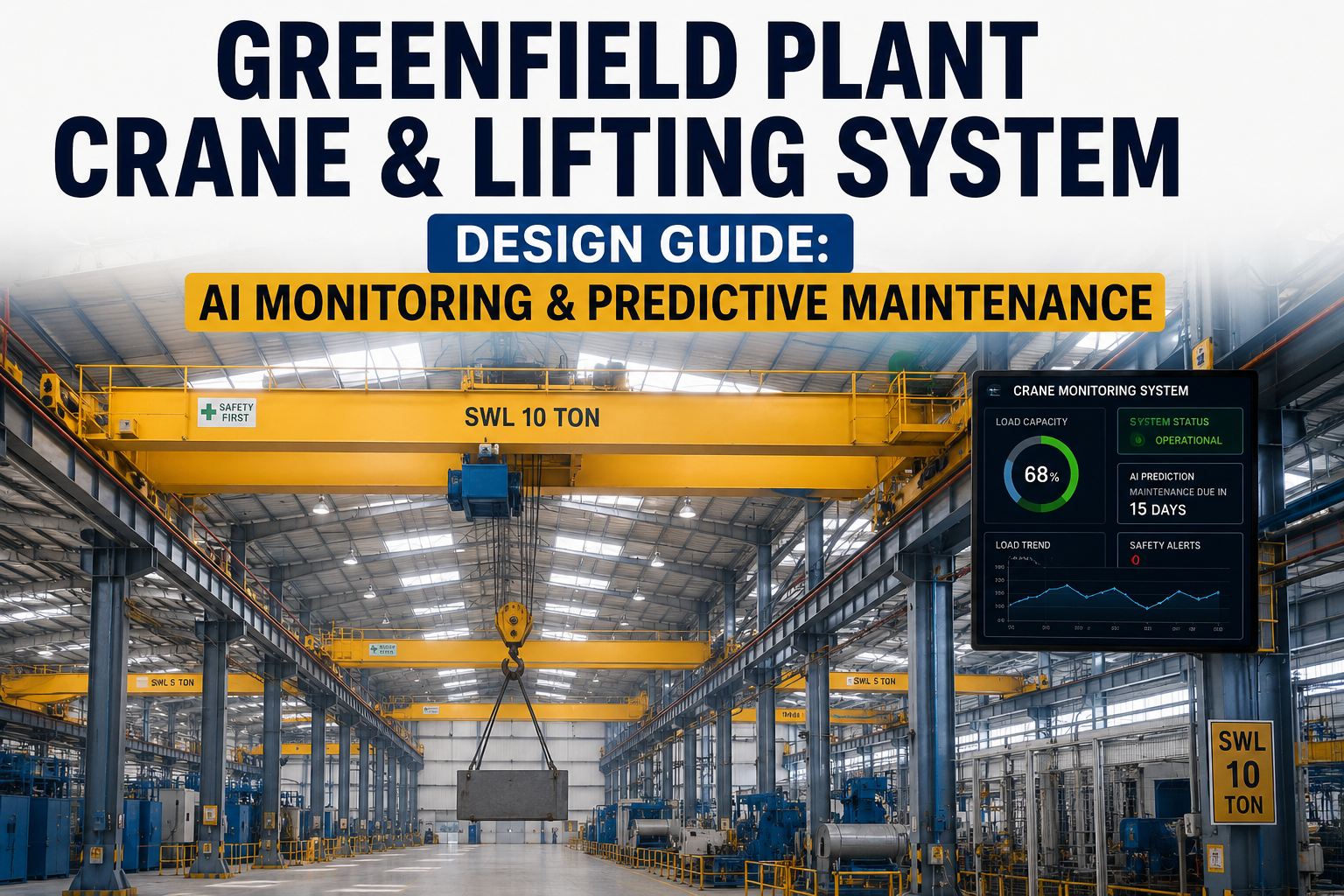
Greenfield Plant Crane & Lifting System Design — 2026 Guide
Get This Sequence Right — Or the Building Pays
Define Your Lifting Requirements
Heaviest single lift (tonnes)
Lifts per shift
Required hook height
Full bay or fixed path?
Output: Rated capacity + hook travel path + daily cycle count
Select Crane Type & CMAA Duty Class
Bridge, monorail, gantry, or jib?
Top-running or underhung?
CMAA Class A–F from cycle count
Single or double girder?
Output: Crane specification + wheel load data + hook height
Feed Crane Data Into the Structural Brief
Runway beam size from wheel loads
Column tie-in loads
Clear height = hook + load + rigging + structure
Floor live load at hook position
Most skipped step — causes $200K to $2M in variation orders when done after steel is ordered
Specify AI Sensor Infrastructure
Load cell at hoist rope termination
Vibration at gearbox + wheel bearings
Motor current at MCC panel
Cable routes in electrical drawings
Output: Sensor schedule + cable routing plan + CMMS integration spec
Issue Building & Crane Specifications Together
Structural engineer gets confirmed wheel loads
Crane manufacturer gets confirmed span + class
Electrical engineer gets sensor cable routes
Zero variation orders from misaligned specs
Result: Crane commissioned on day one with AI monitoring live from the first lift
10xCost to modify runway structure after building completion vs. at greenfield brief
CMAA A–FUnder-classifying by one grade cuts structural design life 40 to 60%
4–8 wkAI warning window for hoist gearbox gear mesh failure
95%AI predictive maintenance adopters on cranes report positive ROI
Crane Type & Duty Class: Two Decisions That Size the Building
Crane type determines where loads land in the building structure. Duty class determines how large and heavy the steel carrying those loads must be. Both are required before a structural engineer can size a single column or runway beam. Duty class under-specification is the most expensive single crane design error: it produces a crane reaching its structural fatigue limit in 10 years rather than 25.
Crane Type by Application
Double-Girder Bridge
5 to 200+ t
Full bay coverage, heavy production, automated lines — CMAA C to F
Building: Runway beam on crane columns — highest structural load. Must be in structural brief before steel is sized.
Single-Girder Bridge
0.5 to 20 t
Light to medium production, maintenance bays — CMAA A to C
Building: Lower wheel loads but eccentric loading on runway beam requires specific design check.
Monorail / Workstation
0.25 to 5 t
Assembly flow, ergonomic part transfer, fixed-path process routing
Building: Beam suspenders from roof purlins — specify suspension loads at roof structure design.
Gantry / Semi-Gantry
2 to 500+ t
Outdoor yards, no building, heavy precast, shipbuilding
Building: Ground rail civil foundation — separate structural calculation from building frame.
CMAA Duty Class — Pick Your Profile
A
Standby
Maintenance cranes, equipment erection — rarely at rated load
B
Light
Warehousing, intermittent assembly — slow speed, moderate lifts
C
Moderate
General manufacturing, machine shops — regular use, ~50% at rated load
D
Heavy
Automotive body, steel service, production lines — frequent rated loads
E
Severe
Foundry, steel mill, container handling — near-continuous at rated load
F
Continuous
Ladle cranes, continuous casting — exceptional, no standard cycle limit
Specify duty class at designed full-capacity throughput — not your year-one ramp. Under-classifying by one grade reduces structural design life by 40 to 60%.
Building Clear Height: The Calculation Most Often Wrong
Clear height is consistently under-calculated because rigging below the hook is invisible in early design. A 1,500 mm spreader beam plus 500 mm sling below the hook consumes 2,000 mm that no early sketch accounts for. Every element must be summed before the building eave height is fixed — because it cannot be changed after erection.
Clear Height Stack — Every Component Between Hook and Roof
Roof / Eave Height (design target — calculated from all items below)
= Sum below
Runway beam depth
300 to 600 mm
Bridge girder depth + hoist housing
800 to 1,500 mm
Minimum clearance above load to obstruction (ASME B30.2)
75 mm min
Rigging below hook: spreader beam + slings + shackles
500 to 2,000 mm — most forgotten
Maximum height of lifted load at highest hook position
Process-specific
Finished Floor Level
0.000 reference
Adding 500 mm to eave height at greenfield costs approximately 2 to 4% of structure CapEx. Discovering the shortfall after erection means structural modification or permanently reduced lifting capability.
Want your clear height stack verified before the structural brief is issued? Book a crane design consultation — we check every element of the height calculation before your eave height is fixed.
AI Predictive Maintenance: What Fails on a Crane and How Far in Advance AI Catches It
Every crane failure leaves a measurable data trail weeks before the event. The warning window column below shows the realistic advance notice AI monitoring provides — and what planned action that window enables.
Component
Failure Mode
AI Signal
Warning Window
Planned Action Enabled
Hoist Gearbox
Gear mesh wear, oil degradation
Vibration GMF sidebands + oil temperature rise
3 to 6 weeks
Schedule oil sample + inspection at next planned outage
Wheel Bearings
Race fatigue, contamination
BPFO/BPFI vibration harmonics + temperature trend
4 to 8 weeks
Order replacement bearing, plan change at next window
Wire Rope
Broken wires, diameter loss, corrosion
Electromagnetic flux leakage + diameter trend
1 to 3 weeks
Replace rope when broken wire count nears ASME B30.2 discard limit
Travel Motor
Winding deterioration, misalignment
Current sideband at fault slip frequency
3 to 5 weeks
Megger winding test, alignment check, schedule overhaul
Hoist Brake
Lining wear, disc overheat, air gap drift
Brake disc temperature + motor current at release
Days to 2 weeks
Measure air gap + lining thickness before next production run
Runway Rail
Misalignment, joint gap, rolling contact fatigue
Travel motor current variation + bridge skew sensor
Weeks (trend)
Commission runway alignment survey, check rail joint gaps
Main Girder
Fatigue crack at weld toes
Load cycle count vs. CMAA fatigue design limit
Prevention-only — AI triggers NDT before crack threshold reached
Annual NDT scheduled when cumulative cycles approach design limit
Specify AI Crane Monitoring in the Purchase Order — Not Three Years After Commissioning
iFactory's greenfield crane consultation delivers crane type and duty class selection, structural brief with confirmed wheel loads, clear height calculation, AI sensor specification, cable routing plan, and CMMS integration — all before your structural engineer and crane manufacturer receive their specifications.
Statutory Inspection: What ASME B30.2 & OSHA Require From Day One
Crane compliance is a continuous program — not a commissioning event. Four inspection categories apply from the first day of operation. AI monitoring supplements every category with sensor-backed data and auto-generated logbook entries.
Daily / Per Shift
Frequent Inspection
ASME B30.2 §2-2.1.1 / OSHA 1910.179(j)(1)
Controls, limit switches, hook visual, rope/chain condition, brake function, warning devices
AI pre-shift report flags any sensor deviation — operator confirms before first lift
Monthly
Periodic Inspection
ASME B30.2 §2-2.1.2
All frequent items plus runway rails, end stops, structural visual, electrical insulation, rope diameter measurement
AI generates CMMS checklist, auto-creates work order for any out-of-tolerance parameter
Annual
Full Periodic + Load Test
ASME B30.2 §2-2.1.2 / CMAA 70
All periodic items plus girder weld NDT, rail gauge survey, rated load test, brake torque test, hook NDT
AI cumulative load cycle count determines if fatigue NDT interval should be shortened
After Any Incident
Post-Event Inspection
OSHA 1910.179(k) / ASME B30.2
Full inspection of all affected components. Rated load test before return to service.
AI event log provides exact loads, positions, and sensor readings at incident moment — objective evidence for investigation scope
Why Greenfield Is the Only Affordable Window
Every crane project we see where the sequence was inverted — crane selected after the building was designed — has at least one variation order worth more than the original crane specification exercise would have cost. Runway beam upgrades after erection. Clear height shortfalls discovered when the first large assembly cannot clear the hoist housing. AI sensor retrofits at 4 to 6 times the greenfield cost because cable routes go through completed electrical systems and sensor brackets need welding to finished structural steel. The building and the crane are one engineering decision. Production requirements, crane duty class, structural brief, and monitoring infrastructure must be resolved in sequence before any of the three engineering disciplines issue their drawings. That coordination is not expensive. The absence of it is.
— iFactory Greenfield Consulting, Materials Handling Engineering 2025 to 2026
10x
Cost multiplier — runway structure modification post-construction vs. at greenfield brief
40–60%
Reduction in structural design life from under-classifying duty class by one CMAA grade
4–6x
Cost to retrofit AI sensors into a commissioned crane vs. specifying at greenfield
Ready to align crane, building, and monitoring specs before any drawings are issued? Talk to our crane design team — we coordinate the full five-step sequence for you.
Get Your Crane, Building & AI Monitoring Specified in the Right Order
iFactory's greenfield crane consultation covers lifting requirements analysis, crane type selection, CMAA duty class, runway structural brief, clear height stack calculation, AI sensor specification, cable routing plan, CMMS integration, and inspection program design — all coordinated before structural steel is ordered or crane manufacturers are engaged.
Frequently Asked Questions
What CMAA duty class should a multi-shift automotive manufacturing crane be specified to?
A multi-shift automotive production crane operating at frequent rated loads across two or three shifts should be CMAA Class D (heavy service) at minimum, and Class E where the crane cycles near-continuously at rated load — for example, at a body panel press on a fully automated line. Class C is correct only where the majority of lifts are well below rated capacity and daily cycle counts are moderate. Under-classifying from Class D to Class C reduces the structural fatigue design life of the bridge girder, runway beam connections, and hoist drum by 40 to 60%, typically producing fatigue cracks at main girder weld toes within 10 to 12 years rather than the 20 to 25 year design horizon.
How is building clear height calculated correctly for an overhead bridge crane?
Clear height is the sum of: finished floor level (0.000), plus maximum height of the lifted load, plus rigging below the hook (spreader beam + sling + shackle, typically 0.5 to 2.0 m — the most commonly omitted element), plus 75 mm minimum clearance above the load (ASME B30.2), plus hoist depth at maximum hook position, plus bridge girder and hoist housing depth, plus runway beam depth, plus a 200 mm design margin. The rigging allowance is the element most frequently missed at greenfield design: a 1,500 mm spreader beam plus 500 mm sling below the hook consumes 2,000 mm of the height stack that is invisible in early architectural sketches.
When should AI load monitoring be specified vs. added retrospectively to an existing crane?
AI load monitoring should always be in the initial crane purchase specification. Retrofitting a load cell into the hoist rope termination requires hoist drum disassembly, rope replacement, and recommissioning — a job costing 4 to 8 times the original load cell cost and taking 3 to 5 days of crane downtime. Vibration accelerometers on gearbox and wheel bearing housings need mounting brackets welded to the crane structure and cable routing planned when the crane is manufactured. Specifying all monitoring sensors in the crane purchase order adds approximately 2 to 5% to crane CapEx and produces data from the first lift rather than from year three when problems are already developing.
What are the key ASME B30.2 and OSHA 1910.179 inspection requirements from commissioning?
Four inspection categories apply from day one. Frequent inspections (daily or per shift) cover functional controls, limit switches, hook condition, rope visual, and brake function — each must be documented with inspector name and date. Monthly periodic inspections add runway rails, structural visual, rope diameter measurement, and electrical insulation checks. Annual inspections add main girder weld NDT, runway rail gauge survey, rated load test at 100% SWL, brake torque test, and hook NDT using magnetic particle or liquid penetrant methods. Post-event inspections are mandatory after any overload, collision, or extended shutdown before the crane returns to service. All records must be retained for the crane's full operational life.
How does iFactory's greenfield crane consultation coordinate the crane and building specifications?
The consultation follows the five-step sequence: production lifting requirements define rated capacity and daily cycle count; crane type selection and duty class produce preliminary wheel load data for the structural brief; clear height is calculated with full rigging stack included; AI sensor specification and cable routing plan are produced alongside the crane purchase specification. All five outputs are delivered before your structural engineer sizes a column or your crane manufacturer receives a purchase order — eliminating the variation order risk from misaligned sequential specifications.
Book your greenfield crane consultation here.