Greenfield HVAC Design Guide | AI Energy Optimization for Industrial Plants
By Riley Quinn on June 19, 2026
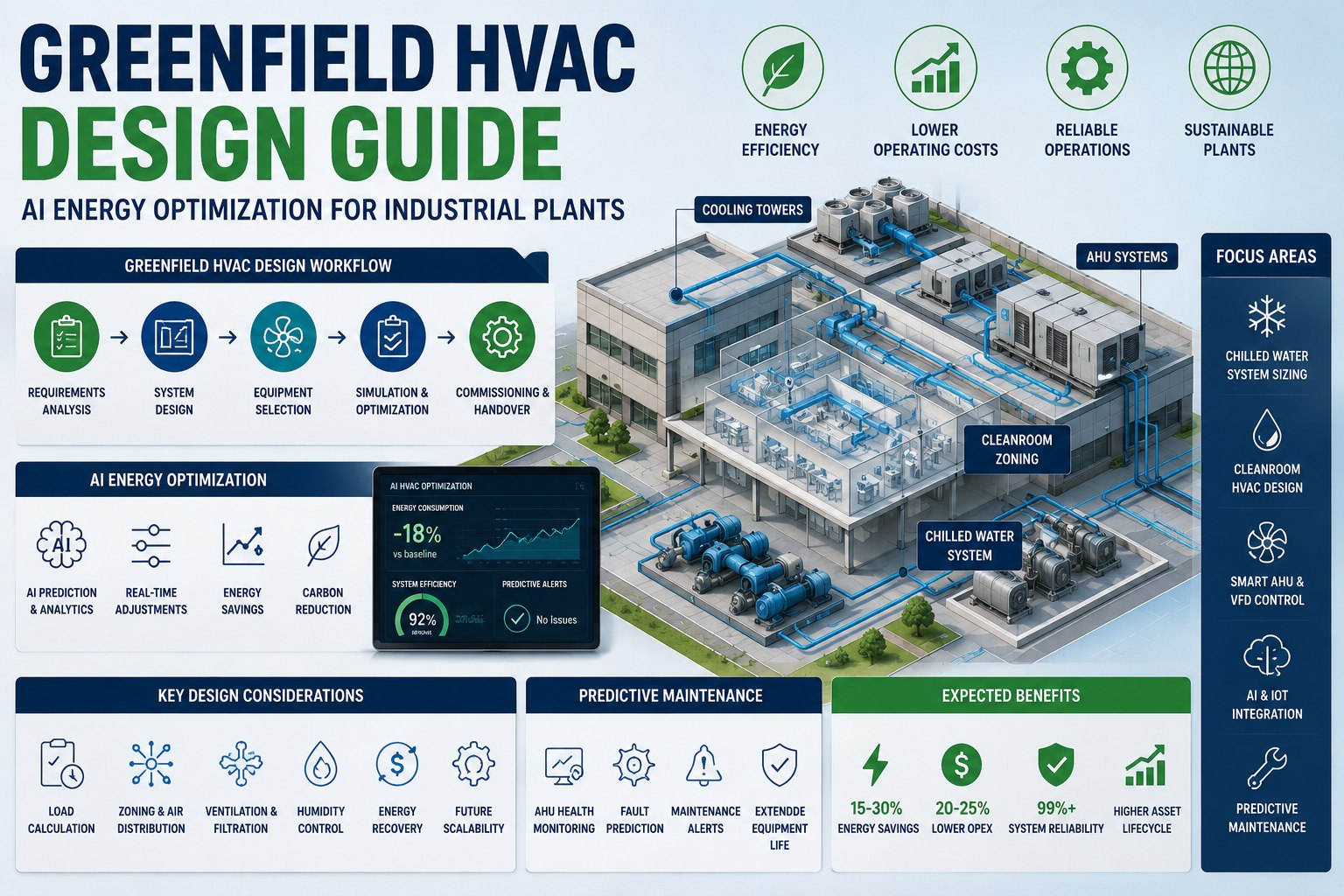
HVAC is the largest single energy consumer in most industrial facilities — accounting for 30 to 50% of total plant energy spend depending on process type, climate zone, and ventilation requirements. In a greenfield plant, every HVAC design decision you lock in during engineering becomes a fixed operating cost for the next 20 to 30 years. Getting chilled water plant sizing wrong costs millions annually. Under-designing AHU capacity forces expensive retrofits during production ramp. Ignoring cleanroom zoning requirements triggers costly commissioning failures. Book a greenfield HVAC consultation to validate your system design against digital twin models before a single piece of ductwork is specified.
VFD-driven fans and pumpsDDC zone controlBACnet/Modbus integrationDemand-based ventilation
15 to 25% energy reduction vs. fixed-speed systems
Layer 2 — Distribution
Chilled water piping (primary/secondary)Supply and return ductworkHEPA and MERV filtration banksPressure balancing dampers
Design errors here cause 18 to 36 month retrofit delays
Layer 1 — Central Plant
Chiller plant (air-cooled / water-cooled)Cooling towersAir handling units (AHUs)Boilers and heat exchangers
Over-sizing by 20% costs $2M to $8M in excess CapEx per plant
The Four Greenfield HVAC Design Decisions That Drive Lifetime Energy Cost
In a greenfield industrial facility, HVAC design decisions cascade. Chilled water plant sizing determines your central plant CapEx and COP range. AHU selection defines your filtration capability and zone coverage. Cleanroom zoning sets your air change rate requirements and containment pressure differentials. Controls architecture determines whether your HVAC system responds to actual load or just scheduled setpoints. Each decision locks in a cost structure that persists for the building's life — and each one is validated or invalidated during commissioning, not during design review.
01
Chilled Water Plant Sizing
Most CapEx-critical decision
Over-size by 20%Chillers operate at low-load inefficiency. COP drops from 6.0 to 3.5. Excess CapEx: $2M to $8M per plant.
Under-size by 15%Production curtailment during peak summer loads. Emergency chiller rental: $25K to $80K per event.
Right-sized with N+1Chillers operate at 70 to 90% load — peak COP range. Redundancy without excess CapEx.
Size to 80 to 90% design load with N+1 redundancy. Validate with digital twin before procurement.
02
AHU Selection and Zoning
Filtration and zone control foundation
Single AHU serving mixed zonesCannot maintain independent temperature and humidity profiles. Cleanroom contamination risk. Impossible to isolate for maintenance.
Dedicated AHU per zone typeIndependent control of temp, RH, and filtration class per zone. Maintenance isolation without production impact.
With VFDs on all fansFan energy reduction of 30 to 60% vs. fixed-speed. Critical for variable-occupancy zones.
Zone AHUs by process type, not by building grid. Match filtration class to ISO zone requirement.
03
Cleanroom Zone Pressure Hierarchy
Contamination containment foundation
No pressure differential designContaminants migrate freely between zones. ISO class degradation discovered at commissioning — months of remediation.
+12.5 Pa cascade (ISO 7 to corridor)Each zone transition maintains positive pressure. Contamination blocked at every boundary. Standard for pharma and food processing.
Negative pressure containmentRequired for hazardous material handling and biohazard zones — air flows inward, contaminants cannot escape.
Design pressure cascade before zoning layout. Every door opening must be modeled. Validate with smoke tests.
04
Controls Architecture
Determines lifetime energy spend
Scheduled setpoints onlyHVAC runs at designed capacity regardless of actual occupancy or process load. 25 to 40% of conditioning energy wasted.
DDC with occupancy sensorsDemand-based ventilation reduces conditioning load by 20 to 35% in variable-occupancy zones.
AI predictive controlAnticipates load 30 to 60 minutes ahead. Chiller sequencing and AHU staging optimized continuously. 30 to 40% total energy reduction.
Specify AI-ready controls infrastructure in greenfield design. Retrofit costs 4 to 6x more than installing at build.
Not sure whether your current HVAC specification has these decisions right? Book a greenfield HVAC design review — our engineering team will walk through your zone layout, chiller sizing assumptions, and controls architecture before drawings are finalized.
Cleanroom HVAC Zoning: ISO Class, ACH, and AHU Design Requirements
Cleanroom HVAC design is not a subset of general industrial HVAC — it is a distinct engineering discipline with ISO classification requirements that determine air change rate, filtration class, pressure differential, and temperature and humidity tolerances for every zone. Getting this wrong is not caught during design review. It is caught during ISO certification testing, after the building is built and the AHUs are installed.
ISO Cleanroom Classification — HVAC Design Requirements by Zone
ISO Class
Air Changes / Hr
Filtration
Temp Control
Typical Industry
ISO 5
240 to 480 ACH
HEPA (H14) — 99.995%
±0.5°C / ±2% RH
Semiconductor, sterile pharma
ISO 6
90 to 180 ACH
HEPA (H13) — 99.97%
±1°C / ±5% RH
Medical device, aseptic filling
ISO 7
30 to 60 ACH
HEPA (H13) or ULPA
±2°C / ±10% RH
Pharma manufacturing, food processing
ISO 8
10 to 25 ACH
MERV-16 / HEPA pre-filter
±3°C / ±15% RH
Electronics assembly, controlled mfg
General Mfg
6 to 12 ACH
MERV-8 to MERV-13
±5°C / comfort range
Automotive, heavy industrial, warehousing
ACH rates in cleanrooms are driven by contamination control, not thermal load — AHUs must be sized to ACH requirements, not just BTU load. This is the most common sizing error in greenfield HVAC design.
Chilled Water System Design: Primary-Secondary vs. Variable Primary Flow
The chilled water distribution architecture you select at greenfield design determines your pump energy spend, chiller efficiency range, and operational flexibility for the building's life. Two dominant architectures exist for industrial plants — primary-secondary (decoupled) and variable primary flow (VPF). Each has specific conditions under which it is the right choice, and neither retrofits cheaply once the plant is built.
Primary-Secondary (Decoupled)
Traditional Architecture
How it works
Separate constant-speed primary loop (chiller side) and variable-speed secondary loop (distribution side). Decoupler pipe bridges the two circuits.
Best for
Plants with multiple chillers, highly variable loads across zones, and need for independent chiller protection from flow fluctuations.
Energy tradeoff
Primary pumps run at constant speed — wasteful during low-load periods. Secondary VFDs recover some of this, but primary pumps remain inefficient.
Typical pump energy
7 to 10% of total chilled water system energy — higher at part-load conditions.
vs
Variable Primary Flow (VPF)
Modern Standard for Greenfield
How it works
Single variable-speed pump circuit serves both chiller and distribution. Flow modulates continuously based on real demand. Minimum flow bypass valve protects chillers.
Best for
Greenfield plants where chiller manufacturers support variable evaporator flow — now standard for most modern equipment. Simpler piping, lower pump CapEx.
Energy advantage
VFD pump energy follows affinity law — reducing flow to 50% cuts pump power by 87.5%. Total pump energy reduction of 30 to 50% vs. primary-secondary.
Typical pump energy
3 to 5% of total chilled water system energy — lower at all load conditions.
Validate Your Chilled Water and HVAC Design Before Equipment Is Specified
iFactory's greenfield HVAC consultation covers your zone load profile, chilled water architecture selection, AHU sizing against ISO classification requirements, and AI controls readiness assessment — all validated in a digital twin before a single purchase order is issued.
How AI Energy Optimization Changes HVAC Performance in Industrial Plants
Conventional Building Management Systems operate on rule-based logic — setpoint schedules, threshold triggers, and fixed control sequences. They respond to conditions that have already occurred. AI-native HVAC optimization runs predictive models that anticipate load changes 30 to 60 minutes ahead based on production schedules, occupancy patterns, ambient conditions, and equipment state — and pre-stages chiller sequencing, AHU airflow rates, and VFD speeds before demand arrives. The difference in energy outcome is not incremental. Research has recorded up to 59% reduction in cooling energy when intelligent management techniques like occupancy-based temperature setpoints are applied.
Predictive Load Forecasting
20 to 35% chiller energy reduction
AI models production schedule, ambient weather, occupancy, and historical load patterns to pre-stage chiller capacity 30 to 60 minutes before peak demand arrives. Eliminates reactive chiller cycling and cold-start energy spikes.
Chiller Sequencing Optimization
15 to 25% additional efficiency
AI determines the optimal number and combination of chillers to run for current load — keeping each unit in its peak COP operating range rather than running one chiller at 40% load. Staged starts extend equipment life significantly.
Demand-Based Ventilation (DCV)
20 to 40% AHU energy reduction
CO2 and occupancy sensors feed AI models that modulate AHU airflow rates and outdoor air damper positions in real time. Zones receive exactly the ventilation their current occupancy and process load requires — not the design maximum at all times.
AHU Fault Detection
60 to 80% fewer unplanned failures
AI models baseline AHU performance across fan speed, coil differential, filter pressure drop, and discharge temperature. Deviations from learned baselines trigger fault alerts 24 to 72 hours before failure — before cleanroom conditions are compromised.
Energy Anomaly Detection
8 to 15% energy waste eliminated
AI detects energy consumption patterns that deviate from expected baselines for production conditions — hunting dampers, coil fouling, refrigerant charge degradation, and stuck-open outside air dampers that BMS rule logic misses entirely.
Demand Response Integration
$80K to $300K annual utility savings
AI pre-cools thermal mass and shifts chiller load timing ahead of utility peak demand windows. Automates participation in utility demand response programs — generating revenue and avoiding demand charges without manual operator involvement.
Predictive AHU Maintenance: From Time-Based PM to Condition-Based Intelligence
AHUs are the most maintenance-intensive components of an industrial HVAC system — filter changes, coil cleaning, belt and bearing inspection, damper actuator verification, and condensate drain maintenance all occur on fixed schedules regardless of actual equipment condition. In cleanroom environments, a failing AHU means potential ISO class exceedance and production hold. Predictive maintenance powered by AI sensor data detects AHU performance degradation before it becomes a failure — shifting from time-based PM to condition-based intervention.
AHU Predictive Maintenance — Failure Signatures and AI Detection
AHU Component
Failure Signature
Key Sensor Inputs
Detection Window
Undetected Impact
Supply Fan Bearing
Vibration frequency shift, increasing temperature at bearing housing
Vibration + bearing temp
14 to 28 days
Catastrophic bearing failure, emergency replacement, 48 to 72 hr downtime
Cooling Coil Fouling
Increasing supply air temperature, rising chilled water delta-T
Supply air temp + CHW delta-T
7 to 21 days
Reduced cooling capacity, cleanroom temp exceedance, ISO class failure
Filter Loading
Rising differential pressure across filter bank, reduced airflow
Filter dP + airflow
3 to 7 days
ACH drops below ISO minimum — cleanroom certification failure
Damper Actuator Failure
Outdoor air volume not tracking setpoint, zone CO2 deviation
Power draw rising vs. airflow output, vibration harmonics
Power meter + vibration
7 to 14 days
Belt snap, complete AHU loss — unplanned downtime in critical zone
Condensate Drain Blockage
Humidity rising in zone without setpoint change, AHU pan water level
Zone RH + drain flow
Hours to 2 days
Water damage, microbial growth risk, cleanroom contamination
Designing your AHU specification for a greenfield plant? Book a greenfield HVAC design consultation — we will review your AHU sensor instrumentation plan and confirm AI predictive maintenance readiness is built into your equipment specifications from day one.
Expert Perspective: Building AI Energy Intelligence Into Greenfield HVAC from Day One
The most expensive HVAC mistake in greenfield design is not over-sizing the chiller plant — it is building a plant that is not instrumented for AI optimization. You can add a larger chiller later, at cost. You cannot add vibration sensors, airflow transmitters, and chilled water delta-T measurement points without opening walls, rerunning conduit, and interrupting production in a live facility. AI HVAC optimization delivers 30 to 40% energy reduction — but only if the sensor infrastructure was specified at design. Every greenfield plant built without AI-ready instrumentation in 2026 is a retrofit project waiting to happen. The incremental cost of adding this instrumentation during greenfield construction is 2 to 3% of HVAC CapEx. The retrofit cost after commissioning is typically 8 to 15 times that figure.
— iFactory Greenfield Consulting, Industrial HVAC Practice 2025 to 2026
30 to 50%
HVAC share of total industrial plant energy consumption
30 to 40%
Energy reduction achieved with AI optimization vs. conventional BMS
8 to 15x
Cost multiplier for adding AI sensor instrumentation post-commissioning vs. at greenfield design
Get Your Greenfield HVAC Design Validated Before You Specify Equipment
iFactory's greenfield HVAC consultation covers zone load profiling, chilled water architecture selection, ISO-class AHU sizing, cleanroom pressure cascade design, AI controls instrumentation specification, and predictive maintenance readiness — all validated in a digital twin before equipment procurement. One session. Concrete design output.
How much should HVAC represent as a percentage of total greenfield industrial plant CapEx?
HVAC typically represents 15 to 25% of total building CapEx for standard industrial facilities, rising to 30 to 40% for cleanroom-intensive environments such as pharmaceutical, semiconductor, or medical device manufacturing. The wide range is driven by ISO classification requirements — an ISO 5 cleanroom requires 240 to 480 air changes per hour, which drives dramatically higher AHU capacity, filtration cost, and ductwork infrastructure than a general manufacturing space requiring 6 to 12 ACH. Getting this percentage right requires an accurate zone-by-zone load profile, not an industry rule of thumb.
What is the most common HVAC design error in greenfield industrial plants?
The most common error is sizing AHUs to thermal BTU load rather than to air change rate requirements for the zone's ISO classification. In cleanroom environments, ACH is the governing constraint — an ISO 7 zone requires 30 to 60 air changes per hour regardless of the thermal load. If the AHU is sized only for cooling BTUs, it will not meet the ventilation rate required for ISO certification. This error is not discovered until commissioning testing, at which point the AHU must be replaced or supplemented — at 2 to 4 times the original cost because the installation is already complete.
When should variable primary flow (VPF) be chosen over primary-secondary chilled water architecture?
VPF is the preferred architecture for most new greenfield industrial plants where modern chillers with variable evaporator flow capability are specified — which is now standard for most major chiller manufacturers. VPF eliminates the constant-speed primary pump and reduces pump energy by 30 to 50% through the affinity law relationship between flow and power. Primary-secondary remains appropriate when legacy chiller equipment is being integrated, when multiple chiller manufacturers with different minimum flow requirements are combined in one plant, or when very large chiller plants require hydraulic decoupling for operational flexibility.
What sensor instrumentation is needed to enable AI HVAC energy optimization in a greenfield plant?
AI HVAC optimization requires instrumentation that conventional BMS specifications often omit: vibration sensors on fan and pump bearings, chilled water supply and return temperature sensors at each AHU connection (not just the chiller plant), differential pressure transmitters across each filter bank, CO2 sensors in variable-occupancy zones, power meters on individual AHU fans and chilled water pumps, and outdoor air volume measurement at each AHU damper. The incremental cost of adding this instrumentation during greenfield construction is 2 to 3% of HVAC CapEx — compared to 8 to 15 times that cost for post-commissioning retrofit.
How does AI predictive maintenance reduce AHU downtime in cleanroom environments?
AI predictive maintenance establishes performance baselines for each AHU across fan speed, coil differential temperature, filter pressure drop, and discharge air conditions. Deviations from these learned baselines — even subtle ones invisible to BMS alarm thresholds — are detected 7 to 28 days before failure for most fault types. This detection window allows planned maintenance during scheduled production downtime rather than emergency response during a cleanroom exceedance event. In ISO 5 and 6 environments where a single AHU failure can trigger production hold and batch rejection, this prevention capability has a direct, measurable financial impact that typically justifies the AI instrumentation investment within 6 to 12 months. Book a greenfield consultation to spec AI-ready AHU instrumentation for your plant.