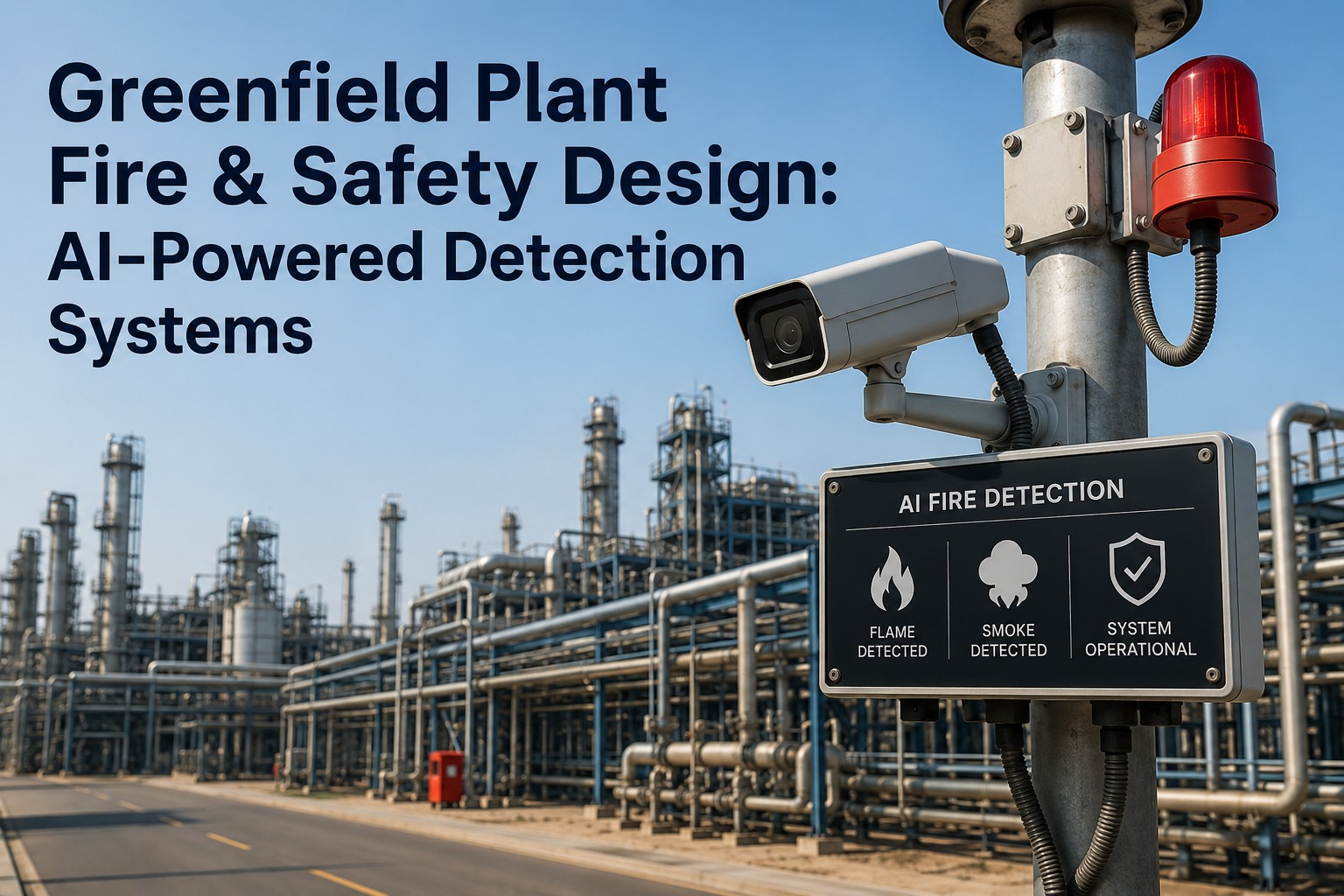
A fire contained in its first two minutes is a manageable incident. A fire that burns for ten minutes in an industrial plant is a catastrophe. Traditional photoelectric smoke detectors respond to the physical presence of smoke particulates — meaning the fire is already established before the alarm fires. AI fire detection systems detect the chemical precursors of combustion — carbon monoxide, volatile organic compounds, thermal anomalies, and early gas signatures — up to 30 minutes before visible smoke appears. In a greenfield plant, the choice between traditional and AI-native fire detection is not made at commissioning. It is made when the fire protection engineer is writing the design brief. Every zone designation, sensor position, suppression system selection, and evacuation route is locked in during that phase. Book a greenfield fire safety design consultation to validate your detection strategy, NFPA compliance approach, and AI integration architecture before fire protection drawings are issued.
Greenfield Plant Fire & Safety Design — AI Detection Systems 2026
The Five Industrial Fire Risk Zones — Every Zone Needs a Different Detection Strategy
ZONE 1 — Extreme Risk
Flammable Liquid / Gas Storage
Flash fire, BLEVE, vapor cloud explosion
UV/IR Flame Detector + Gas Detector
Deluge foam system + explosion venting (NFPA 68)
NFPA 30, NFPA 70 Class I
ZONE 2 — High Risk
Combustible Dust / Powder Process
Dust deflagration, secondary explosion
AI Thermal Camera + Spark Detection
Chemical suppression, explosion venting (NFPA 68/69)
NFPA 652, NFPA 654, NFPA 70 Class II
ZONE 3 — Elevated Risk
Production Floor / Assembly
Equipment fire, electrical fault, process heat
AI Multi-Sensor Fusion + Beam Detector
Wet pipe sprinkler (NFPA 13) or pre-action
NFPA 72, NFPA 13, IBC
ZONE 4 — Moderate Risk
Electrical Rooms / MCC / Server
Electrical arc, insulation fire, thermal runaway
ASD (Aspirating Smoke) + Thermal Imaging
Clean agent (FM-200 / Novec 1230) per NFPA 2001
NFPA 72, NFPA 75, NFPA 2001
ZONE 5 — Standard Risk
Warehouse / Storage / Offices
General combustion, arson, overloaded circuit
AI Smoke Detector + Heat Detector
Wet pipe sprinkler (NFPA 13) — standard
NFPA 72, NFPA 13, OSHA 1910.157
30 min
AI detects fire precursors before visible smoke
$49.4B
Global fire safety market in 2025 — growing to $52.9B in 2026
83%
Of facilities prioritize compliance as their top fire safety driver
2 min
Fire contained in first 2 minutes is a manageable incident
AI Detection vs. Traditional Detection: What Each System Actually Sees
Traditional fire detection is reactive. A photoelectric smoke detector waits for particulate density to cross a threshold. An ionization detector waits for combustion ions to enter the chamber. A fixed-temperature heat detector waits for the ceiling air to reach a set point. By the time any of these thresholds are crossed, the fire has been burning for minutes. AI detection is predictive. Multi-sensor fusion combines temperature gradients, gas concentration changes, optical signatures, and historical pattern models to identify the chemical signature of smoldering combustion before any single threshold is crossed — and before visible smoke or measurable heat is present.
Traditional Detection
T = 0
Ignition source activates
T + 2 to 5 min
Smoldering begins — CO and VOCs present but no sensor triggers yet
T + 8 to 15 min
Visible smoke reaches detector — alarm fires
T + 15 to 25 min
Fire established — suppression activates. Significant damage underway.
Reactive — fire is established before response begins
AI Detection
T = 0
Ignition source activates
T + 1 to 3 min
AI detects CO and VOC concentration change — pre-alarm alert to safety team
T + 3 to 5 min
Thermal anomaly confirmed — suppression pre-staged, evacuation zones pre-positioned
T + 5 to 8 min
Fire crew arrives with full situational awareness. Fire contained at incipient stage.
Predictive — intervention happens before fire is established
Designing detection zones for a new industrial facility? Book a fire safety design consultation — our engineers will map your zone risk profile and specify the correct detection technology for each area before your fire protection drawings are issued.
Detection Technology Selector: Matching the Right Sensor to Each Industrial Hazard
No single detection technology covers every industrial fire hazard. The wrong detector type for a given zone produces either dangerous miss events (detector does not respond to the hazard present) or crippling false alarm rates (detector responds to steam, dust, or welding fumes instead of fire). In a greenfield plant, detector selection is made at design — based on a hazard-specific analysis of each zone — and the detector type drives the mounting position, conduit routing, and addressable loop wiring that is specified on the fire protection drawings.
UV / IR Flame Detector
Detects ultraviolet and infrared radiation emitted by open flames — responds in under 1 second to visible flame
Best for
Flammable liquid and gas storage
Open process areas
Aircraft hangars
Outdoor high-value equipment
Avoid: Dusty environments — UV blocked by particulate contamination
NFPA 72 Ch. 17.8 / UL 1069
Aspirating Smoke Detection (ASD)
Actively draws air samples through pipe network into a central detection chamber — detects smoke at sub-visual concentrations (0.001% obs/m)
Best for
Electrical rooms and data halls
Clean rooms
High-value equipment rooms
Spaces with air movement disrupting point detectors
Avoid: Environments with persistent aerosols — requires environmental characterization
NFPA 72 Ch. 17.7.5 / UL 268A
AI Thermal Camera
Continuous infrared image analysis using AI models to detect thermal anomalies, temperature gradients, and smoldering heat signatures — not dependent on smoke or flame
Best for
Combustible dust process areas
Large open production halls
Battery storage (NFPA 855 2026)
Conveyor lines and belt systems
NFPA 855 (2026) now explicitly permits thermal-image detection for battery storage — UL 2684 listings expanding
NFPA 72, NFPA 855 (2026) / UL 2684
Gas / Combustible Gas Detector
Continuous electrochemical or catalytic bead sensing of flammable gas concentration — alarm at 10% LEL (Lower Explosive Limit), trip at 25% LEL
Best for
Gas cylinder and storage areas
Hydrogen-producing processes
Refrigeration plant rooms
Natural gas meter rooms
Requires calibration gas specification and periodic bump-test schedule — include in maintenance plan at design
NFPA 70 (NEC), NFPA 2 (Hydrogen), OSHA 1910.119
Spark / Ember Detector
Optical detection of infrared radiation from sparks or glowing embers in duct systems — responds in milliseconds to trigger quench suppression before ignition of downstream material
Best for
Dust extraction ductwork
Pneumatic conveying systems
Biomass / wood processing
Grain handling and milling
Position detector minimum 1 m downstream of spark source — shorter distance causes false trips from reflections
NFPA 654, NFPA 664 / FM Approved
AI Multi-Sensor Fusion
Combines smoke, heat, CO, VOC, and optical inputs using machine learning to confirm genuine fire events — eliminates false alarms from industrial environments with steam, welding, or dust
Best for
General production floor
Mixed-hazard industrial zones
Environments with high false-alarm history
Any zone requiring NFPA 72 addressable system
Specifying the right training dataset matters — commissioning should include zone-specific false-alarm calibration period of 2 to 4 weeks
NFPA 72 Ch. 17 / EN 54 / UL 268
Get Every Detection Zone Specified Before Fire Protection Drawings Are Issued
iFactory's greenfield fire safety consultation covers hazard zone analysis, detection technology selection per zone, NFPA compliance mapping, suppression system zoning, AI integration architecture, and evacuation modeling — all delivered as a specification document before fire protection engineering drawings are produced.
NFPA Compliance Map: Which Standards Apply to Your Greenfield Plant
NFPA compliance for an industrial plant is not a single code — it is a portfolio of standards that apply simultaneously, each to a specific system type, hazard category, or occupancy class. In a greenfield facility, the applicable NFPA codes are determined at design and form the basis of the Authority Having Jurisdiction (AHJ) plan review. Missing a code at design — discovering it at plan review — requires costly redesign of the fire protection drawings and can delay occupancy permit by weeks or months.
NFPA 72
National Fire Alarm and Signaling Code
Fire alarm system design, installation, and performance. Governs all initiating devices, notification appliances, control panels, and system documentation.
Applies to: All industrial occupancies requiring a fire alarm system — effectively every greenfield plant above 465 m² or with occupancy above defined thresholds
AI implication: AI detection devices must be listed to NFPA 72 Chapter 17 requirements. UL 268, UL 1069, and UL 2684 (thermal imaging) are the relevant listing standards.
NFPA 13
Standard for the Installation of Sprinkler Systems
Wet pipe, dry pipe, pre-action, and deluge sprinkler systems. Hazard classification (light, ordinary, extra) determines sprinkler type, spacing, and hydraulic demand.
Applies to: All industrial buildings with sprinkler requirement. Pre-action systems for freeze-risk areas or computer rooms. Deluge for high-hazard liquid and foam applications.
AI implication: AI detection can be used to trigger pre-action system release — requires interface specification between FACP and pre-action deluge valve at design.
NFPA 30
Flammable and Combustible Liquids Code
Storage, handling, and use of flammable and combustible liquids. Governs tank spacing, containment bunding, ventilation, and ignition source control.
Applies to: Any greenfield plant with flammable liquid storage, solvent processes, fuel storage, or paint booths above threshold quantities
AI implication: Vapor concentration monitoring (continuous gas detection at 10% LEL alarm) is the primary AI contribution to NFPA 30 compliance.
NFPA 652 / 654
Combustible Dust Standards
NFPA 652 is the foundation document; 654 covers general manufacturing. Requires Dust Hazard Analysis (DHA) for all processes generating combustible dust above minimum explosive concentration.
Applies to: Food processing, pharmaceutical, wood, metal powder, plastic, and chemical manufacturing — broader than most engineers assume
AI implication: Continuous air quality monitoring for dust concentration combined with spark detection in ductwork is the AI-enhanced compliance approach.
NFPA 2001
Clean Agent Extinguishing Systems
Design and installation of gaseous suppression systems using FM-200, Novec 1230, CO₂, or inert gases. Requires enclosure integrity testing to ensure agent concentration is maintained.
Applies to: Electrical rooms, server rooms, control rooms, and MCC rooms where water-based suppression would damage equipment or create safety hazards
AI implication: ASD (Aspirating Smoke Detection) paired with clean agent release provides earliest possible pre-fire warning in enclosed electrical areas.
NFPA 855 (2026)
Energy Storage Systems
2026 edition now permits thermal-image fire detection and smoke detection (not just aspirating) for lithium battery storage areas. New temporary storage provisions for batteries at 50% state of charge.
Applies to: BESS installations, EV charging areas, battery manufacturing, UPS battery rooms, and any energy storage above threshold kWh
AI implication: Thermal imaging (UL 2684 listed products) is now code-compliant for BESS detection per NFPA 855 (2026) — specifying this at greenfield avoids more expensive retrofit solutions.
Not sure which NFPA codes apply to your greenfield facility's hazard profile? Book a fire safety compliance consultation — we will map every applicable standard to your process zones before your fire protection engineer begins drawings.
Suppression Zoning: Matching the Suppression System to the Hazard
The suppression system selection for each zone is a design decision that cannot be revised cheaply after construction. Water-based suppression installed in an electrical room creates its own disaster. Clean agent installed in a large production hall is neither code-compliant nor economically viable. Foam systems required for flammable liquid zones must be sized for the tank area during design — the foam concentrate tank location and piping routes are structural elements of the building. Here is how suppression system selection maps to zone hazard type in a standard industrial plant.
Zone Type
Suppression System
Selection Rationale
AI Trigger Method
Flammable liquid storage
Foam deluge — AFFF or fluorine-free foam (FFF)
Water alone spreads flammable liquid; foam blankets surface to exclude oxygen
UV/IR flame detector triggers deluge valve — response under 1 second to confirmed flame
Combustible dust process
Chemical explosion suppression (NFPA 69)
Water suppression in an explosion is ineffective; chemical agent injected at pressure rise intercepts deflagration within milliseconds
Pressure rise detector or spark detector triggers suppression in under 50 ms — must be hardwired, not networked
Production floor (general)
Wet pipe sprinkler (NFPA 13) — ordinary or extra hazard
Cost-effective, reliable, self-actuating at 68 to 141°C fusible link — no external trigger required for basic activation
AI detection provides early warning for pre-notification; sprinkler activates independently from fusible link
Cold storage / freeze risk
Dry pipe or pre-action sprinkler system
Water in pipes freezes — dry pipe uses pressurized air; pre-action requires detection signal before water fills pipes
AI detection provides dual-interlock signal to pre-action valve — prevents accidental flooding from mechanical pipe damage
Electrical / server rooms
Clean agent — FM-200, Novec 1230, or inert gas (NFPA 2001)
Water damages electrical equipment; clean agents suppress without residue, maintaining equipment integrity
ASD (aspirating smoke) triggers 30-second pre-discharge alarm; personnel evacuate before agent release
Battery / BESS storage
Water mist or high-flow sprinkler for thermal runaway cooling
Lithium battery thermal runaway requires sustained cooling — clean agents suppress flame but cannot prevent thermal runaway propagation
AI thermal imaging detects battery temperature deviation before vent gas release — activates cooling water before thermal runaway propagates
Expert Perspective: Why Greenfield Is the Only Affordable Time to Get This Right
The most expensive fire safety decisions are not the ones made at design — they are the ones that are not made at design and discovered during plan review, occupancy inspection, or after the first incident. A greenfield plant that does not receive a Dust Hazard Analysis before design freeze discovers during construction that every dust-generating process area needs explosion venting, isolation systems, and spark detection that were not included in the structural or M&E design. Retrofitting explosion venting into a completed concrete structure is a building demolition and rebuild exercise. AI detection systems that are not specified at design are installed in the wrong locations on completed cable trays, with surface-mounted conduit and no access platforms, at 4 to 8 times the commissioning cost. The fire protection design brief must include hazard zone analysis, NFPA applicability mapping, AI detection strategy, suppression system selection per zone, and evacuation modeling — all completed before the fire protection engineer produces the first drawing. Every conversation we have after that point involves either a variation order or a compromise.
— iFactory Greenfield Consulting, Fire Safety Engineering Practice 2025 to 2026
30 min
Earliest AI detection of pre-fire chemical signatures vs. minutes for traditional smoke detection
71%
of facilities now prioritizing smart technology integration in fire safety design (2026 survey)
4 to 8x
Cost to retrofit AI detection sensors into a live facility vs. specifying at greenfield design
Ready to build an AI-native fire detection system into your greenfield plant from day one? Talk to our fire safety engineering team — we will review your process zone hazard profile and recommend the correct detection, suppression, and compliance specification before drawings begin.
Design Your Greenfield Plant Fire Safety System Right — Before the First Drawing Is Issued
iFactory's greenfield fire safety consultation covers hazard zone analysis and risk mapping, AI detection technology selection per zone, NFPA code applicability review, suppression system selection, evacuation route modeling, fire protection drawing brief, and AI integration architecture — all delivered before your fire protection engineer produces the first design drawing.
Frequently Asked Questions
How early can AI fire detection systems detect a fire compared to traditional smoke detectors?
AI fire detection systems using multi-sensor fusion can detect the chemical precursors of smoldering combustion — carbon monoxide and volatile organic compounds — up to 30 minutes before visible smoke appears. Traditional photoelectric smoke detectors respond only when particulate density crosses a threshold that requires the fire to be established. AI thermal imaging detects temperature anomalies within 1 to 3 minutes of ignition source activation. The combined effect is that AI systems allow intervention before the fire is established, while traditional systems initiate response after the fire is already burning. In an industrial environment where fuel loads are high, this detection window difference is the difference between a contained incident and a facility-level event.
Which NFPA codes are most commonly missed in greenfield industrial plant fire safety design?
The three most frequently missed NFPA codes in greenfield industrial design are NFPA 652 and 654 (Combustible Dust), NFPA 855 (Energy Storage Systems — particularly in plants with BESS or EV charging), and NFPA 2001 (Clean Agent Systems for electrical rooms). NFPA 652 requires a Dust Hazard Analysis (DHA) for any process generating combustible dust above minimum explosive concentration — which includes food processing, pharmaceutical, wood, metal powder, and plastic manufacturing. The DHA must be completed before design freeze because it drives explosion venting, ductwork isolation, and spark detection specifications that are structural in nature.
What does NFPA 855 (2026) change for battery storage fire detection in greenfield plants?
The 2026 edition of NFPA 855 significantly expands the permitted detection technologies for lithium battery storage areas. The previous 2023 edition required air-aspirating smoke detection or radiant-energy detection. The 2026 edition now also permits thermal-image fire detection — which aligns with UL 2684 (the listing standard for video and thermal image detectors for fire alarm systems, revised August 2025). This means greenfield plants with BESS installations, EV charging areas, or battery manufacturing can now specify AI thermal imaging cameras as the primary detection technology in battery storage zones, rather than the more expensive aspirating smoke detection systems previously required.
Why is clean agent suppression used in electrical rooms instead of water sprinklers?
Water-based suppression in an electrical room creates a compound emergency: electrical equipment energized with water present is a life-safety hazard for responders and causes irreversible damage to switchgear, UPS systems, and servers. Clean agent systems — FM-200, Novec 1230, or inert gas blends — suppress fire by reducing oxygen concentration or interrupting the combustion chain without leaving residue and without conducting electricity. They are paired with aspirating smoke detection (ASD) that detects smoke at sub-visual concentrations, giving 30 to 60 seconds of pre-discharge alarm time for personnel to evacuate before the agent discharges. In a greenfield plant, the enclosure integrity requirements for clean agent (total flooding) must be designed into the room construction — sealed cable penetrations, door seals, and no uncontrolled openings.
How does iFactory's greenfield fire safety consultation work?
iFactory's greenfield fire safety consultation is structured as a pre-design brief session covering your facility's process zone hazard analysis, NFPA code applicability mapping across all zones and systems, AI detection technology selection per zone with detector listing verification, suppression system type selection per zone and interface specification, evacuation route modeling for occupancy density and travel distance, fire protection drawing brief for your fire protection engineer, and AI integration architecture connecting detection, suppression, FACP, and building management systems. All outputs are specification documents your fire protection engineer and M&E contractors work from directly.
Book your greenfield fire safety consultation here.