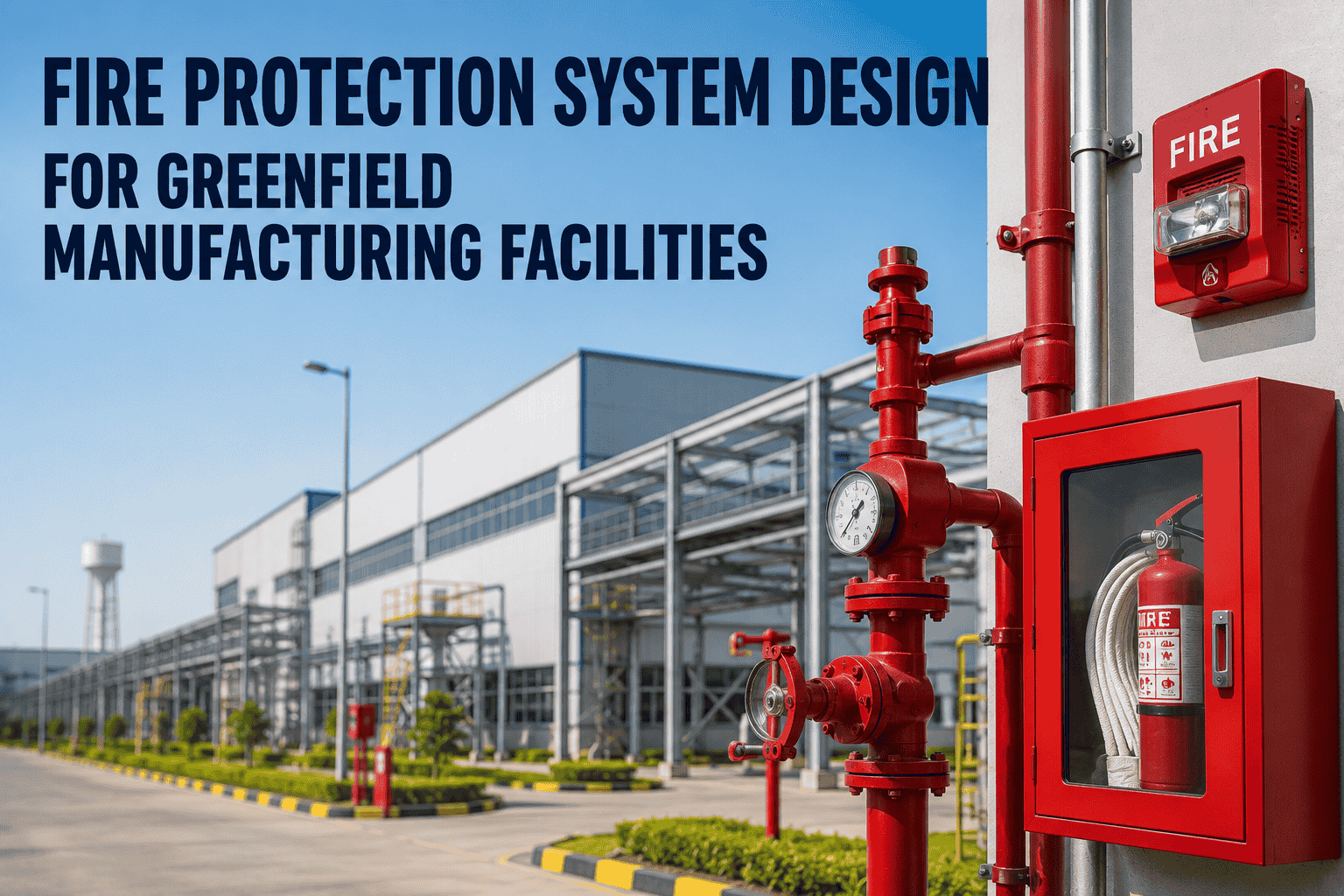
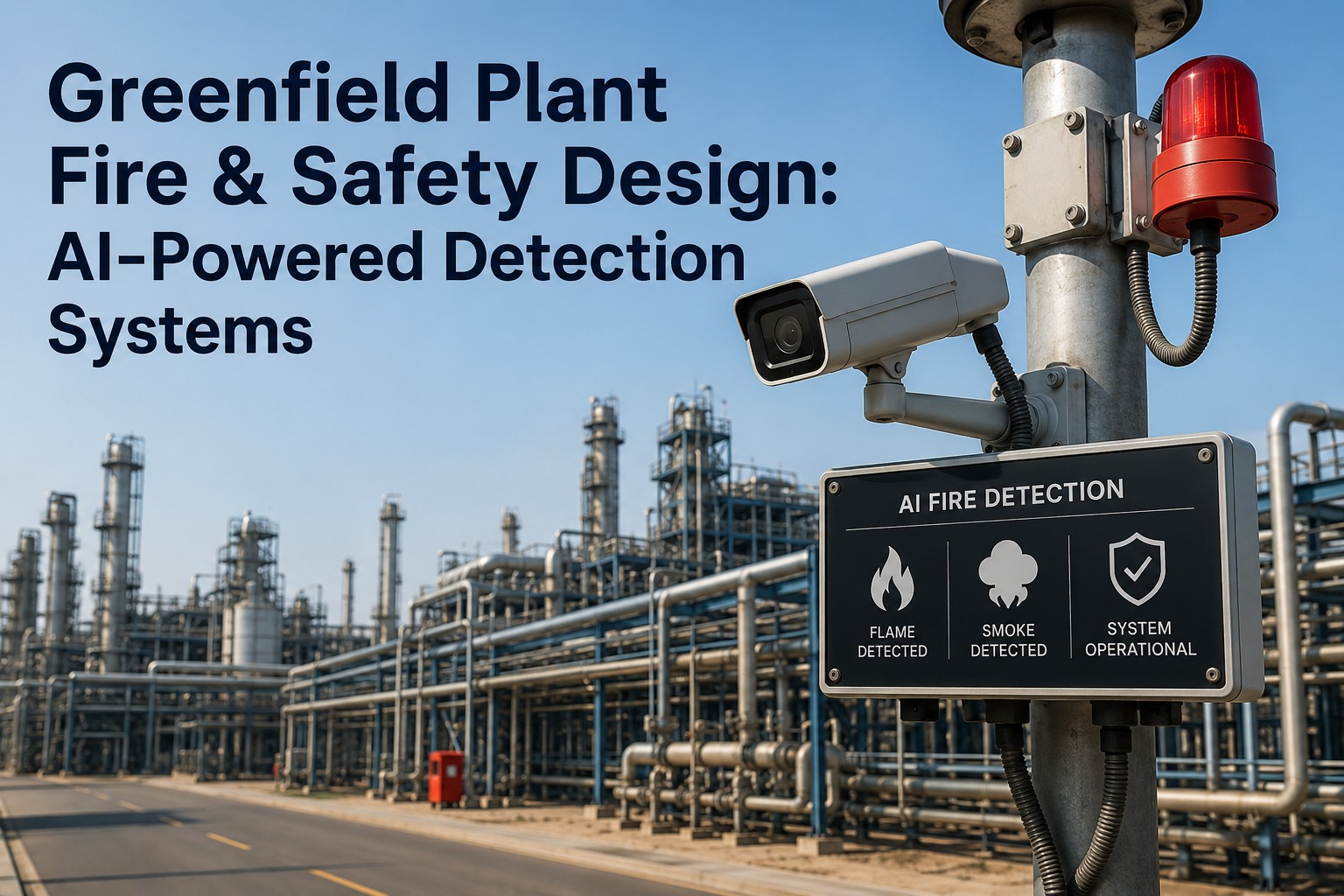
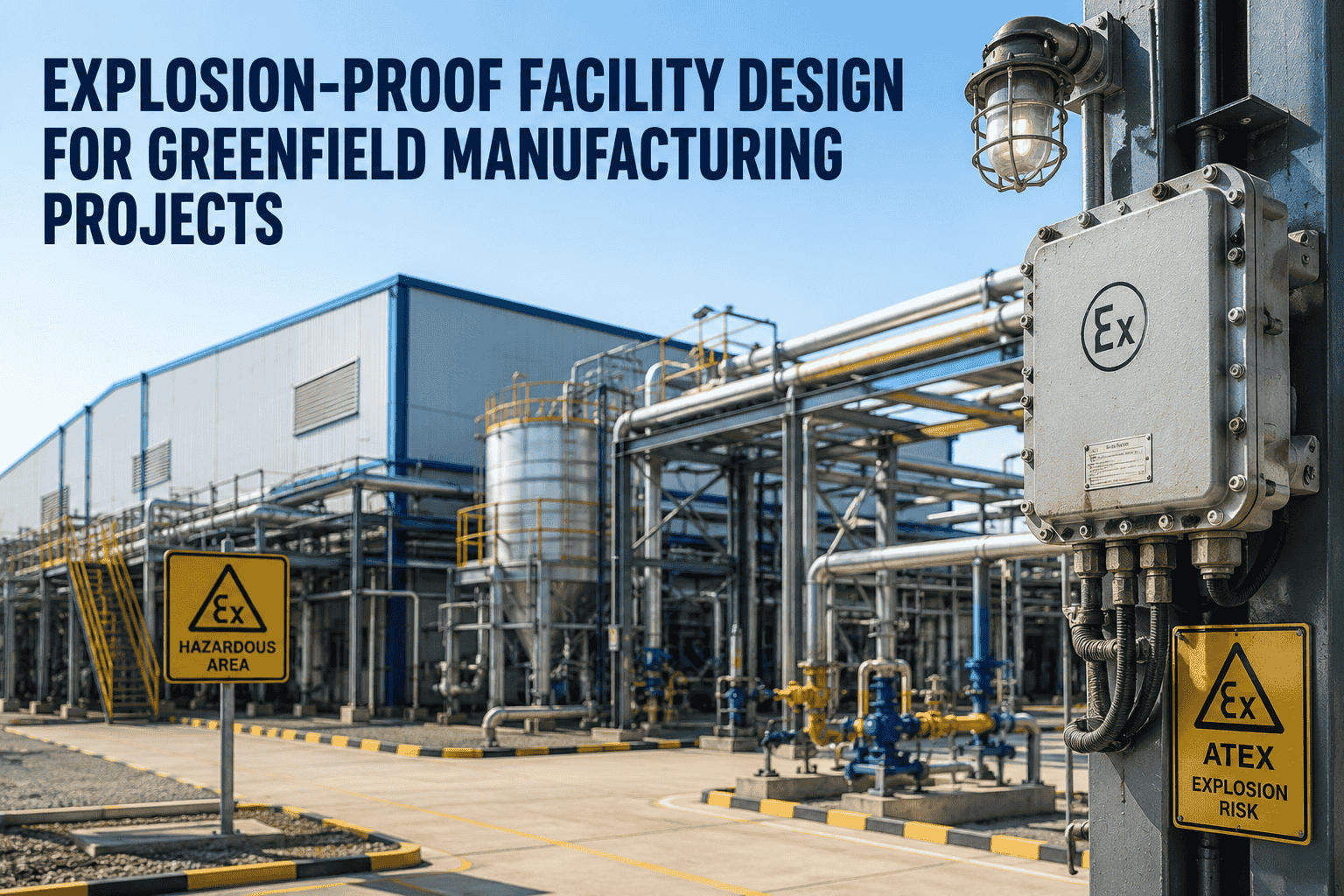
Fire protection system design for greenfield manufacturing facilities sits at the intersection of life safety, regulatory compliance, insurance underwriting, and operational continuity. Done well, it integrates seamlessly with facility design from the earliest planning phase. Done poorly, it surfaces during commissioning as retrofit work that delays startup, inflates capital costs, or constrains operational flexibility for the life of the facility. The greenfield projects that complete fire protection design on schedule treat it as a primary engineering workstream — not a code compliance afterthought — and align fire protection design decisions with process design, building envelope, and utility infrastructure decisions from inception. This guide covers the six pillars of fire protection system design for greenfield manufacturing, with NFPA standards reference, industry-specific hazards, AI-integrated monitoring, and regulatory compliance considerations. Book a greenfield consultation to map fire protection design against your specific facility plan.
Risk Assessment & Hazard Analysis
Foundational hazard identification and risk quantification driving all downstream design decisions.
HAZOP
FMEA
LOPA
PHA
Detection & Alarm Systems
Early warning detection for smoke, heat, flame, and combustible/toxic gas across all facility zones.
Smoke
Heat
Flame
Gas
Fire Suppression Systems
Automatic fire suppression sized to hazard classification with water-based and clean agent systems.
Sprinkler
Pre-action
Clean agent
Foam
Egress & Life Safety
Life Safety Code compliance for exits, travel distance, emergency lighting, and evacuation planning.
Exits
Travel paths
Emergency lighting
Refuge areas
Containment & Compartmentation
Fire-rated walls, doors, dampers, and penetration seals that limit fire spread between zones.
Fire walls
Fire doors
Dampers
Penetrations
Mass Notification & Response
Emergency communication systems and coordinated response to fire department and on-site teams.
Public address
Strobes
Text alerts
FD interface
The Fire Protection Design Challenge for Greenfield Manufacturing
Fire protection design for greenfield manufacturing facilities is harder than most project teams initially scope for. The complexity comes from the intersection of multiple code authorities (NFPA, IBC/IFC, OSHA, state, local), insurance underwriting requirements (FM Global, XL/Zurich), industry-specific hazards (combustible dust, flammable liquids, lithium-ion, hydrogen), and the integration challenge with process design and building architecture. The six challenges below describe what makes fire protection design particularly demanding for greenfield projects and where most schedule and cost overruns occur.
01
Multiple Code Authorities Apply
NFPA standards (60+ relevant codes), International Building Code (IBC), International Fire Code (IFC), OSHA 1910 Subpart L, plus state and local amendments. Each jurisdiction may modify base codes. Insurance underwriters (FM Global, XL, Zurich) impose additional requirements beyond code minimum. Identifying which authorities have jurisdiction and reconciling conflicts requires early code research.
02
Process Hazards Drive Design
Fire protection design follows process hazards, not the other way around. Combustible dust (NFPA 654), flammable liquids (NFPA 30), lithium-ion batteries (NFPA 855), hydrogen (NFPA 2), oxidizers (NFPA 400), reactive chemicals (NFPA 49) all impose specific design requirements. Process changes late in design trigger fire protection redesign and code re-review.
03
Fire Water Demands Are Substantial
Industrial sprinkler systems require fire water supply rates from 500 gpm (light hazard) to 5,000+ gpm (extra hazard) for hours of duration. Many greenfield sites require dedicated fire water tanks (250,000–1,000,000+ gallons), fire pumps, and underground distribution. Utility coordination must begin during site selection — municipal water alone often insufficient.
04
Egress Constrains Building Layout
NFPA 101 travel distance limits (75–400 feet depending on occupancy and protection level), exit width requirements, and accessible egress paths constrain manufacturing layout. Optimizing process flow without violating life safety codes requires fire protection engineer collaboration during architectural design — not after.
05
Insurance Underwriter Engagement
Property insurance for manufacturing facilities typically requires FM Global or equivalent underwriter sign-off on fire protection design. Underwriter requirements often exceed code minimum — particularly for high-value, business-critical facilities. Insurance reviews should start during schematic design, not after construction. Late-stage underwriter requirements drive expensive retrofits.
06
Commissioning Integration Complexity
Fire alarm, suppression, BMS, security, and process control systems must integrate during commissioning. Cause-and-effect matrices defining each device’s actions, integrated testing protocols (NFPA 4), and acceptance testing by Authority Having Jurisdiction (AHJ) all require coordination across multiple trades. Compressed commissioning timelines consistently push fire protection sign-off to the critical path.
Industrial Fire Hazards by Manufacturing Type
Fire protection design begins with industry-specific hazard identification. Different manufacturing industries face fundamentally different fire risks, and the protection systems vary correspondingly. A food & beverage greenfield plant has different protection needs than a lithium-ion battery factory, which differs from a chemical processing plant. The six hazard categories below cover the most common manufacturing industries and the specific protection systems each typically requires.
Hazard 01
Combustible Dust
Food processing, plastics, metals (aluminum, magnesium), pharmaceuticals, sugar, grain. Dust accumulations as thin as 1/32" can fuel explosions. NFPA 652 baseline requirements plus industry-specific standards (NFPA 61 ag, NFPA 484 metals, NFPA 654 chemical/plastic).
Protection: Dust hazard analysis (DHA), explosion venting, suppression systems, housekeeping programs, electrical classification
Hazard 02
Flammable & Combustible Liquids
Chemical processing, paint manufacturing, printing, pharmaceutical, food & beverage (alcohols). NFPA 30 governs storage, handling, and dispensing. Flammable liquids (flash point below 100°F) and combustible liquids (flash point above 100°F) have different requirements.
Protection: Foam suppression (NFPA 11), spill containment, secondary containment, electrical classification (NEC Class I), proper storage
Hazard 03
Lithium-Ion Battery Storage
EV manufacturing, battery production, energy storage facilities. NFPA 855 (2023, 2026 update) governs energy storage systems. Thermal runaway hazards require specialized detection and suppression. One of the fastest-evolving fire protection areas in 2025–2026.
Protection: Specialized detection (off-gas sensors), water suppression with battery-specific design, fire-rated separation, explosion venting
Hazard 04
High-Piled Combustible Storage
Warehousing, distribution, large finished goods areas. IFC Chapter 32, NFPA 13 governs sprinkler density for storage heights. Storage above 12 feet typically triggers high-piled storage requirements with increased sprinkler demand.
Protection: ESFR sprinklers (Early Suppression Fast Response), aisle width controls, commodity classification, in-rack sprinklers for high storage
Hazard 05
Compressed Gases & Hydrogen
Semiconductor, chemical processing, hydrogen fuel production, welding operations. NFPA 55 compressed gases, NFPA 2 hydrogen specific. Hydrogen requires specialized detection (low ignition energy, invisible flame) and ventilation design.
Protection: Gas detection (electrochemical for H2), ventilation design, separation distances, explosion venting, deflagration venting
Hazard 06
Electrical Equipment & Electronics
Data centers, control rooms, switchgear rooms, semiconductor fabs. NFPA 75 information technology equipment, NFPA 76 telecom facilities. Clean agent systems preferred over water for sensitive electronics. Lithium-ion UPS adds modern complication.
Protection: Clean agent suppression (FM-200, Novec 1230, IG-541), early warning aspirating smoke detection, pre-action sprinklers as backup
Want help identifying fire hazards specific to your manufacturing process? Book a greenfield consultation — we’ll walk through industry-specific fire hazards and the protection systems that address them for your facility profile.
The Six Pillars of Fire Protection System Design
Complete fire protection for greenfield manufacturing organizes around the six pillars introduced in the hero. Each pillar requires distinct engineering expertise, specific NFPA code compliance, and dedicated design lead time. The pillars work together — failures in any single pillar reduce the effectiveness of the others. The detailed walkthrough below describes what each pillar covers, the governing standards, and the typical design lead time required for greenfield projects.
Foundation pillar that drives all downstream design decisions. Identifies process hazards, ignition sources, fuel inventories, occupancy classifications, and credible fire scenarios. Methodologies include HAZOP (Hazard and Operability Study), FMEA (Failure Mode Effects Analysis), LOPA (Layer of Protection Analysis), PHA (Process Hazard Analysis), and bowtie analysis. Output: hazard register, fire scenarios, and design basis for protection systems.
MethodologiesHAZOP, FMEA, LOPA, PHA
Lead time4–8 months
StandardsNFPA 1, OSHA 1910.119
Early warning systems that detect fires at the earliest possible moment. Smoke detection (photoelectric, ionization, aspirating/VESDA), heat detection (fixed temperature, rate-of-rise, linear), flame detection (UV, IR), and combustible/toxic gas detection. Connected to fire alarm control panels (FACP) per NFPA 72. Aspirating smoke detection provides earliest warning for high-value spaces.
Detector typesSmoke, heat, flame, gas, VESDA
Lead time6–10 months
StandardsNFPA 72, NFPA 720
Automatic fire suppression sized to hazard classification. Wet pipe sprinklers (general manufacturing), dry pipe sprinklers (unheated areas), pre-action sprinklers (sensitive equipment), deluge systems (high-hazard areas), foam systems (flammable liquids per NFPA 11), clean agent systems (FM-200, Novec 1230, IG-541 per NFPA 2001), water mist (NFPA 750). Fire water supply (NFPA 22 tanks, NFPA 20 pumps) typically dedicated for industrial sprinklers.
System typesSprinkler, foam, clean agent, mist
Lead time9–15 months including water supply
StandardsNFPA 13, 14, 20, 22, 2001
NFPA 101 Life Safety Code governs exits, travel distance limits, exit width based on occupant load, emergency lighting (NFPA 70 Article 700), exit signs, accessible means of egress, areas of refuge. Travel distance limits range 75–400 feet depending on occupancy and protection level. Egress design constrains architectural layout — must be developed alongside building design, not after.
Travel distance75–400 ft per occupancy
Lead timeIntegrate with architectural design
StandardsNFPA 101, IBC Chapter 10
Fire-rated walls, doors, dampers, and penetration seals that limit fire spread between zones. Fire wall ratings range 1–4 hours depending on construction type and occupancy separation. Penetrations of rated assemblies must use UL-listed firestop systems. Smoke control systems (NFPA 92) for atria and large open spaces. Containment design protects egress paths and limits fire size.
Wall ratings1–4 hours typical
Lead timeIntegrate with architectural design
StandardsNFPA 221, NFPA 80, IBC 7
Emergency Communication Systems (ECS) under NFPA 72 Chapter 24. Public address with intelligible voice messages, visual notification (strobes), text/mobile alerts, fire department interface, on-site emergency response team coordination. Modern facilities integrate fire alarm, mass notification, and emergency communication with shelter-in-place and active threat scenarios beyond fire only.
System typesPA, strobes, mobile alerts, FD interface
Lead time6–9 months
StandardsNFPA 72 Ch 24, NFPA 1620
Want to map the six pillars to your specific greenfield project? Book a greenfield consultation — we’ll walk through pillar-by-pillar design decisions and produce a documented fire protection architecture aligned to your facility scope and operating geography.
Smart Safety Monitoring & AI Integration
Fire protection monitoring has evolved significantly in 2024–2026 with AI-integrated detection, predictive analytics, and digital twin integration becoming mainstream for new greenfield projects. The shift is from periodic inspection-based safety management to continuous AI-monitored safety intelligence. The six capability categories below describe how smart safety monitoring works in 2026 manufacturing facilities and where AI integration adds genuine operational value beyond marketing claims.
Capability 01
AI-Enhanced Visual Smoke Detection
Camera-based smoke detection using AI image analysis detects smoke at much earlier stages than traditional smoke detectors in large open spaces. Particularly valuable in high-ceiling warehouses where conventional smoke detectors face stratification issues. Reduces false alarms compared to traditional spot detectors.
Earlier detection in large spaces
Capability 02
Predictive Hot-Spot Analysis
Thermal imaging cameras with AI analysis monitor equipment for abnormal temperature trends — bearings, motors, electrical connections, conveyor systems. Identifies pre-fire conditions before ignition. Particularly valuable for equipment-driven fire scenarios in continuous manufacturing operations.
Prevents equipment-origin fires
Capability 03
Lithium-Ion Off-Gas Detection
Specialized gas detection identifies precursor off-gassing from lithium-ion battery cells before thermal runaway begins. Critical for battery manufacturing, energy storage, EV facilities. Detection times of minutes before visible smoke or thermal runaway provide intervention windows.
Minutes of early warning vs seconds
Capability 04
Integrated Building Management
Fire alarm, BMS, security, and process control systems integrated through unified monitoring platforms. Cause-and-effect matrices coordinate responses across systems: detection in zone A triggers HVAC shutdown, suppression activation, egress lighting, mass notification, and process safe-state simultaneously.
Coordinated response across systems
Capability 05
Digital Twin Fire Modeling
Fire dynamics simulation (FDS) integrated with facility digital twins allows scenario modeling for protection system validation. Pre-construction CFD modeling validates suppression coverage, smoke control effectiveness, and egress timing. Continues providing value through facility lifecycle as conditions change.
Validates protection before construction
Capability 06
Continuous Compliance Monitoring
Inspection, testing, maintenance (ITM) per NFPA 25 tracked automatically through digital platforms. Schedules, certifications, deficiencies, and corrective actions logged continuously. Audit packages generated automatically for AHJ inspections and insurance reviews. Replaces paper-based ITM logs.
Automated NFPA 25 compliance
Curious how AI-integrated fire protection monitoring fits your greenfield project? Book a greenfield consultation — we’ll demonstrate smart safety monitoring capabilities against your facility profile and operational requirements.
Regulatory Compliance & Insurance Requirements
Fire protection compliance for greenfield manufacturing involves multiple overlapping authorities and standards. The framework below covers what greenfield projects must navigate. The strategic question is which authorities have jurisdiction over your specific facility and how to coordinate compliance across them. Authority Having Jurisdiction (AHJ) varies by location and may include state fire marshal, local fire department, building department, OSHA, and insurance underwriter — sometimes with conflicting requirements requiring resolution during design.
Framework 01
NFPA Standards Suite
National Fire Protection Association standards govern most fire protection design. Key standards: NFPA 1 (Fire Code), NFPA 13 (sprinklers), NFPA 72 (fire alarm), NFPA 101 (Life Safety Code), NFPA 25 (ITM), NFPA 80 (fire doors), NFPA 92 (smoke control), plus industry-specific (NFPA 30 flammable liquids, NFPA 654 combustible dust, NFPA 855 ESS, NFPA 2 hydrogen).
Application: Adopted by reference in most state and local fire codes. Updated on regular cycles (typically 3-year). Greenfield projects design to current edition at time of permit application.
Framework 02
International Building Code & Fire Code
IBC governs building construction including fire-resistance, egress, and structural fire protection. IFC governs operational fire protection. Adopted by most U.S. jurisdictions with state-specific amendments. Triennial update cycle. Coordinated with NFPA standards but with some differences.
Application: Mandatory adoption in most jurisdictions. Building permits require IBC compliance demonstration. Fire department approval requires IFC compliance.
Framework 03
OSHA 1910 Subpart L
OSHA Fire Protection regulations covering means of egress, fire prevention plans, fixed fire suppression systems, portable fire extinguishers, employee emergency action plans, and fire detection systems. Layer with NFPA standards rather than replacing them. Subpart L requirements verified during OSHA inspections.
Application: Mandatory for all employers covered by OSHA. Greenfield projects must demonstrate compliance before commencing operations.
Framework 04
FM Global & Insurance Underwriting
FM Global Property Loss Prevention Data Sheets establish underwriting requirements for property insurance. Frequently more stringent than code minimum. Common for FM Global to require larger fire water tanks, additional sprinkler density, advanced detection in critical areas. Similar requirements from XL Catlin, Zurich, and other industrial insurers.
Application: Property insurance requires underwriter sign-off. Engage underwriter during schematic design, not after construction. Late-stage requirements drive expensive retrofits.
Framework 05
State & Local AHJ Authority
State Fire Marshal and local fire department serve as Authority Having Jurisdiction (AHJ) for plan review, permits, inspections, and acceptance testing. Local amendments to base codes vary significantly. Some jurisdictions impose additional requirements beyond NFPA/IBC baseline.
Application: AHJ approval required for occupancy. Pre-design AHJ engagement essential to identify local requirements early. AHJ acceptance testing is gating activity for commissioning.
Design Fire Protection from Project Inception
A greenfield consultation walks through the six pillars of fire protection design, identifies industry-specific hazards for your facility, evaluates AI-integrated monitoring options, and produces a documented fire protection architecture aligned to facility design, NFPA standards, AHJ requirements, and insurance underwriter expectations.
Expert Perspective
"Fire protection design for greenfield manufacturing consistently emerges as a critical-path issue late in projects because it’s consistently scoped late in projects. The pattern repeats across F&B, pharmaceutical, semiconductor, automotive, and chemical greenfield projects: process design and architectural design proceed in parallel, fire protection enters formally during construction documents, AHJ and insurance underwriter feedback arrives during permitting, and the resulting retrofit work compresses the commissioning timeline. The greenfield projects that complete fire protection on schedule treat it as a primary engineering workstream from project inception. Fire protection engineer engaged at schematic design. Risk assessment (HAZOP, FMEA, LOPA) running in parallel with process design. AHJ pre-design meetings to identify local amendments. Insurance underwriter (FM Global or equivalent) engaged at 30% design completion to flag requirements before architectural commitments. The integration challenge across six pillars — risk assessment, detection, suppression, egress, containment, mass notification — requires sustained engineering coordination through the project lifecycle. For 2026 greenfield projects, lithium-ion battery hazards (NFPA 855 update), combustible dust requirements (NFPA 652/654), and AI-integrated detection are the fastest-evolving design areas. Greenfield projects designed to current standards still face guaranteed updates within their first decade as standards continue tightening — designing with adaptability margin matters."
— Greenfield Fire Protection Practice, 2026 perspective
6 Pillars
complete fire protection architecture
60+
NFPA standards relevant to manufacturing
9–15 mo
fire suppression design + water supply lead time
Integrate Fire Protection Across Your Greenfield Design Phases
A greenfield consultation walks through the six pillars of fire protection design, evaluates industry-specific hazards for your facility, identifies NFPA standards and AHJ requirements applicable to your operating geography, and produces a documented fire protection design plan integrated with facility construction phases.
Frequently Asked Questions
When should fire protection design begin for a greenfield project?
At schematic design, not at construction documents. Fire protection design influences architectural layout (egress, fire walls), structural requirements (fire-rated assemblies), MEP design (smoke control, fire pumps), and utility infrastructure (fire water tanks, supply mains). Starting fire protection design at construction documents typically forces architectural and MEP rework during the highest-cost phase. The plants that launch on schedule have fire protection engineer engaged at schematic design, risk assessment (HAZOP/FMEA) running in parallel with process design, AHJ pre-design meetings completed, and insurance underwriter (FM Global or equivalent) reviewing at 30% design completion. The lead times are substantial: HAZOP/risk assessment 4-8 months, fire alarm 6-10 months, fire suppression including water supply 9-15 months. These must be parallel workstreams to facility construction, not sequential after.
How do NFPA and IBC/IFC standards relate to each other?
NFPA (National Fire Protection Association) develops fire protection standards that are adopted by reference in most state and local fire codes. IBC (International Building Code) and IFC (International Fire Code) are model codes developed by the International Code Council, adopted by reference in most state and local building codes. The relationship is generally complementary: IBC governs building construction and fire-resistive design, NFPA standards govern specific systems (sprinklers, alarms, etc.), IFC governs operational fire protection. Conflicts can occur and require AHJ resolution. In practice, greenfield projects design to whichever standard is more stringent for any specific requirement. State and local amendments can modify both codes — California, New York, Massachusetts, and others have substantial amendments.
Schedule a consultation to identify applicable codes for your specific operating geography.
What’s changing with lithium-ion battery fire protection in 2026?
NFPA 855 (Standard for the Installation of Stationary Energy Storage Systems) is the primary standard with the 2023 edition and 2026 update phasing in. Key 2026 considerations: maximum stored energy thresholds per fire area (typically 600 kWh single unit, 50 kWh aggregate), separation distances between ESS units and other equipment, ventilation requirements for hydrogen and other gases produced during thermal runaway, water-based suppression systems with battery-specific design (significantly different from conventional sprinklers), gas detection for off-gas precursors before thermal runaway begins, fire-rated separation between ESS rooms and other facility areas. Insurance underwriter requirements often exceed NFPA 855 baseline for high-value installations. EV manufacturing, battery production, and energy storage facilities should engage specialized fire protection engineers with current lithium-ion expertise — this is one of the fastest-evolving areas in industrial fire protection.
How much fire water supply do greenfield manufacturing facilities typically need?
Fire water supply requirements range widely based on hazard classification and protected area. Light hazard occupancies (offices, light assembly) typically need 500-1,500 gpm for 30-60 minutes. Ordinary hazard (general manufacturing) typically 1,500-3,000 gpm for 60-90 minutes. Extra hazard (chemical processing, flammable liquids) can exceed 3,000-5,000 gpm for 90-120 minutes. High-piled storage warehouses with ESFR sprinklers can require 1,500-3,000 gpm. Adding hose stream demand, foam systems, or industry-specific requirements increases totals. Most greenfield manufacturing facilities require dedicated fire water tanks (250,000-1,000,000+ gallons), fire pumps (NFPA 20), and underground distribution mains. Municipal water alone is typically insufficient for industrial sprinkler systems. Site selection should evaluate fire water supply feasibility — sites without adequate aquifer, municipal capacity, or available land for tanks create downstream protection design constraints.
What does AI-integrated fire detection add beyond traditional systems?
AI-integrated fire detection adds genuine operational value in four specific areas. (1) Visual smoke detection in large open spaces: camera-based AI smoke detection identifies smoke at much earlier stages than conventional smoke detectors in high-ceiling warehouses where stratification limits traditional detection. (2) Predictive hot-spot analysis: thermal imaging with AI monitors equipment temperature trends to identify pre-fire conditions before ignition (particularly for bearings, motors, electrical equipment, conveyor systems). (3) Lithium-ion off-gas detection: specialized sensors detect precursor off-gassing minutes before thermal runaway begins. (4) Reduced false alarms: AI image analysis distinguishes smoke from dust, steam, and other false-positive sources better than conventional smoke detectors. AI integration is not a replacement for NFPA-compliant detection but supplements it with earlier warning and reduced false alarm rates. Insurance underwriters increasingly view AI-integrated detection favorably for high-value installations.