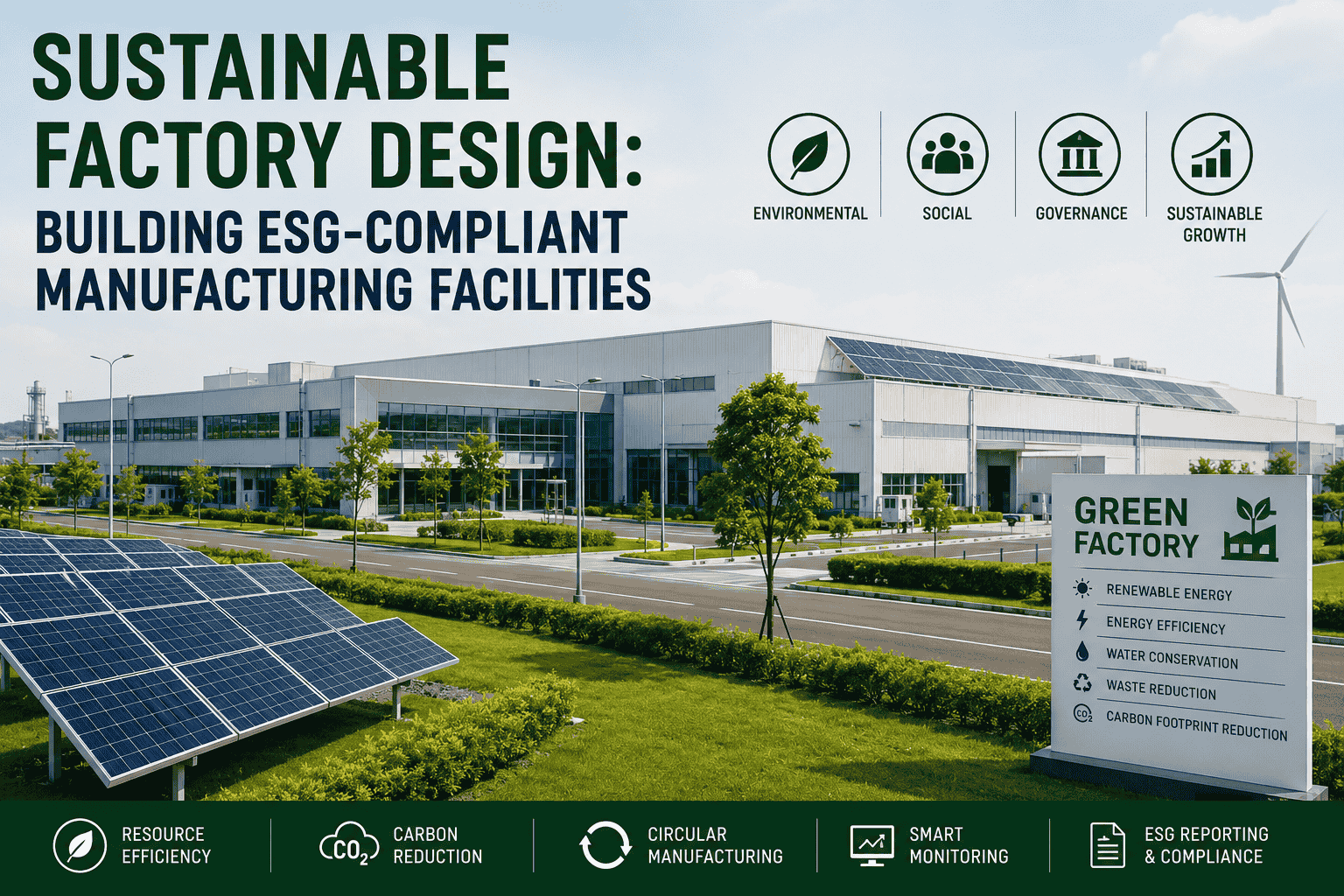
Sustainable Factory Design: Building ESG-Compliant Manufacturing Facilities
By Riley Quinn on June 11, 2026
ESG used to be a corporate report. Today it's a factory design decision. Manufacturers face simultaneous pressure from CSRD reporting mandates, investor scrutiny, customer scope-3 demands, and rising carbon prices — and the factories being built right now will operate inside those rules for the next 30 years. Greenfield is your one chance to design ESG compliance in, not bolt it on. Request an ESG readiness assessment to map sustainability into your factory before the slab is poured.
50% emissions cut by 2030 · 100% renewables · Full circularity
↓ 50%
CO₂ reduction by 2030
100%
Renewable electricity
↑ 70%
Water reuse rate
Zero
Manufacturing waste to landfill
Why ESG-Compliant Factory Design Is the New Baseline
The shift isn't optional anymore. EU CSRD reporting now covers thousands of manufacturers. Major customers demand scope-3 emissions data. Carbon pricing is hitting €80+/ton in the EU ETS. And investors increasingly screen out non-ESG-aligned manufacturers. The factories that win the next decade are the ones designed for these realities from concrete pour, not retrofitted after their first carbon audit.
Regulatory
CSRD, EU Taxonomy, CBAM, SEC climate disclosure rules
Financial
Green financing, carbon pricing, ESG-linked credit lines
Energy/water costs, talent attraction, license to operate
The 6 Pillars of Sustainable Factory Design
Sustainable factory design isn't one decision — it's six interlocking domains, each with its own metrics, technologies, and design choices. Get them right together and you build a net-zero-ready facility. Get any one wrong and you create operational debt that compounds for decades.
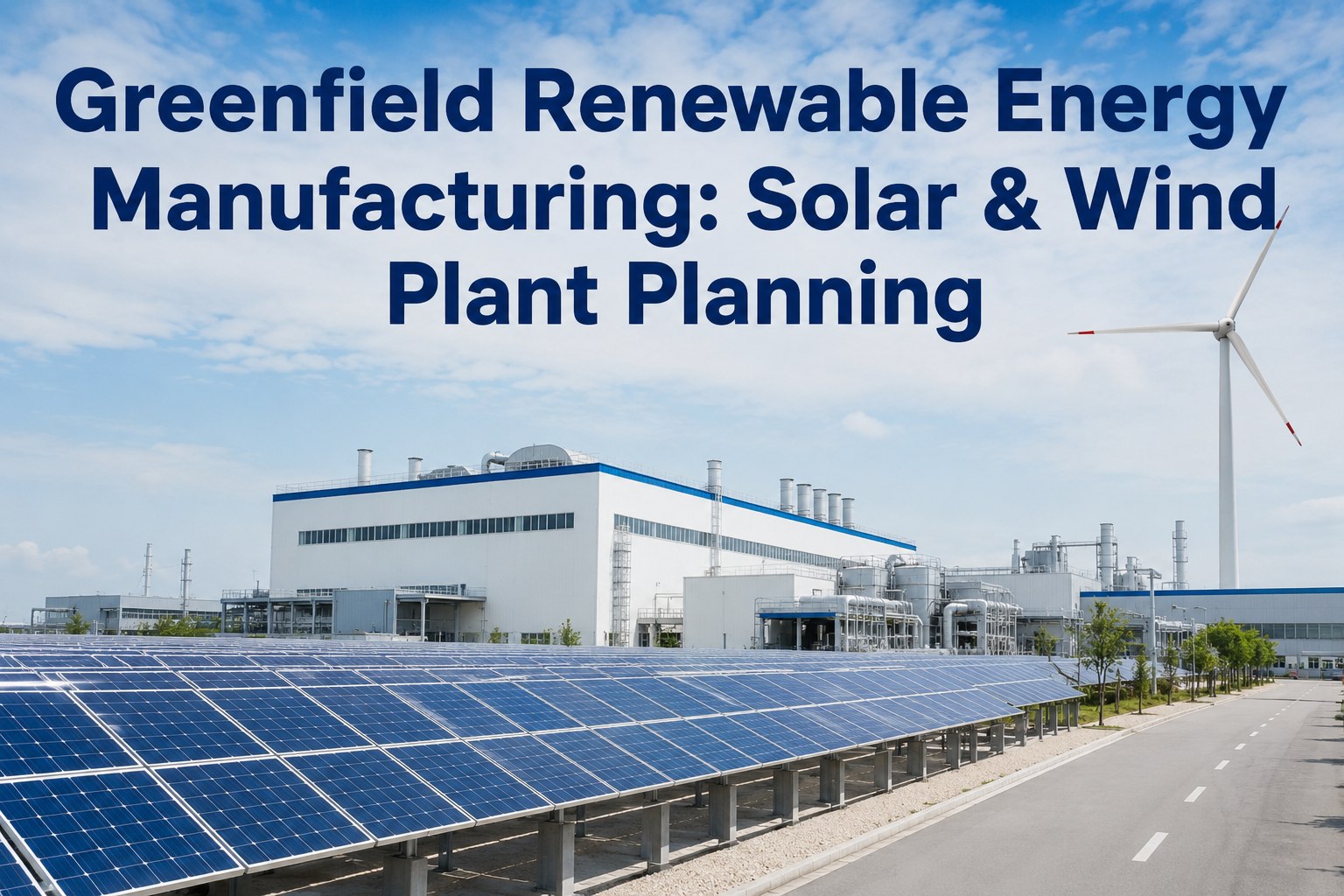
Energy is the largest lever in any sustainable factory design — typically 60-80% of operational scope-1 and scope-2 emissions. The greenfield design choice isn't "should we go renewable" but "what's our energy mix and what's the timeline." LEGO's Binh Duong factory runs on 12,400 solar panels and a Direct PPA. Schneider Electric Le Vaudreuil targets 90% renewables. The blueprint exists.
Recommended Greenfield Energy Mix · Net-Zero Ready
Solar 40%
Wind/PPA 25%
Storage 15%
Green grid 20%
On-site solar PV
Maximum rooftop + carports. Aim for 30-50% of base load.
Direct PPA
Lock 10-15 year wind/solar purchase agreements at fixed prices.
Battery storage
Time-shift renewables, peak shaving, backup. Size for 4-8 hours of base load.
Electrification
Heat pumps, induction heating, electric forklifts. Eliminate scope-1 fossil dependencies.
Heat recovery
Capture process heat for space heating, water heating, absorption chillers.
Pillar 2 · Water Stewardship & Closed-Loop Systems
Water is the next ESG flashpoint. Climate stress, rising tariffs, and regulatory limits are reshaping what "available" water means in industrial contexts. The greenfield play is engineered closed-loop systems — water enters once, gets reused multiple times, and leaves only after rigorous treatment. Some industries (textiles, distilleries, pulp & paper) face ZLD mandates already.
01
Intake
Rainwater harvesting + municipal + bore well
→
02
Process Use
Cooling, cleaning, mixing, rinsing
→
03
Treatment
Primary + secondary + tertiary + UF/RO
→
04
Reuse
Cooling towers, boilers, irrigation, sanitation
↻
05
ZLD (Optional)
For mandated industries: evaporator + crystallizer
70-95%
Water reuse achievable with closed-loop design
↓ 60%
Freshwater withdrawal vs traditional factories
3-5 yr
Typical payback on water recycling investments
Build ESG Compliance Into Your Factory Design
iFactory's greenfield consulting team designs energy, water, and emissions architectures that meet today's mandates and tomorrow's tightening standards. Bring your project — we'll bring the sustainability engineering.
Net zero isn't a single project — it's a phased journey across three carbon scopes over 25+ years. Scope 1 (direct emissions from factory operations), Scope 2 (purchased electricity), and Scope 3 (supply chain and use phase). The factories that achieve net zero design the phasing into their original masterplan. Siemens Amberg cut emissions 50% while growing output 70% — proof that decarbonization and growth aren't trade-offs.
Today · 2026 Baseline
0%
Baseline & Quick Wins
Comprehensive carbon footprint (Scope 1, 2, 3)
Energy audit + low-cost efficiency upgrades
Switch to 100% renewable electricity contracts
→
2030 Milestone
↓ 50%
Electrification & Renewables
On-site solar at maximum rooftop footprint
Heat pumps replace gas boilers
Electric vehicle fleet, charging infrastructure
→
2040 Milestone
↓ 75%
Deep Decarbonization
Hydrogen or biofuel for residual high-heat processes
Scope-3 supplier engagement & mandates
Circular materials replace virgin inputs
→
2050 Target
Net Zero
Full Net-Zero Operations
Residual emissions offset via high-quality removals
100% circular materials & closed-loop production
Continuous ESG reporting embedded in operations
Where does your factory sit on the net-zero roadmap? Book a carbon strategy session to model your decarbonization pathway.
Pillar 4 · Circular Manufacturing in Practice
Linear manufacturing — take, make, dispose — is incompatible with net-zero targets. Circular manufacturing closes the loops at every stage: design products for disassembly, reuse process water, recover byproducts, refurbish components, and recycle materials back to inputs. The most sustainable factory is the one that doesn't need virgin materials.
You can't decarbonize what you don't measure — and you can't satisfy CSRD/SEC disclosure rules without continuous, audit-ready data. Modern greenfield factories embed IoT sustainability monitoring from day one, feeding real-time energy, water, emissions, and material flows into compliance dashboards that generate disclosure reports automatically.
Energy
kWh per unit produced
Renewable %
Peak demand
Power factor
Water
m³ withdrawn
Reuse rate
Effluent quality
Rainwater capture
Emissions
Scope 1 (direct)
Scope 2 (electricity)
Scope 3 (value chain)
Carbon intensity / unit
Materials
Recycled content %
Waste diverted
Hazardous waste
Circularity rate
Need a sustainability monitoring platform that reports CSRD-ready data automatically? Schedule a demo of iFactory's ESG monitoring stack.
ESG Frameworks Mapped to Factory Design
The alphabet soup of ESG frameworks can paralyze decision-making. The good news: they're highly correlated. Master the 4 frameworks below and you'll cover 90%+ of disclosure requirements globally. Design your monitoring infrastructure to capture the underlying data, and reporting becomes a formatting exercise rather than a fire drill.
Mandatory disclosure in UK, Japan, NZ · Foundation of most climate rules
Expert Perspective
Sustainable factory design isn't a sustainability initiative — it's a competitive strategy disguised as one. The factories built right today inherit lower operating costs, cheaper financing, fewer regulatory surprises, and easier customer audits for the next three decades. Siemens Amberg proved you can cut emissions 50% while growing output 70%. That's not a sustainability story. That's an operating advantage your competitors will spend a decade catching up to.
— Sustainable Manufacturing Best Practice
↓ 50%
Siemens Amberg emissions cut while output grew 70%
100%
LEGO Vietnam renewable electricity by 2026
93.4%
Samsung global manufacturing renewables in 2023
€80+/t
EU ETS carbon price reshaping investment math
Bottom Line · Build for the ESG World That's Coming
Sustainable factory design isn't an idealistic add-on anymore — it's the baseline operating model for any manufacturer who plans to be relevant in 2040. The six pillars above (energy, water, carbon, circularity, monitoring, reporting) compound when designed together. The companies that get this right at greenfield will spend the next 30 years harvesting cost savings, regulatory tailwinds, and customer preference. The ones that don't will spend that same time retrofitting buildings that fight their sustainability goals. Greenfield is your one window. Make it count.
Design Your Factory for the ESG Decade
iFactory's greenfield consulting team helps manufacturers integrate energy strategy, water stewardship, circularity, smart monitoring, and ESG reporting into a single coherent factory blueprint — from concept through commissioning. Build it right, once.
Sustainable factory design is the practice of architecting manufacturing facilities to minimize environmental impact across their entire lifecycle — from construction through 30+ years of operations. It rests on six interconnected pillars: renewable energy integration, water stewardship and closed-loop systems, carbon reduction toward net zero, circular manufacturing principles, smart sustainability monitoring, and ESG-aligned reporting. Unlike traditional factory design, which prioritizes production capacity and cost first, sustainable design weighs energy mix, emissions profile, material flows, and environmental compliance equally with throughput. The result is a facility built to operate profitably within tightening ESG regulations, rising carbon prices, and customer scope-3 mandates that will dominate manufacturing economics for the next three decades.
How do manufacturers achieve net-zero in factory operations?
Net-zero manufacturing requires a phased four-stage roadmap. Baseline phase (today): comprehensive Scope 1, 2, 3 carbon footprinting, energy audits, and immediate efficiency upgrades plus 100% renewable electricity contracts. 2030 milestone (50% reduction): on-site solar at maximum rooftop footprint, heat pumps replacing gas boilers, electric fleets and forklifts, battery storage. 2040 milestone (75% reduction): hydrogen or biofuels for residual high-temperature processes, scope-3 supplier engagement, circular material flows replacing virgin inputs. 2050 net-zero target: residual emissions offset via high-quality removals, fully circular operations, continuous ESG reporting embedded in MES/ERP. Siemens Amberg has cut emissions 50% while growing output 70% since 2015, targeting carbon neutrality by 2026 — proof that decarbonization and production growth aren't trade-offs.
What is the difference between Scope 1, 2, and 3 emissions in manufacturing?
Scope 1 emissions are direct emissions from sources the manufacturer owns or controls — boilers, furnaces, on-site fleet vehicles, refrigerants. Scope 2 emissions come from purchased electricity, steam, heat, or cooling — the manufacturer doesn't burn the fuel directly, but their consumption causes it. Scope 3 emissions are all other indirect emissions across the value chain — purchased materials, upstream transportation, employee commuting, product use, end-of-life disposal. Scope 3 is typically 70-90% of a manufacturer's total carbon footprint and the hardest to address, requiring supplier engagement and product redesign. Modern ESG disclosure rules (CSRD, SEC climate disclosure, TCFD) now require Scope 1, 2, and material Scope 3 reporting — meaning greenfield factories need data infrastructure to track all three from day one.
What ESG frameworks should manufacturers comply with?
The four most important frameworks for manufacturers are CSRD (EU's Corporate Sustainability Reporting Directive — mandatory for 50,000+ companies, applies to many global firms with EU operations), GRI (Global Reporting Initiative — the most widely used voluntary framework, used by ~75% of S&P 500 sustainability reports), SASB (Sustainability Accounting Standards Board — industry-specific metrics with financial materiality focus, now part of IFRS Foundation), and TCFD (Task Force on Climate-Related Financial Disclosures — mandatory in UK, Japan, NZ, foundation of most climate rules globally). These frameworks are highly correlated. Design monitoring infrastructure to capture the underlying data (energy, water, emissions, materials, governance), and reporting becomes a formatting exercise across frameworks rather than separate fire drills for each.
How much does it cost to build a sustainable factory?
Sustainable factory design typically adds 5-15% to upfront construction costs versus conventional designs, but pays back within 3-7 years through lower operating expenses, faster green financing, and avoided carbon costs. Major cost categories: on-site renewable energy infrastructure (solar PV at $1-2/W installed plus battery storage at $300-600/kWh), closed-loop water systems (3-5 year payback typical), heat recovery and electrification (varies widely), IoT monitoring infrastructure (typically 1-3% of total CAPEX), and ESG reporting platforms (typically $50K-$500K annually). The hidden math: factories without sustainable design face rising carbon prices (EU ETS at €80+/ton and climbing), higher financing costs, customer scope-3 penalties, and retrofit costs that run 5-10x more than building right at greenfield. Book a sustainable factory CAPEX consultation to model your specific project.