Industrial Flooring for Manufacturing Plants: How to Choose the Right System
By Riley Quinn on June 11, 2026
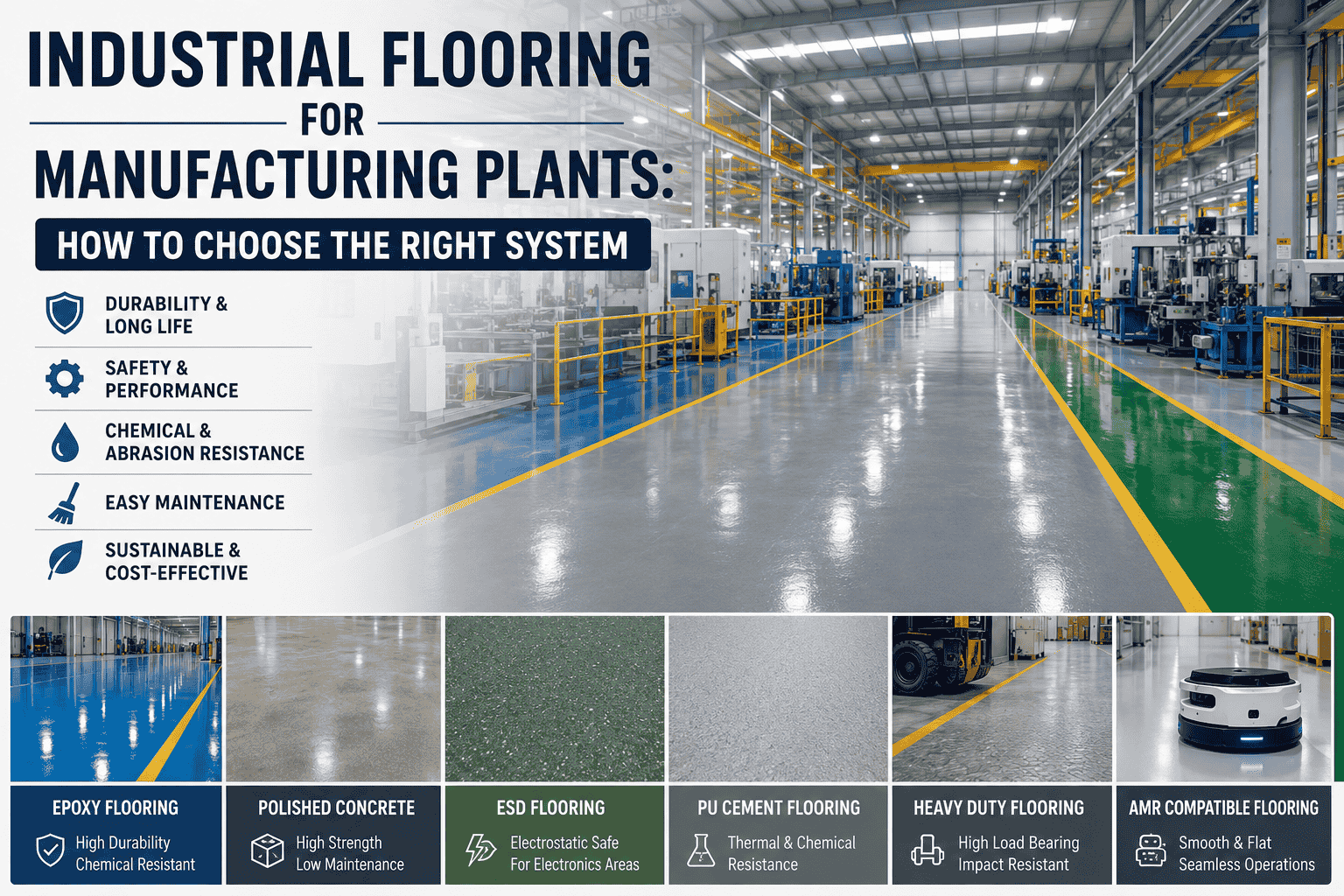
Your factory floor takes a beating most other infrastructure never faces — forklift impact, chemical spills, thermal shock, abrasion, ESD risk, and AMR navigation demands. Choosing the wrong system means ripping it out at 5 years instead of getting 25. This buyer's guide compares the five dominant industrial flooring systems on cost, durability, and fit so your greenfield gets it right the first time. Book a factory design consultation to match the right flooring to your specific operation.
Industrial Flooring Systems · 2026 Comparison
5 Systems · 1 Long-Term Decision
Polished Concrete
$4-$12 /sq ft
20+ yrs
Epoxy Coating
$3-$15 /sq ft
10-15 yrs
Urethane Cement
$10-$20 /sq ft
20-25 yrs
ESD Anti-Static
$8-$15 /sq ft
10-15 yrs
Chemical-Resistant
$10-$20 /sq ft
15-20 yrs
5-10x
Replacement cost vs. building right
25 yrs
Achievable lifespan with right system
$2-$20
Cost per sq ft range across systems
Why Floor Selection Is a 30-Year Decision
The factory floor is the most expensive thing to replace in any manufacturing facility. Unlike equipment that can be retrofitted in a weekend or networks that can be re-cabled in a month, replacing a failing floor means months of shutdown, contamination control, and operational chaos. A wrong choice at greenfield doesn't just cost the floor — it costs production, compliance, and customer trust. The right system pays back every quarter for two decades.
Wrong material
Premature failure in 3-5 years vs. 20-25 years lifespan
Wrong thickness
Cracks under forklift loads, exposing substrate
Wrong chemistry
Floor dissolves on first major chemical spill
Wrong substrate prep
Coating delaminates in months regardless of material spec
The 5 Industrial Flooring Systems Explained
Each of the five major flooring systems was engineered for a specific failure mode. Knowing what each is designed to resist — and what it isn't — is the foundation of every good selection decision. Here's how the five stack up across the dimensions that actually matter.
01
Polished Concrete
Budget Workhorse
Mechanically ground and densified concrete with no coating layer. The cheapest long-term option for facilities without chemical exposure or hygiene mandates. Reflective finish improves lighting efficiency 30%+.
Best forWarehouses, distribution, light manufacturing
Avoid forChemical processing, food & beverage, ESD zones
StrengthsLow cost · Long life · Easy repair
WeaknessesStains easily · Not seamless · Requires re-polishing
02
Epoxy Coating
All-Purpose Workhorse
Resin-based seamless coating in 2-coat to multi-coat systems. The most widely deployed industrial flooring globally. Quartz, flake, and metallic options give design flexibility while maintaining performance.
Best forGeneral manufacturing, automotive, electronics
Avoid forContinuous wet processing, thermal shock zones
StrengthsSeamless · Customizable · Chemical resistant
WeaknessesUV yellowing · 24-72hr cure time · Sensitive to moisture
03
Urethane Cement
Heavy-Duty Specialist
Cementitious urethane mortar with the highest thermal shock and chemical resistance of any coating. Withstands steam cleaning, boiling water, freezer transitions. The food & beverage and pharmaceutical standard.
Best forFood & beverage, dairy, pharma, chemical
Avoid forBudget-constrained light manufacturing
StrengthsThermal shock · Steam cleanable · 25-yr life
Conductive or static-dissipative coating with embedded copper grounding grid. Prevents catastrophic static discharge that destroys electronics, ignites solvents, or corrupts data. Mandatory in many electronics, defense, and chemical facilities.
Best forElectronics assembly, semi-fab, munitions, IT
Avoid forGeneral manufacturing with no static concern
WeaknessesPremium cost · Specialized testing · Re-coats with care
05
Chemical-Resistant Systems
Aggressive Environments
Specialized novolac epoxies, vinyl esters, or polyaspartics formulated for direct contact with acids, solvents, caustics, and hot oils. The last line of defense between aggressive chemistry and your concrete substrate. Often built up to 1/4" thick mortar systems.
Best forPlating, battery production, petrochemicals, labs
Avoid forLight-duty environments (overkill)
StrengthsAcid · Solvent · Caustic resistance
WeaknessesHighest cost · Slow cure · Niche installer base
Side-by-Side Comparison Matrix
The deep dives above explain each system. The matrix below lets you compare all five across the eight criteria that actually drive real-world selection. Use the dot ratings as a first filter before requesting quotes — they'll tell you which 2-3 systems make your shortlist.
Criterion
Polished Concrete
Epoxy
Urethane Cement
ESD
Chemical-Resist
Initial cost
Durability
Chemical resistance
Thermal shock
ESD / anti-static
—
—
—
Cleanability / hygiene
Install lead time
Typical lifespan
20+ yr
10-15 yr
20-25 yr
10-15 yr
15-20 yr
Stop Guessing on Floor Specifications
iFactory's facility design team walks through your specific production processes, chemical exposures, and traffic patterns — then specs the right flooring system, thickness, and finish for each zone. Avoid the $500K rip-out two years from now.
Every industry has dominant failure modes that drive flooring selection. Food & beverage worries about thermal shock and bacteria. Electronics worries about static. Chemical processing worries about acid attack. Use this industry fit matrix to see which systems are recommended, acceptable, or avoid-at-all-costs for your specific operation.
Industry
Polished Concrete
Epoxy
Urethane Cement
ESD
Chemical-Resist
Food & Beverage
Avoid
OK
Best
N/A
OK
Pharmaceutical
Avoid
OK
Best
OK
OK
Automotive Assembly
OK
Best
OK
OK
N/A
Electronics / Semi-Fab
Avoid
OK
N/A
Best
N/A
Chemical / Petrochem
Avoid
OK
OK
OK
Best
Warehouse / Distribution
Best
OK
N/A
N/A
N/A
Aerospace / Defense
OK
Best
OK
Best
OK
Multi-zone factory with different needs in different bays? Schedule a zoning consultation to spec the right floor for each production area.
What's Under the Surface · Floor System Anatomy
Every industrial floor failure traces back to the same root cause: bad preparation under a good surface. The visible top coat is only 5-10% of what makes a floor survive 25 years. The other 90% lives in the substrate, vapor barrier, primer, and base layers below. Here's how a properly engineered floor system stacks up.
05
Topcoat / Wear Layer
10-30 mils · UV-stable · slip-resistant texture
10-30 mils
04
Body / Base Coat
Self-leveling resin · broadcast aggregates · color layer
Initial cost per square foot tells only half the story. The cheaper systems often cost more over 20 years once you factor in maintenance, repairs, and premature replacement. Use the 20-year TCO model below to ground budget conversations in reality — and to defend higher-spec choices to procurement.
System
Initial Cost
20-Year TCO per sq ft
Total
Polished Concrete
$4-$12
$8-$18
Epoxy Coating
$3-$15
$12-$28
Urethane Cement
$10-$20
$14-$25
ESD Anti-Static
$8-$15
$16-$30
Chemical-Resistant
$10-$20
$15-$28
Counterintuitive but true: Urethane cement often has lower 20-year TCO than epoxy despite 2-3x higher initial cost — because it lasts 25 years vs. epoxy's 10-15 with fewer recoats.
Building a defensible CAPEX case for premium flooring? Book a TCO modeling session with our facility design team.
Selection Decision Framework
Faced with five options and a procurement deadline? Walk this decision tree. Each question reflects a real-world differentiator — not the marketing copy vendors will lead with. Five minutes here saves five months of selection meetings.
Q1
Will the floor face direct contact with strong acids, solvents, or caustics?
If yes → Chemical-Resistant System
Q2
Is the facility electronics, semiconductor, defense, or ESD-sensitive?
If yes → ESD Anti-Static System
Q3
Food & beverage, dairy, or pharma with steam cleaning and thermal cycling?
If yes → Urethane Cement
Q4
General manufacturing with moderate chemical and impact exposure?
If yes → Epoxy Coating (right thickness for your loads)
Q5
Warehouse, distribution, or light manufacturing with no chemistry?
If yes → Polished Concrete
Expert Perspective
Most factories don't fail because they picked the wrong floor — they fail because they specified one floor for the whole building. A modern manufacturing facility has at least 3-4 different floor zones with different exposures. Receiving, production, packaging, and quality lab all have different chemical, traffic, and hygiene profiles. Spec each zone independently, and you save 30-40% on cost while extending lifespan. Treat the floor as one decision, and you over-engineer half your building.
— Industrial Flooring Best Practice
3-4
Floor zones in typical modern factory
30-40%
Cost savings from zone-specific specs
90%
Floor failures traced to bad substrate prep
25 yr
Achievable lifespan with right system + prep
Bottom Line · Spec the Floor Your Factory Actually Needs
Industrial flooring is one of the few greenfield decisions where the cheap path is genuinely cheap — for the first three years. After that, the math flips violently. Polished concrete for warehouses, epoxy for general manufacturing, urethane cement for food and pharma, ESD for electronics, chemical-resistant for aggressive chemistry. Spec by zone, prep the substrate religiously, and your floor outlasts the equipment running on it. Get this right at greenfield and you'll be one of the few factories that never re-floors mid-life.
Get Your Greenfield Flooring Specified Right
iFactory's facility design team partners with greenfield project teams to scope every floor zone, every transition, every substrate prep step — so your factory floor lasts as long as the building above it. Avoid the $500K retrofit. Build it right the first time.
What is the best industrial flooring for manufacturing plants?
There's no single best industrial flooring — the right choice depends on industry, chemical exposure, traffic load, and hygiene requirements. For general manufacturing and automotive, epoxy coatings deliver the best balance of cost, durability, and customization at $3-$15/sq ft. For food & beverage, dairy, and pharma facilities requiring steam cleaning and thermal cycling, urethane cement is the standard at $10-$20/sq ft with 20-25 year lifespan. For electronics, semiconductor, and defense facilities, ESD anti-static systems are mandatory at $8-$15/sq ft. For warehouses and distribution centers without chemical exposure, polished concrete at $4-$12/sq ft is the cost-effective choice. For chemical processing, plating, and battery production, specialized chemical-resistant systems at $10-$20+/sq ft are essential.
How much does industrial flooring cost per square foot?
Industrial flooring costs vary 5-10x depending on system type, thickness, and substrate condition. Sealed/polished concrete runs $2-$12/sq ft. Basic two-coat epoxy systems start at $3-$8/sq ft, while high-build epoxy with quartz broadcast or chemical-resistant topcoats reach $10-$15/sq ft. Urethane cement systems typically cost $10-$20/sq ft due to specialized installation and material costs. ESD anti-static systems run $8-$15/sq ft including the copper grounding grid. Specialized chemical-resistant novolac or vinyl ester mortars can exceed $20/sq ft for severe-service applications. Total project costs also depend heavily on concrete preparation requirements — moisture mitigation alone can add $2-$4/sq ft for substrates with high vapor transmission.
What is the difference between epoxy and polished concrete for factory floors?
Polished concrete is mechanically ground and densified concrete with no coating layer — the floor surface IS the concrete, just refined to a smooth, reflective finish. Epoxy is a separate resin coating applied over the concrete substrate, creating a seamless protective layer. Polished concrete is cheaper upfront ($4-$12/sq ft), lasts 20+ years with minimal maintenance, and improves lighting efficiency through reflectivity. But it stains easily, has visible joints, and offers no chemical resistance. Epoxy provides a fully seamless, chemical-resistant, customizable surface (quartz, flake, metallic finishes) at $3-$15/sq ft, but lasts only 10-15 years and is sensitive to UV yellowing and moisture during cure. For warehouses and light manufacturing, polished concrete wins. For chemical exposure or hygiene-critical operations, epoxy or urethane cement wins.
Why is ESD flooring required in electronics manufacturing?
ESD (electrostatic discharge) flooring is required in electronics, semiconductor, defense, and explosives manufacturing because static electricity buildup can cause catastrophic failures invisible to operators. A single static discharge as small as 25 volts (well below the 3,000V threshold humans can feel) can permanently damage sensitive electronic components, costing millions in scrap. In explosive or flammable environments, static discharge can ignite vapors. ESD floors use conductive or static-dissipative coatings combined with an embedded copper grounding grid to safely bleed off static charges before they cause damage. ANSI/ESD S20.20 is the dominant compliance standard, requiring resistance-to-ground between 1×10⁶ and 1×10⁹ ohms. Without ESD flooring, electronics facilities face yield losses, product failures, and warranty claims that dwarf the floor's premium cost.
How long do industrial floor coatings last in manufacturing plants?
Industrial floor lifespan varies dramatically with material choice, traffic intensity, chemical exposure, and substrate preparation quality. Polished concrete lasts 20+ years with periodic re-polishing. Standard epoxy coatings last 10-15 years in moderate-duty environments but can fail in 3-5 years under heavy chemical exposure or thermal shock. Urethane cement is the long-life champion at 20-25 years, withstanding steam cleaning, freezer transitions, and aggressive chemistry. ESD anti-static systems typically last 10-15 years before the conductive properties begin degrading. Chemical-resistant systems run 15-20 years. The single biggest predictor of actual lifespan isn't the material — it's substrate preparation. Approximately 90% of premature floor failures trace back to inadequate concrete prep (insufficient grinding, contamination, moisture issues), not material defects. Book a flooring spec review to validate your substrate preparation requirements.