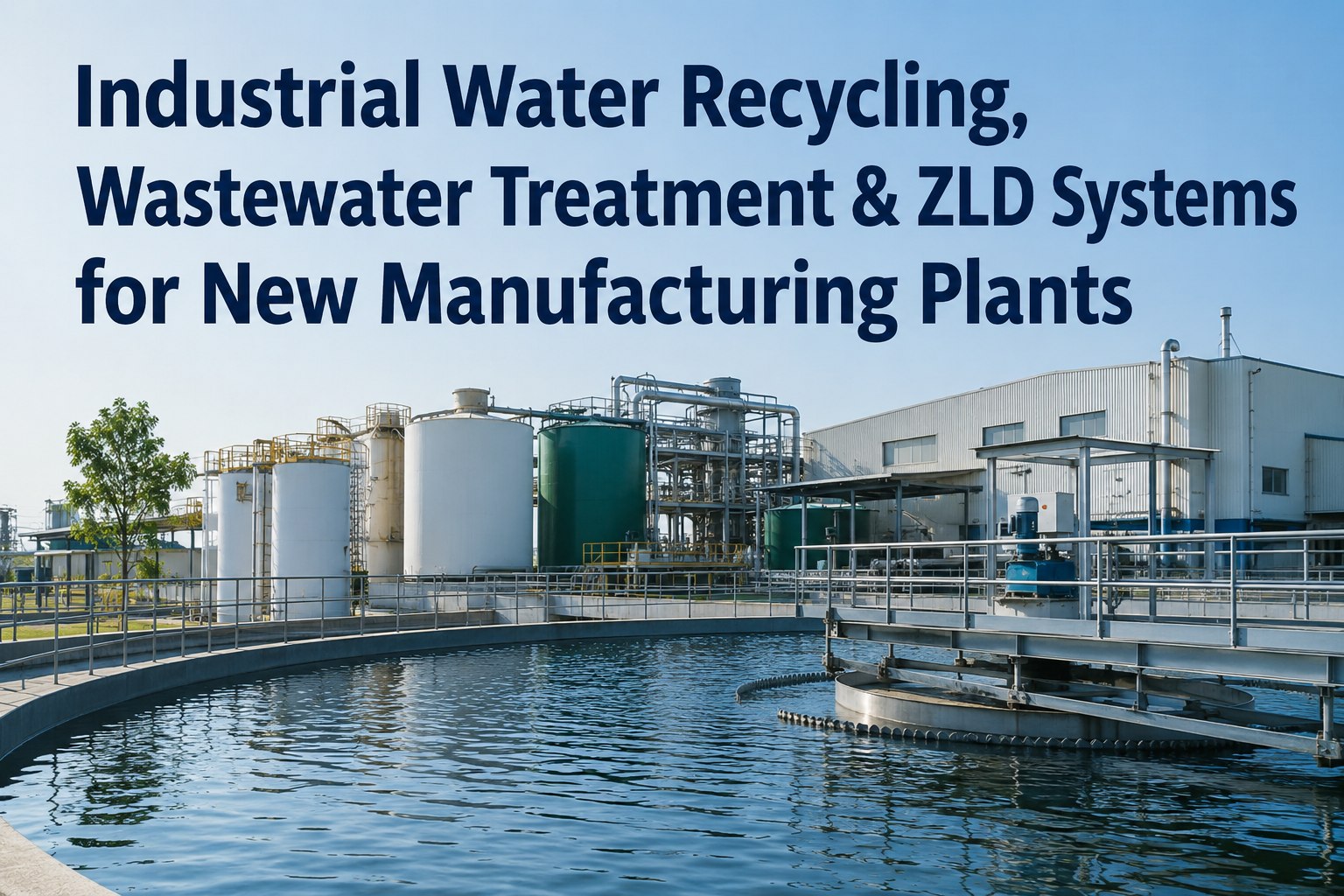
Water is no longer a utility line item — it's a regulatory, ESG, and operational survival issue. CPCB has made Zero Liquid Discharge mandatory across 17 polluting industries, OCEMS monitoring is now compulsory for medium-to-large plants, and EU/US buyers demand ZLD certification in supply chain due diligence. The good news: modern ZLD systems recover 85-95% of process water with 3-5 year payback. This guide breaks down water balance planning, the 5-stage treatment train, industry-specific ZLD requirements, and the ROI math that justifies the CAPEX. Book a water assessment for your greenfield plant to see how it applies to your facility.
Source
Fresh Water
100 KL/day
Groundwater · Municipal · Surface
→
Process
Factory Operations
Cooling · Cleaning · Reactions · Boilers
→
Effluent
Wastewater
~95 KL/day
High COD · TDS · BOD
→
ZLD Train
Treatment + Recovery
UF · RO · MEE · ATFD
~85 KL/day
Recycled to Process
↻ Closes the loop
~10 KL/day
Solid Residue
Salts · Sludge · Recovery
$211M
Indian ZLD market by 2026
17
Industries with mandatory ZLD
60-85%
Typical water recovery rate
3-5 yr
Typical ZLD payback period
Why ZLD Became Mandatory in 2026
Five compounding pressures have moved ZLD from "nice-to-have sustainability initiative" to "operational survival requirement" — and ignoring any single one of them creates real business risk in 2026.
01
CPCB Mandates Expanded
17 polluting sectors now under mandatory ZLD requirements. OCEMS continuous monitoring transmits compliance data directly to SPCB servers — no more monthly sampling loopholes.
02
Buyer Compliance Pressure
EU and US buyers demand ZLD certification in supply chain due diligence. ESG ratings, export contracts, and tier-1 customer relationships now depend on verifiable water stewardship.
03
Groundwater Depletion
Industrial hubs face water rationing and consent renewals tied to recycle ratios. Greenfield plants in water-stressed states cannot get fresh water allocation without ZLD commitments.
04
Resource Recovery Economics
Crystallized salts, recovered chemicals, biogas, and even rare metals create revenue streams. Modern ZLD acts as a biorefinery, not just a treatment plant.
05
Penalty & Shutdown Risk
CPCB closures, environmental compensation orders, and criminal proceedings under the EP Act 1986. Non-compliance penalties now exceed ZLD CAPEX in many cases.
The 5-Stage ZLD Treatment Train
A modern ZLD system isn't a single magic box — it's a multi-stage train where each stage prepares effluent for the next. The 5 stages below cover the full treatment sequence from raw wastewater to crystallized solid residue and recycled water.
01
Pretreatment
Screening · Equalization · pH neutralization
Remove large solids, balance flow and pH spikes before biological stage
02
Primary Treatment
Coagulation · Flocculation · Sedimentation
Chemically settle suspended solids, oils, and emulsions out of effluent
03
Secondary / Biological
MBR · Activated sludge · Anaerobic digester
Microbial digestion of dissolved organics — reduces BOD and COD by 90%+
04
Tertiary (Recovery)
Ultrafiltration · Reverse Osmosis
UF + RO is the gold standard — produces high-quality recycled water at 70-80% recovery
05
ZLD Concentration
MEE · MVR · ATFD · Crystallizer
Evaporate RO reject brine to dry solids — closes the loop with zero liquid discharge
Industries Required to Implement ZLD
Not all manufacturing needs ZLD — but the list of industries where it's mandatory keeps growing. CPCB has classified 17 industrial sectors as "Red Category" with ZLD obligations, and these are the sectors where greenfield plants cannot get water consent without ZLD planning.
Textile & Dyeing
Dye-house effluents with high TDS, salts, color
UF + RO + MEE for salt recovery
Pharmaceutical
High COD/TDS from API manufacturing
MEE + stripper for VOC removal
Distillery
Spent wash with extreme BOD (30,000-80,000 mg/L)
Biomethanation + composting/incineration
Chemical & Petrochemical
Complex organics, hazardous compounds
Multi-stage with hazardous waste recovery
Pulp & Paper
High BOD, lignin, bleaching chemicals
Biological + tertiary + ZLD
Tannery & Leather
Chromium, sulfides, high salinity
Chromium recovery + ZLD
Power Plant (FGD)
Flue gas desulfurization wastewater
Saline-stream membranes + thermal
Food & Beverage
High organic load, seasonal variability
Biological + UF/RO for process reuse
Plan ZLD Into Your Greenfield Project From Day One
Adding ZLD to an existing plant costs 2-3x more than designing it into a greenfield from the start. iFactory's water systems team designs ZLD architectures during concept design — sized for actual process water demand, with the right technology mix for your industry and effluent characteristics.
Water Balance Planning Framework
Every ZLD design starts with a water balance — a quantified accounting of every liter in, every liter out, and every liter recycled. Without an accurate water balance, you'll oversize the ZLD train (waste CAPEX), undersize it (miss compliance), or both. Use the 5-input framework below to build your balance.
Water Input / Output
Typical Range
Notes
Fresh water intake
100 KL/day (baseline)
Set by consent + actual process demand
Process consumption (in product)
2-10% of intake
Water leaving with finished goods
Evaporation losses
10-25% of intake
Cooling towers, drying, ambient
Wastewater generated
65-88% of intake
Must equal sum of recovered + residue
Recycled to process
60-85% of wastewater
Higher % = lower fresh water demand
Solid residue (ZLD output)
5-15% of wastewater
Salts, sludge for TSDF or recovery
Need a quantified water balance for your specific process? Book a water balance modeling session with our greenfield team.
ROI Math · What ZLD Actually Pays Back
ZLD economics aren't just about avoiding fines — modern systems deliver real ROI through 5 distinct value streams. The framework below shows how a typical mid-sized manufacturing facility builds a 3-5 year payback case on a ₹3-8 crore ZLD CAPEX.
Fresh Water Cost Avoidance
60-85% reduction in groundwater/municipal intake
Highest
Penalty & Shutdown Risk Avoidance
CPCB penalties, EC orders, criminal exposure under EPA
High
TSDF Disposal Cost Reduction
Lower sludge volumes through optimized pretreatment
Medium
Resource Recovery Revenue
Crystallized salts, recovered chemicals, biogas sales
Medium
Export Market & ESG Premium
Buyer compliance, ESG rating improvement, supply chain access
Strategic
₹3-8 Cr
Typical ZLD CAPEX (mid-size mfg)
3-5 yr
Typical payback period
15-25%
Annual IRR including risk avoidance
Need a project-specific ROI model with your actual water costs and CAPEX? Connect with our water economics team for a custom TCO build.
5 ZLD Implementation Mistakes to Avoid
Most failed ZLD installations fail for predictable, avoidable reasons. The five mistakes below account for the majority of underperforming systems we see in greenfield audits.
01
Designing ZLD Without Accurate Water Balance
Estimated water demand produces oversized or undersized systems. Build the balance from process flow sheets, not vendor templates.
02
Ignoring Effluent Variability
Average values hide spikes. Design for 90th-percentile load on COD, TDS, and flow — not average. Spikes are what trip biological stages.
03
Cheaping Out on Pretreatment
Inadequate pretreatment fouls RO membranes and crashes MEE performance. Spend on pretreatment to protect downstream CAPEX.
04
No OCEMS Integration Plan
2026 mandates require continuous monitoring transmitted to SPCB. Design OCEMS sensors and data path during the system design — not as an add-on.
05
No Operating Team Training Plan
ZLD is operations-intensive. Without trained operators, recovery rates degrade 20-30% within a year. Plan training as part of commissioning.
Avoid these mistakes by engaging water systems experts during concept design. Book a ZLD design review with our greenfield team.
Expert Perspective
The greenfield plants that get ZLD right share one habit: they treat water as a process input, not a utility. They build the water balance in week one — before the equipment list, before the floor plan, before the consent application. By the time they're in detailed design, the water architecture is locked. The plants that retrofit ZLD eighteen months after startup pay 2-3x more, lose months to consent renegotiation, and end up with bolted-on systems that never hit design recovery. Design ZLD into your concept, not your construction.
— Greenfield Water Systems Best Practice
12,000 MLD
Industrial wastewater India per day
$211M
Indian ZLD market by 2026
2-3x
Retrofit cost vs greenfield ZLD
OCEMS
Now mandatory for medium-large plants
Bottom Line · Water Is Now a Design Decision
ZLD has moved from optional sustainability initiative to mandatory operational reality. CPCB enforcement, OCEMS monitoring, ESG ratings, and export buyer demands have collapsed into one requirement: prove your water is recycled. The plants that design ZLD into greenfield concept land their systems at 60-85% recovery with 3-5 year payback. The plants that retrofit pay double and lose a year of operations. Start your water balance during concept design — not after equipment selection — and you'll build a facility ready for the next decade of water regulation.
Design Water Recovery Into Your Next Factory From Day One
iFactory's greenfield water practice builds ZLD architectures during concept design — water balance modeling, treatment train sizing, OCEMS integration, ROI validation. Built for the 2026 regulatory environment, with the technology mix that fits your specific industry and effluent profile.
Frequently Asked Questions
What is Zero Liquid Discharge (ZLD)?
A wastewater treatment approach where no liquid effluent leaves the facility. Treated water is recycled to process; remaining contaminants concentrate as solid residue (salts, sludge). Typical recovery: 60-85% of process water. Required by CPCB across 17 polluting industries in India.
What are the 5 stages of a ZLD treatment train?
1. Pretreatment (screening, equalization). 2. Primary (coagulation, sedimentation). 3. Biological (MBR, activated sludge — cuts BOD/COD 90%+). 4. Tertiary (UF + RO recovers 70-80% as clean water). 5. ZLD concentration (MEE, MVR, ATFD, crystallizer for brine to solids).
Which industries are required to implement ZLD in India?
CPCB mandates ZLD for 17 "Red Category" sectors including textile and dyeing, pharmaceuticals, distillery, chemical, pulp and paper, tannery, power plants (FGD), and F&B. New greenfield plants in these sectors cannot get water consent without ZLD planning.
What is the typical ZLD payback period?
Most mid-sized manufacturing facilities see 3-5 year payback on ₹3-8 Cr ZLD CAPEX. Returns come from fresh water cost avoidance (60-85% intake reduction), penalty risk elimination, TSDF disposal savings, recovered salt and chemical revenue, and ESG/export market access. Typical IRR: 15-25%.
Why design ZLD into a greenfield plant instead of retrofitting?
Retrofitting ZLD costs
2-3x more than greenfield design and disrupts operations. Greenfield integration lets you size treatment to actual water balance, integrate OCEMS from day one, and locate equipment without space constraints.
Book a greenfield water design session to plan it correctly the first time.