Massive end-of-project punch lists are the #1 reason factory startups slip schedule. The fix isn't a better spreadsheet — it's a rolling punch list system started during construction with A/B/C priority classification, discipline-specific tracking, and a closure workflow that requires owner verification (not just contractor self-signoff). This template covers all 6 disciplines — mechanical, electrical, automation, HVAC, fire protection, and IT/OT — with the actual punch list structure, resolution workflow, and sign-off matrix you can implement on Monday. Book a commissioning readiness assessment before your next handover date.
01
Mechanical Completion
Construction quality verification, ITR-A/B closure, P&ID walkdown
Low PL activity
→
02
Pre-Commissioning
Static checks, dry runs, instrument calibration, loop checks
Med PL activity
→
03
Functional Performance Testing
Dynamic testing, sequence verification, FAT/SAT execution
Peak PL activity
→
04
Punch List Resolution
Category A closure, B mitigation, C tracking with warranty backing
Closure focus
→
05
Handover & First Production
Owner sign-off, ops team transition, initial production runs
Residual C-items
Items generated during phases 1-3 · resolved primarily in phase 4 · zero open Category A items at handover gate.
Priority Classification · The A/B/C System
Without explicit priority classification, every punch item becomes "we'll get to it" and the project drags into months of stalled handover. The A/B/C system used across oil & gas, pharma, and large-scale manufacturing assigns clear closure obligations to each severity tier — and ties each tier to a specific commissioning gate.
Category A
Critical · Blocks Startup
Safety, code, regulatory, or functional defect that prevents commissioning, operation, or compliance. Must be resolved before commissioning can proceed.
ExampleMissing arc flash label on MCC
GatePre-commissioning entry
AuthorityCxA + Owner approval to close
Category B
Significant · Blocks Handover
Functional or performance issue that doesn't prevent startup but must be resolved before owner accepts the facility. System may operate but not at full design intent.
ExamplePLC tag mismatch with documentation
GateSubstantial completion
AuthorityDiscipline lead + Owner verify
Category C
Minor · Trackable Post-Handover
Cosmetic, documentation, or non-critical functional items. Can be resolved post-handover under warranty with formal tracking and agreed closure date.
ExampleTouch-up paint on equipment enclosure
GateFinal acceptance (90-day warranty)
AuthorityDiscipline lead verify only
The 6 Discipline Categories
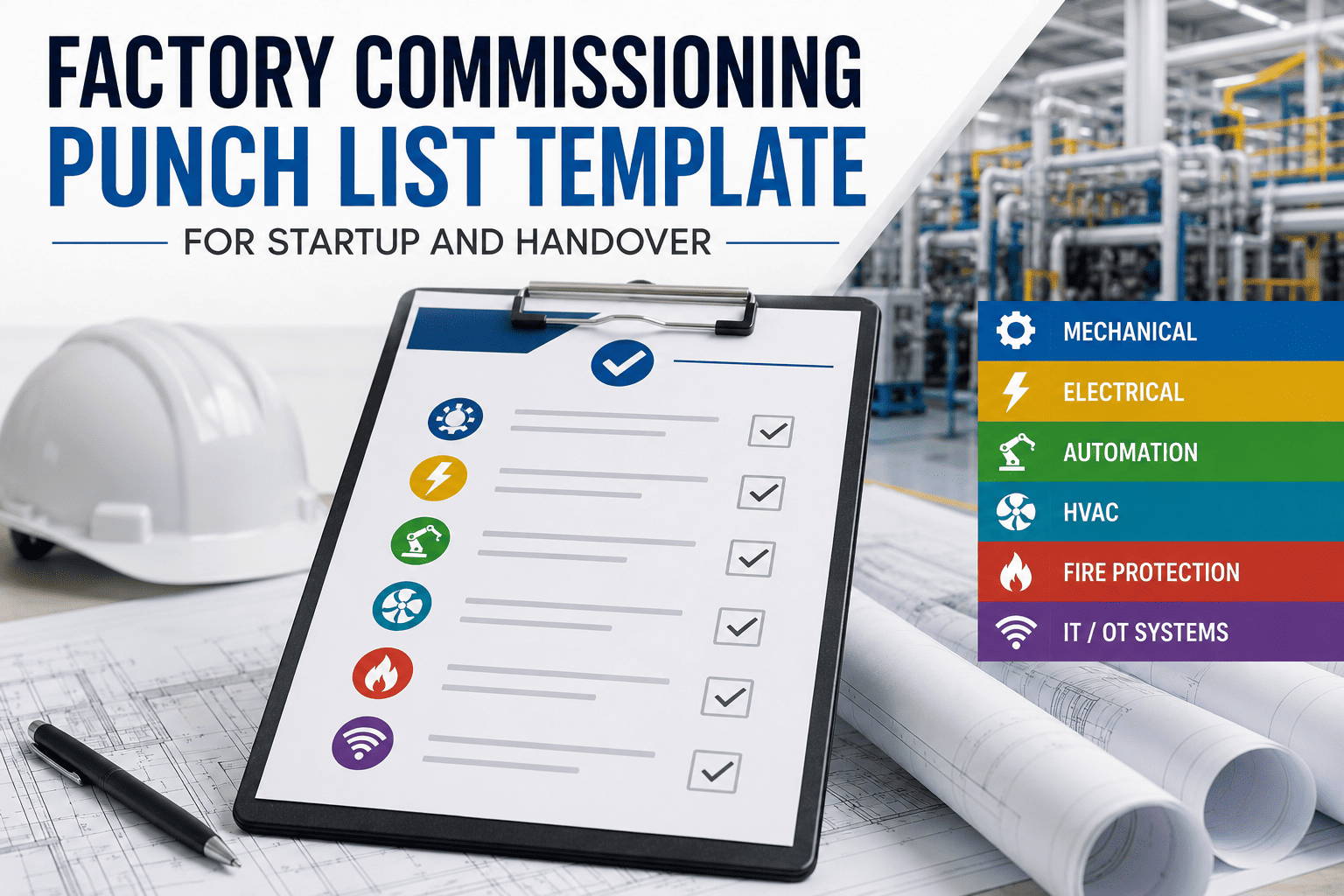
Modern factory commissioning spans six engineering disciplines, each with its own punch list patterns and resolution paths. Group items by discipline in your tracker — not by location — because closure depends on which subcontractor or vendor owns the work. Disciplines below cover ~95% of items in a typical greenfield manufacturing commissioning.
ML-XXX
Mechanical
Piping, pumps, compressors, conveyors, rotating equipment, supports, alignment, lubrication
Owner: Mechanical contractor + OEMs
EL-XXX
Electrical
Panels, MCCs, transformers, motor wiring, grounding, arc flash labels, breaker coordination, lighting
Owner: Electrical contractor
AU-XXX
Automation & Controls
PLCs, HMIs, instruments, loop checks, alarms, interlocks, SCADA tags, recipe parameters
Owner: Systems integrator
HV-XXX
HVAC
Air handlers, ductwork, cleanroom pressure cascades, temperature/humidity control, exhaust, BMS integration
Owner: HVAC contractor
FP-XXX
Fire Protection
Sprinklers, fire pumps, detection, alarm panels, special-hazard suppression, egress, smoke control
Owner: Fire protection contractor
IT-XXX
IT / OT
Network drops, fiber, switches, cybersecurity zones, wireless coverage, MES/ERP integration, server commissioning
Owner: IT team + integrator
Run a Disciplined Punch List Process Before Handover
iFactory's commissioning practice runs full punch list management for greenfield and brownfield factories — rolling tracker, A/B/C classification, multi-discipline coordination, verified closure workflow. Built to land startups on schedule with zero Category A items open at handover.
Sample Punch List Template Structure
Here's what a working factory commissioning punch list actually looks like — with realistic items spanning all 6 disciplines, the standard 8-column field structure, and the status workflow active across items. Use this as the literal starting structure for your tracker, whether in Excel, Smartsheet, or a dedicated commissioning platform.
Item ID
Description
Location
Discipline
Cat
Owner
Status
Due Date
ML-001
Misaligned coupling on conveyor drive motor
Line 3 · Station 7
Mechanical
A
XYZ Mech
Open
2026-06-15
EL-014
Missing arc flash label on MCC-2 incoming
MCC Room 2
Electrical
A
EPC Lead
In Progress
2026-06-12
AU-027
PLC tag F-204 mismatch with P&ID documentation
Filling Line 01
Automation
B
Integrator
Verified
—
HV-008
Cleanroom differential pressure below 15 Pa target
Suite 4 · Filling
HVAC
A
HVAC Sub
Open
2026-06-18
FP-002
Sprinkler head obstructed by HVAC duct
Warehouse Zone B
Fire Protection
A
Fire Sub
Resolved
—
IT-019
Network drop missing at QA bench position 3
QA Lab
IT/OT
C
IT Team
Open
2026-07-01
ML-024
Pump P-301 lubrication schedule not posted
Utility Room
Mechanical
C
XYZ Mech
Closed
—
Required Fields · Every Punch List Item
Item ID · Unique reference using discipline prefix (ML/EL/AU/HV/FP/IT) + sequence number
Description · Specific defect or incomplete work, not vague phrases like "doesn't work"
Location · Room, line, zone, or equipment tag for unambiguous physical reference
Discipline · Determines which subcontractor or vendor owns resolution
Category · A (blocks startup), B (blocks handover), C (post-handover OK)
Owner · Named individual or company accountable for closure
Status · Open → In Progress → Resolved → Verified → Closed
Due Date · Required for Open and In Progress items; aligns with commissioning gates
Photo Evidence · Mandatory for Category A items at identification and closure
Verification · CxA or owner representative signs off before status moves to Closed
Need a punch list tracker configured for your specific commissioning project? Book a template setup session with our commissioning team.
Resolution Workflow Lifecycle
Items don't just go from "open" to "closed" — they pass through a defined verification gate that prevents contractors from self-signing-off and prevents disputes at handover. The 5-stage workflow below maps to commissioning industry standard and aligns with how owner reps and CxAs actually verify work.
01
Identified
During walkdown, FPT, or inspection. Photo + description + initial category assignment.
Actor: Walkdown team
02
Logged & Assigned
Entered in tracker with unique ID. Owner named. Due date set per category gate.
Actor: Project controls
03
In Progress
Work being performed by responsible subcontractor or vendor. Status updates weekly minimum.
Actor: Discipline owner
04
Resolved
Contractor flags item complete with photo evidence + closure description. Awaiting verification.
Actor: Contractor
05
Verified & Closed
CxA or owner rep physically verifies, signs off in tracker. Item moves to Closed permanently.
Actor: CxA + Owner
Set up a verified-closure workflow that prevents contractor self-signoff. Connect with our commissioning team for a workflow design session.
5 Punch List Mistakes That Delay Startup
The same handful of mistakes show up in failed factory commissioning year after year. Avoid these five and your punch list becomes a controlled closeout instead of an unbounded schedule risk.
01
Waiting Until the End to Start the Punch List
End-of-project punch lists balloon to 500+ items. Generate items during construction and pre-commissioning so trades address them while still mobilized. Rolling lists prevent end-of-project bottlenecks.
02
Vague Descriptions Like "Doesn't Work Right"
Vague descriptions produce vague closures and endless disputes. Every item needs specific defect description, measurable acceptance criteria, and photo evidence at identification.
03
No Priority Classification
Without A/B/C tagging, every item becomes "we'll get to it." Force discipline: A blocks pre-commissioning entry, B blocks substantial completion, C is post-handover with warranty backing.
04
Contractor Self-Signoff Without Verification
Items marked "resolved" by the same contractor who created them rarely get physically verified. Mandate CxA or owner-rep verification before any item moves to Closed status.
05
No Centralized Tracker — Excel Across Email
Multiple spreadsheets emailed back and forth produces version chaos by week 3. Use a single source of truth — Smartsheet, dedicated commissioning platform, or shared workbook with version control.
Avoid these mistakes with an experienced commissioning lead in your project. Book a CxA scoping session to assign commissioning authority before construction starts.
Expert Perspective
Every late factory startup we've audited had the same pattern. The punch list started clean — maybe 20-30 items by month two of construction. Then it stalled. Project leadership stopped reviewing it weekly. New items kept getting added but old ones never moved past "In Progress." By substantial completion, the list had 400 items and 60 of them were Category A. The owner refused to take handover. The general contractor refused to pay subs until the items closed. Subs demobilized. Items sat. Schedule slipped 90 days. None of this is a punch list TEMPLATE problem — it's a discipline problem. The best template in the world won't save you from skipping weekly punch list reviews with CxA, owner, and contractor lead in the same room.
— Factory Commissioning Best Practice
200-500
Typical items on greenfield mfg punch list
3-4 wks
Average punch list resolution window
0
Category A items allowed at handover
6
Disciplines tracked in modern punch lists
Bottom Line · Rolling Beats Reactive
A great punch list template doesn't save a bad commissioning process. Generate items during construction. Classify priority as A/B/C from day one. Group by discipline so the right subcontractor sees their items. Mandate photo evidence on Category A items. Require independent verification before items move to Closed. And review the punch list weekly with CxA, owner, and contractor leads in the same room. Get this right and your handover happens on schedule with operations confident in their facility. Get it wrong and you'll be discovering issues during first production while customers are waiting.
Hit Your Factory Startup Date With Zero Surprises
iFactory's commissioning practice combines former CxAs with manufacturing operations expertise to run rolling punch list management across all 6 disciplines. From construction quality through handover — built to find what owners will find before they find it.
Frequently Asked Questions
What is a factory commissioning punch list?
A structured tracker of defects and incomplete work identified during construction, pre-commissioning, and functional testing. Spans 6 disciplines (mechanical, electrical, automation, HVAC, fire protection, IT/OT). Items must close before handover from EPC to owner. Serves as the contractual basis for substantial completion.
What is the A/B/C priority system in commissioning?
Industry-standard severity classification. Category A: critical defects (safety, code, function) — block pre-commissioning. Category B: significant issues — block substantial completion. Category C: minor items — closeable post-handover under warranty. Zero Category A items can remain open at handover.
When should the punch list start during a factory project?
During construction — not at the end. Generate items during prefunctional checks and functional testing while trades are still mobilized. End-of-project lists balloon to 500+ items and stall handover. Rolling lists peak during FPT and resolve over the following 3-4 weeks.
Who is responsible for closing punch list items?
Three separate parties. The
subcontractor or vendor performs the work and marks the item Resolved with photo evidence. The
CxA or owner's rep physically verifies before moving to Closed. The contractor who created the deficiency should never be the same party who closes it.
Book a CxA scoping session to assign verification authority.
What disciplines does a manufacturing commissioning punch list cover?
Six disciplines covering ~95% of items: Mechanical (piping, rotating equipment), Electrical (panels, MCCs, wiring), Automation (PLCs, instruments, loops), HVAC (air handling, cleanroom DP), Fire Protection (sprinklers, alarms), IT/OT (network, integration). Group items by discipline, not location — closure depends on which subcontractor owns the work.