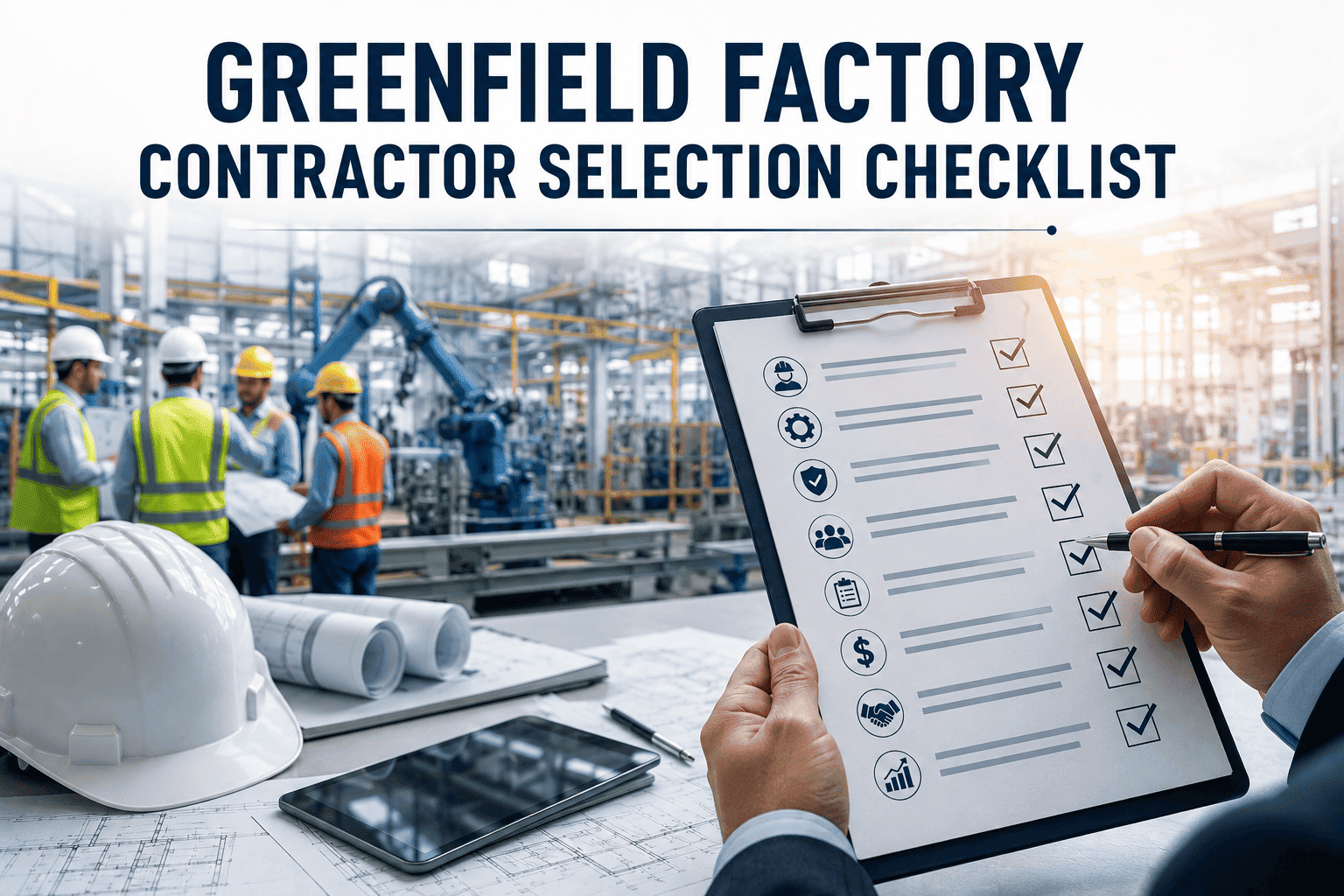
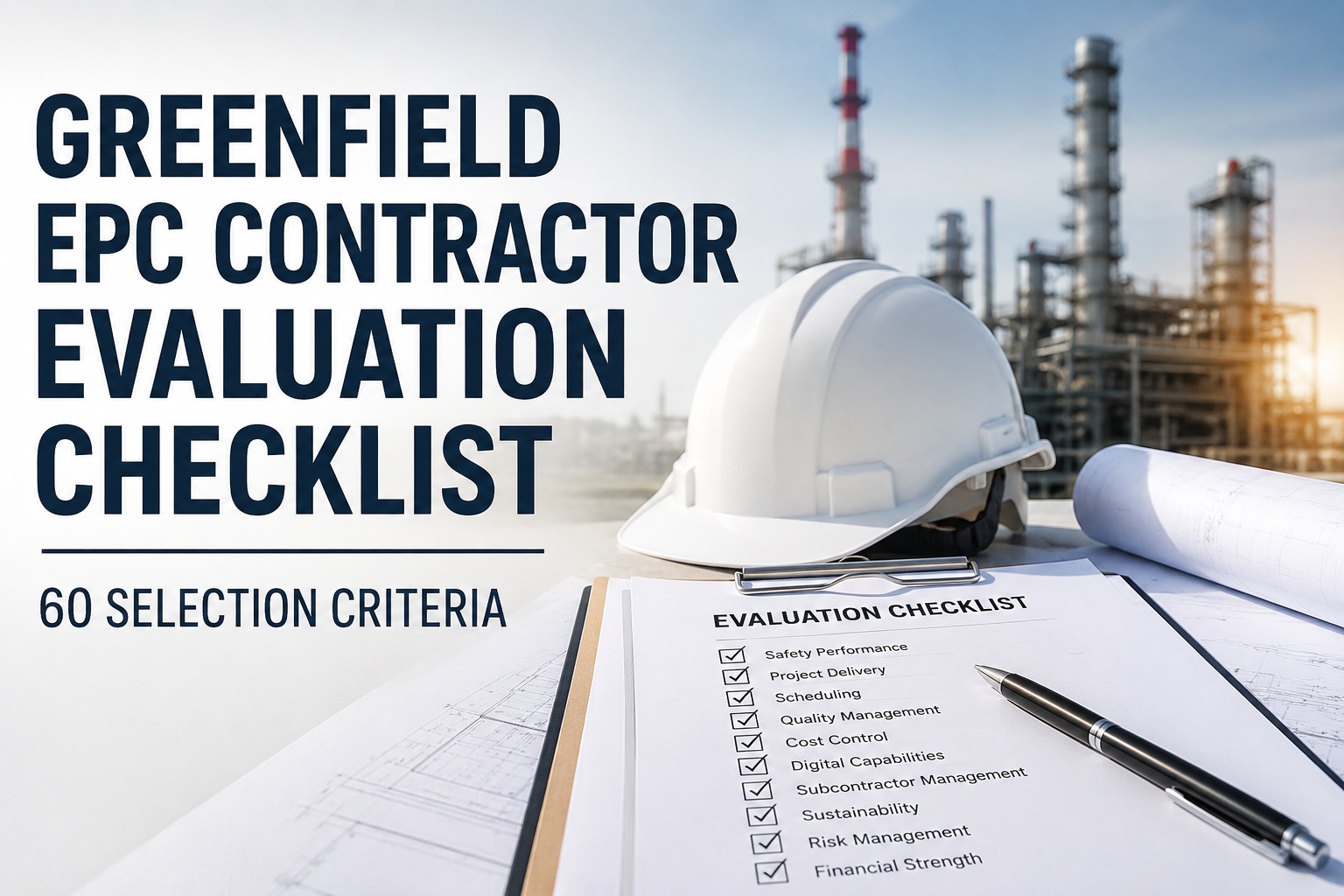
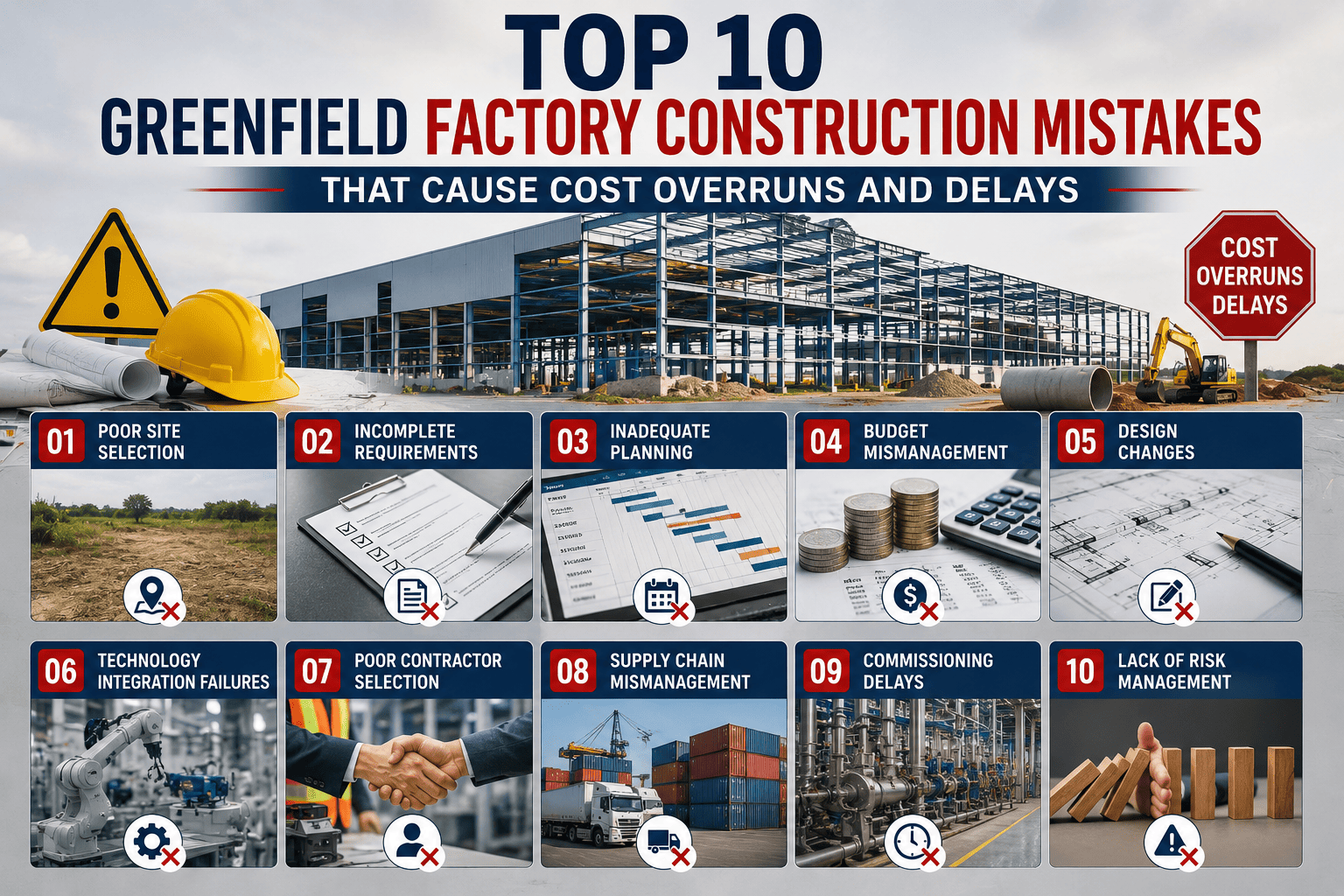
Choosing the wrong contractor doesn't just cost money—it costs months. In greenfield manufacturing, where every week of delay compounds into six figures of lost production, contractor selection is the single highest-leverage decision your project team will make. Yet most owners still evaluate EPC firms, automation integrators, and MEP contractors using outdated spreadsheets, and gut instinct. The result? Misaligned capabilities, scope gaps discovered mid-build, and finger-pointing that derails timelines. This checklist gives you a structured, weighted scoring framework to compare contractors objectively—so the firm you select is the firm that can actually deliver your factory on time, on budget and ready to produce. iFactory's greenfield consulting team has distilled these criteria from hundreds of industrial builds into a repeatable evaluation system.
Contractor Selection Scorecard
A weighted framework for evaluating greenfield manufacturing contractors
100
Point Evaluation
30
Experience
25
Technical
20
Financial
15
Safety
10
Refs
Evaluate across all contractor types
EPC Firms
Automation Integrators
MEP Contractors
Technology Vendors
The Four Contractor Types Every Greenfield Project Needs
A greenfield factory isn't one project—it's four parallel workstreams converging on a single go-live date. Each contractor type brings fundamentally different capabilities, risk profiles, and evaluation criteria. Evaluating an EPC firm the same way you evaluate an automation integrator is like grading a structural engineer on their software architecture skills. Here's what each type owns—and why the evaluation criteria must differ.
01
EPC Contractor
Engineering, Procurement, Construction
Wrong choice = 6–12 month schedule slip
Scope
Full facility design, civil/structural engineering, procurement of major equipment, and construction management through commissioning
iFactory's greenfield consulting team helps you build the evaluation criteria, score contractor bids objectively, and avoid the selection mistakes that derail industrial projects.
Weighted Scoring Framework: The 100-Point Evaluation
The biggest mistake in contractor selection? Treating every criterion equally. A firm with perfect safety scores but no greenfield manufacturing experience will still fail your project. This weighted framework forces your evaluation committee to prioritize what actually predicts project success—and it works across all four contractor types with minor weight adjustments.
EMR above 1.0 or any OSHA willful violations in the past 3 years
Client References
10
points
Direct conversations with 3+ past clients on similar-scale projects, on-time/on-budget delivery rate, change order frequency, dispute history
Refuses to provide references or past clients report >15% cost overrun on comparable projects
The 5-Phase Selection Process
Don't shortcut the process. Rushing from RFP to contract award is how teams end up with the cheapest bid instead of the best contractor. This five-phase workflow builds in the verification steps that separate a thorough evaluation from a rubber-stamp exercise—and it typically takes 8–12 weeks for a major greenfield project.
Week 1–2
Pre-Qualification Screening
Issue a Request for Qualifications (RFQ) to your long list. Filter for minimum thresholds: project scale experience, bonding capacity, safety metrics, and geographic availability. Goal: reduce 15–20 candidates to 5–7 qualified firms.
Deliverable: Short-listed bidders with pass/fail matrix
Week 3–5
RFP Issuance and Bid Collection
Issue a detailed RFP to short-listed firms with scope documents, specifications, evaluation criteria and weights, and submission requirements. Allow 2–3 weeks for responses on complex greenfield projects.
Deliverable: Completed bid packages from 5–7 firms
Week 6–7
Technical and Commercial Evaluation
Score each bid against the 100-point weighted framework. Separate technical evaluation from commercial evaluation to prevent price bias. Flag clarification items and submit written questions to bidders.
Deliverable: Scored evaluation matrix with rankings
Week 8–10
Interviews, Site Visits, and Due Diligence
Invite top 2–3 firms for structured interviews with key personnel. Visit their active or recently completed projects. Verify financial statements, insurance, and bonding directly with underwriters. Call references.
Deliverable: Due diligence report with final scores
Week 11–12
Award and Contract Negotiation
Select the best-value contractor (not necessarily the lowest bid). Negotiate contract terms including milestone-based payments, liquidated damages, performance bonds, and change order procedures. Execute contracts with all parties.
Deliverable: Executed contract with performance guarantees
Want a pre-built RFP template and scoring matrix for your greenfield project? Request your evaluation toolkit from our consulting team.
Pre-Qualification Checklist: Pass/Fail Gate
Before you invest weeks scoring detailed proposals, run every candidate through these non-negotiable minimum requirements. Any firm that fails even one of these criteria should be eliminated before the RFP stage—no exceptions. This gate saves your evaluation committee from wasting time on unqualified bidders.
Experience Requirements
Minimum 3 completed greenfield manufacturing projects in the last 7 years
Validates the firm has current greenfield-specific expertise, not just brownfield or renovation experience
At least 1 project of comparable scale (within 50% of your project value)
A firm that has only delivered $5M projects cannot reliably manage a $50M build
Industry vertical experience in your manufacturing sector
Food-grade, pharma, semiconductor, and heavy industry all have fundamentally different requirements
Financial and Legal Requirements
Audited financial statements for the last 3 fiscal years
Confirms the firm has the financial depth to sustain a multi-year greenfield project
Bonding capacity at or above your project value
If a contractor's surety won't bond the project, their financial risk exposure is too high
No active litigation exceeding 10% of annual revenue
Excessive litigation signals either poor workmanship or adversarial contract management
Safety and Compliance Requirements
EMR (Experience Modification Rate) below 1.0 for the last 3 years
An EMR above 1.0 means the firm's injury rate exceeds the industry average—a non-starter
Zero OSHA willful violations in the past 5 years
Willful violations indicate deliberate disregard for worker safety—disqualifying under any framework
Documented safety management system (ISO 45001 or equivalent)
A formal SMS demonstrates systematic commitment rather than reactive safety culture
Expert Perspective
"The lowest bid wins the contract, but the best-value bid wins the project. In greenfield manufacturing, selecting a contractor based purely on price is the most expensive decision you'll ever make. A structured scoring framework that weights experience, technical depth, and financial stability alongside cost consistently produces better outcomes—fewer change orders, faster commissioning, and higher first-year OEE."
— Industrial Construction Best Practice
72%
of project overruns trace back to contractor selection failures
40%
faster commissioning with pre-qualified contractors
3–5x
ROI on structured evaluation vs. lowest-bid selection
Conclusion: Invest Weeks in Selection to Save Months in Construction
Contractor selection isn't procurement—it's risk management. Every hour your team invests in structured evaluation, weighted scoring, and thorough due diligence pays back tenfold during construction and commissioning. The firms that build the best factories don't necessarily have the flashiest proposals—they have the deepest experience, the strongest financials, and the proven ability to deliver on complex greenfield timelines. Use this 100-point framework to move beyond gut instinct, eliminate unqualified bidders early, and award contracts to firms that will actually deliver your factory on time and on spec. And when you need expert guidance on building your evaluation criteria, structuring your RFP, or validating contractor claims—iFactory's greenfield consulting team has done this hundreds of times.
Build Your Contractor Evaluation Framework
From pre-qualification screening to final contract award—iFactory's greenfield consultants help you select the right EPC firms, automation integrators, and MEP contractors using proven scoring frameworks.
What criteria should I use to evaluate EPC contractors for a greenfield factory?
The most effective evaluation uses a weighted scoring framework covering five core areas: relevant experience (30%), technical capability (25%), financial stability (20%), safety record (15%), and client references (10%). For greenfield manufacturing specifically, prioritize completed projects of similar scale and industry vertical within the last 5–7 years. Verify bonding capacity, review EMR and TRIR safety metrics, and conduct direct reference calls with past clients on comparable projects. Avoid over-weighting price—book a consultation to build a customized scoring matrix for your project.
How do I compare EPC contractors versus design-build firms for my project?
EPC contractors provide full engineering, procurement, and construction under a single contract with guaranteed price and schedule—ideal when you want turnkey delivery and single-point accountability. Design-build firms can fast-track schedules by overlapping design and construction phases but may offer less price certainty. For greenfield manufacturing, EPC is generally preferred because it reduces coordination risk across complex mechanical, electrical, and automation systems. The key differentiator is whether your project needs schedule speed (design-build) or cost certainty with full-scope accountability (EPC).
What are the biggest red flags when evaluating industrial contractors?
The top disqualifying red flags include: an Experience Modification Rate (EMR) above 1.0 (indicating above-average injury rates), any OSHA willful violations within the past 5 years, contract backlog exceeding 80% of bonding capacity (overstretched resources), no completed greenfield projects in your industry vertical, refusal to provide client references, and declining revenue trends over three consecutive years. Also watch for firms that cannot demonstrate BIM proficiency—in modern greenfield projects, BIM coordination between civil, mechanical, electrical, and automation trades is essential for avoiding costly field conflicts.
How long does the contractor selection process take for a greenfield factory?
A thorough contractor selection process for a major greenfield manufacturing project typically takes 8–12 weeks from pre-qualification to contract execution. This breaks down into: pre-qualification screening (1–2 weeks), RFP issuance and bid collection (2–3 weeks), technical and commercial evaluation (1–2 weeks), interviews and due diligence (2–3 weeks), and contract negotiation and award (1–2 weeks). Rushing this timeline consistently leads to poor contractor fits that cost far more in change orders, schedule delays, and rework during construction. Investing the full evaluation period is one of the highest-ROI activities in a greenfield project.
Should I always select the lowest-cost contractor bid?
No—and in greenfield manufacturing, selecting purely on lowest price is the single most common cause of project failure. Industry best practice allocates roughly 60–80% of the evaluation weight to non-price factors (experience, technical capability, safety, financial stability) and only 20–40% to cost. The reason is straightforward: a contractor who underbids by 15% but causes a 6-month schedule delay costs you far more in lost production than the price difference. Best-value selection—where the highest-scoring contractor across all weighted criteria wins—consistently outperforms lowest-bid selection on total project cost, schedule adherence, and first-year operational performance.